
What is branded search and why does it matter for pool builders?
- Why do so many people search my pool company by name, and should I try to grow that?
- What counts as a branded search for a pool company?
- Why do people search my pool company by name?
- Why does branded search matter more for pool builders than for most trades?
- How do I see how many people search my company by name?
- What should someone see when they search my pool company's name?
- Should I bid on my own company name in Google Ads?
- Should I try to create more branded searches?
- Is branded search a good way to judge my marketing?
- Do branded searches affect my ranking for other searches?
- What if a competitor or a review site shows up for my name?
- What's different about branded search for pool builders
- A worked example: reading branded and non-branded search together
- Frequently asked questions
- Key takeaways
- More in this section
- Sources
The short version
- Branded search = people searching your company name, not a generic phrase.
- It's often the last step after a yard sign, a referral, a show or an ad.
- These searchers are warm: make sure your Google profile and site convert them.
- Track branded and non-branded searches separately in Search Console.
- More branded searches usually means people remember you; it doesn't replace new-customer searches.
For pool builders who want to know what searches for their company name tell them, how to measure them, and how to make sure those searches end in a consultation.
Get a free visibility audit · Book a growth call
Why do so many people search my pool company by name, and should I try to grow that?
Branded search is anyone typing your company’s name, or a misspelling of it, into Google instead of a generic phrase like “pool builder near me.” For a pool builder it matters because most homeowners take weeks or months to decide, so many of them first meet you through a yard sign, a neighbor, a show or an ad, then come back later and search your name. Those searches are usually the warmest leads you get, which is why they should land on a complete Google profile and a site that makes booking a design consultation easy. Growing branded search is a sign the rest of your marketing is being remembered, so track it, but don’t treat it as the only measure of success.
Being easy to find by name is part of the foundation we build first: a clean Google Business Profile, consistent listings and a site that turns a name search into a booked consultation. Our local SEO work covers those pieces, the pool builder marketing page explains how we approach the trade, and the pool builder marketing questions library covers the channels that create name recognition in the first place.
What counts as a branded search for a pool company?
Google’s own definition, from its Search Console team, is a query that includes your brand name, variations or misspellings of it, and brand-related products or services. For a pool builder that means searches like your company name, your name plus “reviews” or “pools,” the owner’s name if the company is known by it, and common misspellings of an unusual name.
Everything else is non-branded: “pool builder near me,” “fiberglass pool installers,” “pool cost” and the town-plus-service searches covered on which keywords a pool builder should target. Google says the two behave differently: branded queries typically lead to higher-ranking pages from your site and higher click-through rates, while non-branded queries show how new people find you without any initial intent to go to your site. Source: Introducing the branded queries filter in Search Console (Google Search Central Blog).
Why do people search my pool company by name?
Because something earlier put the name in their head. In our judgement, the usual sources for a pool builder are:
- Referrals. A neighbor or friend says who built their pool, and the homeowner looks you up.
- Yard signs and trucks. A sign in front of a dig or a branded truck in the neighborhood.
- Home and garden shows. A conversation at a booth that turns into a search weeks later. Whether home and garden shows are worth it covers how to measure that.
- Ads and social posts. Someone sees a finished backyard in their feed, doesn’t click, and searches your name later.
- Earlier visits. A homeowner who found you through a generic search last spring comes back by name when they’re ready to talk.
That last point matters. Some branded searches aren’t new demand at all; they’re people you already reached once, returning.
Why does branded search matter more for pool builders than for most trades?
Because of the sales cycle. A homeowner with a broken water heater calls whoever shows up first. A homeowner planning a pool researches for weeks or months, compares builders, talks to their spouse, checks financing and often waits for the right season. In our judgement, that long gap is why so many pool customers come back by name: the first contact and the decision are far apart, and the name is what carries across the gap.
It also means the branded search is often the last step before a consultation request. If that last step goes badly, because your profile is thin or the site makes booking hard, you lose someone your other marketing already paid to reach.
How do I see how many people search my company by name?
Two free places show it:
- Google Search Console. Its Performance report lets you filter queries into branded and non-branded and see impressions, clicks, average position and click-through rate for each group. Google says the filter identifies branded queries automatically. Source: Google Search Central Blog. If the filter isn’t available for your site, you can still filter the query list for your company name by hand in the Performance report (Search Console Help).
- Your Google Business Profile performance report. Google says it shows the search terms people used to find your business, along with views and actions on Search and Maps. The searches metric is updated at the start of each month. Source: Understand your Business Profile performance & insights (Google Business Profile Help).
Look at the trend over a full year, not month to month. Pool demand is seasonal, so a spring rise in name searches may be the season, not your marketing.
Curious what your marketing is actually booking?
Get a free visibility audit — no obligation, no sales pitch.
What should someone see when they search my pool company's name?
Your own Google profile and your own site, at the top, with nothing confusing. In our judgement, check these by searching your name on a phone:
- A complete Google Business Profile with the right phone number, hours, service area, recent photos of finished pools and an active stream of reviews.
- Your site first in the results, with a title that says what you build and where.
- A clear next step: a button or form to book a design consultation, not just a phone number.
- Recent proof: project photos and reviews from the last year, not 2019.
- No look-alikes: old listings, a former company name or a similarly named business that could pull the call away.
A homeowner searching your name is close to deciding. Optimizing a pool builder’s Google Business Profile covers the profile side in detail.
Should I bid on my own company name in Google Ads?
It depends on what shows up when you search your name today. Google’s own help page frames brand traffic as something to manage on purpose: it describes brand exclusions as a way to keep ads off searches for your brand and “avoid paying for clicks from users who are already navigating to your site,” and recommends them if you handle brand traffic in a separate campaign. Source: About brand exclusions (Google Ads Help).
In our judgement, the practical test is simple:
- If your profile and site already own the top of the page and no other company’s ad appears above you, paying for your own name mostly buys clicks you would have had anyway.
- If a competitor’s ad sits above your name, a small, separate brand campaign can be worth it so the homeowner who was looking for you doesn’t land on someone else.
- Either way, keep brand clicks out of your main campaigns’ numbers. Brand clicks are cheap and convert well, so mixing them in makes the rest of your ads look better than they are.
How a pool builder should structure Google Ads campaigns covers where a brand campaign fits.
Should I try to create more branded searches?
Yes, but indirectly. You can’t make people search your name; you can only give them more reasons to remember it. In our judgement, the things that move it for a pool builder are the same things that win jobs anyway: a recognizable look on trucks and yard signs, finished projects people talk about, review volume, a presence at local shows, and ads or posts that show real backyards. A clear, memorable company name helps too.
What we wouldn’t do is chase branded search as a goal on its own. It follows from good work and visible marketing; it doesn’t replace showing up for people who haven’t heard of you yet.
Is branded search a good way to judge my marketing?
It’s one useful signal, read alongside the others. If your branded searches grow year over year while you run shows, ads and a referral push, people are remembering you. If they’re flat while you spend more, the spend may not be building recognition.
Two cautions, in our judgement. First, branded search doesn’t tell you which channel planted the name, so it can make a channel look better or worse than it is. Second, it can hide a weak spot: if almost all your site traffic is branded, you’re mostly being found by people who already know you, and your non-branded visibility may need work. The number that settles it is still signed contracts by source; tracking which marketing produces signed pool contracts covers how to tag them.
Do branded searches affect my ranking for other searches?
Google doesn’t say that searches for your name raise your ranking for generic searches, so we wouldn’t count on it. What Google does say about local results is that they’re mainly based on relevance, distance and popularity, and that how well-known a business is, including links and reviews, plays into it. Source: Tips to improve your local ranking on Google (Google Business Profile Help).
In our judgement, the honest link is indirect: the same work that makes more people search your name, such as reviews, local mentions and well-known projects, is also the kind of thing Google describes as making a business well-known.
What if a competitor or a review site shows up for my name?
Then the homeowner who wanted you has a chance to wander off. In our judgement, check three things. If a competitor’s ad appears, that’s the case for a small brand campaign of your own. If a directory or review site outranks your own site, make sure your site’s home page clearly names the company and what it builds, and that your listings on those sites are accurate and point back to you. If an old listing or a former company name shows up, claim or correct it so the details match everywhere.
If a new local competitor has a name close to yours, responding when a new pool competitor opens nearby covers what to change.
Want to see where your company stands?
A free visibility audit shows where you show up on Google, Maps and AI answers, and what it's costing you in calls.
What's different about branded search for pool builders
Long gap between first contact and decision. The name has to survive weeks or months of research, so recognition does more of the selling than in emergency trades.
Referrals and yard signs feed it. A finished pool in the neighborhood is one of the strongest reasons people search a builder’s name.
The branded search is often the last click. It frequently comes right before a consultation request, so a thin profile or a hard-to-book site costs more here.
Seasonal swings. Name searches rise and fall with the building season, so compare year over year, not month to month.
A worked example: reading branded and non-branded search together
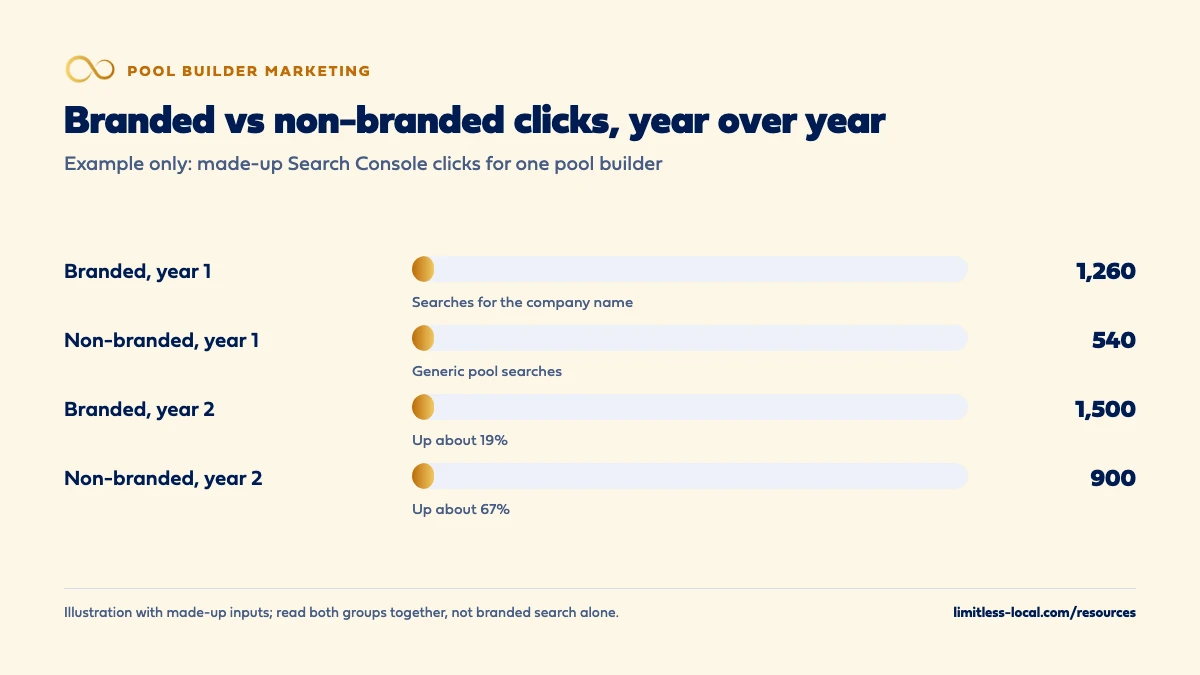
These numbers are made up to show the math, not a benchmark. Say Search Console shows 1,800 clicks to your site over a year. With the branded filter on, 1,260 of them come from searches for your company name and 540 from everything else.
That’s 70% branded. On its own it looks healthy: lots of people know you. But it also says only 30% of your search traffic comes from people who didn’t already have your name, which is where new customers who’ve never heard of you show up.
Now compare a year later: branded clicks rise to 1,500 and non-branded to 900. Branded grew by 240 clicks, about 19%; non-branded grew by 360, about 67%. In our judgement, that’s the pattern you want: recognition growing, and visibility to new homeowners growing faster.
Frequently asked questions
Does my company name need to be unusual to get branded searches?
No, but a generic name makes them harder to measure and easier to lose to similarly named companies. In our judgement, a distinctive name is easier for homeowners to remember and for you to track.
Do people searching my name count as new leads?
Some are new, some are past visitors, customers or vendors. Tag consultation requests by how the homeowner first heard of you, not just by the last search.
Are reviews part of branded search?
Searches like your name plus “reviews” are branded searches. They usually mean someone is checking you before calling, so recent, answered reviews matter.
Can I see branded searches without a website?
Your Google Business Profile performance report shows the search terms people used to find your profile, which includes name searches, even without Search Console.
Will branded searches drop if I stop advertising?
They can, slowly, if ads were planting the name. Watch the trend after any big change in spend, comparing the same months year over year.
Is a misspelled search for my name still branded?
Yes. Google’s definition of a branded query includes variations and misspellings of the brand name.
Key takeaways
- Branded search is people searching your company name, often after a referral, sign, show or ad.
- For pool builders it’s often the last step before a consultation, so it has to convert.
- Measure it in Search Console and your Business Profile, year over year.
- Bid on your name only when a competitor’s ad sits above you, and keep brand clicks separate.
- Read it alongside non-branded search and signed contracts, not as the only score.
Not sure what's working right now?
Start with a free visibility audit: rankings, Google profile, reviews and tracking, checked against your service area.
More in this section
- What keywords should a pool builder target?
- How does a pool builder show up in AI search results?
- Are Google Ads worth it for pool builders?
- Are Local Services Ads worth it for pool builders?
- Which online listings should a pool builder have besides Google?
Sources
- Introducing the branded queries filter in Search Console — Google Search Central Blog
- Performance report (Search results): Overview and basic setup — Search Console Help
- Understand your Business Profile performance & insights — Google Business Profile Help
- About brand exclusions — Google Ads Help
- Tips to improve your local ranking on Google — Google Business Profile Help