
How should a pool builder respond when a new competitor opens nearby?
- A new pool construction company just opened near me. Should I cut prices, spend more, or stay the course?
- Should I do anything at all when a new pool builder opens nearby?
- How do I size up a new pool competitor?
- Should I lower my prices to compete?
- What should I update on my website after a new competitor opens?
- How do I protect my spot in Google Maps?
- Should I spend more on ads when a competitor shows up?
- How do I compete when I have no time to market?
- What about my referral partners?
- When is a new competitor a real threat?
- What should I avoid doing?
- What's different about a new competitor for pool builders
- A worked example: reading the numbers after a competitor opens
- Frequently asked questions
- Key takeaways
- More in this section
- Sources
The short version
- Watch your own numbers before reacting: leads, consultations, close rate.
- Size up the new builder: price, pool types, towns, reviews, ads.
- Make your track record visible: reviews, project photos, years building.
- Respond faster and follow up better than a new company can.
- Avoid a price war; compete on proof, process and service.
For pool builders who just found a new competitor in their towns and want to protect their pipeline without starting a price war.
Get a free visibility audit · Book a growth call
A new pool construction company just opened near me. Should I cut prices, spend more, or stay the course?
Don’t cut prices or double your ad budget on reflex; first find out what the new builder is actually doing and whether your leads have changed. Then tighten what you already have: a complete Google profile with recent reviews and project photos, a website that shows your finished pools and makes booking a consultation easy, fast follow-up on every inquiry, and your referral relationships. A new company usually competes on price or on being easy to find, so in most cases the stronger response is to make your track record more visible, not to match its prices.
Being the obvious choice when a homeowner compares builders comes down to the basics: a strong Google profile, consistent listings, project pages and fast follow-up. Our local SEO work covers the Maps and search side, our pool builder marketing page explains how we approach the trade, and the pool builder marketing questions library covers each piece in more depth.
Should I do anything at all when a new pool builder opens nearby?
Yes, but start by watching rather than reacting. A new company’s first months often look busier from the outside than they are. In our judgement, the right first step is to check your own numbers for the last few months against the same months last year: inquiries, consultations booked, close rate, and where you lost proposals. If none of those have moved, you have time to respond calmly.
If they have moved, find out where. Fewer inquiries points to visibility. The same inquiries but lower close rate points to price or proposal comparisons. Those call for different fixes.
How do I size up a new pool competitor?
The SBA describes competitive analysis as identifying competitors by product or service and market segment, and assessing their strengths and weaknesses. Source: Market research and competitive analysis (U.S. Small Business Administration). For a pool builder, in our judgement, that comes down to a short list:
- What they build: gunite, fiberglass, vinyl, renovations, outdoor living.
- Where they market: which towns their Google profile, site and ads target.
- How they price: what homeowners tell your team in consultations.
- What proof they show: reviews, project photos, years in business.
- Whether they advertise: search your main service terms and note whose ads appear.
Write it down once, then recheck every few months. You’re looking for the overlap with the jobs you want most. If the newcomer is a national franchise rather than a local builder, how a local pool builder competes with national franchises covers that case.
Should I lower my prices to compete?
Usually not. A new builder may price low to win its first jobs, and following it down cuts your margin on every pool, not just the ones you’d have lost. In our judgement, a better response is to make the difference visible: years building, the number of finished pools in the area, warranty and service after the build, and a clear process from design to plaster.
Homeowners spending this much on a backyard are often worried about the builder disappearing mid-project. A track record answers that worry better than a discount. Positioning a pool company as a premium builder covers that side.
What should I update on my website after a new competitor opens?
The pages a homeowner compares you on. In our judgement, check these first:
- Project gallery: recent finished pools, with the town and pool type, so homeowners near the new builder see your work close to them. Setting up a project gallery page covers the format.
- Process page: design, permits, financing, build stages and what happens after.
- Proof: reviews, years in business and anything that shows you’ll be around for service.
- A clear booking path: one obvious way to request a design consultation on every page.
- Town pages: if the competitor is in a town you serve, make sure you have real work to show there.
You don’t need a new site to do this. Most of it is adding recent work and making the booking step obvious.
Curious what your marketing is actually booking?
Get a free visibility audit — no obligation, no sales pitch.
How do I protect my spot in Google Maps?
Google says local results are mainly based on relevance, distance and popularity, and that more reviews and positive ratings can help a business’s local ranking. Source: Tips to improve your local ranking on Google (Google Business Profile Help). You can’t change distance, so a new builder closer to some homeowners may show up ahead of you in those neighborhoods.
What you can work on is the rest: a complete profile with the right categories and services, regular photos of finished pools, and a steady flow of recent reviews. In our judgement, an established builder’s biggest advantage here is review history, and a new competitor can’t copy it quickly. If the new builder already shows above you, why a competitor outranks your pool company in Google Maps walks through the checks.
Should I spend more on ads when a competitor shows up?
Only if your numbers say you’re losing visibility, not just because the competitor is there. If you run Google Ads, the auction insights report lets you compare your performance with other advertisers in the same auctions, using statistics such as impression share and overlap rate. Source: Use auction insights to compare performance (Google Ads Help).
In our judgement, read it like this: if the new builder appears often and your impression share is falling while leads drop, that’s a reason to adjust bids or budget on your best terms. If they appear but your leads are steady, more spend mostly raises what each click costs. Bidding wars between two local builders tend to help nobody but the auction.
How do I compete when I have no time to market?
Pick the few things that matter most and do them every week. In our judgement, for an owner still running builds, that’s:
- Answer every inquiry fast. A new company is often slow to respond while it finds its feet.
- Ask every finished customer for a review. It’s the proof a new builder doesn’t have yet.
- Post finished projects to your Google profile and site as you complete them.
- Call your referral partners so they hear from you before the new builder reaches them.
That list takes a few hours a month, not a full-time marketer. How fast a pool builder should respond to a new lead covers the first point.
What about my referral partners?
Check in with them. Landscapers, home builders, realtors and past customers who send you work may be approached by a new builder looking for its first jobs. In our judgement, a short call or a visit to thank them, tell them about recent projects, and make sure they know how quickly you respond goes a long way. Referral partners care most that the homeowner they send gets treated well, so your record with past referrals is the argument.
When is a new competitor a real threat?
In our judgement, take it seriously when you see two or more of these at once: your inquiries drop in the towns where they market, homeowners in consultations mention them by name, you lose proposals to them on price or timeline, and they appear in the map pack or ads above you for your main searches. One of these alone is normal competition.
If several show up together, go back to the numbers and fix the biggest gap first. If your phone has gone quiet suddenly, what to do first when leads suddenly dry up covers the triage.
What should I avoid doing?
In our judgement, avoid these:
- Talking down the competitor to homeowners. It reads as nervous. Talk about your own work instead.
- Fake or paid reviews to keep ahead. They put the profile and your reputation at risk for a short-term edge.
- Bidding on their company name as your main tactic. It costs money and rarely wins jobs on its own.
- Changing everything at once. If you change prices, ads and the website in the same month, you won’t know what worked.
Not sure which of these is costing you jobs?
A free visibility audit checks the Google profile, reviews, site and tracking, and shows what to fix first.
What's different about a new competitor for pool builders
Track record carries more weight. A pool is a large, months-long project, and homeowners worry about a builder disappearing. Years of finished pools are hard for a new company to match.
Price pressure shows up in consultations. A new builder’s effect often shows as lost proposals, not fewer calls.
Reviews take years to build. A new company can open fast but can’t fake a review history quickly.
Service after the build matters. Showing that you’ll be there for equipment and warranty questions is a real difference.
A worked example: reading the numbers after a competitor opens
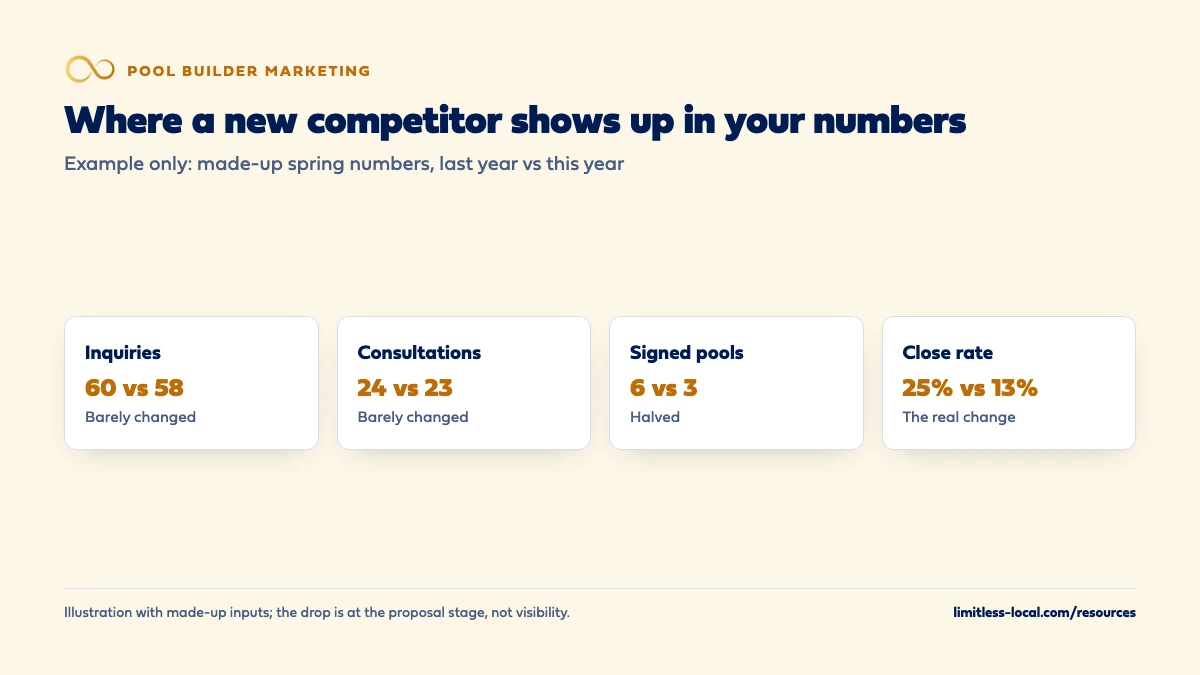
These numbers are made up to show the math, not a benchmark. Say that in the same three spring months last year you had 60 inquiries, booked 24 consultations and signed six pools. This year, after a new builder opened two towns over, you had 58 inquiries, booked 23 consultations and signed three.
Inquiries and consultations barely moved, so the new builder isn’t taking your visibility. The close rate fell from 25% to about 13%. That points to the consultation and proposal stage: homeowners are comparing your proposal with a cheaper one.
The response follows from that: in our judgement, strengthen the proposal with proof and process, follow up faster after the visit, and ask lost prospects what decided it, before touching ad budget or price.
Frequently asked questions
Should I contact the new competitor?
There’s no harm in being professional, and some builders refer overflow work to each other. Keep it to referrals and professional courtesy.
Will a new competitor hurt my Google ranking?
It can change who shows up for homeowners closer to them, because distance is part of local ranking. Your reviews, profile and site still count.
Should I add new services to compete?
Only if you can deliver them well and they fit the jobs you want. Adding services just to match a competitor spreads you thin.
How long should I wait before reacting?
Watch a full season if your numbers are steady. React sooner if inquiries or close rates drop clearly against the same months last year.
Can I mention that I've been in business longer?
Yes, if it’s true. State your own years and track record; don’t make claims about the other company.
What if they copy my website or photos?
Keep originals of your project photos with dates. If your work is used without permission, that’s a question for a lawyer, not a marketing fix.
Key takeaways
- Check your own numbers before reacting to a new competitor.
- Find where the change shows up: inquiries, consultations or close rate.
- Compete on track record, reviews and process, not on price.
- Keep your Google profile, project gallery and follow-up sharp.
- Change one thing at a time so you know what worked.
Want a second set of eyes on your setup?
We'll look at how you show up locally and where calls are leaking, then send you a plain-English breakdown.
More in this section
- How can a local pool builder compete with national franchises?
- How do pool builders stop attracting price shoppers?
- How fast should a pool builder respond to a new lead?
- How should pool builders nurture leads who plan to build next year?
- How do I position my pool company as a premium builder?
Sources
- Market research and competitive analysis — U.S. Small Business Administration
- Tips to improve your local ranking on Google — Google Business Profile Help
- Use auction insights to compare performance — Google Ads Help