
Is it my marketing or my sales process when roofing leads don’t close?
- How do I tell bad roofing leads from a sales or follow-up problem?
- Why is it so hard to tell a marketing problem from a sales problem?
- What numbers do I need to diagnose it?
- What are the signs it's a marketing problem?
- What are the signs it's a sales or follow-up problem?
- How do I qualify roofing leads consistently?
- Should I listen to recorded calls?
- Can bad tracking make it look like a sales problem?
- How do I tell Google which leads became signed roofs?
- What if it's both?
- How long should I track before deciding?
- What's different about diagnosing roofing leads
- A worked example: finding the leak in one month of leads
- Frequently asked questions
- Key takeaways
- More in this section
- Sources
The short version
- Count leads, qualified leads, inspections, estimates and signed jobs by source.
- Lots of unqualified leads points to marketing: targeting, keywords, offers.
- Qualified leads that don't book or don't sign point to speed, follow-up or sales.
- Listen to recorded calls before deciding; they usually settle the argument.
For roofing company owners who are getting leads but not enough signed roofs, and need to know where to fix it.
Get a free visibility audit · Book a growth call
How do I tell bad roofing leads from a sales or follow-up problem?
Split the funnel into stages and find where the drop happens. If many leads are outside your area, asking for services you don’t sell, or never wanted an inspection, it’s a marketing and targeting problem. If good-fit leads book inspections but don’t sign, or never get called back, it’s a speed, follow-up or sales problem. Qualifying every lead the same way, by source, for a few weeks usually shows which one you have.
Our first phase with any client builds the foundation: tracking, follow-up and a clean online presence, so you can see where leads drop off. Our automation services cover follow-up and lead tracking, and our roofing marketing page shows how we work with roofers. How to get roofing leads covers lead sources, and the roofing marketing questions library goes question by question.
Why is it so hard to tell a marketing problem from a sales problem?
Because both look the same from the owner’s chair: money spent, phones ringing, not enough roofs signed. The marketing side says the sales team isn’t closing; the sales side says the leads are junk. Both can be right at once.
The way out is to stop judging the whole funnel at once. A roofing lead passes through stages: it comes in, it’s qualified (right area, right service, real homeowner), it books an inspection, it gets an estimate, and it signs. A marketing problem shows up in the first two stages. A follow-up or sales problem shows up in the last three.
What numbers do I need to diagnose it?
Five counts per lead source, every month:
- Leads: calls, forms and messages, with repeat callers removed.
- Qualified leads: real homeowners in your area asking for work you do.
- Inspections booked and actually completed.
- Estimates delivered.
- Signed jobs.
Count repeat callers carefully. CallRail, as one example, says a unique caller isn’t necessarily a new caller, because repeat callers make up part of its unique callers report. A homeowner who called four times is one lead, not four. If you can’t yet trace leads to signed jobs, start with tracking leads to signed jobs.
What are the signs it's a marketing problem?
- Many leads fail qualification: outside your service area, wrong service (gutters only, when you only do roofs), renters, sales calls.
- Search terms don’t match your work. Google says the search terms report can surface terms to add as negative keywords. Searches for DIY repairs, roofing jobs or materials pricing are a targeting problem, not a sales one.
- Leads cluster in areas you don’t want. That’s a location setting; see targeting specific neighborhoods.
- The ad promises something you don’t deliver, such as a price or a speed that sets up a disappointing first call.
- Very short calls. In our judgement, a lot of calls that end in under a minute usually means the caller wasn’t looking for you.
If price shoppers are the main issue, stopping price shoppers covers how ads and pages can screen them.
What are the signs it's a sales or follow-up problem?
- Qualified leads don’t get a call back the same day, or at all.
- Calls go unanswered during working hours or after five.
- Inspections are booked but not kept, because nobody confirmed or reminded the homeowner.
- Estimates go out and nothing follows. No call, no text, no second visit.
- Close rates differ a lot between salespeople on the same kind of leads.
Each of these is fixable without spending a dollar more on ads. How fast to call back a roofing lead covers speed, and following up on unsigned estimates covers the last step.
Curious what your marketing is actually booking?
Get a free visibility audit — no obligation, no sales pitch.
How do I qualify roofing leads consistently?
Write down what counts as qualified and apply it the same way to every lead, from every source. A simple version: homeowner (or authorized decision-maker), inside your service area, asking for a service you sell, and willing to book an inspection.
Call tracking tools can help. CallRail, as one example, says you can qualify leads manually in its app, score calls with the keypad right after they end, or set automation rules to qualify, score or tag interactions that meet your criteria. It says qualifying leads lets you report on which marketing efforts are attracting good leads and moving them through the sales funnel. Whatever tool you use, the rule is the same: one definition, applied by the same people, every week.
Should I listen to recorded calls?
Yes. In our judgement, ten recorded calls from one source tell you more than a month of arguing about lead quality. Listen for two things: was the caller a good fit (marketing), and how was the call handled (sales)? A good-fit homeowner who gets a rushed answer and no booked inspection is a sales problem. A caller who wanted a gutter cleaning in another county is a marketing problem.
Local Services Ads lets you listen to phone lead recordings in the US from the lead inbox. Check the recording rules that apply in your state before you record; this isn’t legal advice.
Can bad tracking make it look like a sales problem?
Yes, and it’s common. If Google Ads counts every call as a conversion, short wrong-number calls look like leads, and your close rate looks terrible. Google says you set a minimum call length for call conversions and that calls shorter than that aren’t counted, so set it to a length that reflects a real conversation.
The reverse also happens: if forms or calls from one source aren’t tracked, that source looks weak when it isn’t. Before blaming either side, check that every number and form records leads correctly.

How do I tell Google which leads became signed roofs?
When your ads only learn from calls and forms, they look for more calls and forms, good or bad. Google’s offline conversion import lets you send later outcomes, such as a qualified lead or a signed job, back to Google Ads. Google says that if you haven’t adopted offline conversion import yet, it recommends starting with enhanced conversions for leads instead. In our judgement, feeding back qualified leads or signed jobs is one of the clearest fixes when lead quality is the problem, because the ads start optimizing toward the leads that close.
What if it's both?
It often is. In our judgement, fix follow-up first: it costs the least, it pays back on every lead source at once, and it makes the marketing numbers trustworthy. Once every qualified lead gets a fast call back and every estimate gets followed up, whatever still doesn’t close is much easier to pin on lead quality. For typical close rates to compare against, see close rates from online leads.
How long should I track before deciding?
Long enough to see a full cycle from lead to signature. Roofing replacements can take weeks to sign, so in our judgement a few weeks of qualifying is enough to judge lead quality, and a couple of months is needed to judge close rates. Don’t change ads, scripts and staff all at once, or you won’t know which change helped.
Not sure which of these is costing you jobs?
A free visibility audit checks the Google profile, reviews, site and tracking, and shows what to fix first.
What's different about diagnosing roofing leads
Inspections are the real middle of the funnel. In our judgement, the clearest split for a roofer is inspection booked. Before it, lead quality and speed decide most outcomes; after it, the estimate, the salesperson and the follow-up do.
Storm leads behave differently. After hail or wind, more callers want an inspection quickly, and many are comparing several roofers. Track storm months separately, or they’ll distort both your lead quality and your close rate.
Insurance slows decisions. Homeowners waiting on a claim can take weeks to sign. Those aren’t lost leads yet; give them their own status so they aren’t counted as sales failures.
Repairs and replacements close differently. A repair often closes on the first visit; a replacement may need a second meeting. Measure them separately.
A worked example: finding the leak in one month of leads
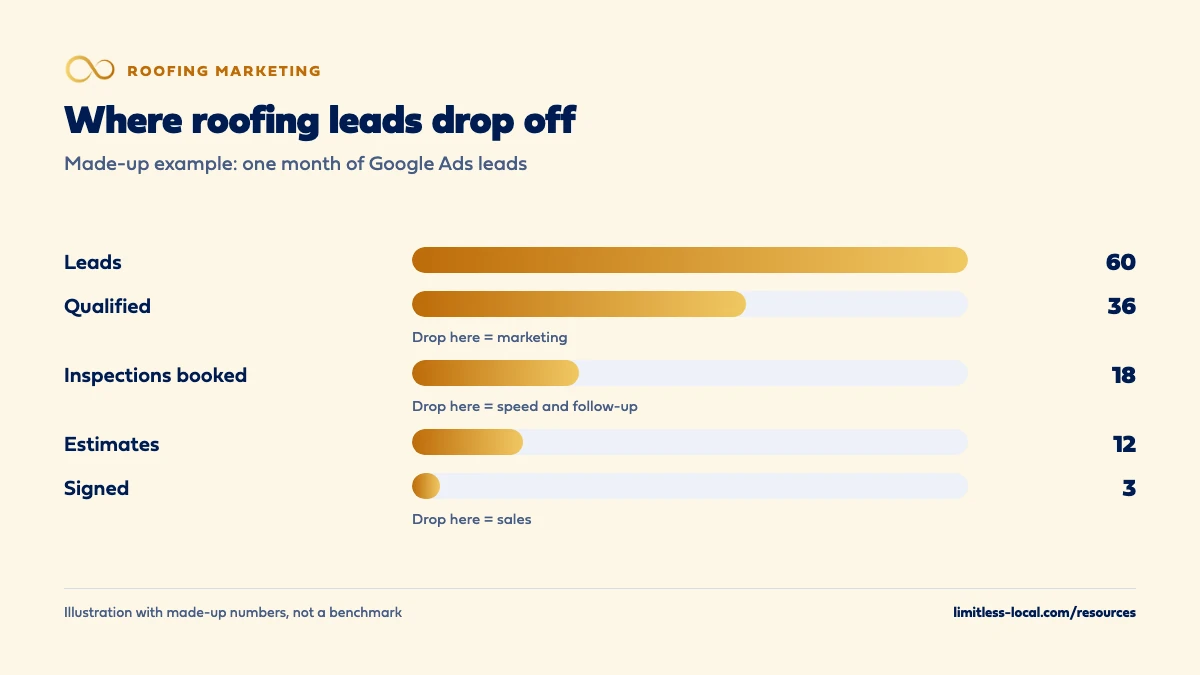
These numbers are made up to show the method, not a benchmark. Say Google Ads brought 60 leads last month after removing repeat callers. Of those, 36 met your qualification rule. Of the 36, 18 booked an inspection, 15 inspections happened, 12 got an estimate, and 3 signed.
Read it stage by stage. Losing 24 of 60 at qualification is a marketing signal: check search terms and location settings. Losing half the qualified leads before an inspection is booked is a speed and follow-up signal: check call-back times and recordings. Then 3 signed out of 12 estimates is a sales signal worth comparing by salesperson. Fix the biggest drop first.
For context on our side: every package includes call, web and form tracking with source tagging, and our automation add-ons (lead tracking dashboard, unified messaging, calendar and reminders, after-hours answering, AI website chat) plug into any tier; pricing for those is shared on the discovery call. We don’t promise a close rate; your sales process is yours.
Frequently asked questions
What counts as a qualified roofing lead?
Write your own rule and keep it. A common version is a homeowner in your service area, asking for a service you sell, who’s willing to book an inspection.
Should my salespeople qualify leads, or the office?
In our judgement, the person who answers the first call should mark qualification, using a written rule, so the salesperson’s own close rate doesn’t color it.
Do shared leads from lead-selling sites close worse?
They can, because the homeowner may be talking to several roofers. Track them as their own source and compare qualified-to-signed rates against your other channels.
My agency says the leads are good. How do I check?
Ask for leads by source, with recordings, and apply your qualification rule yourself. Compare that to what the agency reports.
Can a CRM fix a sales problem?
A CRM can make follow-up consistent and visible, but it doesn’t make the calls. In our judgement, it helps most when someone owns the follow-up list every day.
Is a low close rate always bad?
Not always. A source with a lower close rate but bigger jobs can still be your best. Compare cost per signed job and job value, not just close rate.
Key takeaways
- Split the funnel: leads, qualified, inspections, estimates, signed, by source.
- Drops before qualification point to marketing; drops after point to follow-up or sales.
- Use one written qualification rule and listen to recorded calls.
- Check tracking before blaming either side; short calls can inflate leads.
- Fix follow-up first; it’s cheapest and makes every other number clearer.
Want a second set of eyes on your setup?
We'll look at how you show up locally and where calls are leaking, then send you a plain-English breakdown.
More in this section
- How do I switch roofing marketing agencies without losing leads?
- Why are my roofing ads getting clicks but no calls?
- How do I know if my roofing marketing agency is getting results?
- Which roofing marketing tasks should I do myself or hand off?
- Is door knocking or online marketing better for a roofing company?
Sources
- How to qualify leads in CallRail — CallRail Help Center
- Unique Callers report — CallRail Help Center
- Get negative keyword ideas using the search terms report — Google Ads Help
- About phone call conversion tracking — Google Ads Help
- Offline conversion imports FAQs — Google Ads Help
- Manage leads and jobs — Local Services Help