
What monthly marketing budget does a restoration company need?

- What's the minimum monthly budget for consistent water damage leads?
- Why is there no standard marketing budget for a restoration company?
- What does a monthly restoration marketing budget have to cover?
- How do I work out my minimum ad budget from the jobs I need?
- Why does a budget that's too small give me leads in bursts?
- Is there a minimum budget for Local Services Ads?
- How much should go to local SEO and my Google profile each month?
- What happens if I can't afford the floor yet?
- Should my monthly budget change with storms and freezes?
- What does it cost to have someone run it?
- How do I know my monthly budget is working?
- When should I raise the budget above the floor?
- What's different for restoration companies
- A worked example: finding the floor for six water damage jobs a month
- Frequently asked questions
- Key takeaways
- More in this section
- Sources
The short version
- Start from the signed jobs you need, not from a percentage you read somewhere.
- Signed jobs needed, times leads per signed job, times cost per lead, gives your ad spend floor.
- Divide the monthly ad budget by 30.4 to see the daily budget Google actually works with.
- Add the fixed foundation and the cost of whoever runs it, including your own time.
For restoration owners who want water, mold and fire calls every week, not in bursts, and need to know the smallest budget that gets them there.
Get a free visibility audit · Book a growth call
What's the minimum monthly budget for consistent water damage leads?
There’s no single right number, but there is a floor: enough ad spend to buy a steady flow of leads every week, plus the fixed cost of a Google profile, a website with real service pages, call tracking and someone answering every call. Work the floor out backward from the signed jobs you need each month, how many leads it takes to sign one, and what a lead costs in your market. Then check the daily ad budget is large enough to keep ads running through the day and night, because a budget that runs out by mid-afternoon produces leads in bursts and too little data to judge.
If you’d rather hand the work off, it helps to know what management costs before you set the floor. Our packages start with Essentials at $3,500 a month, which manages Google Ads up to $2,500 a month in spend for one location; Growth, at $4,500 a month, adds Local Services Ads management and Google Ads up to $5,000 in spend. Ad spend is paid to Google directly in every tier, and Scale is custom for multi-market companies. The packages page lists what each tier includes, and our restoration marketing page covers how we work with water, fire and mold companies. For every channel side by side, start with the restoration marketing guide; the restoration marketing questions library takes the narrower questions one at a time.
Why is there no standard marketing budget for a restoration company?
Because the inputs swing too much from one company to the next. The Small Business Administration’s guide to marketing budgets says there’s no hard and fast answer to how much a marketing budget should be, that many businesses use a percentage of revenues as a guide, and that the range of percentages is wide. It suggests checking with your industry trade association or trade publications for benchmarks.
In our judgement, a percentage of revenue is a useful ceiling check for restoration, not a floor. A company living on program work and one that wins every job from Google can share a revenue figure and need very different budgets.
The floor comes from a different question: how much do you have to spend, every month, to get enough real leads to fill the jobs you need, steadily enough that you can tell what’s working? That’s the number this page works out.
What does a monthly restoration marketing budget have to cover?
Three things, and owners often budget for only the second one:
- The foundation. A verified Google Business Profile, a website with a page for each service you sell, call tracking that tags where each call came from, and a phone that gets answered around the clock. Most of this is set up once and maintained monthly.
- Paid lead flow. Google Ads, Local Services Ads or both. This is the variable part, and it’s paid to Google, not to whoever runs it.
- Labor. Someone has to run it: you, an employee, a freelancer or an agency. Your own hours count, even if no invoice arrives for them.
Ad spend without the foundation tends to leak. A click that lands on a thin website, or a call that rolls to voicemail at 2 a.m., costs the same as one that books.
How do I work out my minimum ad budget from the jobs I need?
Work backward in three steps, using your own job records wherever you have them:
- Signed jobs needed from marketing. Take the jobs you need each month and subtract the ones that reliably come from programs, referral partners and repeat accounts. What’s left is what paid and search marketing has to win.
- Leads per signed job. If roughly one in four real leads becomes a signed job, every job needs four leads. Count only leads from people in your area asking for work you do.
- Cost per lead. Your Google Ads or Local Services Ads account shows it. If you’ve never run ads, treat your first month as the test that finds it.
Multiply them: signed jobs times leads per job times cost per lead is your monthly ad spend floor. Working back from a revenue goal walks through each step in more detail.
Why does a budget that's too small give me leads in bursts?
Because Google Ads budgets are set per day, and a small daily budget runs out. Google’s page on average daily budgets explains that you set an average daily amount per campaign; Google may spend less on some days and more on others, but never more than two times the average daily budget on any one day for most campaigns, or more than 30.4 times it in a month. To turn a monthly amount into a daily budget, divide by 30.4.
When a campaign keeps hitting that limit, Google’s budget tips page says your ads might not show as frequently as you’d like, or might not show at all. If your daily budget is gone by early afternoon, the burst pipe at 9 p.m. finds someone else.
Small budgets also slow down Google’s automated bidding. Its page on Smart Bidding learning lists low daily budgets among the very restrictive settings that can slow down a campaign’s ramp-up, and advises making sure daily budgets are sufficient so the system has room to optimize.
Is there a minimum budget for Local Services Ads?
Google gives a recommendation rather than a hard minimum. Its page on how bidding works for Local Services Ads recommends setting a minimum budget of 10 leads per week for optimal results when you use Maximize leads bidding, and notes it takes about two weeks to see accurate results while the model learns about your business. So your Local Services Ads floor is roughly 10 times your cost per lead, every week.
The budget format is changing. Google is moving Local Services Ads into Google Ads as Performance Max campaigns with pay-per-lead goals. Restoration isn’t among the categories Google names for the first phase in August 2026, but the move expands to service-area businesses without storefronts in late 2026 and to remaining categories in 2027. When your account moves, your weekly budget is divided by 7 to set a daily average, monthly spend is capped at 30.4 times that daily figure, and manual bidding goes away.
For the per-lead side of the math, what a restoration lead costs on Local Services Ads covers what moves the price.
Curious what your marketing is actually booking?
Get a free visibility audit — no obligation, no sales pitch.
How much should go to local SEO and my Google profile each month?
Enough to keep the work moving every month, because it compounds slowly. Ads can generate leads within days of launch, while SEO typically takes 3-6 months to show meaningful organic growth. Google’s local ranking help also says there’s no way to request or pay for a better local ranking; local results are mainly based on relevance, distance and popularity, and more reviews and positive ratings can help.
That makes the SEO part of a minimum budget mostly about consistency rather than size. In our judgement, a restoration company on a tight budget gets more from steady monthly work on its profile, its core water, mold and fire pages and its reviews than from a big burst of work followed by nothing. What monthly restoration SEO work includes lists the deliverables so you can judge what a month of it should look like.
What happens if I can't afford the floor yet?
Shrink the target, not the daily budget. Spreading a small budget across every service, every town and every hour is how you end up with a few leads a month and no way to tell what produced them. In our judgement, it’s better to concentrate:
- One service. Water damage first; mold and fire can wait for a second campaign.
- A tighter area. The towns your crew can reach fastest, where you’re most likely to win the job.
- Fewer hours, covered well. If nobody can answer at 3 a.m., paying for 3 a.m. clicks is waste.
Meanwhile, work on what costs time rather than money: a complete Google profile, reviews from every job, and referral partners. A one-truck company has its own playbook in getting emergency calls cheaply.
Should my monthly budget change with storms and freezes?
Yes, and planning for it is part of setting the floor. In our judgement, storms, freezes and burst-pipe seasons tend to bring more people searching and more companies bidding for the same calls, so it’s better to set a steady monthly floor and hold a separate reserve you can add during a weather event than to inflate the everyday budget to cover the peaks.
The mechanics help here. Google’s Smart Bidding page says changes to daily budgets take effect immediately and don’t trigger a “Learning” status, so you can raise spend for a few days and bring it back down. Extra leads only help if you have a crew to send.

What does it cost to have someone run it?
Count it either way: in dollars if you hire it out, in hours if you do it yourself. Every hour you spend on ads and reviews is an hour you’re not estimating or running crews.
The options run roughly from cheapest to most expensive: doing it yourself, a part-time freelancer, an in-house marketer, or an agency retainer. In our judgement, the right choice depends less on the retainer than on what each signed job ends up costing once management is included, which is why the worked example below adds it in. How much of your time managing a marketer takes covers the hours you’ll still spend either way.
How do I know my monthly budget is working?
Judge it on cost per signed job, not on clicks or leads. That means every lead tagged with its source and every signed job matched back to the lead that produced it. The SBA’s budget guide notes that tracking can be as simple as asking new customers where they learned about your business; with ads running, call tracking and a lead source field in your job software are more reliable.
Then compare your cost per signed job with the most you can pay for a job of that type. Setting a cost per booked job ceiling explains how to set that ceiling.
When should I raise the budget above the floor?
When three things are true at once: your cost per signed job is under your ceiling, your crews and drying equipment have room for more work, and your campaigns are regularly running out of budget. Google’s budget tips page says Google Ads shows recommended budgets for campaigns that repeatedly meet their average daily budget but have the potential to earn more clicks and impressions; that’s a signal to look at, not an instruction to follow.
Raise it in steps and give each step a few weeks before judging it. If the cost per signed job climbs, the extra money is buying weaker leads; try a new service or town instead.
Talk it through with someone who runs this every day
A 15-minute growth call: your market, your numbers, and what a realistic budget looks like. No pressure.
What's different for restoration companies
Emergency hours set the daily budget. Burst pipes and storms don’t keep business hours, so in our judgement a restoration budget has to last the full day, not just until lunchtime.
Not every job comes from marketing. Program work, referral partners and repeat commercial accounts can make up a big part of a restoration company’s jobs. Subtract them before you size the budget, or you’ll pay for jobs you’d have had anyway.
The first job can lead to a second. Mitigation can lead to a rebuild. If yours often do, a signed mitigation job is worth more than its own invoice, and you can afford a higher cost per signed job than the mitigation alone suggests.
Cash arrives later. Ad spend is due when the ads run, while payment on a job may come weeks later. In our judgement, plan the floor around what your cash flow can carry for a few months, not just what one month’s math says.
A worked example: finding the floor for six water damage jobs a month
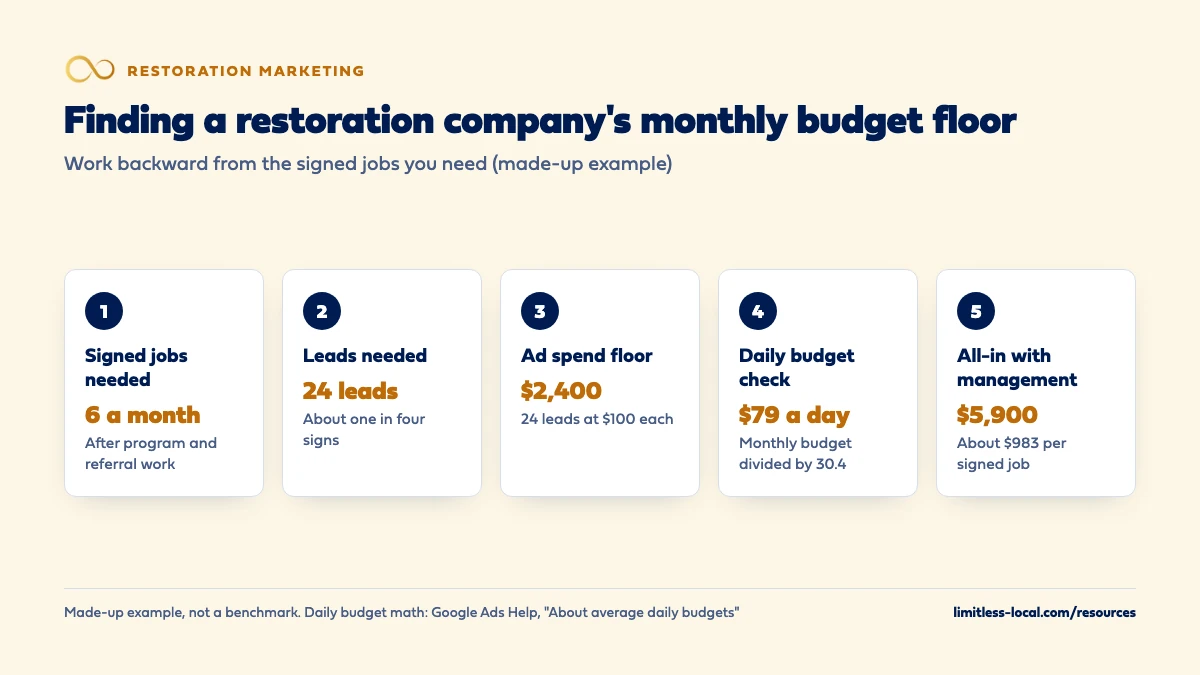
These numbers are made up to show the math, not a benchmark for your market. Say a restoration company needs 6 signed water damage jobs a month from its marketing, after subtracting program and referral work. About one in four real leads signs, so it needs 24 leads. Its cost per lead runs about $100, so the monthly ad spend floor is 24 times $100, or $2,400.
Divided by 30.4, that’s a daily budget of about $79. The owner checks whether $79 a day keeps ads running through the evening in the towns they serve. If the campaign is regularly running out by mid-afternoon, the floor is too low for the area, and the answer is a tighter area or a single service, not hoping for the best.
At $2,400 in ad spend, the cost per signed job from ads alone is $2,400 divided by 6, or $400. Now add management. If the company hires our Essentials package ($3,500 a month, which manages Google Ads up to $2,500 in spend), the all-in monthly cost is $2,400 plus $3,500, or $5,900, and the all-in cost per signed job becomes $5,900 divided by 6, about $983. If a signed job can carry that, the managed route fits; if it can’t, doing more of the work in-house until the job count grows is the honest answer.
Frequently asked questions
Is 10% of revenue the right marketing budget for a restoration company?
There’s no reliable rule. The SBA says many businesses use a percentage of revenues as a guide but that the range is wide. In our judgement, use a percentage as a ceiling check and build the floor from the jobs you need.
Can I start with $500 a month in Google Ads?
You can, but at about $16 a day, a campaign covering several services and a wide area will often run out early. If that’s the budget, narrow it to water damage in your closest towns and the hours you can answer.
Does the ad spend floor include what I pay an agency?
No. Ad spend is paid to Google; management is a separate cost. Add both before you judge what a signed job costs you.
How long should I run at the floor before deciding it isn't working?
Give it long enough to see a steady pattern of signed jobs. Google says Local Services Ads take about two weeks to show accurate results, and SEO typically takes 3-6 months, so judge each channel on its own clock.
Should mold and fire have their own budget?
Once the water damage floor is covered, yes. Separate budgets stop one service from using up the money meant for another, and let you judge each on its own cost per signed job.
Key takeaways
- Build the budget floor from the signed jobs you need: jobs times leads per job times cost per lead.
- Google Ads budgets are daily: divide the monthly figure by 30.4 and check it lasts through the evening.
- Google recommends a Local Services Ads budget of at least 10 leads a week when you use Maximize leads.
- If you can’t afford the floor, narrow the service, area and hours rather than spreading the budget thin.
- Add management and your own time, then judge everything on cost per signed job.
Ready to compare options?
Book a short growth call and we'll walk through the math for your service area, including when we're not the right fit.
More in this section
- What marketing does a brand-new restoration company need first?
- What is a good cost per booked job for a restoration company?
- How do I keep marketing steady while hiring restoration techs?
- How much of my time does managing a restoration marketer take?
- How should a restoration company handle marketing during storm season?
Sources
- How to Get the Most From Your Marketing Budget — U.S. Small Business Administration
- About average daily budgets — Google Ads Help
- Tips for optimizing your average daily budget — Google Ads Help
- About Smart Bidding learning — Google Ads Help
- How bidding works for Local Services Ads — Google Local Services Help
- Local Services Ads transition to Performance Max campaigns with pay-per-lead goals — Google Ads Help
- Tips to improve your local ranking on Google — Google Business Profile Help