
Can a small HVAC company afford TV advertising?

- Is TV advertising worth it for a small HVAC company with a few trucks?
- What does TV advertising cost a small HVAC company?
- Why is broadcast TV a hard fit for a small HVAC service area?
- Is streaming or YouTube TV advertising different from broadcast?
- Can I target only my service area with TV-screen ads?
- When can TV make sense for an HVAC company?
- What should a small HVAC company fund before TV?
- How do I track calls from a TV ad?
- How do I test TV without betting the shop?
- Is radio or direct mail a cheaper step than TV?
- What's different about TV advertising for HVAC companies
- A worked example: what a TV test has to book to pay for itself
- Frequently asked questions
- Key takeaways
- More in this section
- Sources
The short version
- Fund the basics first: Google profile, reviews, Local Services Ads and Google Ads.
- Broadcast TV is bought by TV market, not by service area.
- Streaming and YouTube ads through Google Ads can be targeted by location and started small.
- Any TV test needs its own tracking number and a loss limit you can live with.
For owners of smaller HVAC companies who’ve been pitched a TV spot, or watched a bigger competitor run one, and want to know whether it’s a sensible next step.
Get a free visibility audit · Book a growth call
Is TV advertising worth it for a small HVAC company with a few trucks?
A small HVAC company can sometimes afford a TV test, but in most cases it isn’t the best use of the money until cheaper, trackable channels like your Google profile, Local Services Ads and Google Ads are already booking jobs. Broadcast TV is sold by TV market, the viewing areas Nielsen defines as DMAs, so you pay for production and airtime across the whole market, and in our judgement most of those viewers live outside a small company’s service area. If you want to be on the TV screen, streaming and YouTube ads bought through Google Ads can be targeted by location, and whichever you choose, give the ad its own tracking number and judge it by booked jobs.
We don’t buy TV airtime or make commercials. Our marketing packages cover Google, Maps, ads and lead follow-up, with call tracking and a monthly report in every one, which is the same yardstick you’d hold a TV spot to. The HVAC marketing page shows how those channels fit together, the HVAC marketing guide covers every channel, and the rest of the HVAC marketing questions library goes question by question.
What does TV advertising cost a small HVAC company?
There’s no reliable published price list we can point you to, because local TV is priced market by market and station by station. What you’ll pay for comes in three parts: making the commercial, the airtime (the spots themselves), and how many times it needs to run before people remember it.
Market size drives the airtime price. Nielsen, which defines the TV markets advertisers buy, says each market is ranked by its number of TV households, and that broadcasters use that market size to make decisions on ad inventory pricing. In our judgement, that means the same 30-second spot costs more in a big metro than in a small one, and a small company in a big metro gets the steepest price for the widest audience.
If a station pitches you, ask for the total cost, the number of times the spot will air, the time slots, and its audience estimate, all in writing.
Why is broadcast TV a hard fit for a small HVAC service area?
Because TV is sold by market, not by the towns your trucks drive to. Nielsen describes its markets, called DMAs, as regions defined to represent specific television viewing areas. A local station’s spot reaches viewers across that whole area.
In our judgement, for a company running a few trucks in a handful of towns, most of the households a broadcast spot reaches are ones you’d never drive to. You’re also paying to reach people whose AC is working fine that week. Search is the opposite: Google Ads and Local Services Ads show up when someone in your area is looking for help right now. That’s why we’d fund those first.
Is streaming or YouTube TV advertising different from broadcast?
Yes, mainly in how you buy it and how you target it. Google says ads on YouTube TV can use the same targeting strategies as YouTube video ads, and that Google Ads campaigns bought on an auction basis are eligible to serve on YouTube TV, though not guaranteed to. If you want to be sure your ad runs there, Google says you have to buy placements on a reservation basis.
Google also lets you extend YouTube video campaigns to the Google TV network, ad space on the TV screen on smart TVs and streaming devices that run Google TV, and that network supports location targeting. There are limits: Google says you can’t target specific YouTube TV channels in Google Ads campaigns. In our judgement, these options suit a small company better than broadcast, because you can start with a budget you choose instead of a station’s package.
Can I target only my service area with TV-screen ads?
With ads bought through Google Ads, you choose the locations. Google says you can show ads to people based on their physical location, the locations they’ve shown interest in, or both, and that the default setting uses both. You can change that in the advanced location options.
In our judgement, for a service business, set it to people who are in, or regularly in, the towns you serve, so you aren’t paying to reach someone in another state who searched your city once. Broadcast TV doesn’t give you that control; the station’s market is the market.
Curious what your marketing is actually booking?
Get a free visibility audit — no obligation, no sales pitch.
When can TV make sense for an HVAC company?
BDC, the Business Development Bank of Canada, notes that while digital advertising tends to be more budget-friendly, traditional advertising such as TV still has value depending on who you’re trying to reach. In our judgement, for an HVAC company, TV starts to make sense when most of these are true:
- Your locations and trucks already cover most of the TV market.
- Your Google profile, reviews, Local Services Ads and Google Ads are working, and spending more there has stopped buying more booked jobs.
- You can set aside a test budget you could lose without touching payroll.
- Your office and crews can handle more calls if it works.
That usually describes a larger, multi-truck company. How HVAC marketing changes once you have 10 or more trucks covers that stage.
What should a small HVAC company fund before TV?
The channels that reach homeowners at the moment they need you, and that you can measure call by call. The SBA’s advice for tight budgets is to ramp up low-cost or free methods and be very selective about the more expensive ones.
For an HVAC company, in our judgement, that order usually runs: a complete Google Business Profile, a steady flow of reviews, a website that works on phones, call tracking, then Local Services Ads and Google Ads, then your past customers through email and reminders. Whether to start with LSAs, Google Ads or SEO helps you pick the first paid channel. If those are all working and capped, TV becomes a fair question.
How do I track calls from a TV ad?
Give the ad its own phone number. The SBA suggests using different codes for each print, direct mail, TV or radio ad to see which attract the most customers. Call tracking tools offer the phone version: CallRail, for example, lets you create an offline tracking number for print, TV or radio ads that forwards to your main business number, so every call from the spot is counted separately.
Add two more checks. Have your office ask every new caller how they heard about you and enter it in your field software. And watch searches for your company name: Google Search Console’s branded queries filter separates searches that include your business name from those that don’t (Google says it only appears for sites with enough queries and impressions), and in our judgement a jump in branded searches while a spot is running is a useful sign, even when people don’t call the number on screen. Tracking whether your HVAC marketing is paying off covers the setup.
How do I test TV without betting the shop?
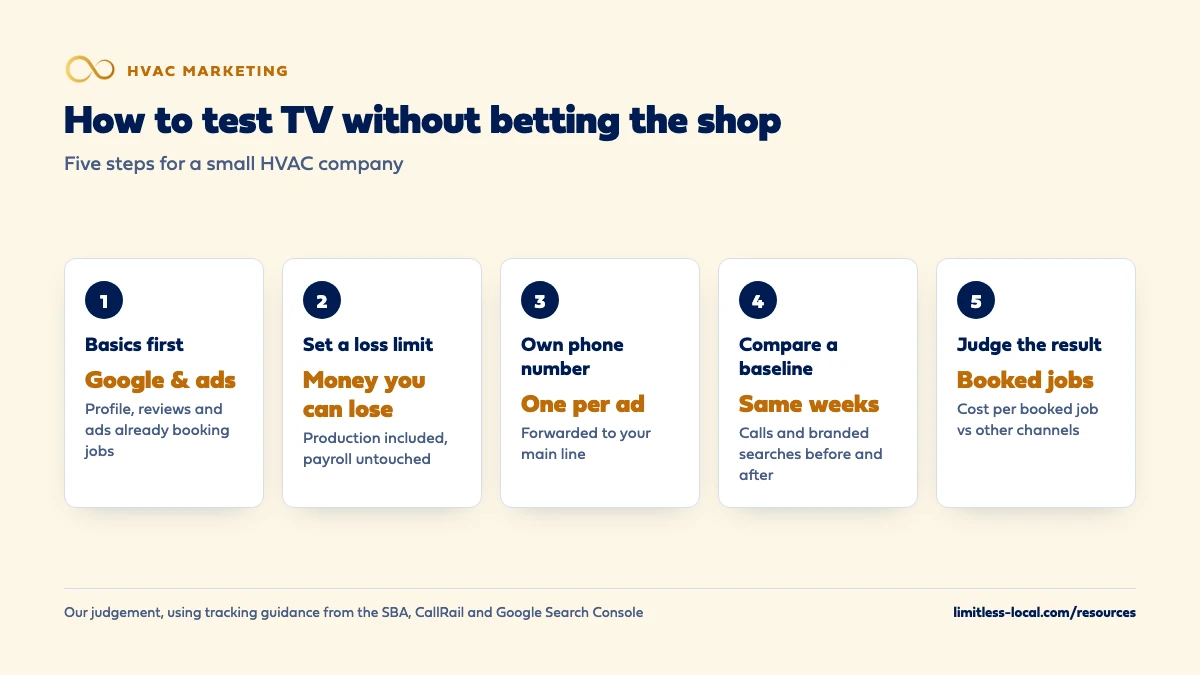
In our judgement, a sensible TV test for a small HVAC company looks like this:
- Set a loss limit first. Decide the most you’ll spend, production included, and treat it as money that might buy nothing.
- Pick one market and one message. One service, one reason to call, one number.
- Run it for a fixed stretch. Agree start and end dates up front.
- Compare with a baseline. Calls, branded searches and booked jobs in the same weeks before the spot, and the same weeks last year.
- Judge it by booked jobs. Divide the total cost by the booked jobs it produced, and compare that with your other channels.
If the cost per booked job doesn’t come close, you’ve learned it for a set price. If it does, you have a reason to run it again.
Is radio or direct mail a cheaper step than TV?
Often, yes, and both can be tracked the same way: a dedicated number on every ad. In our judgement, direct mail fits a small HVAC company better than broadcast because you choose the exact neighborhoods, including your past customers, instead of a whole market. Whether direct mail is still worth it for HVAC companies covers costs and tracking.
If you’re deciding how much to spend on marketing overall before choosing any channel, what percent of revenue an HVAC company should spend on marketing starts there.
What's different about TV advertising for HVAC companies
Demand follows the weather. HVAC calls jump in the first heat wave and the first cold snap. In our judgement, TV schedules are usually booked ahead and are harder to turn up or down at short notice than Google Ads, which you can change the same day.
Emergencies go to whoever shows up in search. A homeowner with no cooling picks up a phone and searches; they don’t wait for a commercial. TV can help them remember your name, but search and Maps are where the emergency call is won.
Replacements are where TV has the best case. A homeowner planning a system replacement has time to think, and in our judgement that’s where a familiar name from TV is most likely to matter. If you run TV, a replacement or financing-focused message is easier to justify than a repair offer.
Not sure which of these is costing you jobs?
A free visibility audit checks the Google profile, reviews, site and tracking, and shows what to fix first.
A worked example: what a TV test has to book to pay for itself
These numbers are made up to show the math. They aren’t real TV prices or HVAC margins.
- Production: $4,000. Airtime for a short run: $6,000. Total: $10,000.
- If an average replacement leaves $2,000 in gross profit, the test needs 5 replacements to break even.
- If it brings service calls instead, at about $200 gross profit each, it needs 50 of them.
Now put the same $10,000 into Google Ads. If your Google Ads cost works out to about $250 per booked job, that’s around 40 booked jobs, and you can see which ones came from the ads. The point isn’t that TV can’t win; it’s that the TV test has to beat a number you already know.
For comparison, our Essentials package is $3,500 a month and includes Google Ads management for up to $2,500 a month in ad spend, which is paid to Google separately, along with call tracking. Whether TV, ads or neither is the right next step for your company is what a free visibility audit is for.
Frequently asked questions
Is cable TV cheaper than broadcast for an HVAC company?
It can be, depending on the market and the provider, but we can’t point you to a reliable published price. Ask any seller for the total cost, the number of airings, the area covered and the audience estimate in writing, then run the break-even math.
Can I run YouTube ads that show on TV screens?
Yes. Google says YouTube video campaigns can extend to the Google TV network, and auction-based Google Ads campaigns are eligible to serve on YouTube TV, though placement there isn’t guaranteed unless you buy on a reservation basis.
Does TV help my Google ranking?
Not in any way Google documents. What TV can do is get more people searching for your company by name, which Search Console’s branded queries filter can show if your site has enough search volume for it to appear.
Should I put my main phone number on a TV ad?
Use a tracking number that forwards to your main line instead. That way every call from the ad is counted, and you can keep the number running after the spot ends.
How long should a TV test run?
There’s no standard length. In our judgement, agree a fixed start and end date up front, long enough for the spot to air the number of times the station recommends, and compare it with the same weeks before and last year.
Key takeaways
- Most small HVAC companies should fund Google, reviews, Local Services Ads and Google Ads before TV.
- Broadcast TV is bought by TV market, and Nielsen says market size informs how stations price ad inventory.
- Streaming and YouTube ads through Google Ads can be targeted by location and started small.
- Every TV test needs its own tracking number, a fixed budget and a baseline to compare with.
- Judge TV by cost per booked job against channels you already measure.
Want a second set of eyes on your setup?
We'll look at how you show up locally and where calls are leaking, then send you a plain-English breakdown.
More in this section
- Do Google Ads work for a brand-new HVAC company?
- Are Google Local Services Ads worth it for an HVAC company?
- What's the simplest marketing setup for a small HVAC company?
- Is SEO worth it for a small HVAC company?
- Do Facebook ads work for getting HVAC calls?
Sources
- Need to know: What is a DMA®, and why does it matter? — Nielsen
- About YouTube TV ads — Google Ads Help
- Expand your reach with the Google TV network — Google Ads Help
- About targeting geographic locations — Google Ads Help
- Create a number for print, TV, or radio ads — CallRail Help Center
- How to Get the Most From Your Marketing Budget — U.S. Small Business Administration
- What is an average marketing budget for a small business? — BDC (Business Development Bank of Canada)
- Introducing the branded queries filter in Search Console — Google Search Central Blog