
How many hours a week does in-house pool builder marketing take?

- How much time a week should a pool builder plan for running marketing in-house?
- Where do the hours go when you run pool marketing yourself?
- How much time does the Google Business Profile take each week?
- How long does it take to ask for reviews and reply to them?
- How much time do Google Ads take if I manage them myself?
- How much time does the website and SEO content take?
- How much time does social media take for a pool company?
- How long does monthly reporting take?
- How do the hours change through the pool season?
- Why do the first few months take longer?
- How can I cut the hours without dropping what matters?
- When should a pool builder hand some of it off?
- What's different about in-house marketing for pool builders
- A worked example: one pool builder's marketing week
- Frequently asked questions
- Key takeaways
- More in this section
- Sources
The short version
- The basics (Google profile, reviews, photos, a lead log) take a few hours every week, all year.
- Running your own Google Ads adds weekly checks of what people searched and what it cost.
- Website content, social posts and a monthly report add more on top.
- The first few months take longer, while you learn the tools and set up templates.
For pool builders thinking about keeping marketing in-house, who want to see where the hours actually go each week before they commit to it.
Get a free visibility audit · Book a growth call
How much time a week should a pool builder plan for running marketing in-house?
It depends on how much you run yourself. Keeping the basics going, meaning your Google Business Profile, review requests and replies, job-site photos and a simple lead log, takes a few hours every week of the year. Running your own Google Ads, adding website content, posting on social media and pulling a monthly report adds several more, and in spring the whole job can grow into most of a part-time role. Plan the hours task by task and protect them in peak season, because that’s when in-house marketing is the first thing to slip.
If those hours are coming out of design consultations and job-site time, that’s the trade-off to weigh. Our delivery is team-driven and hands-off: onboarding takes your team about 2-3 hours, campaigns go live in weeks 1-2, and after that you get monthly reviews instead of weekly chores. Our packages page lists what each tier takes off your plate, our pool builder marketing page shows how we work with pool companies, and the pool builder marketing questions library covers the rest.
Where do the hours go when you run pool marketing yourself?
In-house marketing isn’t one job. It’s a handful of small ones that each need a slot in your week:
- Google Business Profile: posts, new photos, keeping hours and services right.
- Reviews: asking every customer at handover, then replying to what comes in.
- Google Ads, if you run them yourself: checking searches, costs and leads.
- Website: adding finished projects, updating pages, fixing what breaks.
- Social posts: build progress and finished pools on Facebook and Instagram.
- Reporting: matching leads to consultations and signed contracts once a month.
Answering and following up on leads takes time too, but that’s sales work, and it has to happen whoever runs the marketing. Keep it on its own line, and use the list above to see what marketing itself takes. The cost side of the same list is covered in what a pool builder budgets beyond ad spend.
How much time does the Google Business Profile take each week?
Less than most owners fear, as long as you batch it. A weekly session covers it: upload the best photos from active job sites, write one post about a finished pool or a build stage, and check that your hours and services are still right.
Google’s help page on creating posts on your Business Profile says you can schedule a post to publish later or set it to repeat weekly or monthly, and that posts older than 6 months are archived unless a date range is set. Scheduling means you can write a month of posts in one sitting in the slow season. The photos are the part that can’t be batched far ahead, because they need to come from real builds as they happen. Ask your crew leads to snap progress shots, so you’re choosing photos, not taking them.
How long does it take to ask for reviews and reply to them?
A few minutes per customer, if you set it up once. Write a short text message with your Google review link, save it, and send it at the startup walkthrough or handover, when the homeowner is standing next to their new pool. Then send one reminder a few days later.
Replying is the other half. Google’s guide to managing customer reviews says helpful and positive replies can show you’re responsive to customers, and that the person who wrote the review is notified when you reply. A thank-you that mentions the pool type or the town takes a minute or two. A critical review takes longer, because it deserves a calm, specific answer. Set aside time for those as they come, rather than squeezing them in between job sites.
How much time do Google Ads take if I manage them myself?
More than the other tasks, and it’s the one where skipped weeks cost the most. The core weekly job is reading your search terms report, which Google says shows how your ads performed when triggered by actual searches. For a pool builder, that’s where you find money going to searches for pool supplies, pool cleaning, above-ground kits or jobs outside your towns.
A weekly check usually covers:
- New search terms, and which ones to block as negative keywords.
- Spend against budget, and whether any campaign is running hot.
- Calls and form leads, and whether they look like real pool buyers.
- Ads or landing pages that need a seasonal update.
Blocking the wrong searches is a big part of that hour or two. The negative keywords pool builders need gives you a head start on the list.
How much time does the website and SEO content take?
Plan on a steady slot each week, with bigger pushes in the slow season. Google’s own advice in Do you need an SEO? is that if you run a small local business, you can probably do much of the work yourself, starting with its SEO starter guide.
For a pool builder, the weekly work is mostly adding finished projects to the gallery with a few lines about the pool type and town. The bigger jobs are writing pages for each pool type you build and each main town you serve, and those are best saved for fall and winter, when you have time to write them well. A page written in a rush in April usually reads like it.
Curious what your marketing is actually booking?
Get a free visibility audit — no obligation, no sales pitch.
How much time does social media take for a pool company?
As much as you let it, which is why it needs a cap. Two or three posts a week from photos you already have, written in one sitting, is enough to keep your pages active and give homeowners something to see when they check you out. Build stages make great posts: the dig, the steel, the first fill. Homeowners love watching a backyard change.
What eats time is trying to be on every platform, or making each post from scratch. Pick the one or two places your buyers actually look, reuse the photos you took for your Google profile, and stop there. What a pool builder should post on Instagram and Facebook has post ideas that come straight from the job site.
How long does monthly reporting take?
A couple of hours a month once your tracking is set up, and much longer if it isn’t. The job is to answer one question: which channels produced design consultations and signed contracts, and what did each cost?
If every lead has a source in your CRM or job software, that’s a matter of pulling a report and adding your spend. If leads live in texts, emails and sticky notes, you’ll spend those hours rebuilding the month by memory, and the answer will still be a guess. Getting the tracking right once is the best time-saver on this whole list.
How do the hours change through the pool season?
The marketing hours stay fairly steady. What changes is how much time you have to give them:
- Late winter and spring: searches pick up, leads come in fast, and ads need closer watching. This is when in-house marketing usually slips, because the same people are also running consultations.
- Summer: crews are busy, but this is when finished pools look their best. Get the photos.
- Fall and winter: the best time for the big jobs, like website pages, new landing pages and a year of scheduled posts.
Plan the heavy writing for the slow months and keep spring to the essentials: Google Ads checks, review requests and fast lead follow-up. How fast a pool builder should respond to a new lead covers why that last one matters most when it’s busy.
Why do the first few months take longer?
Because you’re learning the tools while doing the work. Setting up Google Ads properly, connecting tracking, building review templates and getting photos organized all take hours that you only spend once. The first month or two of in-house marketing can easily take double the weekly time it settles into.
Spend that setup time well and the weekly hours drop. Spend it badly, with ads that aren’t tracked or a profile that’s half complete, and you’ll spend the hours anyway, just on fixing things later.
How can I cut the hours without dropping what matters?
- Batch. One sitting for a month of posts, one for review replies, one for the Google Ads check.
- Template. Save your review request text, your post formats and your monthly report layout.
- Delegate the photos. Crew leads take progress shots; you pick the best ones.
- Drop the low-value channels. If a platform hasn’t produced a consultation in a season, stop posting there.
- Protect the high-value hours. Google Ads checks and lead follow-up come first; extra social posts come last.
When should a pool builder hand some of it off?
When the hours start coming out of work only you can do: design consultations, closing contracts, running crews. Other signs are spring weeks where the Google Ads check doesn’t happen, reviews that go unanswered for a month, or a monthly report that never gets pulled.
Handing off doesn’t have to be all or nothing. Many builders keep the photos, reviews and social posts in-house and hand off Google Ads, SEO and tracking, the parts with the steepest learning curve. Whether to hire an agency or do it yourself walks through that choice, and an in-house marketer versus an agency covers what a hire would cost.
Talk it through with someone who runs this every day
A 15-minute growth call: your market, your numbers, and what a realistic budget looks like. No pressure.
What's different about in-house marketing for pool builders
Your busiest marketing months are your busiest sales months. Spring is when homeowners search, call and book consultations, and it’s also when owners have the least spare time. Trades with steadier demand don’t get squeezed the same way.
Photos come from your job sites. Nobody else can take pictures of your builds, so even if you hand off everything else, someone on your crew needs to keep shooting.
Leads take months to sign. Reporting means matching a lead from last fall to a contract this spring, which takes more care, and more time, than a trade where the job closes the same week.
The winter is a gift. The slow months give you hours most trades don’t get. Use them for the big content jobs, so spring is only upkeep.
A worked example: one pool builder's marketing week
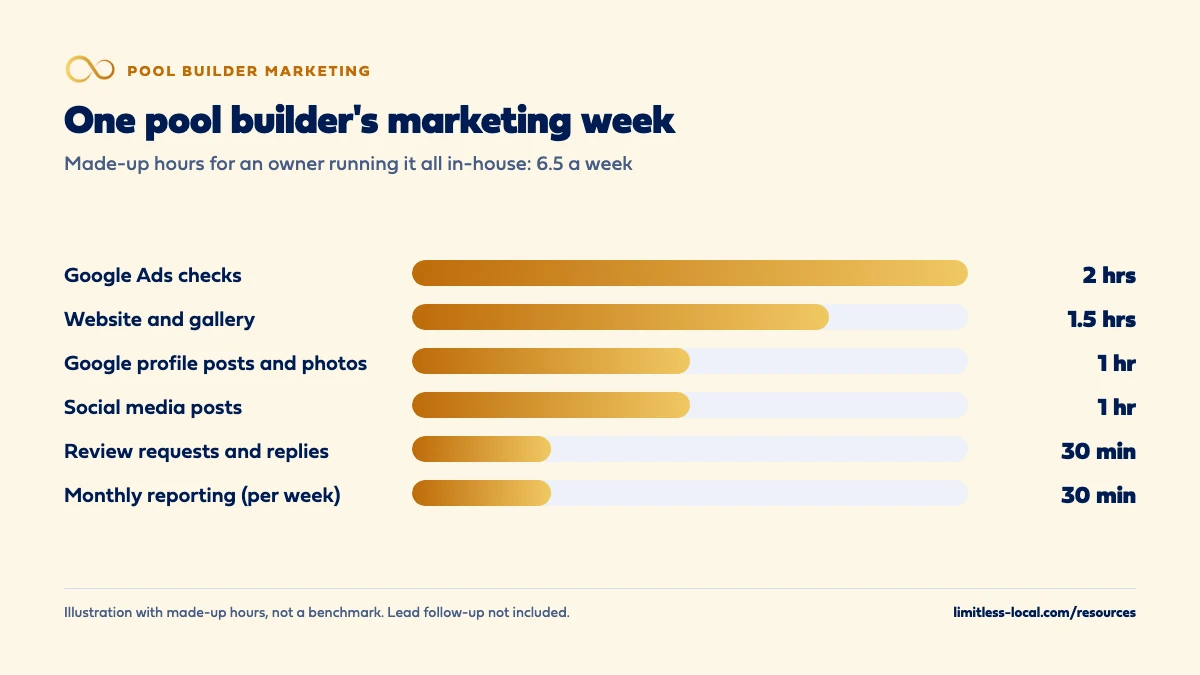
These hours are made up to show the math, not a benchmark for pool builders. Say an owner runs everything in-house, including Google Ads, and has tracking set up:
- Google Ads checks: 2 hours.
- Website and project gallery: 1.5 hours.
- Google Business Profile posts and photos: 1 hour.
- Social media posts: 1 hour.
- Review requests and replies: 30 minutes.
- Monthly reporting, spread across the weeks: 30 minutes.
That’s 6.5 hours a week, not counting answering and following up on leads. Now say an hour of the owner’s time is worth $100 to the business. Those hours are worth $650 a week, or about $2,817 a month.
That number isn’t a bill, but it’s real. Set it next to what it would cost to hand the work off, and next to what the owner could do with those hours instead, like another design consultation or two each week.
Frequently asked questions
Can a pool builder do marketing in an hour a week?
Only the bare minimum: a Google profile post, a few photos and review requests. That keeps your profile alive, but it won’t cover running ads or building website content.
Should the office manager handle marketing?
They can take the routine tasks, like posting photos, sending review requests and logging lead sources. Give them a written weekly checklist and a fixed time slot, or it will lose out to phones and scheduling every time.
Is it worth learning Google Ads myself?
If you enjoy it and will check the account every week, including in spring, yes. If weeks will get skipped, that’s the first task to hand off, because unchecked ads keep spending.
How much time does it take to switch from in-house to an agency?
Mostly the handover: access to your accounts, your Google profile and your website, plus a conversation about your towns, pool types and goals. Make sure every account stays in your company’s name.
Does marketing take less time in the off-season?
The upkeep stays about the same. What the off-season gives you is spare time, which is best spent on the bigger jobs like new website pages and a backlog of scheduled posts.
What's the one task I shouldn't skip when I'm busy?
Getting back to new leads fast. Every other task can wait a week; a homeowner who called about a pool and heard nothing may have booked someone else by then.
Key takeaways
- In-house pool marketing is a handful of small weekly jobs: Google profile, reviews, ads, website, social posts and reporting.
- The basics take a few hours a week; running your own Google Ads and content adds several more.
- Batch, template and delegate the photos to cut the hours without dropping what matters.
- Save big writing jobs for fall and winter so spring is only upkeep.
- Hand off the parts with the steepest learning curve first when the hours start coming out of consultations.
Ready to compare options?
Book a short growth call and we'll walk through the math for your service area, including when we're not the right fit.
More in this section
- How much should a pool builder spend on marketing?
- Should a pool builder hire an in-house marketer or an agency?
- How long does pool builder SEO take to bring in leads?
- How should a pool builder prepare marketing before peak season?
- How should a pool builder split its marketing budget?
Sources
- Create & manage posts on your Business Profile — Google Business Profile Help
- Manage customer reviews — Google Business Profile Help
- About the search terms report — Google Ads Help
- Do you need an SEO? — Google Search Central