
Are citations worth paying for as a pool builder?

- What are citations, and are they worth paying for for my pool construction business?
- What counts as a citation for a pool builder?
- Why do citations matter for a pool company at all?
- What kinds of citation services can I pay for?
- Which citation work is worth paying for?
- Why are bulk citation packages usually a waste?
- Can a pool builder build and fix citations without paying anyone?
- What should a paid citation cleanup actually include?
- What should I ask before paying for a citation service?
- When does a pool builder need citation work the most?
- Do citations help a pool builder show up in AI search?
- What's different about citations for pool builders
- A worked example: cleanup versus a bulk package
- Frequently asked questions
- Key takeaways
- More in this section
- Sources
The short version
- A citation is any mention of your business name, address and phone on another site.
- Worth paying for: a one-time audit and cleanup of the listings that matter, done properly.
- Rarely worth it: bulk packages that add hundreds of directory listings nobody visits.
- Accuracy beats volume, because Google pulls business details from other sources too.
For pool builders who’ve been pitched a citation or listings package and want to know what they’d actually be buying, and which parts are worth the money.
Get a free visibility audit · Book a growth call
What are citations, and are they worth paying for for my pool construction business?
A citation is any listing or mention of your pool company’s name, address and phone number on another website: directories, map apps, review sites, association pages and local news. Paying someone to set up and clean up the listings that homeowners and map apps actually use is often worth it, especially if you’ve moved, changed numbers or inherited a mess from an old agency, because Google builds your business information partly from what’s published elsewhere and from data it licenses from other companies. Paying for bulk packages that promise hundreds of new directory listings usually isn’t, because volume doesn’t fix wrong details and those directories send few, if any, homeowners.
Accurate listings are part of the foundation we build before anything else. Listing cleanup and buildout is included from our Essentials package up, and your name, address and phone get synced across 50+ directories, as part of our local SEO work. We’ve been on the owner’s side of this trade too: we were an equity partner in a pool construction company, where we built the lead-generation engine and ran sales and marketing. Our pool builder marketing page covers how we work with pool companies, and the pool builder marketing questions library goes question by question.
What counts as a citation for a pool builder?
Any place online that names your business and gives your address or phone number. They come in two kinds:
- Listings: structured profiles on Google, Bing, Apple Maps, Yelp, the Better Business Bureau, Facebook, Nextdoor and general business directories.
- Mentions: your details in an article, an association member list, a home show exhibitor page or a supplier’s website.
Pool builders have a few that most trades don’t: manufacturer and dealer locators for the pool brands you install, pool industry association directories, and pages from landscapers, designers or outdoor-living suppliers you work with. Those are often worth more than any general directory, because they’re where homeowners shopping for a pool actually look.
The details in every one of them should match. Why that matters is covered in what NAP is and why it matters for a pool builder.
Why do citations matter for a pool company at all?
Because Google doesn’t rely only on what you type into your profile. Its page on how Google sources business information lists several sources: publicly available information such as crawled web content, including your website; licensed data from third parties; users, including business owners and customers; and Google’s own interactions with a business.
So if a data company, an old directory and your website all show different phone numbers, any of them can end up in front of a homeowner. Google’s local ranking tips also say businesses with complete and accurate info are more likely to show up in local search results. The popularity side of local ranking takes into account how many websites link to your business, which is one more reason the listings worth having are real ones, on sites people use.
What kinds of citation services can I pay for?
Most offers fall into one of four kinds:
- A one-time audit and cleanup. Someone finds every listing for your business, fixes wrong details, merges or removes duplicates and fills in the important profiles.
- An ongoing listing sync. A subscription that keeps your details the same across a set of directories and pushes changes out when something changes.
- Bulk submission packages. A one-off fee for a large number of new directory listings, usually sold by count.
- Paid upgrades on single directories. Premium placement or ads on one site.
They’re very different products, and only some are worth your money. Ask any vendor which of these four you’re actually buying.
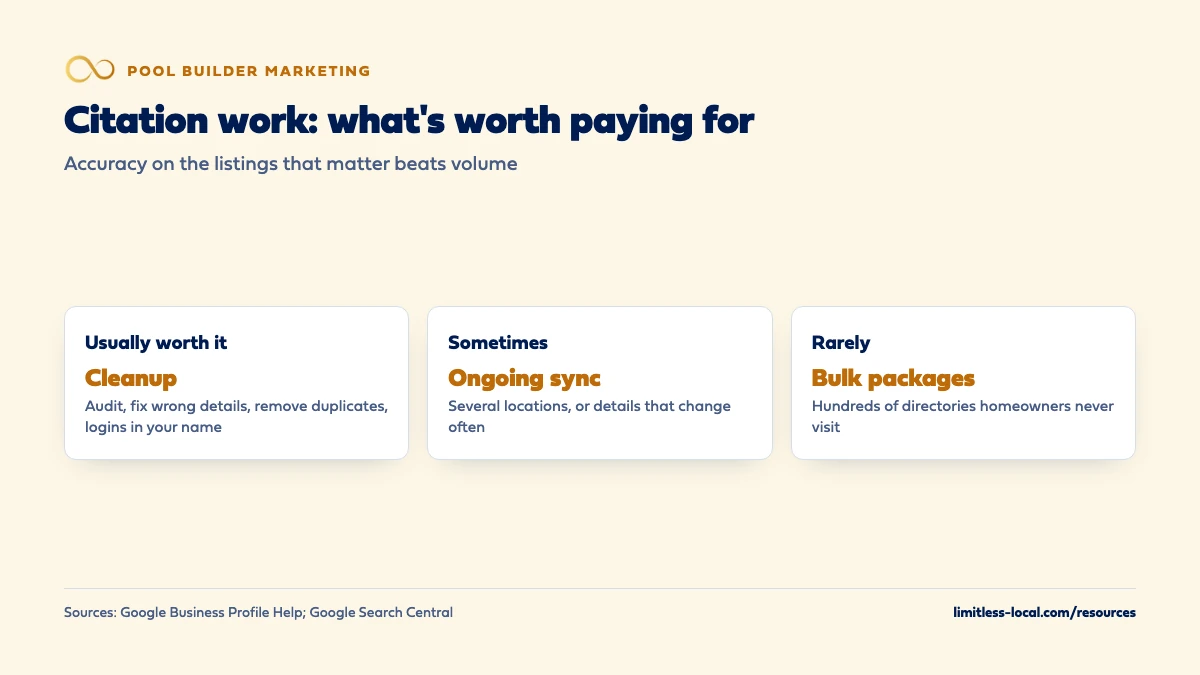
Which citation work is worth paying for?
Usually worth it: the cleanup. If your company has moved, changed phone numbers, changed its name, merged with another builder or worked with several agencies over the years, there are probably wrong listings out there. Finding and fixing them is tedious work that pays off for years.
Sometimes worth it: ongoing sync. It earns its keep when your details change often, when you run several locations, or when you’d rather not log in to a dozen sites every time your hours change. For a single-location builder whose details never change, a careful cleanup plus a yearly check may be enough.
Rarely worth it: bulk packages. More on those below.
Judge paid upgrades one by one. Pay for premium placement on a directory only if you can track the calls and consultations it sends, and keep it only if those turn into signed pools.
Curious what your marketing is actually booking?
Get a free visibility audit — no obligation, no sales pitch.
Why are bulk citation packages usually a waste?
Because they solve the wrong problem. A pool builder’s listing problem is almost never “not enough directories.” It’s wrong details on the listings that matter, duplicates, and profiles that were never claimed. Adding hundreds of new listings doesn’t fix any of that, and it can add new places where your details go stale.
Google’s advice in Do you need an SEO? is to avoid SEOs that talk about link popularity schemes or submitting your site to thousands of search engines, which it calls typically useless exercises that don’t affect your ranking in the major search engines. Bulk directory packages are built on the same volume-first idea. Spend the money on accuracy instead.
Can a pool builder build and fix citations without paying anyone?
Yes, if you have the time and patience. The core list is short:
- Google Business Profile.
- Bing Places. Its help page on managing listings says that if you’re syncing your Google business, your offered services are imported automatically, which saves typing.
- Apple Business, which feeds Apple Maps.
- Yelp, the Better Business Bureau, Facebook and Nextdoor.
- Any manufacturer locator or industry association you qualify for.
Start with those, claim each one in your company’s name, and make the details match your Google profile exactly. Which online listings a pool builder should have besides Google goes through each one.
What should a paid citation cleanup actually include?
If you pay for it, get all of this in writing:
- An audit: a list of every listing found, with what’s wrong on each.
- Fixes: name, address, phone, website, hours and categories corrected to match your Google profile.
- Duplicates: merged or removed, including listings at old addresses.
- Core profiles completed: services, photos and descriptions on the listings homeowners actually see.
- Logins: every account in your company’s name, with access handed to you.
- A final report: the same list, showing what changed.
The logins point matters more than it sounds. Listings created under a vendor’s account can be hard to edit later. If you’ve been burned on that before, restarting marketing after a bad agency covers getting accounts back.

What should I ask before paying for a citation service?
- Which sites, exactly? Ask for the list. If it’s hundreds of names you’ve never heard of, that’s a bulk package.
- Who owns the accounts? Your company should, not the vendor.
- What happens if I cancel? Ask whether the listings stay as they are, revert or disappear.
- How do you handle duplicates? A good service removes them; a careless one creates them.
- Which phone number goes on the listings? Your main business number, used the same way everywhere.
- What results do you promise? If the answer is a ranking, walk away. Nobody can honestly promise a ranking.
When does a pool builder need citation work the most?
Some moments make a cleanup well worth it:
- You moved your office or yard, and old addresses are still out there.
- You changed phone numbers, or an old agency put its own tracking numbers on your listings.
- You rebranded or merged with another company.
- You added a location and need a second set of listings that doesn’t clash with the first.
- Homeowners say they found the wrong number or drove to the wrong address.
If none of those apply and your main listings already match, a yearly check of the core list may be all you need. If you’re losing Maps visibility to a competitor and wondering whether listings are the reason, why a competitor outranks your pool company in Google Maps helps you find the real gap first.
Do citations help a pool builder show up in AI search?
They help in the same way they help everywhere else: by making the details about your company consistent wherever a tool looks. AI tools that search the web pull from websites, listings and review sites. If those sources agree on your name, address, phone, services and towns, the answer an AI tool gives about your company is more likely to be right.
Map apps keep their data fresh too. Apple’s guide to maintaining location accuracy in Apple Business says customers can report a problem from your place card, and Apple reviews those reports and may edit your listing, emailing your organization when it changes the name, status or hours. Keep an eye on those emails so a well-meant edit doesn’t leave the wrong hours up. The bigger picture is in how a pool builder shows up in AI search results.
Want to see where your company stands?
A free visibility audit shows where you show up on Google, Maps and AI answers, and what it's costing you in calls.
What's different about citations for pool builders
Industry listings beat general directories. A dealer locator for the pool brand you install, or an association directory, puts you in front of homeowners already shopping for a pool. A general directory rarely does.
Builders often work from a yard, not a storefront. If you serve homeowners at their homes and don’t take visitors, decide how your address appears and keep it the same everywhere. Mixed approaches across listings are a common source of mismatches.
Seasonal hours change. If your office hours shift between peak season and winter, update your Google profile first and make sure the change reaches every listing you control.
New builds and service may be separate. Builders that also run a service division sometimes end up with two sets of listings. Decide whether that’s one business or two, and set up the listings to match.
A worked example: cleanup versus a bulk package
These numbers are made up to show the difference, not a benchmark for pool builders. Say a pool company that moved a few years ago searches for its old address and phone number and finds 25 listings:
- 9 show the old address.
- 4 show an old phone number.
- 3 are duplicates.
That’s 16 problem listings. At about 20 minutes each to claim, correct or remove, the cleanup takes roughly 320 minutes, a bit over five hours, done once. You can do that yourself or pay someone to do it carefully.
Now say a vendor offers a package that adds 300 new directory listings. None of those 16 problem listings gets fixed. The old address and number keep circulating, and the company now has 300 more places where its details could go stale. The cleanup is the one that pays.
Frequently asked questions
What's the difference between a citation and a backlink?
A citation is a mention of your name, address and phone. A backlink is a link to your website. Many listings are both, but a citation can exist without a link, like your details on an association’s member page with no link.
How many citations does a pool builder need?
There’s no magic number. Get the core listings complete and accurate, add the industry and local ones you genuinely qualify for, and stop there.
Should I delete old listings or update them?
Update them if the platform lets you, so homeowners who find them get the right details. Remove true duplicates, and mark listings for addresses you’ve left as moved or closed where the site allows it.
Can I use a call tracking number on my listings?
Keep your main business number as the number on your listings. If you want to track calls from a listing, set it up so your main number stays the one published everywhere.
How often should I check my citations?
Once a year, plus any time you move, change numbers, change hours or rebrand.
Will fixing my citations get me into the map pack?
Not on its own. Accurate listings remove a problem, but where you show up still depends on relevance, distance and popularity, including your reviews, profile and website.
Key takeaways
- A citation is any mention of your pool company’s name, address and phone on another website.
- A one-time audit and cleanup of the listings that matter is usually worth paying for.
- Bulk packages that add hundreds of directories rarely help and can add new places for wrong details.
- Industry listings, like dealer locators and association directories, are often worth more than general directories.
- Whoever does the work, keep every listing login in your company’s name.
Not sure what's working right now?
Start with a free visibility audit: rankings, Google profile, reviews and tracking, checked against your service area.
More in this section
- Are home and garden shows worth it for pool builders?
- How can pool builders get referrals from landscapers and builders?
- Is buying leads from Angi or HomeAdvisor worth it for pool builders?
- Are Local Services Ads worth it for pool builders?
- How do pool builders stop attracting price shoppers?
Sources
- Understand how Google sources & uses info in Business Profiles & local search results — Google Business Profile Help
- Tips to improve your local ranking on Google — Google Business Profile Help
- Do you need an SEO? — Google Search Central
- Bing Places for Business: manage your listings — Bing Places for Business
- Maintain location information accuracy with Apple Business — Apple Support