
How do I grow a plumbing business past one or two trucks?
- What does it take to grow a plumbing company from one or two trucks to a small fleet?
- Why do so many plumbing companies get stuck at one or two trucks?
- What changes when I go from one truck to two?
- Where should the calls for a second or third truck come from?
- Who answers the phone once I'm not the only plumber?
- What should I know before hiring the plumber who drives truck two?
- How do I keep reviews and referrals coming when I'm not on every job?
- What should plumbing marketing look like at three to five trucks?
- Should I widen my service area to keep more trucks busy?
- How do I know when I'm ready for the next truck?
- What mistakes keep plumbing shops stuck at two trucks?
- What's different about growing a plumbing company
- A worked example: how many jobs a new truck has to book
- Frequently asked questions
- Key takeaways
- More in this section
- Sources
The short version
- Most shops stall because the owner is the plumber, the dispatcher and the marketing.
- Truck two needs calls that don't depend on who you know.
- Someone has to answer every call once you're under a sink all day.
- Add a truck when the schedule stays full, and turn on the marketing for it before day one.
For plumbing owners who are still on the tools most days and want the next truck to run without them.
Get a free visibility audit · Book a growth call
What does it take to grow a plumbing company from one or two trucks to a small fleet?
Grow past one or two trucks by moving the work that runs through you onto the business: calls from your Google profile, website and ads instead of your personal phone, a business line someone answers every time, and reviews and repeat customers tied to the company name. Add the next truck only when the current ones stay booked most weeks, and line up the marketing for it before the new plumber starts. Judge every step by cost per booked job and how full each truck is, not by how busy you feel.
That’s the order we build in, too: tracking, follow-up and a clean Google presence first, then local SEO and ads around the towns and jobs you want, then monthly changes based on calls, leads and revenue. Our packages lay out what each tier covers, and the plumbing marketing page shows how that fits a plumbing shop. The rest of the plumbing marketing questions library goes question by question.
Why do so many plumbing companies get stuck at one or two trucks?
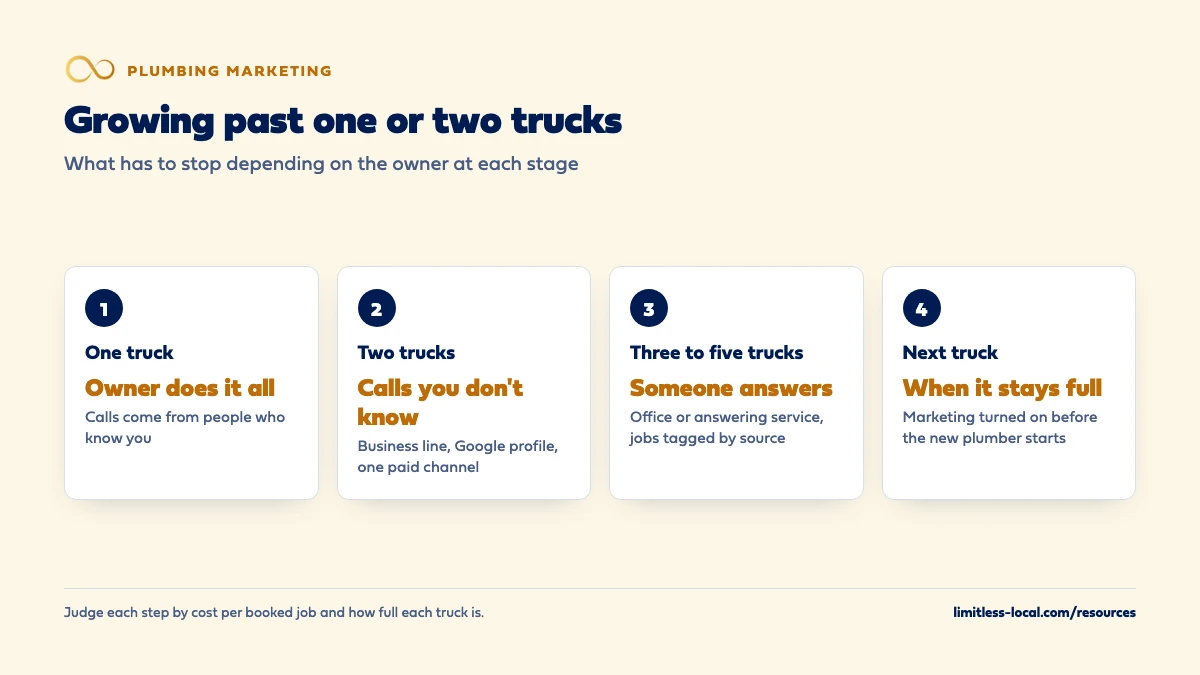
Because at one truck, the owner is the business. You run the calls, quote the jobs, answer the phone between jobs, chase the invoices and, when there’s time, post something on the Google profile. Most of the work comes from people who know you: past customers, a builder you did a favor for, a neighbor’s referral. That works fine for one truck. It doesn’t stretch to three.
The jump from one truck to a small fleet means three things have to stop depending on you personally:
- Where the calls come from. Your personal network has a ceiling. A second and third truck need calls from people who’ve never heard of you.
- Who answers the phone. If every call goes to your cell, every job you’re on is a call you might miss.
- How the work gets judged. Once someone else drives truck two, reviews, repeat work and referrals have to point to the company, not just to you.
Fix those three and the next truck has something to run on. Skip them and a new hire usually means a second plumber sitting in the shop while you scramble for work.
What changes when I go from one truck to two?
The second truck is the hardest one, because it roughly doubles the work you need to find and it’s the first truck you don’t drive. A few things change at once:
- The phone can’t be your personal cell anymore. Put a business number on the truck, the website and the Google profile, and route it somewhere that gets answered when you can’t.
- You need steady calls, not lucky weeks. One truck can live on referrals and repeat customers. Two trucks need a channel that brings new customers every week.
- You start dispatching. Someone has to decide which truck takes which call. Even a simple shared calendar in Jobber, Housecall Pro or ServiceTitan beats a list in your head.
- You find out what your work is worth. Until now, the gap between a good week and a bad week was your own time. With a second plumber on payroll, a slow week costs you real money.
If you’re unsure whether to hire first or market first, whether to market harder before or after hiring another plumber walks through the timing.
Where should the calls for a second or third truck come from?
From places people find you without knowing you first. For a plumber that usually means four things, roughly in this order:
- Your Google Business Profile. It’s free, and Google lists plumbers as a classic service-area business: one that goes to customers instead of serving them at its address. A complete profile with your services, hours, real photos and a steady flow of reviews is the base everything else sits on.
- A website with a page for each main job. Drain cleaning, water heaters, leak repair, sewer lines. Homeowners search for the problem, not for “plumber.”
- One paid channel run well. Local Services Ads or Google Ads search campaigns can bring calls within days, which matters when you’ve just added payroll. Pick one, run it tightly and learn your cost per booked job before adding the second.
- Repeat customers and referrals, on purpose. A maintenance plan, a follow-up email after big jobs and a clear ask for a referral turn one-time jobs into the next ones.
SEO and the Google profile take longer. Ads can generate leads within days of launch, but SEO typically takes 3 to 6 months to show meaningful organic growth, so start it before you need it.
Who answers the phone once I'm not the only plumber?
Somebody other than you, most of the time. This is the change owners put off longest, and it’s often the one that decides whether truck two pays off. A plumbing call is usually urgent. If it rings out while you’re crawling under a house, the homeowner calls the next plumber on the list.
The options, from smallest to biggest step:
- A spouse or part-time person answering a forwarded line during set hours.
- An answering service that books jobs into your calendar, not one that only takes messages.
- A dispatcher or office person, usually once you’re at three trucks or more.
It also matters for ads. On Local Services Ads, Google counts a missed call during your business hours as a lead when the caller stays on the line for more than 20 seconds, so an unanswered phone can cost you money as well as the job. After-hours calls need their own plan, which how to stop losing after-hours plumbing calls covers.
Curious what your marketing is actually booking?
Get a free visibility audit — no obligation, no sales pitch.
What should I know before hiring the plumber who drives truck two?
A few things affect the marketing directly:
- Licensed plumbers are hard to find. The Bureau of Labor Statistics projects about 42,000 openings a year for plumbers, pipefitters and steamfitters over the decade to 2035, and says most states and some localities require plumbers to be licensed, often after 2 to 5 years of experience and an exam. Start looking well before the schedule breaks.
- Who you hire decides what you market. An apprentice adds hands to your truck. A licensed plumber who can work alone adds a second truck to fill. Only the second one needs a new stream of calls.
- Local Services Ads screen your techs. Google treats plumbing as an urgent category, so plumbers go through an extra level of screening that includes background checks on service professionals. Under its screening rules, in categories that require it, every employee or contractor who performs services for customers needs a background check; office staff who don’t serve customers directly don’t. Add each new plumber before they start running LSA calls.
- Payroll comes with paperwork. The SBA’s hiring checklist starts with an Employer Identification Number, deciding between an employee and an independent contractor, and setting up payroll and tax withholding.
How do I keep reviews and referrals coming when I'm not on every job?
At one truck, customers review you. At three trucks, they review whoever showed up. That’s fine, as long as asking for the review is part of the job and not something you remember to do.
- Make the ask a step in the job, right after the work is done and the customer has seen it working. A text with a direct link to your Google review form is the easiest version.
- Let techs see their own reviews. Reviews that name a plumber are a good way to coach, and most plumbers like seeing their name.
- Keep the brand consistent. Same truck wrap, same uniform shirt, same business number on the invoice. A referral only works if the customer can find you again.
- Never pay for reviews or offer anything in exchange for good ones. Thank people, and make the ask easy.
For scripts and timing, how to get plumbing techs to ask for reviews goes step by step.
What should plumbing marketing look like at three to five trucks?
At this size the marketing stops being something you squeeze in and becomes a budget line you manage. A few changes usually come with it:
- Track every job back to a source. Tag each new customer in your field software with where they came from, and use tracked phone numbers so you can see which channel made the phone ring. Without it, you can’t tell which part of the budget filled the trucks.
- Budget by job type, not by channel. Emergency service calls, water heaters, drain and sewer work, repipes. Each has its own ticket size and its own ceiling for what you can pay to book one.
- Add a second paid channel. Once one channel runs at a cost per booked job you’re happy with, adding the other one spreads the risk.
- Fill the slow weeks on purpose. Memberships, planned work and past-customer emails smooth out the gaps between emergencies.
Tracking which plumbing marketing books jobs covers the setup in more detail.
Should I widen my service area to keep more trucks busy?
Only after you’re filling the towns you already serve. A wider area looks like more calls on paper, but every extra mile is drive time nobody pays for. On Local Services Ads it can cost you twice: Google no longer credits leads from areas you don’t serve, so a service area drawn too wide means paying for calls your trucks won’t drive to.
A better order: get the towns closest to the shop working first, then add the next ring where your trucks already pass through, one or two towns at a time. Watch your cost per booked job and your drive time in each new town before adding more. Which towns a plumber should target first walks through how to pick them.
How do I know when I'm ready for the next truck?
Look for the same signs for a few weeks in a row, not one busy stretch:
- New customers are waiting days for a non-emergency appointment.
- Emergency calls are going to voicemail or getting turned away because every truck is out.
- Your plumbers are booked most of the day, most days, without you filling gaps with odd jobs.
- You know your cost per booked job for at least one channel, and it leaves room in the margin.
If the trucks have open slots most days, the next truck isn’t the problem. More calls are, or a better booking rate on the calls you already get.
What mistakes keep plumbing shops stuck at two trucks?
- Hiring before there’s work for the new truck. A second plumber with half-empty days eats the margin you were trying to grow.
- Turning on ads before anyone can answer the phone. Paid calls that ring out are the most expensive calls you’ll ever get.
- Spreading a small budget across every channel at once. One channel run well beats four run badly.
- Judging marketing by calls instead of booked jobs. A busy phone full of price shoppers and out-of-area callers doesn’t fill a truck.
- Letting accounts sit in someone else’s name. Your domain, Google profile and ad accounts should belong to the business before you scale the spend on them.
Not sure which of these is costing you jobs?
A free visibility audit checks the Google profile, reviews, site and tracking, and shows what to fix first.
What's different about growing a plumbing company
Emergencies set the pace. A burst pipe or a backed-up sewer line doesn’t wait for a free slot. The more trucks you run, the more it pays to keep one plumber’s day loose enough to take an urgent call, because those homeowners book whoever answers and shows up first.
After-hours work is a growth decision. Night and weekend calls can fill a lot of a second truck’s week, but only if someone is on call and the phone gets answered. Decide whether you’re offering it before you list round-the-clock hours on your Google profile.
Big tickets change the math. Water heaters, repipes and sewer lines can be worth many service calls each. A shop that grows by marketing those jobs on purpose needs fewer total calls to keep the trucks busy than one living on small fixes.
A worked example: how many jobs a new truck has to book
These numbers are made up to show the math, not a benchmark for your market. Say adding a second truck, with a licensed plumber’s pay, the truck payment, fuel and insurance, costs $9,000 a month. Your average job leaves $350 of gross profit after parts, and your marketing costs $100 per booked job. Each job then leaves $250 toward the new truck.
To cover $9,000, the truck needs 36 booked jobs a month, or about 1.7 a day across 21 working days. Anything past that is profit. If the shop can’t find those extra jobs today, the next step is more calls before the next hire, not after.
Lower the cost per booked job, or add a few more water heaters to the mix, and that number drops quickly. Our Essentials package is $3,500 a month for one location; Growth, at $4,500 a month, adds Local Services Ads management and SEO for up to 2 locations. Ad spend is paid to Google separately in both.
Frequently asked questions
Should my second hire be a plumber or someone to answer the phone?
If you’re missing calls today, someone to answer the phone often pays for itself first, because every answered call is a chance at a job you already paid to get. If the phone is covered and the schedule is full, hire the plumber.
Can I grow a plumbing business on referrals alone?
One truck often can. Past two or three trucks, referrals rarely come steadily enough to keep everyone busy every week, so most shops add a Google profile, a website and at least one paid channel.
Do I need a dispatcher at three trucks?
Not always a full-time one, but someone has to own the schedule. Many shops start with a part-time office person or an answering service that books into the calendar, then hire a dispatcher once the calls keep that person busy all day.
Does a new plumber need to be added to my Local Services Ads?
Yes. Google says plumbers go through service professional background checks for Local Services Ads, and every worker who performs services for customers needs one. Check your Local Services dashboard for your exact requirements and get each new plumber through it before they run calls from those ads.
How much should I spend on marketing to fill a new truck?
Work it backward: the jobs the truck needs each month times the most you can pay to book one. The worked example above shows the math with made-up numbers.
Key takeaways
- Plumbing shops stall at one or two trucks when calls, phones and reviews all run through the owner.
- Truck two needs calls from people who don’t know you yet: a Google profile, a service-page website and one paid channel.
- Someone has to answer every call, because urgent plumbing customers call the next plumber.
- Hire when the trucks stay full for weeks, and start the marketing before the new plumber’s first day.
- Track every job to a source so you know your cost per booked job before adding the next truck.
Want a second set of eyes on your setup?
We'll look at how you show up locally and where calls are leaking, then send you a plain-English breakdown.
More in this section
- How do I scale a plumbing business with marketing?
- How do I get more plumbing leads?
- How do I market a second plumbing location?
- How should a new plumbing company get its first customers?
- How many towns should my plumbing company target?
Sources
- Plumbers, Pipefitters, and Steamfitters: Occupational Outlook Handbook — U.S. Bureau of Labor Statistics
- Business screening and verification requirements – United States — Google Local Services Help
- Understand the screening and verification process — Google Local Services Help
- How leads work — Google Local Services Help
- About Automated Local Services Ads lead credits — Google Local Services Help
- Business Profile for service businesses overview — Google Business Profile Help
- Hire and manage employees — U.S. Small Business Administration