
Do I need one marketer or several specialists for my roofing company?
- Should a roofing company hire one generalist marketer or a team of specialists?
- What jobs does roofing marketing actually involve?
- What can one good generalist handle for a roofer?
- Which roofing marketing jobs need a specialist?
- What goes wrong when several specialists work with nobody in charge?
- Who should own the results if I use more than one person?
- How does the size of my roofing company change the answer?
- Is one full-time marketer cheaper than several specialists?
- How do I give several people access without losing control?
- How do I keep several people pulling in the same direction?
- Where does an agency fit into this choice?
- Which setup does my roofing company need right now?
- What's different about this choice for a roofing company
- A worked example: three specialists and one missing number
- Frequently asked questions
- Key takeaways
- More in this section
- Sources
The short version
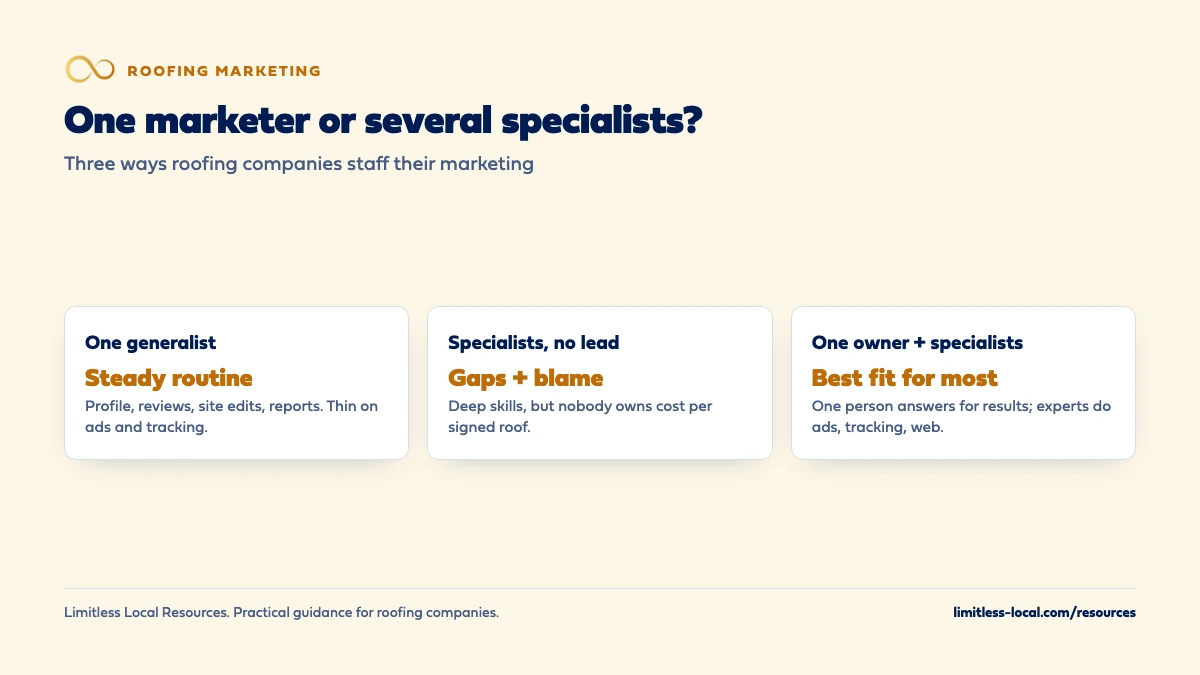
- One generalist covers the profile, reviews, simple website edits and reporting.
- Google Ads, tracking and web development are where specialists earn their fee.
- Specialists with nobody in charge leave gaps; one person has to own the result.
- Keep every login in your company's name, with at least two admins.
For roofing owners deciding whether one person can carry all the marketing, or whether ads, tracking and the website need their own experts.
Get a free visibility audit · Book a growth call
Should a roofing company hire one generalist marketer or a team of specialists?
Most roofing companies need one person who owns the marketing results, backed by a few specialists, rather than a straight choice between the two. One good generalist can run your Google Business Profile, reviews, website updates and basic reporting, but Google Ads, call tracking and web development reward specialist skill, and mistakes there cost money quietly. Several freelancers with nobody in charge usually ends in gaps and finger-pointing, so whatever mix you pick, make one person answerable for what each signed roof cost.
That’s how our own work is set up: a team of specialists handles the Google profile, website, ads and tracking, and you get one plan and one report built around booked jobs, not a different story from each person. See how it fits a roofing company on our roofing marketing page, or compare what each tier covers on the packages page. For every channel in more depth, the roofing marketing guide lays them out, and the roofing marketing questions library takes the follow-ups one at a time.
What jobs does roofing marketing actually involve?
Before you decide how many people you need, list the work. For a roofing company it usually breaks into seven jobs:
- Google Business Profile and reviews: keeping the profile accurate, adding photos of real roofs, asking every customer for a review and replying to them.
- Website and SEO: service pages for replacement, repair and storm work, pages for your core towns, and content that answers what homeowners ask.
- Google Ads and Local Services Ads: budgets, searches, locations, ad copy and the weekly cleanup.
- Tracking: knowing which calls and forms came from which source, and which of those became signed roofs.
- Follow-up: how fast leads get a call back and how open estimates get chased.
- Photos and creative: crew and job-site photos, ad images, yard signs and truck graphics.
- Reporting: one monthly view of spend, leads, inspections and signed jobs.
Some of these are steady, low-skill habits. Others are technical and expensive to get wrong. That split is what decides the answer.
What can one good generalist handle for a roofer?
More than most owners expect. A capable generalist can keep your Google profile current, post job photos, run the review ask after every job, reply to reviews, update the website when you add a service, write a monthly email to past customers and pull a simple report together.
What a generalist is really good at is consistency. Most of the profile and review work isn’t hard; it just has to happen every week, including in storm season when everyone’s busy. If your marketing is mostly your Google profile, word of mouth and a small website, one person may be all you need. That person could be you, someone in your office with a few protected hours, or a part-time hire.
Where generalists struggle is depth. Ask one person to also run a Google Ads account, fix call tracking and rebuild a slow website, and something gets done badly or not at all.
Which roofing marketing jobs need a specialist?
Three jobs reward specialist skill, because errors there don’t show up as obvious failures. They show up as money that quietly goes nowhere.
- Google Ads. Someone has to read the search terms report, which shows the actual searches that triggered your ads, and block the ones that will never become a roof: job hunters, do-it-yourselfers, towns you don’t serve. Which negative keywords a roofer should add shows how much of this there is.
- Tracking. Call tracking numbers, form tracking and getting signed jobs back into your ad account take setup skill. If tracking breaks, every other decision is made blind.
- Web development. Page speed, phone layout, forms that actually deliver and site structure are developer work, not copywriting.
Local Services Ads, SEO strategy and ad creative can go either way. A strong generalist can learn them; a specialist will usually get there faster.
What goes wrong when several specialists work with nobody in charge?
Hiring an ads freelancer, an SEO freelancer and a web developer separately looks like the best of everything. In practice, a few things tend to go wrong:
- Nobody owns the number that matters. The ads person reports cost per lead, the SEO person reports rankings, the web person reports a finished site. Nobody reports what each signed roof cost.
- Changes collide. The developer swaps the contact form and breaks the tracking. The SEO person rewrites a page the ads were sending traffic to.
- Gaps fall between contracts. Review requests, follow-up on open estimates and the Google profile often belong to nobody.
- You become the project manager. Every decision routes back to you, usually on a roof, usually by text.
None of this means specialists are a mistake. It means they need someone in charge.
Who should own the results if I use more than one person?
One person, by name, answerable for leads, inspections and signed jobs by source. That role is what a marketing manager does in a bigger company: the U.S. Bureau of Labor Statistics describes advertising, promotions and marketing managers as working with art directors, advertising sales agents, financial staff and others, and says advertising managers often serve as liaisons between the client and the agency that develops and places the ads.
At a roofing company, that person can be you, an office or operations manager with real time set aside, an in-house marketer or the lead on an agency team. What matters is that they:
- Set the targets: which jobs, which towns, what each signed roof can cost.
- Approve changes to the budget, the website and tracking before they go live.
- Run one monthly review with every specialist looking at the same numbers.
- Decide when something isn’t working, and say so.
Curious what your marketing is actually booking?
Get a free visibility audit — no obligation, no sales pitch.
How does the size of my roofing company change the answer?
The right mix moves as you grow:
- Just starting or one crew: one person, often you. Focus on the Google profile, reviews and a simple site. If you add ads, hire a specialist to set them up properly rather than learning on live spend.
- A few crews and steady ad spend: a generalist who owns the routine work, plus specialist help for Google Ads and tracking. This is where most growing roofers land.
- Several crews, more towns or a second location: a team. Someone owns results full time, with specialists for ads, the website and tracking.
Budget matters too. The more you spend on ads each month, the more a specialist’s skill is worth, because the same mistake costs more at a bigger budget.
Is one full-time marketer cheaper than several specialists?
Sometimes, but compare the full cost. One full-time hire means salary, payroll costs, benefits, software and the time it takes to train them on roofing. For a sense of scale, the median annual wage for marketing managers was $166,790 in May 2025, across all industries nationally. That’s a manager’s pay, not a figure for a roofing coordinator, but it shows why companies rarely hire a senior marketer just to run a profile and an ad account.
Specialists are usually paid by the project or the month, and you only pay for the skills you need. The catch is the coordination cost from the section above. When a roofing company is ready for a full-time marketing hire goes through the signs, and what an agency, an employee or doing it yourself really costs puts the three side by side.
How do I give several people access without losing control?
Every person gets their own login, at the lowest level that lets them do the job, on accounts your company owns.
- Google Business Profile: Google lets you add owners and managers. Managers can edit info, respond to reviews and manage posts, but can’t add or remove users or remove the profile. Keep yourself as primary owner, and give outside help manager access.
- Google Ads: Google’s access levels run from email-only and billing through read-only, standard and admin. Standard access can edit campaigns; only admins can give access, change access levels or unlink manager accounts. Google also notes that if your account has only one administrator, you may lose access to your tags if that user becomes unavailable, and recommends adding at least one additional administrator.
- Website, tracking and domain: the logins and billing in your company’s name, with your specialists added as users.
When someone leaves, you remove one user. You don’t rebuild your marketing. How much control a roofer should keep over marketing goes deeper.
How do I keep several people pulling in the same direction?
- One goal. Signed roofs in the towns and job types you want, at a cost per job you can live with. Everyone’s work is judged against that.
- One source of truth. Leads and signed jobs come from your tracking and your job software, not from each specialist’s own report.
- One monthly meeting. Everyone looks at the same numbers together, so the ads person hears that the leads didn’t close and the web person hears that calls dropped after the new form.
- One change log. A shared note of what changed and when: budgets, pages, forms, phone numbers. When results move, you can see why.
- One person approves spend. Nobody raises a budget or signs up for a new tool on their own.
Where does an agency fit into this choice?
An agency is the specialist team with someone in charge already built in. You get people who focus on ads, the website, local SEO and tracking, and one person who answers for the plan. The risk is the same as with freelancers if nobody on the agency side owns your results, so ask who that person is before you sign.
An agency fits best when you want specialist depth without managing three contracts, and when your spend is big enough that the skill pays for itself. It fits worse if your marketing is still mostly a Google profile and reviews, where one dependable person in your office may do just as well. Whether to hire a roofing-specialist agency or run it yourself weighs that call, and how to choose a roofing marketing agency covers what to ask.
Which setup does my roofing company need right now?
Run through these five questions:
- Do you run Google Ads or Local Services Ads with real money behind them? If yes, get specialist help for the ads.
- Can you say which source each of last month’s signed roofs came from? If not, tracking needs a specialist before anything else.
- Is your website slow, broken on phones or missing service pages? That’s a developer job.
- Does someone ask every customer for a review and update the profile every week? If not, you need a dependable generalist, not more specialists.
- Is there one person who could explain your cost per signed roof today? If not, decide who that is first.
Most roofers find they need one owner of results, one dependable person for the routine work (sometimes the same person) and specialist help for whichever of ads, tracking or the website they rely on most.
Want to see where your company stands?
A free visibility audit shows where you show up on Google, Maps and AI answers, and what it's costing you in calls.
What's different about this choice for a roofing company
Storms change everything at once. When hail hits, ad budgets, the Google profile, the website and the phones all need attention in the same week. A single owner of results can make those calls quickly; four separate specialists waiting on each other can’t.
Every lost lead is expensive. A replacement is a high-ticket job, so a broken form or a slow callback costs far more than it would for a small service call. That raises the value of tracking and follow-up skills.
The sale takes longer. A roof goes from call to inspection to estimate to signature, sometimes with an insurance adjuster in between. Whoever owns results has to follow leads all the way to signed contracts, not stop at the lead count.
The slow season is the build season. Winter is when a generalist can catch up on photos, pages and reviews, and when specialists can fix tracking and the site before spring.
A worked example: three specialists and one missing number
These numbers are made up to show the math, not a benchmark for your market. A roofer hires an ads freelancer, an SEO freelancer and a web developer. Ad spend is $3,000 a month and the three fees add up to $2,400 a month.
The ads freelancer reports 60 leads at $50 each. The SEO freelancer reports better rankings. The developer reports a faster site. Everyone looks busy. Nobody reports that only 6 of those leads became signed roofs, so the real cost per signed roof is $5,400 divided by 6, or $900.
Once one person owns that number, the next questions are obvious: which searches produced the 6, why the other leads didn’t sign, and whether the callbacks were fast enough. The specialists didn’t change; someone finally put their work against the same goal.
For comparison, our Essentials package is $3,500 a month and covers Google Business Profile management, Google Ads management up to $2,500 a month in spend, the website content, link building, review generation and call, web and form tracking, with ad spend paid to Google separately. Whether that beats a set of freelancers comes down to the same cost-per-signed-roof math.
Frequently asked questions
Can my office manager be the one person who owns marketing?
Yes, if they get real hours set aside and the authority to make calls. Owning results means looking at leads and signed jobs every month and telling specialists what to change, which doesn’t work squeezed between scheduling and invoicing.
Is a freelancer the same as a specialist?
Not always. Some freelancers are deep in one skill, like Google Ads; others are generalists who take on everything. Ask what they spend most of their week on and what they’d hand off.
Should my marketer only work with roofing companies?
It helps when they know storm seasons, inspections and insurance-driven work, but skill in the channel matters more than the logo list. A strong ads specialist can learn roofing faster than a roofer can learn ads.
What should I do if my specialists blame each other?
Put everyone in the same monthly meeting, looking at the same tracking and signed-job numbers. Most disputes end once the numbers come from one place instead of each person’s own report.
Do I need a separate person for social media?
Usually not at first. Posting job photos and reviews is routine work a generalist can handle alongside the Google profile. Add specialist help only if paid social becomes a real part of your budget.
What happens to my accounts if I let a specialist go?
Nothing, if the accounts were in your company’s name from the start. Remove their user access, change any shared passwords, and the profile, ad account, website and tracking stay with you.
Key takeaways
- Most roofers need one owner of results, backed by specialist help where mistakes are costly.
- A generalist covers the steady work: profile, reviews, site edits and reports.
- Google Ads, tracking and web development are the jobs where specialists earn their fee.
- Specialists with nobody in charge leave gaps and report numbers that don’t add up to signed roofs.
- Keep every account in your company’s name, give each person their own login, and keep two admins.
Not sure what's working right now?
Start with a free visibility audit: rankings, Google profile, reviews and tracking, checked against your service area.
More in this section
- Hire a roofing-specialist agency or run marketing myself?
- Which roofing marketing tasks should I do myself or hand off?
- What marketing should a roofing company add first to grow?
- When is a roofing company ready for a full-time marketing hire?
- How should a roofing company choose a marketing agency?
Sources
- Advertising, Promotions, and Marketing Managers: Occupational Outlook Handbook — U.S. Bureau of Labor Statistics
- About access levels in your Google Ads account — Google Ads Help
- Manage access to your Google Ads account — Google Ads Help
- Manage your Business Profile owners & managers — Google Business Profile Help
- About the search terms report — Google Ads Help