
Agency vs own lead quality: what should a pool builder expect?

- How do I compare agency leads with the leads my pool company generates itself?
- What counts as an agency lead versus a lead I generate myself?
- Why do agency leads often look worse than referrals?
- Is it fair to compare a referral lead to an ad lead?
- How do I define a qualified lead the same way for every source?
- How do I compare close rates by source?
- What does a signed contract really cost from each source?
- How long should I wait before judging agency lead quality?
- How do I keep agency leads and my own leads from getting mixed up?
- What can I do if the agency's leads really are low quality?
- Should agency leads and referral leads get the same follow-up?
- What's different about lead quality for pool builders
- A worked example: comparing one season, source by source
- Frequently asked questions
- Key takeaways
- More in this section
- Sources
The short version
- Agency-driven leads usually arrive earlier in the buying process than referrals.
- Fewer signed contracts per lead is normal; judge cost per signed contract.
- Use one written definition of a qualified lead for every source.
- Compare over a full season, because pool contracts sign slowly.
For pool builders comparing the leads an agency brings in with their own referrals, repeat customers and home show leads, and wondering whether the agency’s are any good.
Get a free visibility audit · Book a growth call
How do I compare agency leads with the leads my pool company generates itself?
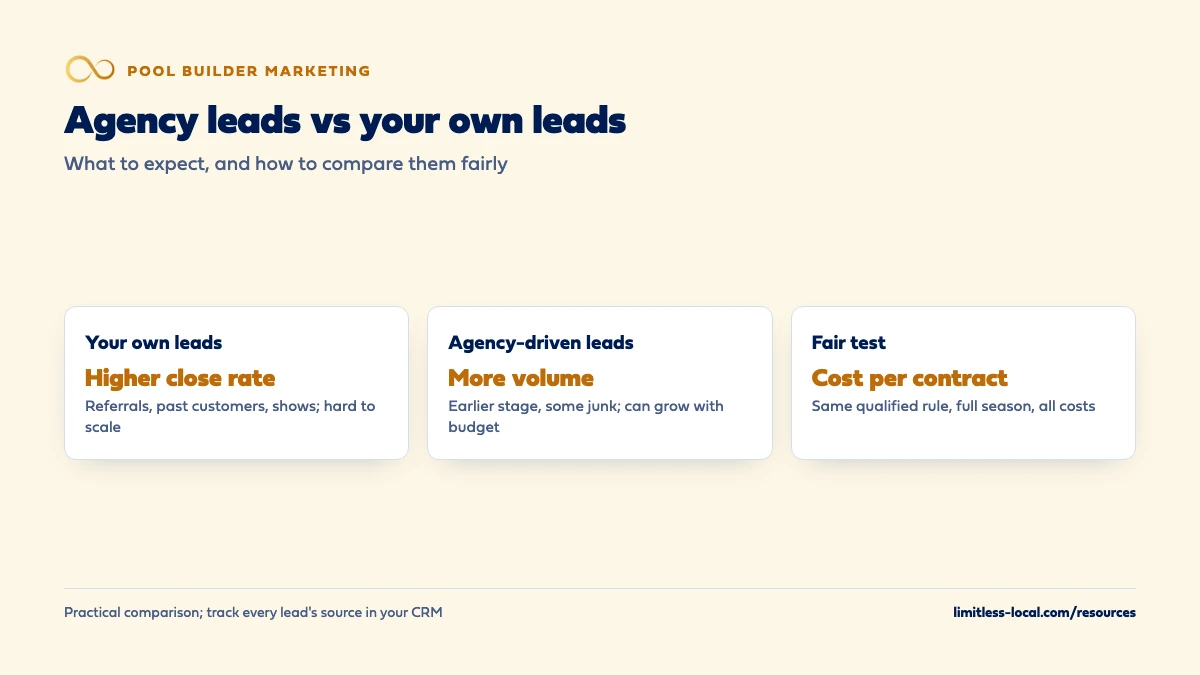
Expect leads from the channels an agency runs, such as Google Ads, SEO and Maps, to include more early-stage homeowners and price shoppers than your own referrals and past customers, so fewer of them will sign per lead. That’s normal, and it isn’t the right test. Compare sources with the same definition of a qualified lead, over a full season, on what each signed contract cost, including the fee, the ad spend and your own costs for the leads you generate yourself.
That comparison is the one we’d want you to make about us. Every package includes reporting and attribution: monthly reports with a cost-per-lead breakdown, call tracking with recording and transcription, form and chat lead tracking, source tagging and a real-time dashboard, so you can set our leads next to your referrals and see what each signed contract cost. If something isn’t working, we’ll tell you and fix it. The packages page lists what each tier includes, our pool builder marketing page shows how we work with pool companies, and the pool builder marketing questions library goes question by question.
What counts as an agency lead versus a lead I generate myself?
Draw the line by who runs the channel:
- Agency-driven leads come from channels the agency runs for you: Google Ads, Meta ads, your website’s search rankings, your Google Maps listing if they manage it, and landing pages they built.
- Leads you generate yourself come from your own relationships and effort: referrals from past customers, realtors and landscapers, repeat customers, home shows, yard signs, word of mouth and people who already knew your name.
Write the list down before you compare anything, and agree on it with the agency. Half the arguments about lead quality start because nobody decided whether a homeowner who heard about you from a neighbor and then clicked an ad counts as the agency’s lead or yours.
Why do agency leads often look worse than referrals?
Because they arrive at a different point in the purchase. A referred homeowner has already seen a friend’s pool, heard what building with you was like and decided you’re probably the one. They’re half-sold before they call.
A homeowner who finds you through a search is often earlier. Some are just starting to price out a pool, some are collecting three or four bids, and some are checking whether a pool is even possible in their yard. Paid and search channels also bring in a share of junk: wrong-service calls, spam and people outside your area.
So agency leads will usually sign at a lower rate per lead than referrals. That’s not proof the agency is bad. It’s what search and ads look like for a high-ticket, slow purchase. The question is whether enough of them sign, at a cost your margin can carry.
Is it fair to compare a referral lead to an ad lead?
Not lead for lead. Referrals are your best leads, and they’ll almost always win on close rate. The trouble is you can’t buy more of them on demand. Most builders’ referral flow depends on how many pools they built last year, and it doesn’t grow just because you need more contracts this spring.
The fair comparison is at the contract level:
- How many signed contracts did each source produce this season?
- What did each of those contracts cost?
- Could you have gotten those same contracts any other way?
A channel with a lower close rate can still be worth every dollar if it adds contracts your referrals never would have.
How do I define a qualified lead the same way for every source?
Write one rule and apply it to every lead, whatever the source. For a pool builder, a qualified lead usually means the homeowner:
- Lives in your service area and owns the home.
- Wants a type of pool or project you actually build.
- Has a budget, or a financing plan, in a realistic range for that project.
- Wants to build within a timeline you can work with.
Mark every lead against that rule, including referrals and home show leads. If you only grade the agency’s leads, you’ll find their junk and miss your own. What tracking shows cost per qualified lead covers where to record it, and qualifying leads before a design consultation covers the questions to ask.
Curious what your marketing is actually booking?
Get a free visibility audit — no obligation, no sales pitch.
How do I compare close rates by source?
Break it into two steps for each source: leads to design consultations held, and consultations to signed contracts. A weak first step points to lead quality or follow-up; a weak second step points to the sales conversation, pricing or fit.
Your CRM can do most of the work if every lead has a source. Housecall Pro’s conversion rate reporting includes lead conversion by lead source, and Jobber’s lead source report tracks the number of leads and the revenue tied to them, so you can see which marketing channels bring in the most valuable leads.
Don’t judge close rates on small numbers. A handful of leads from a home show can swing wildly. What close rate is good for pool construction leads explains how to read your own.
What does a signed contract really cost from each source?
Add up everything, on both sides.
- Agency-driven: the agency fee plus the ad spend, which is paid to Google or Meta directly.
- Your own: home show booth fees and travel, printing, thank-you gifts for referrers, the cost of any lead platform you pay for, and your own or your staff’s time spent working those channels.
Then divide each total by the signed contracts that source produced in the same period. Referrals often come out cheaper per contract, but they’re rarely free, and a home show that produced a single contract can turn out to be one of your most expensive sources.
Compare the result with your gross profit on an average pool, not with each other alone. A source that costs more per contract is still a good deal if it adds contracts at a cost your margin can carry.
How long should I wait before judging agency lead quality?
Longer than a month, because pool contracts sign slowly. A homeowner who calls in March may hold a consultation in April and sign in June, or plan for next year. Judge contracts over a full season.
Watch the ad platform’s settings, too. Google’s page on conversion windows explains that conversions are recorded within a set period after an ad interaction, that the default is 30 days, and that for Search and Display campaigns you can set it anywhere from 1 day up to 30, 60 or 90 days, depending on the conversion source. A signed contract that comes in after the window closes won’t show in the ad reports, which can make the agency’s channels look worse than they are.
In the early months, look at what you can see: how many leads met your qualified rule and how many booked a consultation. How to know if your pool marketing agency is working covers the full check.
How do I keep agency leads and my own leads from getting mixed up?
Record two things for every lead: what your tracking shows, such as a tracked phone number or form, and what the homeowner says when you ask how they heard about you. They often differ, and both are useful.
The common mix-up is a referred homeowner who searches your company’s name and clicks your ad or your Google listing to call. The tracking credits the ad; the homeowner credits their neighbor. Pick a rule and stick to it, for example: if the homeowner names a person who sent them, it’s a referral. How branded search works for pool builders explains why searches for your own name need their own line in the report.
What can I do if the agency's leads really are low quality?
Give the agency specific feedback and expect changes. Lead quality from ads and search is adjustable:
- Tell them which leads were junk and why: wrong service, outside the area, budget far off, spam.
- Tighten targeting: negative keywords, a service area that matches where your crews go, and ads that name the type of pool you build.
- Ask better questions on forms: town, project type and timeline filter out a lot of poor fits.
- Send signed contracts back to Google Ads. Google’s page on offline conversion imports says importing them lets you measure what happens after an ad results in a click or call, and it recommends that advertisers starting out use enhanced conversions for leads, which uses customer data such as email addresses to improve accuracy and bidding performance. That points your ads toward the kind of homeowners who actually signed.
If the numbers still don’t work after a season of that, you have your answer.
Should agency leads and referral leads get the same follow-up?
The same speed, a different conversation. Every lead deserves a fast reply, wherever it came from. But a referral is ready to talk design, while a homeowner who found you through a search may need to hear why you, how your process works and what a pool really involves before they’re ready to book a consultation.
Many agency-driven leads are planning for later. Treat “not this year” as a lead to nurture, not a dead one. Following up on leads through a long sales cycle covers how to stay in touch without pestering.
Not sure which of these is costing you jobs?
A free visibility audit checks the Google profile, reviews, site and tracking, and shows what to fix first.
What's different about lead quality for pool builders
Every lead is a big decision. A pool is one of the largest purchases a homeowner makes, so even good leads take time, and early-stage curiosity is a bigger share of search traffic than in repair trades.
A booked job is a signed contract. A call or a consultation isn’t the finish line, so lead quality has to be judged at the contract, not at the phone.
Financing shapes qualification. Many homeowners need financing, so budget questions are often about monthly payments and approval, not a lump sum.
Referrals depend on last year. Your referral flow tracks how many pools you built before, which is exactly why it can’t carry a growth year on its own.
A worked example: comparing one season, source by source
These numbers are made up to show the math, not a benchmark for pool builders. Say a builder tracks a six-month season.
Agency-driven channels: 100 leads, 25 consultations, 6 signed contracts. The agency is on our Essentials package at $3,500 a month, which covers Google Ads management up to $2,500 a month in spend, and the builder spends $2,000 a month on ads, paid to Google directly. That’s $21,000 in fees plus $12,000 in ad spend, $33,000 in total, or $5,500 per signed contract.
The builder’s own channels: 20 leads from referrals and a home show, 12 consultations, 5 signed contracts. The home show booth cost $4,000 and thank-you gifts $500, so $4,500 in total, or $900 per signed contract.
Per contract, the builder’s own leads win easily. But the referrals and the show topped out at 5 contracts, and the agency’s channels added 6 more. If gross profit on an average pool is $20,000, each of those 6 contracts cost $5,500 to win and brought in far more than that. Both sources are worth keeping.
Frequently asked questions
Should an agency's leads close as well as my referrals?
Usually not, and that’s fine. Referrals arrive half-sold. Judge agency-driven leads on cost per signed contract and on whether they add contracts your referrals wouldn’t.
Who decides whether a lead counts as qualified?
You do, with a written rule the agency agrees to. Your sales team marks each lead, because only they know what the homeowner said.
Can I make the agency pay for junk leads?
Agency fees pay for the work, not for individual leads, and ad spend goes to the platform. Your lever is feedback: show which leads were junk and why, and expect targeting changes.
Is a pay-per-lead service better than an agency for lead quality?
It depends on the service and your market. Compare it the same way: one qualified rule, one season, cost per signed contract.
What if most of my contracts come from referrals?
Then referrals are your base, and paid and search channels are how you grow past what last year’s customers can send. Track both so you know what each adds.
How many leads do I need before comparing close rates?
Enough that one deal doesn’t swing the result. For most builders, that means a full season of leads per source, not a few weeks.
Key takeaways
- Agency-driven leads usually arrive earlier and sign at a lower rate per lead than referrals; that’s normal.
- Use one written definition of a qualified lead and apply it to every source, including your own.
- Compare sources on cost per signed contract, counting the fee, ad spend and your own channel costs.
- Judge over a full season, and set ad conversion windows long enough for slow pool contracts.
- Low-quality agency leads can be fixed with specific feedback, tighter targeting and signed contracts sent back to Google Ads.
Want a second set of eyes on your setup?
We'll look at how you show up locally and where calls are leaking, then send you a plain-English breakdown.
More in this section
- How do pool builders qualify leads before the design consultation?
- How fast should a pool builder respond to a new lead?
- How do pool builders keep leads coming in the off-season?
- How should pool builders nurture leads who plan to build next year?
- How many leads are needed for a pool builder to hit its revenue goal?
Sources
- Conversion Rate Reporting — Housecall Pro Help Center
- Lead Source Report — Jobber Help Center
- About conversion windows — Google Ads Help
- About offline conversion imports — Google Ads Help