
Which marketing channels work best for custom pools vs simpler builds?
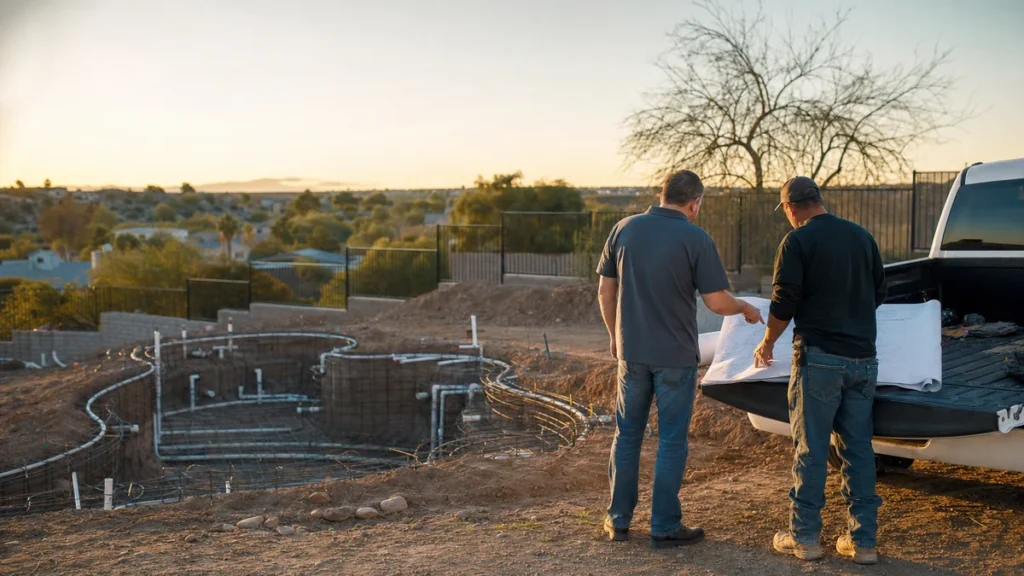
- How should a pool builder market high-end custom pools differently from standard builds?
- What's the difference between marketing a custom pool and a simpler build?
- Which marketing channels work best for high-end custom pools?
- Which marketing channels work best for simpler pool builds?
- Should a pool builder run separate Google Ads for each kind of build?
- Do Google Maps and SEO work for both custom and simpler builds?
- Do social media ads work better for custom pools or simpler builds?
- Where do Houzz and other directories fit?
- Should I show prices for simpler builds but not for custom pools?
- How do I keep simpler-build leads from swamping my custom pipeline?
- How do I measure which channels work for each kind of build?
- What's different about this split for pool builders
- A worked example: same channel, two different answers
- Frequently asked questions
- Key takeaways
- More in this section
- Sources
The short version
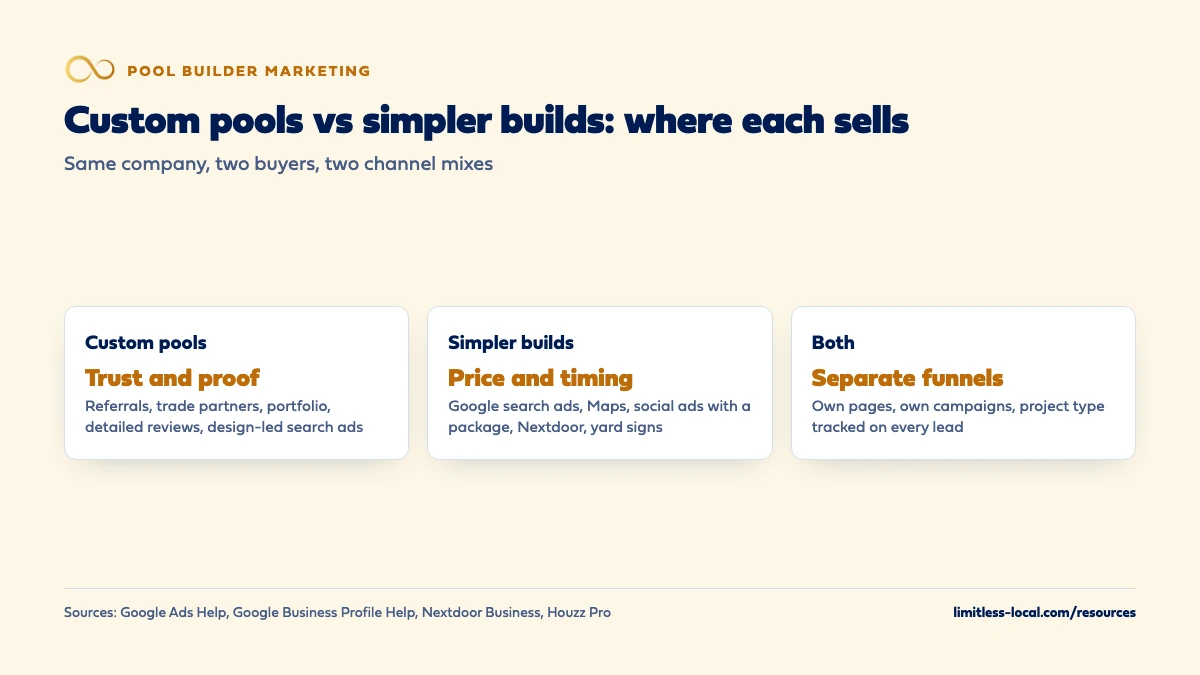
- Custom pools: referrals, designers and landscape partners, your portfolio, detailed reviews and tightly targeted search ads.
- Simpler builds: Google search ads, Google Maps, social ads with a clear package or starting point, and local channels like Nextdoor.
- Most channels work for both; what changes is the message, the targeting and the page people land on.
- Track project type on every lead so you can judge cost per signed contract for each kind of build.
For pool builders who sell both big custom backyards and simpler, more standard pools, and want each kind of job to come from the channels that suit it.
Get a free visibility audit · Book a growth call
How should a pool builder market high-end custom pools differently from standard builds?
Custom pools sell on trust and proof, so they come mostly from referrals, trade partners, a strong portfolio on your own website, detailed reviews and search ads aimed at design-minded searches. Simpler builds, like standard fiberglass or package pools, sell on price, timing and convenience, so Google Ads, your Google Business Profile in Maps, and Facebook, Instagram and Nextdoor work harder for them. If you sell both, run them as two separate funnels with their own pages, ads and tracking, so the cheaper jobs don’t bury the custom pipeline.
Splitting one company’s marketing into two funnels is exactly the kind of setup we build: separate service pages, separate campaigns and tracking that tells you which kind of pool each lead wants. Our local SEO work covers the pages, Maps and reviews, and the pool builder marketing page shows how it all fits a pool company. More questions like this one are in the pool builder marketing questions library.
What's the difference between marketing a custom pool and a simpler build?
It’s two different buyers making two different decisions.
The custom pool buyer is planning a backyard. They’re comparing designers as much as builders, they want to see work like what they’re imagining, and they’ll spend weeks or months deciding. Price matters, but trust matters more: will this company get the design right, keep the schedule and leave the yard the way they promised?
The simpler build buyer usually wants a good pool at a sensible price, installed before summer. They’re comparing a short list of companies on price, timing and how easy you are to deal with. They decide faster and they’re more likely to call two or three builders the same afternoon.
That’s why one channel mix rarely serves both. The marketing that wins a custom client (long project stories, design consultations, a portfolio) can feel slow and expensive to the simpler buyer. The marketing that wins a simpler build (packages, starting points, quick quotes) can make a custom builder look like a commodity.
Which marketing channels work best for high-end custom pools?
- Referrals from past clients. A custom client usually knows someone who built with you, or saw your pool at a neighbor’s party.
- Trade partners. Landscape architects, outdoor living designers, home builders and remodelers meet these homeowners before you do. Our page on getting referrals from landscapers and builders covers how to set that up.
- Your website’s portfolio. Every custom lead checks it, whatever channel they came from. One page per featured project, with the town, the design and the story, does more than a wall of photos.
- Detailed reviews. Custom buyers read them for the design process, the crew and the cleanup, not just the stars.
- Houzz and design-focused platforms, where homeowners go to collect ideas before they pick a builder.
- Search ads on design-led searches, like custom pool design or pool and outdoor kitchen, in the towns where your best clients live.
What these share is proof. The custom client needs to see your work and hear from people like them before they’ll book a consultation.
Which marketing channels work best for simpler pool builds?
- Google search ads on searches like fiberglass pool installation or inground pool cost in your towns. These people are ready to talk now.
- Your Google Business Profile in Maps. A lot of simpler-build buyers search “pool builders near me” and call from the map.
- Facebook and Instagram ads that show a finished package pool and a clear next step, run in the months before your build season.
- Nextdoor. Nextdoor’s small business page describes a free Business Page and free Business Posts that show up in the neighborhood newsfeed, alongside paid ads. Neighbors recommending you to neighbors suits a builder working the same subdivisions.
- Yard signs on active builds. Simpler builds often cluster in newer neighborhoods, and the next yard over is a warm lead.
- Home and garden shows, where you can show a display pool and book consultations on the spot.
These channels reward speed and clarity. The simpler-build buyer wants to know what you install, roughly what it takes and when you can start.
Should a pool builder run separate Google Ads for each kind of build?
Yes. Mixing them in one campaign means one budget, one set of ads and one landing page trying to talk to two different buyers, and you won’t be able to tell which kind of job your money is buying.
- Separate campaigns, each with its own budget, so the cheaper, higher-volume searches can’t eat the money meant for custom work.
- Separate keywords and negative keywords. The custom campaign can exclude bargain searches; the simpler-build campaign can exclude design and luxury terms you’d rather send to the custom campaign.
- Separate landing pages: a portfolio-led page for custom, a package-led page for simpler builds.
- Different targeting. Google Ads lets you target by location, using where people are physically located, the locations they’ve shown interest in, or both. A custom campaign might cover only the towns where your best clients live; a simpler-build campaign can cover your whole service area.
If you want the custom campaign to lean toward higher-income households, our page on targeting high-income neighborhoods with pool ads covers the options.
Curious what your marketing is actually booking?
Get a free visibility audit — no obligation, no sales pitch.
Do Google Maps and SEO work for both custom and simpler builds?
Yes, but they work differently for each.
For simpler builds, Maps is often where the call happens. Someone searches, sees three builders with good ratings nearby, and taps the phone button. Google’s tips to improve your local ranking say local results are mainly based on relevance, distance and popularity, so your categories, your services list, your reviews and how close you are to the searcher decide a lot of that.
For custom pools, search is more of a research tool. The homeowner may find you through Maps or a search, but they won’t call until they’ve been through your website, your project pages and your reviews. A builder whose site shows nothing but generic stock photos loses the custom client at that step, however well it ranks.
The fix for both is the same: give each kind of work its own page. A page for custom pool design, a page for fiberglass pools, a page for renovations, each with your own photos and the towns you serve. That helps Google match you to the right searches and helps each buyer feel they’ve found the right builder. Our page on separate pages for each pool type goes into how to build them.
Do social media ads work better for custom pools or simpler builds?
Social ads tend to work more directly for simpler builds, and more as a slow-burn awareness channel for custom pools.
A simpler-build ad can do the whole job: a finished pool, what’s included, when you’re booking for, and a button to request a consultation. People scrolling in late winter and early spring are often ready to act on that.
A custom pool is rarely bought from a social ad. What social does well for custom work is keep your best projects in front of homeowners while they plan: a short video of a build from dig to water, a before-and-after of a yard, a designer walking through a finished project. When that homeowner is ready to talk, you’re already the builder they’ve been watching.
That means you judge them differently. Hold simpler-build ads to cost per consultation and cost per signed contract. Give custom-pool content a longer runway, and look for it showing up in where your custom leads say they first saw you.
Where do Houzz and other directories fit?
Houzz leans toward the custom side, because homeowners go there to collect ideas and look at finished projects. Its advertising page describes letting you choose the types of projects and budgets you serve so it can match you to homeowner requests with those criteria, which is useful if you only want leads above a certain size.
Lead marketplaces work the other way. They tend to send more price-driven, faster-moving requests, which suit simpler builds and repairs better than custom work, and the homeowner may be talking to several other companies at the same time.
Whichever you try, treat it as a test with a start and end date, and judge it by signed contracts. Our page on how a pool builder uses Houzz to get leads walks through setting up a profile that brings in the right projects.
Should I show prices for simpler builds but not for custom pools?
Often, yes. A simpler-build buyer is shopping on price and timing, and a clear starting point or package (“fiberglass pools installed from”) helps them decide to call you instead of the next builder. Hiding it makes you one more company they have to phone to find out.
Custom work is different. There’s no fair starting price for a project that hasn’t been designed yet, and a low number can pull in the wrong buyer. Instead, give a realistic range for the kind of project you build and explain what moves it: size, shape, finishes, water features, decking, the yard itself. That sets expectations without boxing you in.
Keep the two apart on the website, too. If your custom portfolio page carries a package price, custom buyers start anchoring on it. Our page on positioning a pool company as a premium builder covers how the custom side should look and sound.
How do I keep simpler-build leads from swamping my custom pipeline?
- Ask two questions up front: what kind of pool they have in mind, and roughly when and at what budget. Put them on every form and ask them on every call.
- Route by project type. Custom leads go to your designer or senior salesperson; simpler builds go to whoever handles packages. Nobody should spend a two-hour design consultation on a buyer who wants a standard shell next month.
- Offer different first steps. A design consultation for custom; a quick site visit or phone quote for simpler builds.
- Watch your calendar. If simpler builds are filling the schedule you wanted for custom work, pull back their ad budget before the busy season, not during it.
Our page on qualifying leads before a design consultation has the questions to ask.
How do I measure which channels work for each kind of build?
Record the project type and the lead source on every lead, then follow each one to a signed contract or a no. Without both fields you’ll see that Google Ads “works,” but not that it signs simpler builds at a good cost while custom contracts come almost entirely from referrals.
Look at three numbers for each channel and each project type: how many leads, how many consultations, and how many signed contracts, plus what each signed contract cost you. Custom pools will usually have fewer leads and a lower share that sign, and that’s fine if each contract is big enough to carry it.
Give custom channels longer to prove themselves. A referral partner might send nothing for months and then two contracts in one spring. A simpler-build ad campaign can tell you in a few weeks whether it’s producing consultations.
Not sure which of these is costing you jobs?
A free visibility audit checks the Google profile, reviews, site and tracking, and shows what to fix first.
What's different about this split for pool builders
The price gap is huge. A big custom backyard and a standard package pool can be very different contract sizes, so one channel’s cost per signed contract can look terrible for one and great for the other.
Both run on the same crews and calendar. Every simpler build you sign takes a slot a custom project could have used, so channel decisions are really scheduling decisions.
The season compresses everything. Most homeowners want water by summer, so both funnels peak at once. Plan which one gets the budget in late winter, before the calls start.
Renovations are a third lane. Resurfacing, tile and equipment jobs behave more like simpler builds: faster, more price-aware and good for Maps and search ads.
A worked example: same channel, two different answers
These numbers are made up to show the math, not a benchmark. Say a pool builder spends $3,000 a month on Google Ads for four months, $12,000 in total, and tags every lead by project type.
- Simpler builds: 40 leads, 16 consultations, 4 signed contracts at a made-up $55,000 each. Cost per signed contract: $12,000 x 60% (the share of spend on these searches) / 4 = $1,800.
- Custom pools: 10 leads, 5 consultations, 1 signed contract at a made-up $160,000. Cost per signed contract: $12,000 x 40% / 1 = $4,800.
On cost per contract, the simpler builds look better. On revenue per ad dollar, they’re close: $220,000 from $7,200 of spend versus $160,000 from $4,800. And if the custom pool carries a bigger margin and the crews were free, it may be the better use of the slot. The point is that one blended number would have hidden all of this.
Frequently asked questions
Can one website serve both custom and simpler pool buyers?
Yes, as long as each kind of work has its own pages. Send custom ads to a portfolio-led page and simpler-build ads to a package-led page, rather than both to the homepage.
Should a custom pool builder stop doing simpler builds?
Not necessarily. Simpler builds can keep crews busy and cash flowing. The risk is letting them crowd out the custom work you’d rather sell, so watch your calendar and budget for each.
Are home shows better for custom or simpler pools?
They can work for both, but they’re strongest for simpler builds and renovations, where a homeowner can see a display and book a quick visit. Custom buyers usually need a portfolio and a longer conversation.
Do custom pool clients use Google Maps to find builders?
Many do, especially at the start. They’ll still check your website, project pages and reviews before they call, so Maps gets you on the list and your proof gets you the consultation.
How long should I test a channel for custom pools?
Longer than for simpler builds, often a full season, because custom buyers take longer to decide. Track consultations along the way so you’re not judging only on signed contracts.
Key takeaways
- Custom pools sell on trust and proof: referrals, trade partners, portfolio, detailed reviews and targeted search ads.
- Simpler builds sell on price and timing: search ads, Maps, social ads with a clear package and neighborhood channels.
- Run separate campaigns, pages and budgets so one buyer’s searches don’t eat the other’s money.
- Show a clear starting point for simpler builds; give a realistic range and what drives it for custom work.
- Tag every lead with project type and source, and judge each channel by cost per signed contract for each kind of build.
Want a second set of eyes on your setup?
We'll look at how you show up locally and where calls are leaking, then send you a plain-English breakdown.
More in this section
- Which marketing channels get pool builders jobs fastest?
- Which marketing tasks should a pool builder do in-house?
- What marketing tools and software does a pool builder need to buy?
- How do I grow a pool construction business with marketing?
- How should a pool builder split its marketing budget?
Sources
- About targeting geographic locations — Google Ads Help
- Tips to improve your local ranking on Google — Google Business Profile Help
- Small Business Ads: Promote Locally with Nextdoor — Nextdoor Business
- Targeted Advertising for Contractors — Houzz Pro