
How competitive is my local restoration market for marketing?
- How do I size up restoration competition in my area, and how does it change my timeline?
- What makes a local restoration market competitive?
- How do I check the Maps side of my market?
- How do I check the regular search results?
- How do I check how crowded the ads are?
- How do I count the restoration companies I'm really up against?
- Does a bigger city always mean a tougher market?
- How does competition change how long marketing takes?
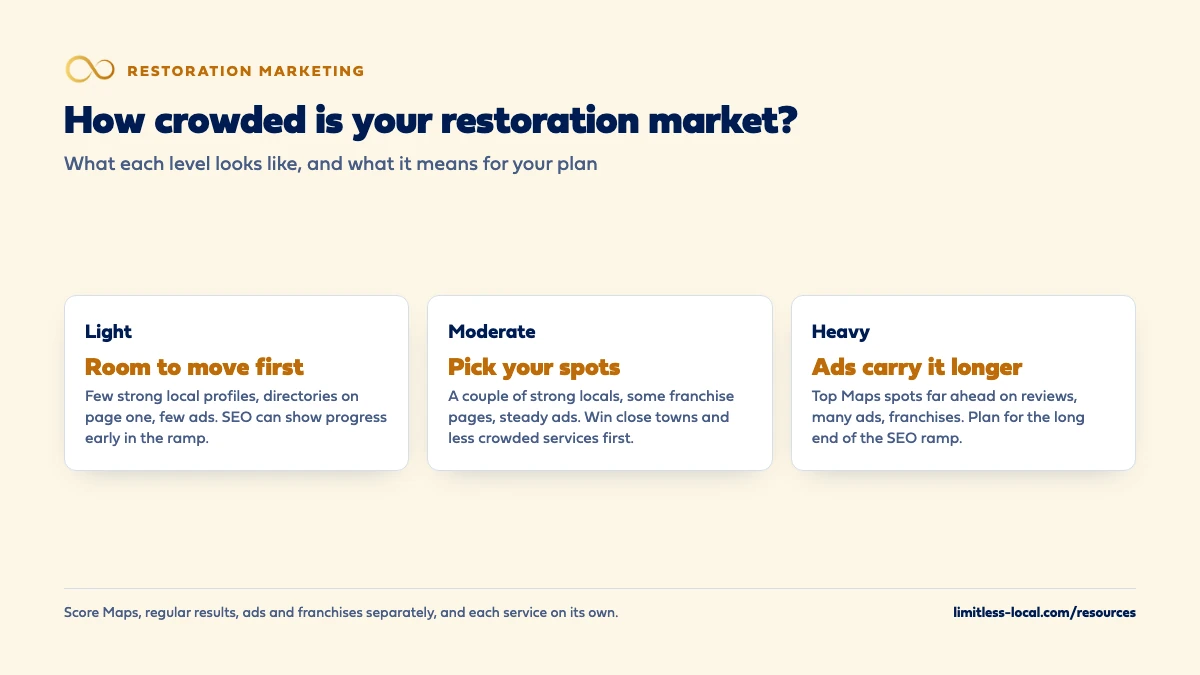
- How do I score my market as light, moderate or heavy?
- What should I do differently in a crowded market?
- What should I do differently in a light market?
- How often should I re-check my market?
- What's different about restoration competition
- A worked example: scoring one made-up suburban market
- Frequently asked questions
- Key takeaways
- More in this section
- Sources
The short version
- Size up Maps, the regular results and ads separately; each can be crowded on its own.
- Count who you're really up against, including franchises and certified firms near you.
- Crowded markets mean slower SEO and pricier clicks, not a closed door.
- Re-check every few months and whenever a new competitor shows up.
For restoration owners who want to know what they’re up against in their own towns before they set a budget or a timeline.
Get a free visibility audit · Book a growth call
How do I size up restoration competition in my area, and how does it change my timeline?
Check three places: Maps, where you look at which restoration companies show up from different spots in your area and how many reviews they have; the regular results, where you see whether local companies, national franchises or directories hold the top spots; and ads, where you count advertisers and use Google’s Keyword Planner to see how many advertisers show and what top-of-page bids run in your area. The more of those that are crowded, the longer search work tends to take and the more each click costs. A light market can show progress early in the usual three-to-six-month SEO ramp, while a crowded metro often sits at the long end of it, so plan ads to carry the calls in the meantime.
Sizing up a market is where our local SEO work starts, because the plan for a crowded metro and a quiet county shouldn’t look the same. We work on the three places owners need to show up: the regular Google results, the Maps 3-pack and AI answers. Ads can bring leads within days of launch, while SEO typically takes three to six months to show meaningful organic growth, and we won’t guarantee rankings in any market, crowded or not. See how it applies to water, fire and mold work on our restoration marketing page, read the restoration marketing guide, or browse the restoration marketing questions library.
What makes a local restoration market competitive?
It’s not just how many restoration companies are in town. A market is competitive when the companies already showing up are strong at the things Google looks at, and when plenty of them are paying for the same searches. Things that make a market tougher:
- Several established local companies with lots of recent reviews and detailed websites.
- National franchise locations and large networks in or near your towns.
- Directories and lead sellers holding top spots for your main searches.
- Many advertisers on emergency searches, including Local Services Ads.
- Carpet cleaners, plumbers and general contractors also chasing water damage work.
A big city usually has more of all of these, but not always. Some suburbs are packed; some metros have few strong local players. You find out by looking, not by population.
How do I check the Maps side of my market?
Search the way homeowners do, on your phone: “water damage restoration,” “mold remediation,” “fire damage restoration” and “water damage near me.” Do it from a few spots in your service area, not just your shop, because results change with where the searcher is.
For the companies in the top three each time, note their review count, rating, how recent the last few reviews are, their main category, and whether their profile has real photos and services listed. Google’s guide to improving your local ranking says local results are mainly based on relevance, distance and popularity, and that how many reviews you have and how many websites link to your business feed into how well-known a business is. So if the top three have many times your reviews and you only show up near your own shop, the Maps side of your market is crowded.
How do I check the regular search results?
Below the map, look at who holds the first page for the same searches plus your main towns, such as “water damage restoration [your city].” Sort what you see into three groups:
- Local companies with dedicated pages for each service and town.
- National franchise locations with a local page on a big brand’s site.
- Directories and lead sellers: listing sites and pages built to sell leads to whoever pays.
If strong local companies with detailed service and town pages hold most spots, expect a longer climb. If directories and thin franchise pages hold them, there’s often room for a local company with specific, useful pages. How a restoration company should build city pages that rank covers what those pages need.
How do I check how crowded the ads are?
Start by looking. Run your main searches at a few times of day and count the ads and Local Services Ads above the results. Then use Google Ads’ Keyword Planner with your service area set as the location. Google’s page on Keyword Planner forecasts and statistics explains the two columns that matter:
- Competition shows the number of advertisers that showed on each keyword relative to all keywords across Google, as low, medium or high, and it’s specific to the location you chose.
- Top of page bid comes as a low range, roughly the 20th percentile of what advertisers have historically paid for a top-of-page spot, and a high range, roughly the 80th percentile.
High competition and a wide, high bid range on your emergency terms mean clicks will cost more. How local competition changes restoration ad costs goes deeper on the ad side.
How do I count the restoration companies I'm really up against?
Make a short list from what you’ve already seen: the companies in the map results, the ones running ads and the ones on page one. Add franchise locations that cover your towns. If you hold IICRC certification, check the IICRC Global Locator, which homeowners and business owners use to find certified firms and technicians; the certified firms near you are competitors who can show the same credential.
Then cut the list to companies that actually do the work you want. A carpet cleaner that does some water extraction competes with you on a few searches, not on mold or fire. A franchise that covers four counties may be strong on paper but slow to show up in your town. The companies that match your services and your area are your real market.
Curious what your marketing is actually booking?
Get a free visibility audit — no obligation, no sales pitch.
Does a bigger city always mean a tougher market?
Bigger cities bring more searches and more companies chasing them, so clicks usually cost more and Maps spots are harder to win. They also bring more volume, so there’s more work to win once you’re visible. Smaller markets often cost less per click but can run out of searches sooner.
The U.S. Small Business Administration’s guide to market research and competitive analysis lists the questions that apply here too: demand, market size, location, and market saturation, meaning how many similar options people already have. For a restoration company, saturation is the one that moves your timeline most. A mid-size town with few strong local competitors can be easier to win than a small one with two well-reviewed companies that have owned Maps for years.
How does competition change how long marketing takes?
Ads can bring leads within days of launch in almost any market; competition mostly changes what each click and lead costs. SEO is different. It typically takes three to six months to show meaningful organic growth, and competition is a big part of where you land in that range, or past it.
In a light market, a complete Google profile, real service pages and a steady flow of reviews can show progress near the front of that ramp. In a crowded one, you’re building against companies that have been collecting reviews and links for years, so plan on the long end and plan ads to carry the calls meanwhile. Why restoration SEO takes longer than other trades explains the trade-specific reasons.
How do I score my market as light, moderate or heavy?
Mark each of these as easy, middle or hard, then look at where most of your marks land:
- Maps: how far ahead the top three are on reviews, and whether you show up beyond your own neighborhood.
- Regular results: local companies with strong pages (hard) versus directories and thin pages (easier).
- Ads: Keyword Planner competition and bid ranges on your emergency terms, and how many ads show.
- Franchises and certified firms serving your towns.
- Overlap from carpet cleaners, plumbers and contractors on water work.
Mostly easy is a light market; mostly hard is heavy. Score each service separately if you need to, since mold and fire searches are often less crowded than water damage.
What should I do differently in a crowded market?
- Narrow the battlefield. Win the towns closest to your base first; distance is on your side there.
- Go where competitors are thin. Mold, sewage, fire and commercial work often have fewer strong pages than water damage.
- Out-answer them. In emergencies, the company that picks up wins a lot of jobs that rankings alone don’t.
- Build relationships rankings can’t take. Property managers, plumbers and agents send work no matter who holds the map pack this month.
- Keep reviews coming after every job, steadily, not in bursts.
- Run ads with tight targeting on the searches and towns that actually book jobs.
If a new company has just opened near you, holding your Map Pack spot against a new restoration competitor covers that situation.
What should I do differently in a light market?
Move first and cover everything. In a light market, the company that builds the complete profile, the full set of service pages and the steady review habit early often holds the top spots for a long time, because nobody else is pushing.
You can lean more on search work and less on ads, since clicks are cheaper and organic progress tends to come sooner. Don’t skip ads entirely, though: emergencies still go to whoever is at the top today. And watch for new entrants; light markets are where franchises and new companies like to open.
How often should I re-check my market?
Every few months, and right away if calls drop or a new competitor appears. Re-run the same searches from the same spots so you can compare like with like.
Once you’re running Google Ads, the auction insights report does part of this for you: it compares your performance with other advertisers in the same auctions, including impression share and how often they show above you. It doesn’t show insights when your impression share is under 10%, so a very small budget may leave it empty.
Want to see where your company stands?
A free visibility audit shows where you show up on Google, Maps and AI answers, and what it's costing you in calls.
What's different about restoration competition
Franchises and networks. Restoration has more national brands and networks than most home-service trades, so a town with only two local companies can still be crowded once franchise locations are counted.
Emergency searches pull heavy ad spend. Water damage searches are urgent, so the top of the page is often full of ads and Local Services Ads even in mid-size markets.
Storms change the field for a while. After a big storm or freeze, out-of-town companies can show up in your area for weeks. Judge your market in a normal month, not mid-surge.
Other trades overlap. Plumbers and carpet cleaners compete on water searches but rarely on mold, fire or rebuild, which is where a full-service restoration company can stand apart.
A worked example: scoring one made-up suburban market
This market is made up to show how the scoring works. A water and mold company searches from three spots in its service area.
- Maps: the same three companies show up for water damage everywhere, with about 310, 180 and 95 reviews. The owner’s company has 40 and shows up only near its shop. Hard.
- Regular results: two franchise location pages, two directories and one local company hold the top five. Middle.
- Ads: Keyword Planner shows high competition on water damage terms and medium on mold terms. Four ads show on most emergency searches. Hard for water, middle for mold.
- Franchises: three cover the area. Hard.
That’s a heavy market for water damage and a moderate one for mold. A sensible plan: ads with tight targeting to carry water calls from day one, search work aimed first at mold and at the towns closest to the shop, and a review request after every job. The owner should expect the SEO side to sit at the long end of the usual ramp for water, and check progress in calls and booked jobs, not just rankings.
Frequently asked questions
Can I just look at how many restoration companies are listed in my city?
It’s a start, but a count misses how strong they are. Ten weak profiles are less competition than three companies with hundreds of recent reviews and detailed sites.
Does Keyword Planner tell me how hard it is to rank organically?
No. Its competition column is about advertisers on each keyword, not organic rankings. Use it for the ad side and check the regular results yourself for the rest.
Should I avoid a heavy market altogether?
Not necessarily. Heavy markets have more searches and more jobs. They take longer and cost more per click, so the budget and timeline need to fit, and narrowing to nearby towns and specific services helps.
Is mold or fire work less competitive than water damage?
Often, though it varies by town. Score each service separately, because a market can be heavy for water damage and moderate for mold.
Do national franchises always win in Maps?
No. Local results are mainly based on relevance, distance and popularity, not brand size. A local company close to the searcher with a complete profile and steady reviews can outrank a franchise location.
How much does a crowded market add to SEO time?
There’s no fixed number. SEO typically takes three to six months to show meaningful growth, and a crowded market tends to push you toward the long end of that or past it.
Key takeaways
- Size up Maps, the regular results and ads separately; each can be crowded on its own.
- Count only competitors who do your services in your towns, including franchises and certified firms.
- Keyword Planner’s competition and top-of-page bid ranges show the ad side for your location.
- Crowded markets push SEO toward the long end of its usual ramp, so plan ads to carry calls meanwhile.
- In a crowded market, narrow to close towns and less crowded services; in a light one, move first.
Not sure what's working right now?
Start with a free visibility audit: rankings, Google profile, reviews and tracking, checked against your service area.
More in this section
- How profitable is a restoration company, and where does marketing fit?
- What marketing does a brand-new restoration company need first?
- Best low-budget marketing move for a small restoration company?
- How should a restoration company market to commercial properties?
- What skills do I need to hire to run restoration marketing in-house?
Sources
- Tips to improve your local ranking on Google — Google Business Profile Help
- About Keyword Planner forecasts — Google Ads Help
- Use auction insights to compare performance — Google Ads Help
- IICRC Global Locator — IICRC
- Market research and competitive analysis — U.S. Small Business Administration