
What does a good roofing marketing plan look like for 2027?

- How should a roofing company lay out its marketing for 2027?
- What goes into a good roofing marketing plan?
- Step 1: How many signed roofs do I want in 2027?
- Step 2: How do I set the budget from that goal?
- Step 3: What should I fix before spending more?
- Step 4: Which channels belong in a 2027 roofing plan?
- Step 5: What changes for Local Services Ads in 2027?
- Step 6: How should my plan handle AI search?
- Step 7: How do I plan the year around storm season?
- Step 8: What should happen every month, all year?
- Step 9: How often should I review the plan?
- What should a roofer leave out of a 2027 plan?
- What's different about a roofing marketing plan
- A worked example: building a 2027 plan from a job goal
- Frequently asked questions
- Key takeaways
- More in this section
- Sources
The short version
- Start with the signed roofs you want and work back to leads and budget.
- Fix tracking, phones and follow-up in the first weeks of the year.
- Pair fast channels (ads, LSAs) with slow ones (Google profile, reviews, SEO).
- Plan the calendar around storm season, and review monthly on cost per signed roof.
For roofing owners sitting down to plan next year’s marketing, who want one plan across every channel instead of a pile of separate ideas.
Get a free visibility audit · Book a growth call
How should a roofing company lay out its marketing for 2027?
A good roofing marketing plan for 2027 starts from the number of signed roofs you want, works backward to the leads and budget that takes, and fixes tracking, phones and follow-up before adding spend. It pairs fast channels (search ads and Local Services Ads, now managed inside Google Ads) with slow ones (a strong Google Business Profile, steady reviews and SEO), and sets a calendar for storm season and the slow months. Then it gets reviewed every month on cost per signed roof, and reset every quarter.
That plan follows the same three phases we use with every roofer: build the foundation (tracking, follow-up and a clean online presence), turn on lead flow with local SEO and ads around the towns and jobs you want, then improve and scale month by month. Our packages are built around those phases, and our roofing marketing page shows how it fits a roofing company. For a channel-by-channel walk-through, the roofing marketing guide goes deep on each, and the roofing marketing questions library takes the follow-ups one at a time.
What goes into a good roofing marketing plan?
A plan you’ll actually use fits on a page or two. It answers six questions:
- Goal: how many signed roofs, and of what kind, do you want next year?
- Budget: what will it cost to get there, month by month?
- Foundation: what has to be fixed before more leads come in?
- Channels: which ones, and what job does each do?
- Calendar: what happens when, around storm season and the slow months?
- Review: what do you check monthly, and what do you reset each quarter?
Most roofers have pieces of this in their heads. Writing it down is what stops the year from turning into reacting to whatever the last sales rep pitched. The steps below fill in each part.
Step 1: How many signed roofs do I want in 2027?
Start with jobs, not leads or clicks. Pick a number of signed roofs for the year, and split it by type if it matters: replacements, repairs, insurance work, commercial.
Then work backward with your own numbers:
- How many estimates does it take to sign one roof?
- How many leads does it take to get one estimate?
- So how many leads do you need each month?
Canada’s Business Development Bank (BDC) makes the same point in its small-business budgeting guidance: marketing goals need to be measurable and specific, because the goal decides what work and what investment are needed (What is the average marketing budget for a small business?). How many roofing leads a month it takes to hit a job goal walks through that math.
Step 2: How do I set the budget from that goal?
Multiply the leads you need by what a lead costs you, then check the result against what a signed roof earns you. If you don’t know your cost per lead yet, use a conservative guess for the first quarter and replace it with real numbers by spring.
Then sanity-check it:
- Does the budget leave enough for each channel to actually learn something?
- Does the total make sense against your revenue and gross profit?
- Can your crews install what the plan says you’ll sign?
Plan for the budget to move. Most roofers spend more ahead of and during storm season and less in the slow months. If you’re weighing a big step up, when $5,000 a month in marketing makes sense for a roofer covers the readiness checks.
Step 3: What should I fix before spending more?
Do this in the first weeks of the year, before the spring push:
- Tracking. Every call and form tagged by source, and every lead followed to signed or lost. Tracking which roofing leads turn into signed jobs covers the setup.
- Phones. Who answers during business hours, who backs them up, what happens after hours.
- Follow-up. A schedule for open estimates, so nothing sits for weeks.
- Your Google Business Profile. Complete, accurate and full of real job photos.
- Your business details everywhere else. The same name, address and phone across directories. Our packages sync these across 50+ directories, and you can fix the big ones yourself in an afternoon.
- Your website on a phone. Tap to call works, the forms are short, and it loads fast.
None of this is exciting. All of it makes every dollar you spend later go further.
Step 4: Which channels belong in a 2027 roofing plan?
Give each channel a job:
- Google search ads bring calls fast and let you pick the jobs and towns you pay for. Ads can generate leads within days of launch.
- Local Services Ads bring pay-per-lead calls on Search and Maps, for roofers who answer fast and have good reviews.
- Your Google Business Profile and reviews are free, and they decide how you show in Maps. Google says local results are mainly based on relevance, distance and popularity, and more reviews and positive ratings can help (Tips to improve your local ranking on Google).
- SEO builds organic calls in your home towns. It typically takes 3 to 6 months to show meaningful organic growth, so 2027’s SEO work is really for late 2027 and beyond.
- Past customers and referrals are your cheapest leads. Plan a few messages a year, especially after storms.
Which of these to lean on depends on your company. Which roofing companies get the best results from SEO versus ads helps you decide the mix.
Curious what your marketing is actually booking?
Get a free visibility audit — no obligation, no sales pitch.
Step 5: What changes for Local Services Ads in 2027?
Where you manage them. Google is moving Local Services Ads into Google Ads as Performance Max campaigns with pay-per-lead goals, and roofing was in the first phase, which began in August 2026 for select advertisers (Local Services Ads transition to Performance Max). If your account hasn’t moved yet, plan for it in 2027:
- Budgets go daily. Your weekly budget is divided by 7, and monthly spend is capped at your daily average times 30.4.
- Manual bidding goes away. You can’t set a maximum cost per lead anymore.
- Your old reports don’t carry over. Download or screenshot your history before the move.
- Your Google Business Profile matters more. Business name, address and hours sync one way from it into Google Ads.
What stays the same: you still pay per lead, and the ads still show on Search and Maps. Budget your Local Services Ads by the month in your plan, since that’s how the spending limit now works.
Step 6: How should my plan handle AI search?
Mostly by doing the basics well. Google says the same foundational SEO practices apply to its AI features as to Search overall, there are no additional technical requirements to appear in AI Overviews or AI Mode, and keeping your Business Profile information up to date is part of it (AI features and your website). Traffic from those AI features is counted in the Performance report in Search Console, so you can see it alongside the rest of your search traffic.
For a roofer, that means clear pages about each service and town, real job photos and details, and a complete, well-reviewed Google profile. We optimize for the three places owners need to show up: the regular Google results, the Maps 3-pack, and AI answers like ChatGPT, Google AI Overviews and Siri. Skip anyone selling AI tricks that skip the basics. How a roofing company gets recommended by ChatGPT goes further.
Step 7: How do I plan the year around storm season?
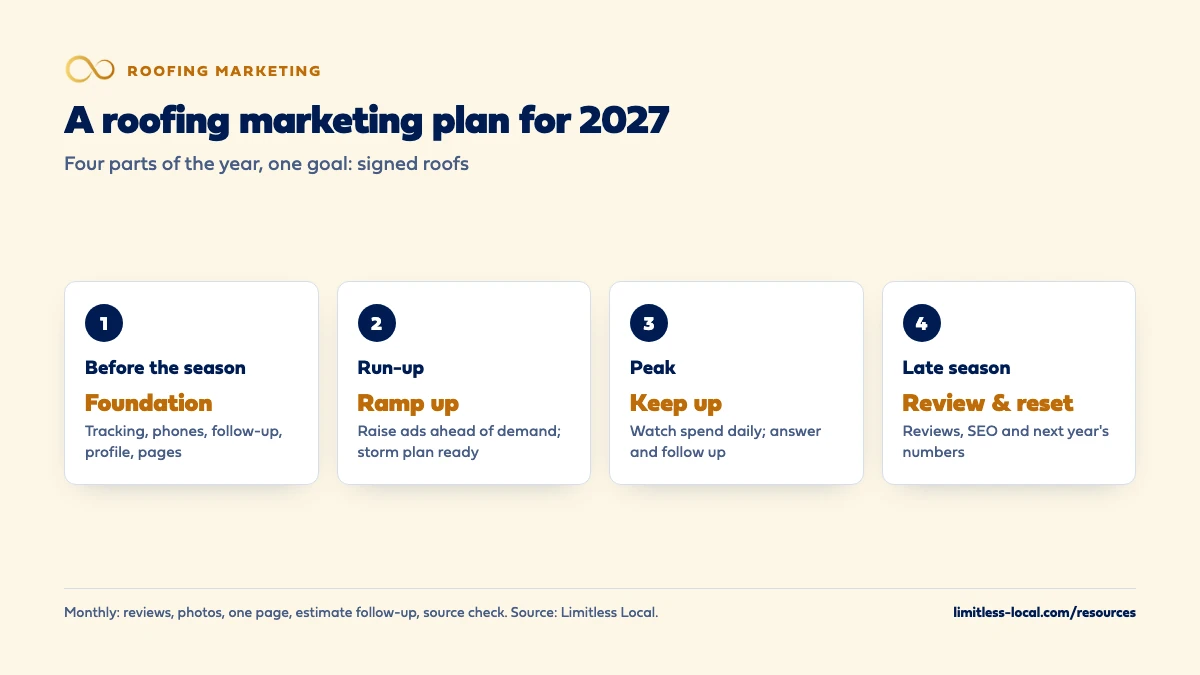
Build the calendar around when your area’s roofing demand rises and falls. For many roofers it looks something like this:
- Quiet months before the season: foundation fixes, Local Services Ads screening if needed, new service and town pages, photos, and past-customer outreach.
- Run-up to storm season: raise ad budgets a little ahead of demand, check that phones and inspection scheduling are ready, and have your storm plan written down.
- Peak and storm weeks: watch ad spend daily, turn budgets down if leads go unanswered, and follow up every open estimate.
- Late season and winter: trim ads to the jobs you can still install, push reviews from the year’s jobs, and work on the website and SEO while crews have room.
How a roofing ad budget should change from storm season to winter covers the money side of that calendar.
Step 8: What should happen every month, all year?
A plan works because of the habits inside it, not the big launches. Every month:
- Ask every finished customer for a review, and reply to every review.
- Add new job photos to your Google profile.
- Publish or update at least one useful page about a service, a town or a common homeowner question.
- Follow up on every open estimate.
- Check where every signed job came from.
A roofer who does those five things every month for a year will usually look a lot stronger online by December than one who did a big push in March and stopped.
Step 9: How often should I review the plan?
Monthly for the numbers, quarterly for the plan.
Monthly: leads, booked inspections, estimates and signed roofs by source, and cost per signed roof for each paid channel. If you don’t have tracking software yet, the SBA’s advice to small businesses holds: tracking can be as simple as asking every new customer where they learned about you (How to Get the Most From Your Marketing Budget).
Quarterly: compare what you spent with what you planned, and move money toward the channels signing roofs at the lowest cost. Reset the next quarter’s calendar with what you learned.
What should a roofer leave out of a 2027 plan?
Some things look like progress and aren’t:
- Every new channel at once. Add one at a time, and give each enough budget to judge.
- More leads than you can handle. Paid leads that go unanswered are the most expensive kind.
- Reports that measure activity. Impressions and clicks don’t sign roofs. Ask for cost per signed roof.
- Long contracts you can’t leave. We work month to month, so we have to earn the business every month. Hold anyone you hire to the same standard.
- Ranking promises. Nobody can honestly guarantee a ranking, so don’t plan around anyone who says they can.
Not sure which of these is costing you jobs?
A free visibility audit checks the Google profile, reviews, site and tracking, and shows what to fix first.
What's different about a roofing marketing plan
Weather writes part of your calendar. A plumber’s year is fairly steady. A roofer’s can swing hard after one hailstorm. Build slack into the plan so a storm week doesn’t wreck the budget, and so a quiet spring doesn’t panic you into overspending.
Few, big jobs. Your goal might be dozens of roofs, not thousands of service calls, so each signed job moves the numbers a lot. Judge by the quarter, not the week.
Trust is the product. Homeowners spending five figures want to see reviews, photos and a long local track record. The slow channels in your plan build exactly that.
Insurance work stretches the timeline. If insurance jobs are a big share of your work, expect more time between lead and signed roof, and plan follow-up to match.
A worked example: building a 2027 plan from a job goal
These numbers are made up to show the math, not a target for your company. A roofer wants 60 signed roofs in 2027. From last year’s records, about 1 in 3 estimates signs, so the plan needs 180 estimates. About half of leads turn into an estimate, so it needs 360 leads, about 30 a month on average, more in storm season and fewer in winter.
Say paid leads cost about $100 each in this roofer’s towns, and the plan has ads bring every one of them in year one. That’s $36,000 in ad spend for the year, around $3,000 a month on average. Any leads from the Google profile, reviews, referrals and SEO bring that number down, which is why the slow channels earn their spot in the plan even though they won’t fill the first quarter.
Then the roofer checks it against capacity: can the crews install 60 roofs on top of repeat and referral work? If not, the goal or the hiring plan changes before the budget does.
Frequently asked questions
When should a roofer write next year's marketing plan?
In the slow months before the year starts, while crews have room. That leaves time to fix tracking and start slow channels, like Local Services Ads screening and SEO, before demand picks up.
How long should a roofing marketing plan be?
A page or two. If it doesn’t fit, it won’t get used. Put the goal, budget, channels, calendar and review dates on it, and keep the details in your tracking.
Should my plan include social media?
As a supporting channel, usually. Posting real job photos keeps your company looking active, and remarketing ads can remind past website visitors about you. It rarely belongs at the center of a roofing plan.
What if I don't know my close rate or cost per lead?
Use careful guesses for the first quarter, and make tracking the first job of the year. By spring you’ll have real numbers to replace them.
Can I hand the plan to an agency?
You can hand over the work, but keep the goal, the budget and the review dates in your own hands. Any good partner should show you, every month, what they did and what it produced.
Does a one-crew roofer need a written plan?
Yes, even a short one. A smaller company has less room for wasted spend, so knowing which channel does which job matters more, not less.
Key takeaways
- Start the plan from the signed roofs you want and work back to leads and budget.
- Fix tracking, phones, follow-up and your Google profile before adding spend.
- Give every channel a job, pairing fast ads with slow-building reviews and SEO.
- Plan for Local Services Ads to live inside Google Ads, with daily budgets and no manual bidding.
- Review monthly on cost per signed roof, and reset the plan every quarter.
Want a second set of eyes on your setup?
We'll look at how you show up locally and where calls are leaking, then send you a plain-English breakdown.
More in this section
- What marketing should a roofing company add first to grow?
- How should a roofing company market commercial roofing?
- How do I know if my roofing marketing agency is getting results?
- What is the best marketing idea for a roofing company to try first?
- What does a roofing marketer actually do each month?
Sources
- What is the average marketing budget for a small business? — BDC (Business Development Bank of Canada)
- How to Get the Most From Your Marketing Budget — U.S. Small Business Administration
- Local Services Ads transition to Performance Max campaigns with pay-per-lead goals — Google Ads Help
- AI Features and Your Website — Google Search Central
- Tips to improve your local ranking on Google — Google Business Profile Help