
How do I estimate how many people search for pool builders in my area?
- How many monthly searches and potential customers are there for pool construction in my market?
- Why estimate how many people search for pool builders near you?
- Step 1: Which searches should I count?
- Step 2: How do I get search counts from Keyword Planner?
- Step 3: How do I see when people search during the year?
- Step 4: What does my Google Business Profile tell me?
- Step 5: What does Search Console add?
- Step 6: How do I turn all that into one estimate?
- How do I turn searches into potential customers?
- How many homeowners in my area could buy a pool?
- What if my market is too small for the tools to show?
- What do I do with the estimate once I have it?
- What's different about sizing search demand for pool builders
- A worked example: from searches to signed pools
- Frequently asked questions
- Key takeaways
- More in this section
- Sources
The short version
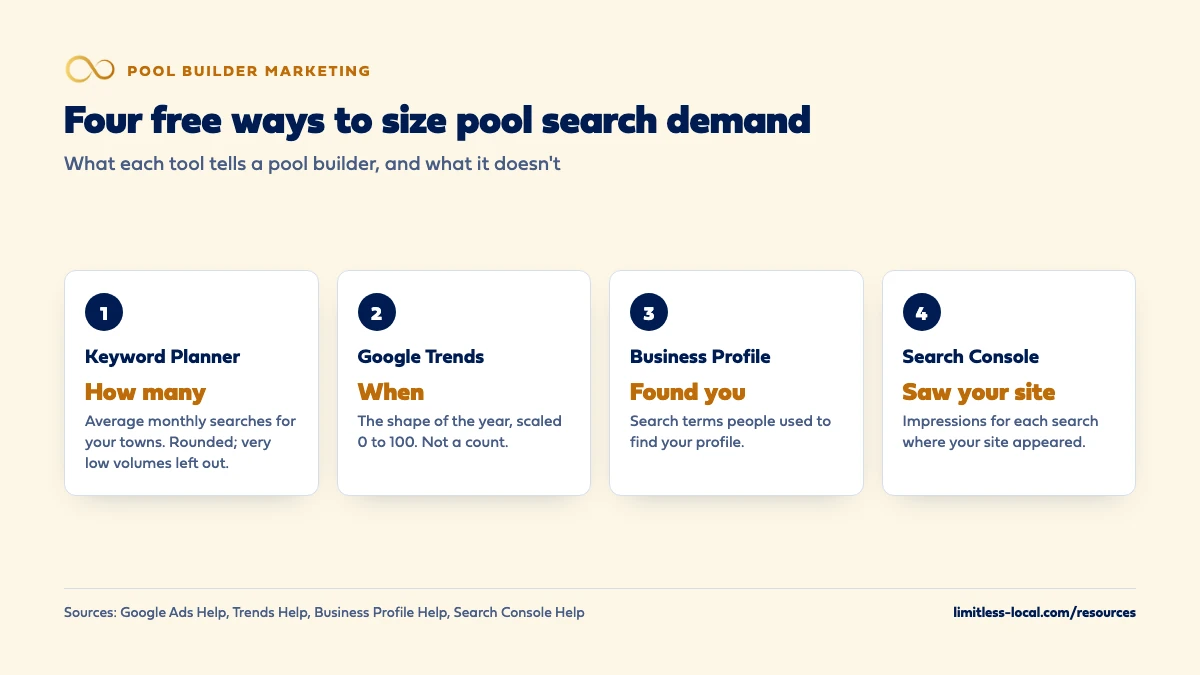
- Keyword Planner gives average monthly searches for the locations you choose.
- Google Trends shows when in the year searches rise and fall, not how many there are.
- Your Business Profile and Search Console show the searches you already appear for.
- Remove cleaning, supply and brand searches, and treat the result as a range.
For pool builders sizing up a market before setting an ad budget, choosing towns to target or deciding whether SEO is worth the wait.
Get a free visibility audit · Book a growth call
How many monthly searches and potential customers are there for pool construction in my market?
Start with Google’s Keyword Planner: list the searches a homeowner uses when they want a pool built, set the location to the counties and towns you build in, and read the average monthly searches for each. Then check the seasonal pattern in Google Trends, and compare both with the search terms in your Google Business Profile performance report and the impressions in Search Console. Strip out searches for pool cleaning, supplies and your own company name, and treat what’s left as a range, not an exact count, because the tools round their numbers and leave out very low-volume searches.
That range is where good marketing decisions start: which towns to target, how much ad budget the market can actually use and whether SEO has enough searches to be worth the wait. When we turn on lead flow, our local SEO and ads are built around the towns and jobs you want, and our marketing for pool builders page shows how it fits with ads and tracking. The rest of the pool builder marketing questions library goes one question at a time.
Why estimate how many people search for pool builders near you?
Because almost every marketing decision depends on it. How much you can sensibly spend on Google Ads, whether a town deserves its own page, how long SEO will take to pay off and whether a second crew can be kept busy all come back to how many homeowners are actually looking for a builder where you build.
You don’t need a perfect number. You need a range that’s good enough to tell a market with a few dozen serious searches a month from one with several hundred, and to tell which of your towns carry the demand. An afternoon with free Google tools gets you there.
Step 1: Which searches should I count?
Count the searches a homeowner types when they want a pool built, in the words they actually use:
- Hiring searches: pool builder, pool contractor, inground pool, pool construction, pool company.
- Type searches for what you build: gunite pool, fiberglass pool, vinyl liner pool, plunge pool.
- Town versions: each of those with your main towns and counties, such as “pool builder” plus a town name.
- Renovation searches, if you want that work: pool remodel, pool resurfacing, pool renovation.
Keep a separate list of searches to leave out: pool cleaning, pool service, pool supplies, above-ground pools, pool tables and public pools. They’ll show up in every tool and inflate your number.
What keywords a pool builder should target goes deeper on picking the list.
Step 2: How do I get search counts from Keyword Planner?
Google’s Keyword Planner is free inside a Google Ads account, though you have to finish account setup, including billing information, before you can use it. You don’t have to run an ad.
- Open Keyword Planner and choose Get search volume and forecasts.
- Paste in your list from Step 1.
- Set the location to the counties or towns you build in, not the whole state.
- Read the Avg. monthly searches column.
Google’s notes on Keyword Planner data explain a few things about that number that matter for a pool builder. It’s averaged over 12 months by default, so a spring peak and a winter low get blended together. It’s counted for exact matches only. The numbers are rounded, so totals across several locations may not add up the way you’d expect. And keywords with very low search volume can’t be found or forecast at all, which happens a lot with “pool builder” plus a small town name.
You can also use Discover new keywords with your website address, and Google will suggest related searches you might have missed.
Step 3: How do I see when people search during the year?
Use Google Trends for the shape of the year. Search “pool builder” or “inground pool”, set the region to your state or metro, and look at the last few years. You’ll usually see the months when interest climbs and the months it fades.
Read it as a shape, not a count. Trends scales interest from 0 to 100 relative to all searches in that place and time, so a 100 in your metro isn’t the same number of searches as a 100 somewhere else. Searches made by very few people show as 0, so narrow terms in small areas often come back empty.
Put the two tools together: Keyword Planner tells you roughly how many searches a year, Trends tells you how they’re spread across the months. Whether people search for pool builders in winter covers what the slow months mean for SEO.
Step 4: What does my Google Business Profile tell me?
Your profile’s performance report shows the searches you already show up for. The Searches metric lists the search terms people used to find your business; it updates at the start of each month and can take a few days to appear. Alongside it you’ll see views, calls, website clicks and direction requests.
This doesn’t tell you how many people searched in your area. It tells you how many of those searches found you, and in which words. Compare it with Step 2. If Keyword Planner shows healthy demand for “pool builder” in your county but your profile rarely appears for it, you’ve found a visibility gap, not a demand problem.
Performance data is only available for verified profiles, so verify yours first if you haven’t.
Curious what your marketing is actually booking?
Get a free visibility audit — no obligation, no sales pitch.
Step 5: What does Search Console add?
Search Console’s Performance report does the same job for your website. Open it, switch to the Queries tab and look at Impressions, which counts how many times your site appeared in Google results for each search. The default view covers the past three months, so stretch the date range to a full year to see the season.
Filter the queries for words like pool, builder, inground and your town names. The searches with lots of impressions but few clicks are demand you’re seen for but not winning. The searches you expected to see but don’t appear at all are demand you aren’t reaching yet.
Like your profile report, this only counts searches where your site showed up, so it’s a floor, not the size of the market.
Step 6: How do I turn all that into one estimate?
- Add up the average monthly searches from Keyword Planner for your hiring, type and town searches.
- Take out anything that isn’t a pool buyer: cleaning, supplies, above-ground, and searches for your own company name, which are people already looking for you.
- Use the Trends shape to spread the yearly total across the months, so you know how much of it lands in your peak season.
- Sanity-check the result against your profile and Search Console numbers. They should be smaller than the market estimate, but in the same ballpark for the searches where you’re strong.
Write the answer as a range, a low and a high figure for your peak months, not a single number. Every tool rounds, samples or leaves out low-volume searches, and the range is more honest than any one of them.
How do I turn searches into potential customers?
Searches aren’t buyers. One homeowner might search a dozen times across several weeks, and plenty of searchers are just curious about cost. To get from searches to contracts, walk the number down through your own funnel: how many searches turn into a visit or a call, how many of those become a real lead, how many book a design consultation and how many sign.
Use your own numbers wherever you have them, because close rates and consultation rates vary a lot between builders and markets. If you don’t have them yet, the worked example below shows the shape of the math with made-up numbers. How many leads a pool builder needs to hit its revenue goal runs the same funnel backward from your target.

How many homeowners in my area could buy a pool?
Search counts tell you who’s looking right now. To size the bigger pool of possible buyers, check the U.S. Census Bureau’s QuickFacts for each county you serve. It covers every state and county, plus cities and towns with a population of 5,000 or more, and lists households, the owner-occupied housing rate, the median value of owner-occupied homes and median household income.
That helps you rank towns, not count buyers. A town with lots of owner-occupied homes at higher values is usually a better place to spend ad money and build a town page than one with mostly renters, even if their search counts look similar. It also helps you see where a referral-driven market is bigger than search makes it look.
What if my market is too small for the tools to show?
It happens often in rural areas and small towns. Keyword Planner leaves out searches with very low volume, Trends shows them as 0, and Google says its forecasts are less accurate for small geographic areas because there’s less data to work with.
Widen the lens. Check the county or the nearest metro instead of the town, then scale down by eye using what you know about where your past customers live. Lean harder on your own data: profile searches, Search Console impressions and how many pool inquiries you got last year by town. In a small market, your own lead records are often better than any tool.
What do I do with the estimate once I have it?
- Pick your towns. Put pages, profile posts and ad money where demand and homeowner profile are both strong.
- Set a sensible ad budget. A market with few searches can’t absorb a big search budget, no matter what you’re willing to spend.
- Set expectations for SEO. More searches means more to win, but usually more competition too. How competitive local SEO is for a pool builder in your city covers the other half of that question.
- Plan the season. Use the Trends shape to have pages, reviews and ads ready before the climb, not during it.
Then redo the estimate once a year. Markets grow, new neighborhoods fill in and the searches homeowners use shift over time.
Not sure which of these is costing you jobs?
A free visibility audit checks the Google profile, reviews, site and tracking, and shows what to fix first.
What's different about sizing search demand for pool builders
The word “pool” is crowded. Pool cleaning, pool supplies, pool parties, pool tables and public pools all share the word. Pool builders have to filter harder than most trades, or the market looks several times bigger than it is.
Demand is seasonal and the sale is long. Searches climb ahead of the swim season, but contracts often sign months after the first search. Use the Trends shape to time your marketing, and expect the contracts to lag behind it.
New builds and renovations are different markets. Someone searching “pool resurfacing” already owns a pool. Size the two separately if you sell both, because they need different pages, ads and budgets.
A lot of demand never shows up in search. Referrals, neighbors who watched your crews work and trade partners send buyers who never type “pool builder” into Google. Search demand is one slice of your market, not all of it.
A worked example: from searches to signed pools
These numbers are made up to show the math, not a benchmark for your market. Say Keyword Planner shows about 900 average monthly searches across your hiring, type and town searches in the counties you build in. You take out about 300 that are really cleaning, supply, above-ground or your own company name, leaving 600 searches a month from homeowners who look like pool buyers.
Now walk it down through a made-up funnel. If your website, profile and ads together win one in ten of those searches as a visit or call, that’s 60 a month. If one in ten of those becomes a real lead, that’s 6 leads. If half of those book a design consultation and one in three consultations signs, you’re at about one signed pool a month from search.
That’s an average across the year. With a strong spring peak, more of those leads land in a few busy months and fewer in winter. The point isn’t the final number; it’s seeing which step in the chain you can improve, whether that’s showing up for more of the 600 or turning more consultations into contracts.
Frequently asked questions
Do I have to pay for Google Ads to use Keyword Planner?
You have to complete your Google Ads account setup, including billing information, before you can use it. You don’t need a live campaign to look up search volumes.
Are paid keyword tools more accurate than Google's free ones?
They can be easier to use and show extra details, but they’re estimates too. For a local pool market, Google’s own tools plus your profile and Search Console data are usually enough to make the decision.
Should I count searches for my own company name?
Not in the market estimate. People searching your name already know you; count them separately as a sign of how well referrals and word of mouth are working.
Do AI answers like ChatGPT count as searches?
Not in these tools. Google Trends, for example, filters out searches made by Google’s own AI Mode and AI Overviews, and Keyword Planner counts Google searches. Treat AI questions as extra demand the numbers don’t show.
How often should I redo the estimate?
Once a year is plenty for most pool builders, ideally in the slow months, so you can plan the next season’s budget and pages with fresh numbers.
Can I estimate demand for a town I don't serve yet?
Yes. Run the same steps with that town as the location. Your profile and Search Console won’t show much there yet, so Keyword Planner, Trends and Census numbers carry the estimate.
Key takeaways
- Keyword Planner gives average monthly searches for your locations; Trends gives the shape of the year.
- Your Business Profile and Search Console show how much of that demand already finds you.
- Filter out cleaning, supply, above-ground and brand searches, or the market looks far bigger than it is.
- Treat the result as a range and walk it down through your own funnel to signed contracts.
- Use the estimate to pick towns, size the ad budget and time the season, and redo it every year.
Want a second set of eyes on your setup?
We'll look at how you show up locally and where calls are leaking, then send you a plain-English breakdown.
More in this section
- How competitive is local SEO for a pool builder in my city?
- How does a pool builder show up in AI search results?
- Do people search for pool builders in winter, or does SEO slow?
- How should a pool builder set up its Google service area?
- What keywords should a pool builder target?
Sources
- Use Keyword Planner — Google Ads Help
- About Keyword Planner forecasts — Google Ads Help
- FAQ about Google Trends data — Google Trends Help
- Understand your Business Profile performance & insights — Google Business Profile Help
- Performance report (Search results): Overview and basic setup — Search Console Help
- U.S. Census Bureau QuickFacts: United States — U.S. Census Bureau