
How competitive is local SEO for a pool builder in my city?
- How do I size up local SEO competition for pool builders in my market?
- What makes local SEO competitive for a pool builder?
- How do I check who I'm up against in Google Maps?
- How do my reviews compare with the leaders?
- How does my service area change the competition?
- How competitive are the regular search results in my city?
- What can Google Ads data tell me about competition?
- Is my city too competitive for a pool builder to rank?
- How does competition change how long SEO takes?
- What can a pool builder win even in a crowded market?
- When should I lean on ads instead of waiting on SEO?
- What's different about local SEO competition for pool builders
- A worked example: sizing up one market
- Frequently asked questions
- Key takeaways
- More in this section
- Sources
The short version
- Competition depends on your market, not on a national number.
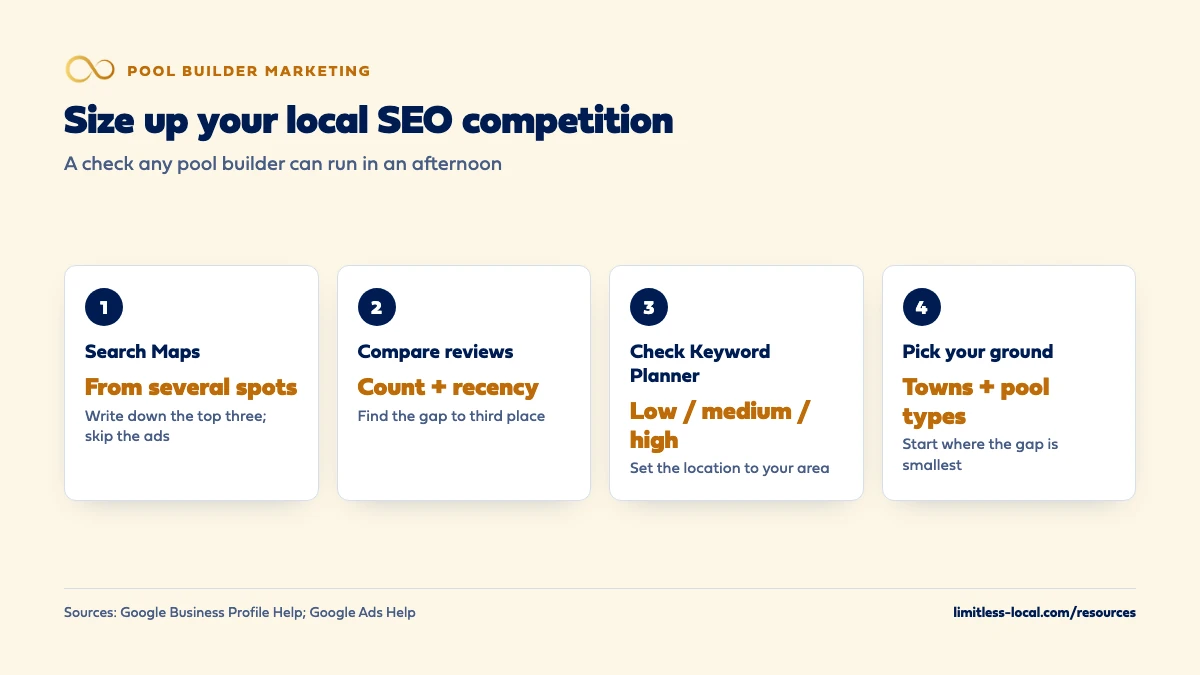
- Search Maps from several spots, and compare reviews with the top three builders.
- Keyword Planner shows how crowded the ad auction is in your location.
- Start where the gap is smallest: nearby towns, specific pool types, renovations.
For pool builders weighing local SEO who want to know how hard their own market will be before they spend, and where they can realistically win.
Get a free visibility audit · Book a growth call
How do I size up local SEO competition for pool builders in my market?
It depends on your market, and you can size it up yourself in an afternoon. Competition is set by how many pool builders serve your area, how many reviews and how much website content the leaders have, how spread out your metro is, and whether directories and national companies crowd the results. Search Maps from several spots around your service area, compare review counts with the top three builders, check Google’s Keyword Planner for how many advertisers compete in your location, and aim first at the towns and pool types where the gap is smallest.
This is the same check we start with. A free visibility audit looks at where you show up on Google, in Maps and in AI answers across your service area, and where the gaps are against the builders above you. From there, our local SEO work goes after the towns and jobs you want, and our pool builder marketing page shows how we work with pool companies. The pool builder marketing questions library covers the rest, question by question.
What makes local SEO competitive for a pool builder?
A handful of things, and they’re different in every market:
- How many builders serve your area, and how many of them actually invest in their Google profile, reviews and website.
- How strong the leaders are: their review counts, how recent those reviews are, and how much useful content their websites have.
- How spread out your metro is. In a sprawling area, distance splits the map into many small neighborhoods, each with its own top three.
- Who else crowds the results: directories, lead sites and national or franchise builders taking spots on page one.
- How long your season is. Year-round pool markets tend to have more builders competing for the same searches than markets with a short summer.
None of these shows up in a single score. The good news is you can check every one of them yourself, and the answer is usually more useful than a general “it’s competitive.”
How do I check who I'm up against in Google Maps?
Search the way homeowners do, from where they live. Distance is one of the three things Google’s local ranking tips say local results are mainly based on, along with relevance and popularity, so what you see from your office isn’t what a homeowner across town sees.
- Pick a few spots spread across your service area: your own town, the nicer neighborhoods you want, and the edges.
- From each one, search on a phone for the phrases homeowners use: “pool builder,” “pool company near me,” “inground pool installation,” and the pool types you build.
- Write down the top three in Maps each time, plus where you show up, if at all.
- Note any listing labelled Sponsored or Ad. Google’s page on how it ranks results says ads are always labelled that way and that nobody can pay for better treatment in the rankings, so those spots are paid, not earned.
A pattern usually jumps out: the same two or three builders everywhere, or a different leader in every town. The second kind of market is easier to break into. If you’re often fourth or fifth near your own yard and nowhere further out, how proximity affects a pool builder’s Maps ranking explains why.
How do my reviews compare with the leaders?
For each builder in the top three, note how many Google reviews they have, their rating and how recent the newest few are. Then put your own next to them.
Popularity is based partly on how many websites link to your business and how many reviews you have, and more reviews and positive ratings can help your local ranking. A builder with a steady stream of recent reviews is harder to pass than one with a big pile that stopped growing years ago.
What you’re looking for is the size of the gap. If the third-place builder has a few dozen more reviews than you, a season of asking every customer can close it. If the leaders have several hundred and you have a handful, Maps for the broad searches is a longer climb, and you’ll want to pick narrower ground first. How many Google reviews a pool builder needs goes deeper.
How does my service area change the competition?
A lot. The bigger the area you try to cover, the more builders you’re up against, and the further many homeowners are from your listed location. Google’s help page on service areas lets a service-area business set up to 20 service areas by city, postal code or other area, and you can’t set it as a radius around your business.
Setting a service area tells homeowners where you work. It doesn’t move your location closer to them, so listing a far-off city won’t make you rank there in Maps. Be honest about where your crews actually go, and expect to rank most easily in the towns closest to you.
That’s often a useful way to think about competition: you don’t have one market, you have a ring of towns, and some are much easier than others.
Curious what your marketing is actually booking?
Get a free visibility audit — no obligation, no sales pitch.
How competitive are the regular search results in my city?
Look below the map, too. Search the same phrases and note what holds the top spots in the regular results:
- Directories and lead sites listing many builders.
- National or franchise builders with a page for your city.
- Local builders’ websites.
If local builders’ own websites rank well, look at what their pages have: a page for each town, a project gallery with real local builds, pages for each pool type, answers to homeowner questions. That’s roughly the bar. If directories own the top spots and no local builder has a strong site, that’s often an opening, because a local builder with genuinely useful pages can compete with a generic list.
Not sure which phrases to check? What keywords a pool builder should target covers the ones that bring homeowners ready to build.
What can Google Ads data tell me about competition?
More than most owners expect, even if you don’t run ads. Keyword Planner, inside Google Ads, gives estimates of how many searches a keyword gets each month, and Google’s page on Keyword Planner forecasts describes two useful columns:
- Competition: the number of advertisers that showed on each keyword relative to all keywords across Google, specific to the location you’ve selected, shown as low, medium or high.
- Top of page bid (low range and high range): what advertisers have historically paid for a top-of-page bid on that keyword, based on your location settings.
Set the location to your service area and compare phrases. High competition and high bids on “pool builder” mean plenty of companies are paying to reach the same homeowners, which usually means they’re working on SEO too. Lower numbers on narrower phrases, such as a pool type or renovation work, point to ground that’s easier to win. These are ad figures, not organic rankings, so use them as a sign of how hard others are fighting for the same homeowner, not a forecast of your SEO results.
Is my city too competitive for a pool builder to rank?
Rarely across the board. Even in big, crowded metros, the competition for “pool builder” across the whole area is very different from the competition for “fiberglass pool installer” in one suburb, or for pool renovations in the older neighborhoods.
The more useful question is: where can you win first? Usually that’s:
- The towns closest to your office or yard.
- The pool types or jobs you’re best known for.
- Searches the leaders ignore, like renovations, resurfacing or specific features.
Winning there builds reviews, links and content that help you push into the harder searches later. If a market really is locked up for the broad searches, that’s a reason to change the plan, not to skip SEO entirely. Whether local SEO is worth it for a pool builder runs the math on how many contracts it has to bring.

How does competition change how long SEO takes?
It mostly changes the slope of the ramp. SEO typically takes 3-6 months to show meaningful organic growth, and in a crowded market with established leaders, closing the gap on broad searches can take longer than that. In a market where few builders invest, steady work can show up sooner.
Nobody can promise a ranking or a date, in any market. What you can do is set milestones that tell you it’s working: showing up in Maps in your nearest towns first, then for specific pool types, then further out. How long pool builder SEO takes to bring leads covers what to expect month by month.
What can a pool builder win even in a crowded market?
More than it looks from the top of the map:
- Your home turf. The towns nearest your listed location are where distance is on your side.
- Specific searches. Pool types, features and renovation work often have fewer builders competing seriously.
- Reviews. Asking every customer, every time, is entirely in your hands.
- Useful content. Pages that answer the questions homeowners in your area actually ask, with your own projects as proof.
- Your Google profile. Many builders leave theirs thin. Complete services, real photos and regular updates are within reach of anyone.
Each one is a smaller fight than “pool builder” across the whole metro, and they add up.
When should I lean on ads instead of waiting on SEO?
When the gap is big and you need signed contracts this season. Ads can generate leads within days of launch, while SEO is a ramp. In a crowded market, many builders run both: ads for the broad, high-intent searches they can’t rank for yet, and SEO work building toward the searches they can win.
The same competition shows up in ads, though. If Keyword Planner shows high competition and high bids, budget for it, and judge the ads on what each signed contract cost, not on clicks.
Not sure which of these is costing you jobs?
A free visibility audit checks the Google profile, reviews, site and tracking, and shows what to fix first.
What's different about local SEO competition for pool builders
Climate shapes the field. In year-round pool markets, many builders compete for the same homeowners all year. Where summers are short, there are fewer builders and a tighter buying window.
Homeowners search wide. A pool is a big purchase, and many homeowners will look at builders from neighboring towns, not just the closest one. That spreads the competition across a bigger area than a quick repair trade sees.
National names show up. Franchise and national builders, plus pool directories, often take regular-results spots for broad searches, which leaves room for local builders on narrower ones.
Specialties split the market. Fiberglass, vinyl and concrete, new builds and renovations all draw different searches, so a builder can be in a crowded market for one and a quiet one for another.
A worked example: sizing up one market
These numbers are made up to show the method, not a benchmark for any city. Say a pool builder searches “pool builder” from several spots across their service area and writes down the top three in Maps. The same three builders show up almost everywhere, with 240, 180 and 95 Google reviews. The builder has 40.
The gap to third place is 55 reviews. That’s a big hill for the broad search across the whole metro, but not hopeless. Then they check two narrower searches. Searching “fiberglass pool installer” from their own suburb and the next one over, they’re already fourth, and the top three there have fewer reviews. Keyword Planner shows high competition for “pool builder” in their area and low competition for the fiberglass phrase.
The plan: ask every customer for a review this season, build out fiberglass pages and project photos for the two nearest suburbs, and run ads on the broad searches while the SEO catches up. They check the same searches every quarter to see whether the gap is closing.
Frequently asked questions
Is there a tool that scores how competitive my city is?
Some SEO tools offer a difficulty score, but none of them sees your market the way homeowners do. Searching Maps from several spots and comparing reviews tells you more.
Does a bigger city always mean tougher SEO for pool builders?
Not always. A big metro has more builders, but it also splits into many neighborhoods, and the leader in one suburb may not show up in the next.
Should I list more cities in my service area to compete in them?
Only the places you really serve. A service area tells homeowners where you work, but it doesn’t make you closer to them, so far-off cities rarely show you in Maps.
Can I see how many people search for pool builders in my city?
Keyword Planner gives estimates of monthly searches and competition for the location you choose. Treat them as estimates and compare phrases against each other.
How often should I recheck the competition?
Once a season is plenty. Run the same searches from the same spots so you can see whether the gap is closing.
Do national pool companies make it impossible to rank?
No. They often hold regular-results spots for broad searches, but the Maps results still weigh distance heavily, which favors builders close to the homeowner.
Key takeaways
- How competitive local SEO is depends on your market: number of builders, their reviews and content, metro size and who crowds the results.
- Search Maps from several spots in your service area, because distance changes who shows up.
- Compare review counts and recency with the top three builders to see the real gap.
- Keyword Planner’s competition and bid columns show how crowded the ad auction is in your location.
- Start where the gap is smallest, and use ads for broad searches while SEO catches up.
Want a second set of eyes on your setup?
We'll look at how you show up locally and where calls are leaking, then send you a plain-English breakdown.
More in this section
- Does local SEO bring a pool builder enough leads to be worth it?
- How should a pool builder write website content for local keywords?
- How long does pool builder SEO take to bring in leads?
- Do people search for pool builders in winter, or does SEO slow?
- How does proximity affect a pool builder's Google Maps ranking?
Sources
- Tips to improve your local ranking on Google — Google Business Profile Help
- Manage your service areas for service-area & hybrid businesses — Google Business Profile Help
- About Keyword Planner forecasts — Google Ads Help
- Use Keyword Planner — Google Ads Help
- How Google determines ranking results — Google Search