
What do homeowners search when they are ready to hire a pool builder?
- Which Google searches show a homeowner is ready to hire a pool builder?
- What makes a search a ready-to-hire search?
- How do a homeowner's searches change as they get closer to hiring?
- What do "near me" and town-name searches tell you?
- Which pool-type searches mean a homeowner knows what they want?
- What does it mean when homeowners search for my company name?
- Are "best pool builders" and "reviews" searches ready to hire?
- Are cost and financing searches worth showing up for?
- Which searches look like pool buyers but aren't?
- Where do ready-to-hire searches find you: Maps, your website or ads?
- How do I see what homeowners actually searched to find me?
- How should my website and profile match these searches?
- What's different about ready-to-hire searches for pool builders
- A worked example: sorting a month of search terms
- Frequently asked questions
- Key takeaways
- More in this section
- Sources
The short version
- Ready-to-hire searches name a pool job and a place, or say "near me".
- Pool-type searches (fiberglass, gunite, pool and spa) mean the homeowner has done homework.
- Your company name plus "reviews" means you're on the shortlist.
- Your profile, Search Console and Google Ads reports show the real wording.
For pool builders who want to know which searches mean a homeowner is close to calling, and how to show up for those searches instead of the curious ones.
Get a free visibility audit · Book a growth call
Which Google searches show a homeowner is ready to hire a pool builder?
When homeowners are ready to hire a pool builder, their searches name the job and the place: “pool builder near me”, “inground pool builders” plus their town, a pool type like “fiberglass pool installation” or “gunite pool company”, or a builder’s name plus “reviews”. Those searches show up in three places you can win: the Google Maps results, the regular results that lead to your website, and the ads at the top. To see the exact words your own homeowners use, check the searches in your Google Business Profile performance report, the queries in Search Console and the search terms report in Google Ads.
Showing up for ready-to-hire searches is the core of our local SEO work: your Google profile, a page for each pool type and area you want, and reviews that make you the obvious pick. Our Essentials package, at $3,500 a month, includes a content sprint of up to 10 pages, Google Business Profile management and Google Ads management for up to $2,500 a month in ad spend, which is paid to Google separately. Our pool builder marketing page covers the rest of how we work with pool companies, and the pool builder marketing questions library goes question by question.
What makes a search a ready-to-hire search?
A homeowner who’s ready to hire stops asking about pools and starts asking about builders. You can usually spot it in the words. A ready-to-hire search tends to have one or more of these:
- It names the work. Pool builder, pool contractor, inground pool installation, pool construction.
- It names a place, or says “near me”. A town, a county, a neighborhood, or nothing at all because their phone already knows where they are.
- It asks for a company, not information. “Pool companies in [town]” is a buyer. “How are pools built” is a reader.
- It names a builder. Your company name, or a competitor’s, often with “reviews”.
These aren’t the only searches worth showing up for, but they’re the ones closest to a phone call. What keywords a pool builder should target covers the full list, including the research searches further back.
How do a homeowner's searches change as they get closer to hiring?
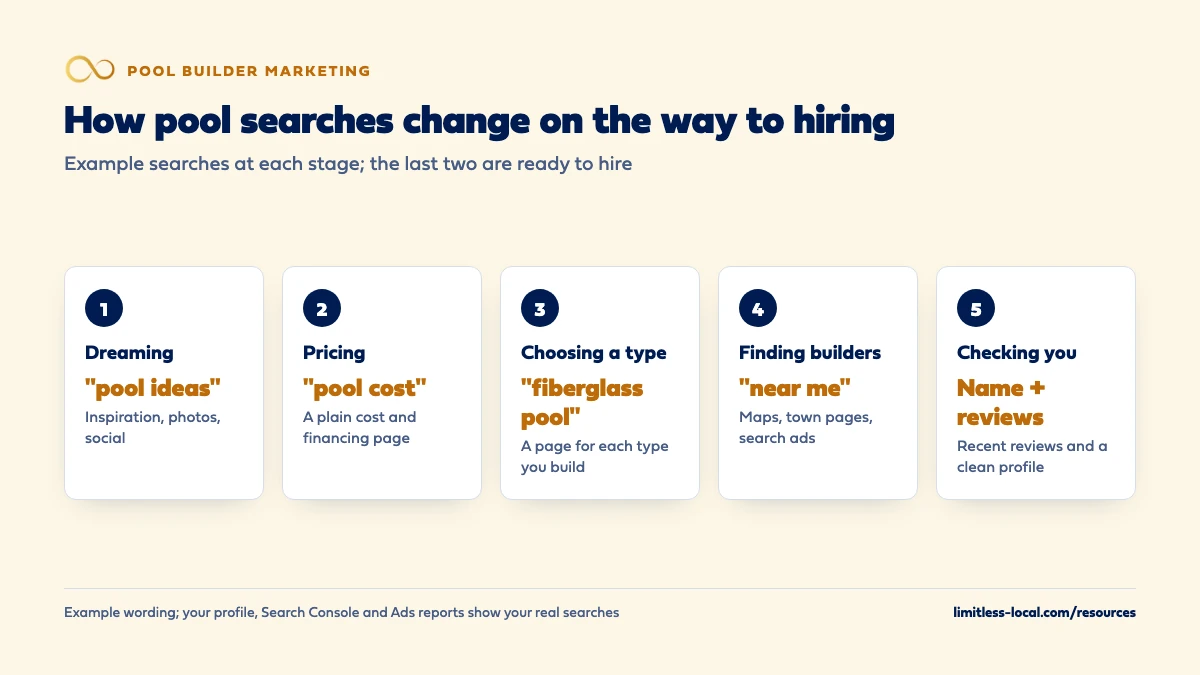
Pool buyers rarely go straight to “pool builder near me”. The searches usually move through stages like these (the wording is an example, not a list of what’s popular in your area):
- Dreaming: “backyard pool ideas”, “small pool designs”.
- Pricing: “inground pool cost”, “is a pool worth it”.
- Choosing a type: “fiberglass vs gunite pool”, “fiberglass pool installation”.
- Finding builders: “pool builders near me”, “inground pool companies” plus a town.
- Checking you out: your company name, your name plus “reviews”, your name plus “cost”.
Stages four and five are ready-to-hire. Stage three is close behind, because someone comparing fiberglass and gunite installations is usually months, not years, from signing. The first two are worth content, but they won’t make the phone ring this week.
What do "near me" and town-name searches tell you?
They tell you the homeowner wants someone local, and wants them now. In a 2018 Think with Google article, How ‘Near Me’ helps us find what we need, Google’s VP of Marketing for the Americas called a search for something near you a pretty strong signal of intent, and noted that smartphone users had been dropping location words like ZIP codes and neighborhoods from local searches because they assume results will already fit their location.
For a pool builder, that means many of your best searches don’t contain your town at all. “Pool builder” typed on a phone in your service area can be just as local as “pool builder” plus the town name. Where the searcher is matters, so your Google profile and website need to make it obvious where you build.
Town-name searches still matter, too, especially from homeowners researching on a laptop, or looking for a builder in a town they’re moving to.
Which pool-type searches mean a homeowner knows what they want?
Searches that name the kind of pool are some of the best you can get, because the homeowner has done the homework and is narrowing down. Examples:
- “Fiberglass pool installation”, “fiberglass pool installers”.
- “Gunite pool builder”, “concrete pool company”.
- “Vinyl liner pool installation”.
- “Pool and spa builder”, “plunge pool installer”, “saltwater pool” plus builder.
- “Custom pool builder”, “luxury pool builder”.
Only chase the types you actually build. A homeowner searching for a fiberglass installer who lands on a gunite-only builder bounces, and if you pay for that click, it’s money gone. Each type you want deserves its own page with real photos, so the homeowner lands right on it.
What does it mean when homeowners search for my company name?
It means you’re on their shortlist. A homeowner searching your name has heard about you from a neighbor, seen a job sign or a build in progress, or found you earlier and come back. Searches like your name plus “reviews”, “cost” or “complaints” are the last check before they call.
What they see matters a lot at this point: your Google profile with recent reviews and photos, your website, and anything else that comes up for your name. If a directory listing with old information shows up first, or your profile has a few reviews from years ago, you can lose a homeowner who was ready to call. How branded searches work for pool builders covers what to check and fix.
Curious what your marketing is actually booking?
Get a free visibility audit — no obligation, no sales pitch.
Are "best pool builders" and "reviews" searches ready to hire?
Yes. Searches like “best pool builders” plus a town, “top rated pool companies” or “pool builder reviews” come from homeowners comparing their options. They’re picking who to call.
You win these mostly on reviews: how many, how recent, and what they say. Homeowners skim for the things they’re worried about, like whether the builder stayed on schedule, cleaned up and answered the phone during the build. Reviews that mention the pool type and the town also help show what you build and where. Getting more Google reviews for a pool company covers how to ask at the right moments.
Are cost and financing searches worth showing up for?
Yes, but know what they are. “How much does an inground pool cost” or “pool financing” usually comes from a homeowner who’s serious but not ready to pick a builder. They’re figuring out whether a pool fits their budget.
Those homeowners are worth catching early, because whoever helps them understand the cost often gets the first call. A plain page about what drives the price of a pool in your area, and how financing works with you, can do that. Just don’t judge it like a ready-to-hire page; expect fewer immediate calls and more homeowners who come back later. If you offer financing, how a pool builder can advertise financing options covers what to say.
Which searches look like pool buyers but aren't?
Plenty of searches contain “pool” and have nothing to do with building one. If you run ads, these are the ones that waste money; if you’re doing SEO, they’re the ones to ignore:
- Service and repair: “pool cleaning”, “pool service near me”, “pool pump repair” (unless you sell that work).
- Above-ground and DIY: “above ground pool”, “pool kit”, “how to build a pool yourself”.
- Supplies: “pool supply store”, “pool chemicals”.
- Jobs: “pool builder jobs”, “pool construction salary”.
- Public pools: “pools near me” often means somewhere to swim.
Negative keywords for pool builders has a starter list for Google Ads.

Where do ready-to-hire searches find you: Maps, your website or ads?
A ready-to-hire search usually shows three kinds of results, and you can show up in all three:
- The Google Maps results. Driven by your Google Business Profile. Google’s help page Tips to improve your local ranking on Google says local results are mainly based on relevance, distance and popularity, and that complete, accurate business information and more reviews and positive ratings can help.
- The regular results. Your website’s pages, which need to match the pool type and area being searched.
- The ads at the top. Search ads you pay for per click, which you can aim at the exact searches and towns you want.
Maps and the regular results take months to build. Ads can show up within days. Many builders run ads on the most valuable ready-to-hire searches while the free results catch up.
How do I see what homeowners actually searched to find me?
You don’t have to guess. Three free reports show real search wording:
- Google Business Profile performance. Google’s page Understand your Business Profile performance says the Searches metric shows the search terms people used to find your business, updated at the start of each month.
- Search Console. The Performance report shows which search queries bring traffic to your website.
- The Google Ads search terms report. Google’s page About the search terms report says it shows how your ads performed when triggered by actual searches. Some low-volume searches are left out for privacy.
If you want to look ahead, Google’s Keyword Planner gives search volumes and forecasts, though very low-volume keywords aren’t discoverable or forecastable, which can happen for small towns. Read your reports once a month, and sort the searches into ready-to-hire, research and not-for-you.
How should my website and profile match these searches?
Use the homeowner’s words, not the trade’s. Google’s SEO Starter Guide suggests thinking about the words a user might search for, since people who know a topic well may use different words than people who are new to it. Your crew says “shotcrete”. Your homeowner may type “concrete pool”.
- A page for each pool type you build, with real photos and the words homeowners use for it.
- Pages for the areas you want most, with builds you’ve done there, not a list of towns pasted at the bottom.
- A Google profile that matches: the right categories, your services in plain words and photos of each pool type.
- A clear next step on every page: call, or request a design consultation.
Writing website content for local pool keywords goes through the page-by-page details.
Want to see where your company stands?
A free visibility audit shows where you show up on Google, Maps and AI answers, and what it's costing you in calls.
What's different about ready-to-hire searches for pool builders
The search path is long. A pool buyer can spend months on ideas, costs and pool types before typing “pool builder near me”. You can show up early, but only the last stages are ready to hire.
Pool type matters more than in most trades. A homeowner who’s decided on fiberglass or gunite searches for it by name, and they want a builder who specializes in it.
“Pool” is a crowded word. Cleaning, repair, supplies, above-ground kits and public pools all share it, so a lot of pool searches aren’t buyers.
Few searches, big jobs. Pool searches in a smaller market can be too thin for tools to report on, but each ready-to-hire search is worth a lot to you.
A worked example: sorting a month of search terms
These numbers are made up to show the method, not a benchmark for your market. Say a pool builder’s search ads got 60 clicks last month. Sorting the search terms report into three piles gives:
- Ready to hire, 24 clicks: “pool builder” plus a town, “inground pool builders near me”, “fiberglass pool installation”. These brought 4 consultation requests.
- Research, 21 clicks: “how much does an inground pool cost”, “fiberglass vs gunite”. These brought 1 request.
- Not for you, 15 clicks: “pool cleaning service”, “above ground pool installers”, “pool builder jobs”. No requests.
A quarter of the clicks were never going to be customers, so the first fix is adding negative keywords for that pile. The second is giving more of the budget to the ready-to-hire searches. The research pile isn’t useless; it might deserve a cost page on the website and a smaller budget, judged over a longer stretch. Do the same sorting with your Google profile searches and Search Console queries, and you’ll know which pages to build next.
Frequently asked questions
Do homeowners search "pool contractor" or "pool builder"?
Both show up, along with “pool company” and “pool installer”. Your own Google profile searches and Search Console queries show which ones homeowners in your area use most, so use those words on your pages.
Should I target searches in towns I don't build in yet?
Only if you’d happily take the job. Pages and ads for towns outside your area bring calls you’ll turn down, which costs you money on ads and time on the phone.
Do homeowners ask AI assistants for pool builders now?
Some will, often in a full sentence instead of a few keywords. The same basics help you there: a complete Google profile, steady reviews and clear pages about what you build and where.
Why don't I see many searches in my Google profile report?
Smaller markets simply have fewer pool searches, and the report only shows terms people used to find your profile. Check it over several months instead of judging one.
Are searches for my competitors' names worth targeting with ads?
Those homeowners already have a builder in mind, so they’re harder to win over. Spend on the general ready-to-hire searches first, and make sure your own name search looks strong.
How often do the searches homeowners use change?
The core searches stay fairly steady, but new pool types and features come and go. Reviewing your search reports once a month catches new wording early.
Key takeaways
- Ready-to-hire searches name the pool work and a place, say “near me”, ask for a company or name a builder.
- Pool-type searches like fiberglass or gunite installation come from homeowners who are narrowing down.
- A search for your company name means you’re on the shortlist, so your profile and reviews must hold up.
- Many “pool” searches are cleaning, supplies, above-ground or jobs; keep them out of your ads.
- Your Google profile searches, Search Console queries and Google Ads search terms show the real wording.
Not sure what's working right now?
Start with a free visibility audit: rankings, Google profile, reviews and tracking, checked against your service area.
More in this section
- What keywords should a pool builder target?
- What should a pool builder website include to get more consultations?
- How do I estimate how many people search for pool builders in my area?
- Which online listings should a pool builder have besides Google?
- How do pool builders qualify leads before the design consultation?
Sources
- How 'Near Me' helps us find what we need, not just where to go — Think with Google
- Tips to improve your local ranking on Google — Google Business Profile Help
- Understand your Business Profile performance & insights — Google Business Profile Help
- Performance report (Search results): Overview and basic setup — Search Console Help
- About the search terms report — Google Ads Help
- Use Keyword Planner — Google Ads Help
- SEO Starter Guide: The Basics — Google Search Central