
How can a restoration company build local links and authority?
- How do restoration companies earn local links and mentions from plumbers, property managers and their community?
- What does authority mean for a local restoration company?
- Why do a few local links beat a big pile of links?
- Which partners can link to a restoration company?
- How do I ask a partner for a link without it becoming a link swap?
- Can I pay, trade work or sponsor something for a link?
- Which community groups and local organizations are worth joining?
- Do certifications and trade associations count?
- How can local news and storm coverage earn me mentions?
- What should I publish that other sites will want to link to?
- Which link offers should a restoration company turn down?
- How do I see which links I've earned?
- What's different about local links for restoration companies
- A worked example: a 90-day local link plan
- Frequently asked questions
- Key takeaways
- More in this section
- Sources
The short version
- Authority comes from real local sites and reviews that vouch for you.
- Ask partners for a recommended-vendor link because it helps their customers.
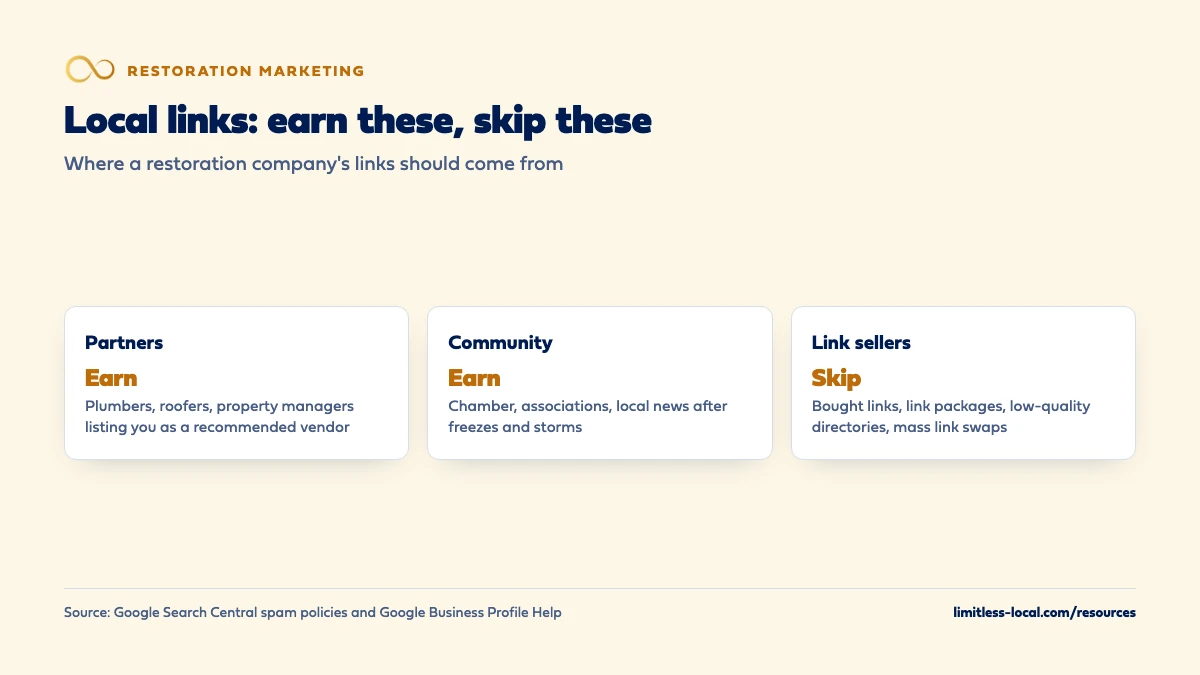
- Never buy, trade work for or mass-swap links; sponsor for goodwill, not rank.
- Check what you've earned in Search Console's Links report.
For restoration owners who want more local sites pointing to them, from the plumbers, property managers and groups they already work with.
Get a free visibility audit · Book a growth call
How do restoration companies earn local links and mentions from plumbers, property managers and their community?
A restoration company builds local links and authority by earning mentions from the people and groups around its work: plumbers, roofers and property managers who recommend it, local associations and chambers it belongs to, certification listings, and local news that quotes it after freezes and storms. Ask partners to list you as a recommended vendor because it helps their customers, publish useful guides worth linking to, and turn down anything sold as a link package. Google lists links and reviews as part of how well-known a business looks, and treats bought links, traded links and excessive link swaps as spam.
Link building that comes from real local relationships is part of our local SEO work, alongside your Google profile, listings and reviews. The restoration marketing page shows how it fits water, fire and mold companies. For every channel in one place, read the restoration marketing guide, or browse more restoration marketing questions.
What does authority mean for a local restoration company?
In plain terms, authority is how well-known and trusted your company looks to Google. Google’s local ranking help page says local results are mainly based on relevance, distance, and popularity, and that prominence is based partly on how many websites link to your business and how many reviews you have.
So authority isn’t something you buy or claim. It’s what other people say about you on the web: a plumber’s site that sends its customers your way, a property management company that lists you as its water damage vendor, a local news story that quotes you after a freeze, a chamber of commerce member page. Each one is a vote that says “this company is real, and it’s part of this community.”
Reviews are the other half of the same signal. Links and reviews together tell Google you’re a company people actually use.
Why do a few local links beat a big pile of links?
Google’s SEO starter guide says Google primarily finds pages through links from other pages it has already crawled, and that other sites linking to you is something that happens naturally over time. The natural links for a restoration company come from the businesses and groups in its own towns.
A link from the plumbing company down the road, whose customers call you after a burst pipe, makes sense to Google and to people. A link from a random blog in another country selling link packages makes sense to nobody, and it can count against you. Ten real local links will do more for a restoration company than hundreds of junk ones, and they’ll never come back to bite you.
There’s a bonus, too. Local links send real people. A homeowner who clicks through from their property manager’s vendor page is far closer to booking than one who found you by accident.
Which partners can link to a restoration company?
Start with the people who see water, fire and mold before you do, or right after you leave:
- Plumbers. They find the leak; you dry the house. Many keep a “trusted partners” or “recommended pros” page.
- Roofers and HVAC companies. Storm leaks and condensate overflows turn into water damage calls.
- Property management companies. They often list approved vendors for their owners and tenants.
- Home inspectors and real estate agents. They spot old water damage and mold and need someone to refer.
- Insurance agents. Some keep resource pages for clients who’ve just had a loss.
- Rebuild contractors and flooring companies. They pick up where your drying ends.
If you already trade referrals with these people, you’ve done the hard part. Building a referral network with plumbers and property managers covers how to start those relationships; this page is about turning them into links and mentions too.
How do I ask a partner for a link without it becoming a link swap?
Ask for it as part of a real working relationship, not as a trade. Something like: “Your customers sometimes need water damage help after you’ve fixed the leak. Would you add us to your recommended partners page so they can find us fast?” That’s useful to their customers, and it’s honest.
What to avoid is the swap. Google’s spam policies list excessive link exchanges (“link to me and I’ll link to you”) and partner pages made only for cross-linking as link spam. A handful of genuine partners who recommend each other is normal business. A page listing fifty businesses you’ve never worked with, all linking back, is the thing Google means.
Make it easy for them. Send your exact business name, your website address, a one-line description of what you do and the towns you cover. Partners are busy; a ready-to-paste blurb gets added, a vague request gets forgotten.
Can I pay, trade work or sponsor something for a link?
Not for ranking purposes. The same spam policies list buying links for ranking as link spam, and that includes exchanging money, goods or services for links. So a free mold inspection in exchange for a link on someone’s site is off the table, and so is any “guest post” you pay for.
Sponsorships are different. Google says paid links aren’t a policy problem as long as they’re marked, and its guide to qualifying outbound links says advertisements and paid placements should carry the rel="sponsored" value. Sponsoring a youth sports team or a community fundraiser is still worth doing for the goodwill and the local name recognition. Just don’t sponsor something because someone promised it would help you rank.
And never pay partners for referrals. Earn the referral and the link by doing great work for their customers.
Curious what your marketing is actually booking?
Get a free visibility audit — no obligation, no sales pitch.
Which community groups and local organizations are worth joining?
Pick a few you’d join anyway, and show up. Groups that often have member directories or event pages that mention local businesses:
- Your chamber of commerce and local business associations.
- Property owner, landlord and apartment associations, where restoration is a service members really need.
- Real estate and home inspector groups that run local events.
- Neighborhood associations and HOA vendor lists, where they’re open to them.
- Local preparedness and community events, where a restoration company has something useful to say about freezes, storms and flooding.
The link is a side effect. What you’re really building is a reputation as the restoration company everyone in town knows, which also happens to be what Google is trying to measure.
Do certifications and trade associations count?
They’re worth having for trust, and some come with a listing. The IICRC, for example, runs a Global Locator that connects homeowners and business owners with certified firms and technicians in cleaning, restoration and inspection. If you hold the certification, make sure your firm’s listing is complete and matches your business name, address and phone exactly.
State and regional restoration or contractor associations often have member directories too. Treat these as listings that back up who you are, more than as a ranking lever. They help most when they’re consistent with everything else about your business online.
Which listings and directories are worth the effort is covered in which restoration citations and directories matter.
How can local news and storm coverage earn me mentions?
Restoration owners have something most businesses don’t: you’re a useful voice when the weather turns. After a hard freeze, a flood or a big storm, local reporters need someone to explain what homeowners should do next. Be that person.
- Introduce yourself to a reporter or two before the season, with a short note on what you can speak to: burst pipes, drying out a basement, what to photograph for an insurance claim, how to tell if water got into the walls.
- When the weather hits, answer fast. Reporters on deadline take the first knowledgeable person who calls back.
- Keep it useful and free of sales talk. The mention and the link come from being the expert, not from pitching.
Not every story will link to you, and that’s fine. A mention by name still helps homeowners recognize you, and the online versions often do link.
What should I publish that other sites will want to link to?
Partners, reporters and associations link to things that help their own audience. A restoration company is sitting on that kind of material:
- A freeze-prep checklist for homeowners and property managers.
- “What to do in the first hour after water damage” written by someone who’s been on hundreds of jobs.
- A plain guide to documenting a loss for an insurance claim.
- Before-and-after job write-ups with your own photos, showing what drying actually involves.
Then tell people it exists. Send the freeze checklist to your property managers before winter. Offer it to the chamber newsletter. What a restoration company should publish to look like an expert has more ideas for pages worth linking to.
Which link offers should a restoration company turn down?
Say no to anything that’s mainly about the link, not about people. From Google’s list of link spam, the offers restoration owners actually get pitched include:
- Link packages, “high-authority backlinks” and paid guest posts with keyword-stuffed links.
- Low-quality directory or bookmark sites.
- Automated programs or services that create links to your site.
- Links hidden in widgets, or spread across the footers of many sites.
- Forum comments stuffed with links to your pages.
If a provider can’t tell you which real sites your links will come from, assume it’s one of these. And if your rankings dropped after a past provider “built links,” that’s worth checking; why a restoration website won’t rank, and what to fix walks through looking for a penalty.
How do I see which links I've earned?
Google Search Console’s Links report shows which sites link to you most, and which of your pages get the most links. It’s a sample, not a complete list, it includes links Google found over time that may since have been removed, and it doesn’t say whether a link is marked nofollow.
Check it every couple of months. You’re looking for two things: that the partner and community links you asked for show up, and that the pages you care about most, like water damage and mold, are the ones getting linked. If every link points to your homepage, ask partners to link to the service page that matches what they refer.
Links are one piece of a bigger picture. What Google needs to trust your restoration company is local shows how links fit with your profile, listings and reviews.
Not sure which of these is costing you jobs?
A free visibility audit checks the Google profile, reviews, site and tracking, and shows what to fix first.
What's different about local links for restoration companies
You already have a referral network. Few trades sit at the center of so many others. Plumbers, roofers, property managers, inspectors and rebuild contractors all touch the same jobs, which means more natural places to be recommended than most local businesses get.
The weather makes you newsworthy. Freezes, floods and storms create local news, and restoration is the expert angle. Few home-service owners get that kind of natural press opportunity.
Commercial relationships carry weight. A property management company’s vendor page is a link and a trust signal at once. What property managers look for in a restoration vendor covers how to get onto those lists.
Referral money is off limits. Partners may suggest a fee per referred job. Don’t. Keep the relationship and the link earned by good work.
A worked example: a 90-day local link plan
This plan is made up to show the shape of the work, not a forecast. A restoration company lists 20 places that could reasonably mention it:
- 10 trade partners it already swaps jobs with: plumbers, a roofer, an HVAC company, a flooring company.
- 6 property management companies it has done work for.
- 3 community groups: the chamber, a landlord association and a neighborhood association.
- 1 local newsroom, with a short note before freeze season.
Over 90 days, the owner sends each partner a ready-to-paste blurb, joins the landlord association, and sends a freeze-prep checklist to every property manager. Say 4 of the trade partners add a link, 2 property managers put the company on their vendor pages, and all three groups list it as a member. That’s 9 new local sites mentioning the company, each with a real reason to, and no money spent on links.
Nine links won’t move rankings overnight. But they’re the right kind, they send real customers, and they keep adding up every quarter you repeat the routine.
Frequently asked questions
How many local links does a restoration company need?
There’s no set number. A handful of genuine local links from partners and community groups is a solid start, and the right number depends on how many links the companies already ranking in your area have.
Do links from partners outside my service area help?
They can still help Google find you, but local links make more sense for a local business and send customers who can actually hire you. Focus on your own towns first.
Does a link on a supplier or equipment maker's dealer page count?
It’s a genuine business relationship, so it’s fine to ask to be listed. It shows you’re a real company, though it says less about your local area than a link from a nearby partner.
How long do local links take to affect rankings?
Expect months, not weeks. SEO typically takes 3-6 months to show meaningful organic growth, and links build up slowly as relationships turn into mentions.
Should I link back to my partners from my own site?
If you genuinely recommend them to your customers, yes. Keep it to real partners. A page listing dozens of businesses only for cross-linking is what Google calls link spam.
Is a social media mention as good as a link?
It’s not the same as a link from a local website, but it still puts your name in front of local people. Treat social mentions as word of mouth rather than an SEO tactic.
Key takeaways
- Authority is how well-known and trusted you look; Google ties local prominence partly to links and reviews.
- The best restoration links come from partners, property managers, community groups and local news.
- Ask for links because they help a partner’s customers, not as a swap.
- Never buy links or trade work for them; mark sponsorships and do them for goodwill.
- Publish freeze checklists, first-hour guides and job write-ups that others want to share.
- Use Search Console’s Links report to see what you’ve earned.
Want a second set of eyes on your setup?
We'll look at how you show up locally and where calls are leaking, then send you a plain-English breakdown.
More in this section
- How should a restoration company build city pages that rank?
- How should a restoration company get more customer referrals?
- Can a restoration company rely on SEO and Maps without ads?
- What can a restoration company use for leads while SEO ramps up?
- What does Google need to trust my restoration company is local?
Sources
- Tips to improve your local ranking on Google — Google Business Profile Help
- SEO Starter Guide: The Basics — Google Search Central
- Spam Policies for Google Web Search — Google Search Central
- Qualify Outbound Links for SEO — Google Search Central
- Links report — Search Console Help
- IICRC Global Locator — IICRC