
What is a realistic cost per booked plumbing job by channel?

- What should a booked plumbing job cost from Google Ads, LSAs, SEO and referrals?
- Why is there no single realistic cost per plumbing job?
- How do I work out cost per booked job for a channel?
- What drives the cost per booked job from Google Ads?
- What drives the cost per booked job from Local Services Ads?
- What drives the cost per booked job from SEO and my Google profile?
- What does a booked job from referrals and repeat customers cost?
- What about lead services and directories?
- Why does my booking rate matter more than my lead price?
- What's the most I can afford to pay per booked job?
- How do I compare channels fairly?
- How do I build my own realistic range?
- What's different about cost per job for plumbing companies
- A worked example: four channels side by side
- Frequently asked questions
- Key takeaways
- More in this section
- Sources
The short version
- There's no honest national number; build your own from three months of data.
- Paid channels: cost per job = cost per lead divided by your booking rate.
- SEO and your profile: a fixed cost that gets cheaper per job over time.
- Judge every channel against what its average job earns you.
For plumbing owners comparing channels who want to know what a booked job should cost from each one, and why their number won’t match anyone else’s.
Get a free visibility audit · Book a growth call
What should a booked plumbing job cost from Google Ads, LSAs, SEO and referrals?
A realistic cost per booked plumbing job is the one your own numbers show: each channel’s full monthly cost divided by the new jobs it actually booked, and it varies widely by market, job type and how well your office books calls. Google Ads and Local Services Ads charge per click or per lead, so their cost per job moves with your booking rate; SEO and your Google profile carry a fixed monthly cost that gets cheaper per job as volume builds; and referrals cost little cash but can’t be turned up on demand. A channel is working when its cost per booked job sits comfortably under what an average job from that channel earns you.
Cost per booked job is the number we report on, not clicks or impressions. Every Limitless Engine package includes call tracking with recording, source tagging and a monthly report with a cost-per-lead breakdown, so each channel’s cost can be matched to the jobs it booked. Google Ads management comes with every package, and Growth adds Local Services Ads; see how our local ads work for plumbing companies, or browse more plumbing marketing questions.
Why is there no single realistic cost per plumbing job?
Because four things change it, and every plumbing company has a different mix:
- The job. An emergency leak search and a planned water heater swap draw different searches, different competition and different tickets.
- The market. More plumbers bidding in a metro means higher prices per click and per lead than in a small town.
- The channel. Some charge per click, some per lead, some a flat fee, some nothing up front.
- Your office. How many calls turn into booked jobs, which can double or halve your cost per job on its own.
Lead platforms say the same about their own pricing. Thumbtack, for example, explains that lead prices vary with the type and size of the job, how many pros are available and your market. So a number quoted for “plumbers” nationally is an average of shops that look nothing like yours. The useful work is building your own number for each channel.
How do I work out cost per booked job for a channel?
One formula for every channel:
Cost per booked job = everything the channel cost in a period ÷ new-customer jobs it booked in that period.
“Everything” means ad spend plus management fees, software, tracking and any staff time spent on it. “New-customer jobs” means first-time customers who booked paid work, not repeat customers or members who happened to call the ad number. Use the same period for both, and use at least a month; three is better.
The exact steps, including how to handle Local Services Ads credits and agency fees, are in how to work out your plumbing customer acquisition cost.
What drives the cost per booked job from Google Ads?
Google Ads charges per click, so the cost per job is a chain: what each click costs, how many clicks it takes to get a call or form, and how many of those turn into a booked job. Improve any link and the whole number drops.
- Cost per click depends on the keywords, your market and how many plumbers are bidding.
- Clicks per call depends on your ad, your landing page and whether the search was really for a plumber.
- Calls per booked job depends on your office.
To estimate the first link before you spend, Google’s Keyword Planner forecasts show a top-of-page bid range for each keyword in your location: the low end approximates the 20th percentile and the high end the 80th of what advertisers have historically paid. Emergency searches like “burst pipe” or “emergency plumber” usually sit toward the expensive end because the job is urgent and valuable.
What drives the cost per booked job from Local Services Ads?
Local Services Ads charge per valid lead, not per click, which cuts out one link of the chain. Google’s page on how leads work lists what you pay for: answered calls, missed calls during your business hours where the caller stays on the line more than twenty seconds, messages, voicemails and booking requests. Lead prices vary by location, job type, lead type and bidding. Google screens out spam and duplicates, and reassesses charged leads over a 30-day period, crediting ones it later finds are low quality.
So your cost per booked job from LSAs comes down to two things: the average cost per charged lead after credits, and how many leads book. Missed calls hurt twice here: you pay for the lead and you don’t get the job. The other big lever is settings. If you’re getting unwanted leads, narrow your service areas, categories and service types; that can mean fewer but better leads. Whether Local Services Ads are worth it for plumbers covers the full decision.
What drives the cost per booked job from SEO and my Google profile?
Organic search and your Google Business Profile don’t charge per click or per lead. The cost is fixed: an agency fee, your website, content and your own time. That changes the shape of the number completely.
In the first months, the fixed cost is spread over few jobs, so the cost per booked job looks terrible. SEO typically takes 3 to 6 months to show meaningful organic growth. As calls build, the same monthly cost is spread over more jobs and the cost per job falls, often below your paid channels. Once you rank, extra calls don’t cost more.
That’s why comparing SEO with ads in month two is unfair to SEO, and comparing them in month twelve can be unfair to ads. Judge SEO on its trend over several months, and judge it on booked jobs from organic search and your profile, not on rankings. How long until plumbing marketing hits a profitable cost per job shows what that trend usually looks like by channel.
Curious what your marketing is actually booking?
Get a free visibility audit — no obligation, no sales pitch.
What does a booked job from referrals and repeat customers cost?
Very little in cash, which is why they’re the best jobs you get. The real costs are indirect: the work quality and follow-up that earn the referral, a maintenance program, and any thank-you you give.
Two cautions when you compare them with paid channels:
- Keep repeat customers out of your ad numbers. A past customer who Googles your name and clicks your ad was already yours. Counting them makes the ad look cheaper than it is.
- You can’t turn referrals up on demand. They grow with your customer base, slowly. Paid channels are what you use when you need more jobs next month.
If you have a lot of past customers and members, regular contact with them is usually the cheapest booked job you can buy. Getting more repeat customers and referrals for a plumbing company covers how.
What about lead services and directories?
Lead platforms charge per lead or per opportunity, so they work like Local Services Ads in the math: cost per lead divided by your booking rate. Some let you set your own lead price and auto-pay when a matching customer reaches out; others show open jobs where you contact the customer first and pay only if they respond.
What usually raises cost per booked job on these platforms is competition for the same customer. If several plumbers are contacting one homeowner, your booking rate drops and your cost per job rises, even when the lead price looks cheap. Track them like any other channel, with their own tracking number or lead source, and compare cost per booked job, not price per lead.
Why does my booking rate matter more than my lead price?
Because it divides into everything. Pay $70 a lead and book half of them, and each job cost $140. Book a quarter and the same leads cost $280 a job. No change in the ads, double the cost.
Booking rates differ a lot from shop to shop. ServiceTitan’s call booking rate data from June 2022, covering more than 3,000 trade businesses using its software in the U.S. and Canada, put plumbing’s average call booking rate at 43%, with businesses of 25 or more techs at 59% and those with fewer than five at 24%, across all trades. That’s a snapshot of one software company’s users, not a target for your shop, but it shows how wide the gap between offices can be.
So before you decide a channel is too expensive, listen to a dozen of its calls. Missed calls, slow callbacks and calls that end without an offer to book are cheaper to fix than any ad.

What's the most I can afford to pay per booked job?
Your ceiling comes from your own tickets and margins, not from what other plumbers pay. A simple way to set it:
- Take the average first-job ticket from that channel.
- Multiply by your gross margin on that work.
- Decide how much of that gross profit you’re willing to spend to win the customer.
Set separate ceilings for emergency work and planned work. A water heater replacement or sewer line can carry a much higher cost per booked job than a small drain call and still be well worth it. And if a channel brings customers who come back for years, or join your maintenance plan, you can justify a higher first-job cost for it. How much a plumber can afford to pay for a lead works through the ceiling in more detail.
How do I compare channels fairly?
- Same period, same definitions. One month or one quarter, and the same meaning of “booked” everywhere.
- Full cost. Include management fees and software, not just ad spend.
- New customers only. Keep repeat customers and members out.
- Split emergency and planned work. Their costs and tickets are different enough to hide each other.
- Allow for slow bookings. Big jobs often book days or weeks after the first call, so count them by lead source on the job.
- Give each channel a fair run. A few months for paid channels; longer for SEO.
Field software can do much of this. Housecall Pro’s ROI Table, for example, can show cost per job by lead source once you enter what you spent on each one.
How do I build my own realistic range?
Use your last three months. For each channel, work out cost per booked job each month. Your best and worst months are your realistic range for now, and the middle is your working number.
Then recheck it every quarter. The range moves when you change your ads, your booking process, your service area or the season, and when competitors come and go. A channel whose range sits under your ceiling is worth more budget; one whose range sits over it needs fixing or cutting.
If you don’t have three months of clean data yet, that’s the first project, before any channel comparison. How to track which plumbing marketing books jobs gets you there.
Talk it through with someone who runs this every day
A 15-minute growth call: your market, your numbers, and what a realistic budget looks like. No pressure.
What's different about cost per job for plumbing companies
Emergency and planned work are two different businesses. Emergency searches are usually pricier per click and per lead, but they book fast and the tickets can be high. Planned work like repipes and water heaters takes longer to book and needs estimates. Work out cost per booked job for each.
After-hours calls change the math. If night calls go to voicemail, LSAs can still charge for missed calls during your listed business hours, and you lose the job too. Night coverage often lowers cost per job more than any ad change.
One job can turn into several. A first visit for a clogged drain can become a camera inspection, a sewer repair and a maintenance plan. Look at what the customer was worth over a year, not only the first ticket, before you call a channel too expensive.
A worked example: four channels side by side
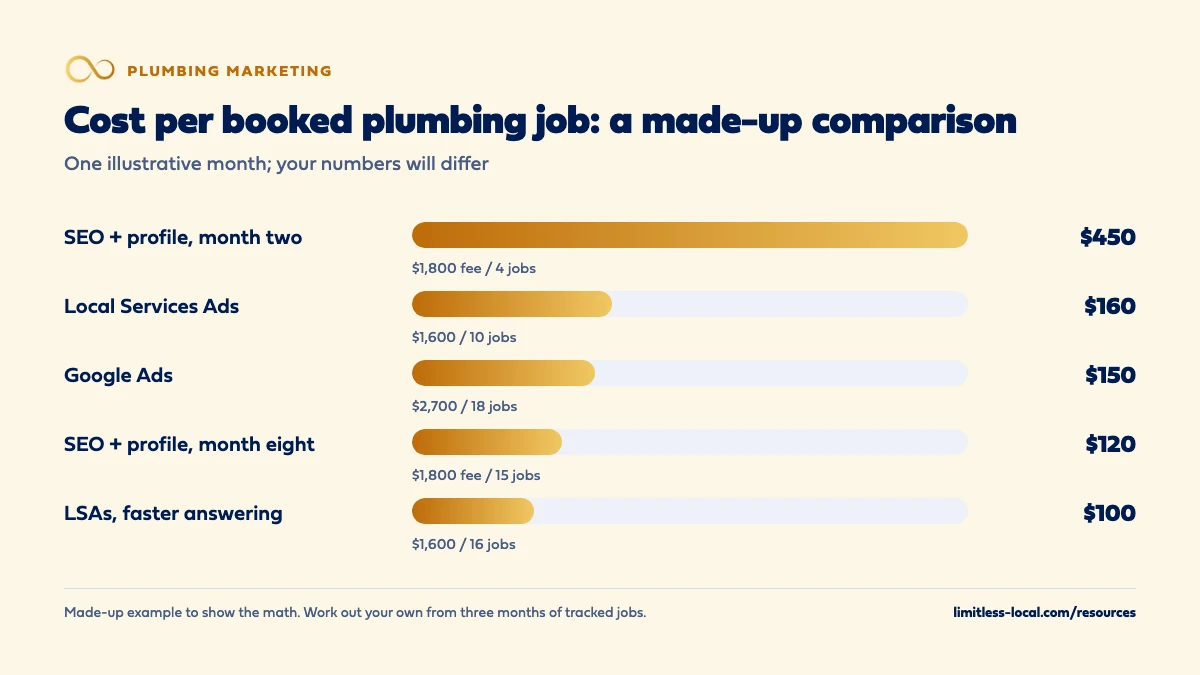
These numbers are made up to show the math, not a benchmark for your market. Say a plumbing shop tracks one month:
- Google Ads: $2,700 in spend and fees, 18 new-customer jobs booked. That’s $150 per booked job.
- Local Services Ads: 32 charged leads at $50 after credits, so $1,600, and 10 booked jobs. That’s $160 per booked job.
- SEO and Google profile: a $1,800 monthly fee. In month two it booked 4 jobs, or $450 per job. By month eight it books 15, or $120 per job.
- Referrals: 8 jobs with almost no cash cost.
LSAs look cheapest per lead ($50) but book only 10 of 32. Lift that to 16 booked jobs by answering faster and the cost per job falls to $100. SEO looks worst early and best later. If this shop’s average first job earns $300 in gross profit, Google Ads and LSAs are both under that ceiling, SEO is over it in month two and well under it by month eight, and the next question is which channel has room to grow.
Frequently asked questions
Is cost per lead or cost per booked job the better number?
Cost per booked job. A cheap lead that never books costs more than an expensive one that does.
Should I count the agency fee in cost per booked job?
Yes. Everything you pay to run a channel belongs in its cost, including management, software and tracking.
My cost per job is higher than other plumbers say they pay. Is something wrong?
Not necessarily. Their market, job mix and definition of a booked job may be different. Compare your number with your own ceiling and your own trend instead. What a qualified plumbing lead costs in your market explains why numbers differ.
How long should I track before trusting the number?
At least a month for paid channels, ideally three. SEO needs longer, because it ramps over several months.
Does a membership sign-up count as a booked job?
Count it separately. Track first jobs for cost per booked job, and memberships as extra value the channel brought.
Should I cut the channel with the highest cost per job?
Only if it stays over your ceiling after you’ve fixed booking and settings and given it a fair run. A channel with a higher cost per job can still be worth it if its jobs are bigger.
Key takeaways
- There’s no honest national cost per booked plumbing job; your own three months of data is the realistic number.
- For paid channels, cost per booked job is cost per lead divided by booking rate, so your office matters as much as your ads.
- SEO and your Google profile start expensive per job and get cheaper as calls build.
- Keep repeat customers out of channel numbers, and split emergency from planned work.
- Judge each channel against your own ceiling: what its average job earns you.
Ready to compare options?
Book a short growth call and we'll walk through the math for your service area, including when we're not the right fit.
More in this section
- How much budget and time does each plumbing marketing channel need?
- How much should a plumber budget to book a set number of jobs?
- How long until plumbing marketing hits a profitable cost per job?
- What percentage of plumbing leads should turn into booked jobs?
- How do I work out my plumbing customer acquisition cost?
Sources
- How much do I pay for leads and opportunities? — Thumbtack Help
- About Keyword Planner forecasts — Google Ads Help
- How leads work — Google Local Services Help
- Data Report: Average Call Booking Rates — ServiceTitan
- Marketing Dashboard: ROI Table — Housecall Pro Help Center