
How do I tell if my website can outrank local restoration rivals?
- How can a restoration owner size up the competitors ranking above their website?
- Which competitors am I actually trying to outrank?
- Am I losing in the map pack, the regular results, or both?
- Check 1: Do they have a page for the exact job and town?
- Check 2: Are their pages more useful than mine?
- Check 3: Who links to them, and who links to me?
- Check 4: How do their reviews and Google profile compare?
- Check 5: Does their site work better on a phone?
- Check 6: How close are they to the people searching?
- Is Google showing my site at all for these searches?
- How do I score the comparison?
- What if the companies above me are far ahead on everything?
- How long would it take to pass them?
- What's different about outranking restoration rivals
- A worked example: scoring one town against two rivals
- Frequently asked questions
- Key takeaways
- More in this section
- Sources
The short version
- Compare yourself only against the companies ranking for your real searches.
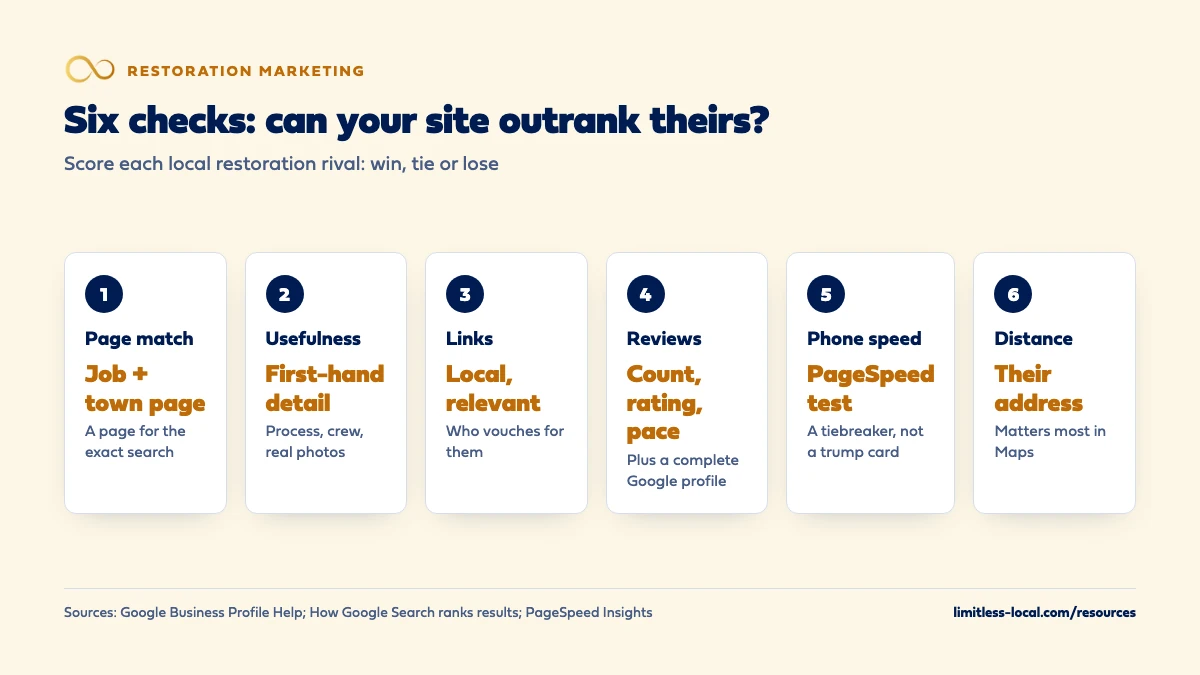
- Check page match, usefulness, links, reviews, phone speed and distance.
- Gaps in pages and links are fixable; distance isn't.
- Start with the searches where you're closest, not the biggest prize.
For restoration owners looking at the water, fire and mold companies above them on Google and wondering whether passing them is realistic or a money pit.
Get a free visibility audit · Book a growth call
How can a restoration owner size up the competitors ranking above their website?
Pick the searches you want to win, note the three or four restoration companies that rank for them, and compare your site to theirs on six things: a dedicated page for the exact job and town, how useful those pages are, how many local and relevant sites link to them, their reviews and Google profile, how well their pages work on a phone, and how close they are to the people searching. If the gap is mostly pages and links, steady work can close it. If they beat you on nearly everything and sit closer to the searchers, start with narrower searches you can realistically win.
This kind of side-by-side is where a free visibility audit starts: where you show up today, who’s above you, and what it would take to pass them. When it’s worth doing, the pages, links, Google profile work and tracking are all part of our packages, and our restoration marketing page shows how that applies to water, fire and mold work. The restoration marketing guide covers every channel, and the rest of the restoration marketing questions go one question at a time.
Which competitors am I actually trying to outrank?
Not every restoration company in your county. Only the ones that rank for the searches that bring you jobs. Write down five to eight of those searches, the way a homeowner or property manager would type them: “water damage restoration [your town]”, “mold remediation [nearby town]”, “fire damage cleanup near me”, “sewage cleanup [town]”.
Search each one and note who shows up in two places: the map pack (the three businesses with the map) and the regular website results below it. You’ll usually see the same three or four names over and over. Those are your real rivals. A national franchise’s corporate page or a directory listing isn’t someone you’re trying to beat page for page; the local company two towns over is.
Results change with the searcher’s location, device and history, so check from a few spots in your service area, or have a crew member search from their phone on a job across town.
Am I losing in the map pack, the regular results, or both?
They’re scored differently, so the self-check splits here. Google says local results in Maps are mainly based on relevance, distance and popularity, and that how well known a business is depends partly on how many websites link to it and how many reviews it has (Google Business Profile Help). The regular results are about your website pages: whether they match the search, how useful they are and how other sites treat them.
Your website feeds both. It backs up your Google profile in Maps and it competes on its own below. But if you’re in the map pack and missing from the website results, the fix is pages and links. If it’s the other way around, look at your profile, reviews and address first. Why newer competitors outrank an older company digs into the map pack side.
Check 1: Do they have a page for the exact job and town?
Open the page that ranks, not their home page. Does it exist only to cover water damage in that town, or is it a general services page? Google’s explanation of how ranking works says the most basic sign a page is relevant is that it contains the same words as the search, for example in its headings or body text.
Then open yours. If they have a dedicated water mitigation page, a separate mold remediation page and a page for the town, and you have one “Services” page listing everything, you’ve found your first gap. It’s also the cheapest to close: you can write a strong page in an afternoon if you know the work.
Watch the other direction too. If a rival has fifty near-identical town pages with only the town name swapped, that’s not something to copy. Building city pages that rank covers how to do town pages properly.
Check 2: Are their pages more useful than mine?
Read their ranking page like a homeowner with a wet basement would. Does it say what happens in the first hour, who shows up, how drying is checked and what the homeowner should and shouldn’t touch? Does it have real photos of their crew and equipment? Or is it three paragraphs that could be about any company in any state?
Google’s guidance on helpful content asks whether a page shows first-hand expertise and a depth of knowledge, like the kind that comes from actually doing the work. Restoration owners have a big edge here, because you’ve stood in the water. If their page is generic and yours explains your actual process, mark it as a win for you. If theirs is detailed and yours is thin, that’s a gap you can close with a few hours of writing and photos you already have on your phone.
Check 3: Who links to them, and who links to me?
Google says one of the factors used to judge quality is whether other prominent websites link to or refer to the content. For a local restoration company, the links that count are the believable ones: a plumber’s “companies we trust” page, the chamber of commerce directory, a local news story after a freeze, a property management association’s member list.
Search Console’s Links report shows a sample of the sites linking to you, though not to anyone else. To see a competitor’s links, use one of the backlink checkers that offer a free lookup by domain. Don’t compare raw totals, which can be padded with junk. Compare how many local, relevant sites link to each of you, and which of those you could earn too.
If they’re ahead here, it’s usually the slowest gap to close, because real links come from real relationships. Building local links and authority covers where they come from. Don’t buy them: Google’s spam policies list buying links for ranking purposes as link spam.
Curious what your marketing is actually booking?
Get a free visibility audit — no obligation, no sales pitch.
Check 4: How do their reviews and Google profile compare?
For the map pack, put each rival’s Google profile next to yours and note:
- Review count and star rating.
- How recent their newest reviews are, and how often new ones come in.
- Primary category and the services listed.
- Hours (24/7 or not) and whether they reply to reviews.
- Photos of real jobs, crews and trucks.
Google says more reviews and positive ratings can help local ranking. You don’t need to beat the leader’s total tomorrow, but if they get several new reviews a month and you get one a quarter, the gap widens every month you wait. A strong review habit is one of the few things a smaller company can match quickly.
Check 5: Does their site work better on a phone?
A homeowner with water on the floor is usually searching on a phone, so test the ranking pages the way homeowners see them. Google’s PageSpeed Insights will check any public page, yours or a competitor’s, and when there’s enough real-visitor data it shows how the page performed for actual Chrome users over the previous 28 days. It rates Largest Contentful Paint as good at 2.5 seconds or less.
Google’s ranking explanation says that when all other signals are relatively equal, more accessible content may perform better, and it names mobile-friendly pages that load quickly. So speed is a tiebreaker, not a trump card. If your page is slow and theirs is fast, fix it, but don’t expect speed alone to jump you past a company with better pages and more links. Mobile speed fixes for a restoration website lists what usually helps.
Check 6: How close are they to the people searching?
This one matters most in Maps. Google says distance is how far each business is from the person searching, and you can’t change your address with marketing. If a rival’s shop sits in the middle of the town you want and yours is twenty minutes out, they’ll have an edge in the map pack there no matter what you do.
The regular website results lean less on your address, which is why a strong town page can rank in places where your Google profile struggles. So a lost distance check doesn’t end the conversation. It tells you to win that town through your website and ads instead of counting on Maps.
Is Google showing my site at all for these searches?
Before you compare anything else, make sure you’re in the race. Search Console’s Performance report shows which searches your site appeared for, how often, and the average position of your top result. If your water damage page has almost no impressions for the searches you care about, Google may not be indexing it or may not see it as a match.
If that’s the case, the comparison with your rivals is premature. Fix indexing and the basics first, which why a restoration website won’t rank walks through step by step.
How do I score the comparison?
Make a simple grid: your company and each rival across the top, the six checks down the side. Mark each box win, tie or lose. Then read it like this:
- You lose mostly on pages and usefulness. Good news. That’s the fastest gap to close, and it’s mostly writing and photos.
- You lose mostly on links and reviews. Closable, but it takes months of steady effort, not a sprint.
- You lose on distance but win elsewhere. Push the website results and ads in that town; don’t count on the map pack.
- You lose on almost everything. Don’t pick that fight first. Go after narrower searches where you’re closer and the competition is lighter.
What if the companies above me are far ahead on everything?
Then change the target, not your ambition. A rival that dominates “water damage restoration” in the biggest city in your area may be weak on “mold remediation” in the suburbs where your crews already work, or on sewage cleanup, or on commercial water damage. Run the same six checks on those narrower searches. Wins there bring calls sooner and build the links, reviews and pages that help you on the bigger searches later.
Meanwhile, ads can put you above the companies you can’t outrank yet, which is often the right call while SEO builds. What decides the cost to rank for water damage searches helps you price the bigger fight.
How long would it take to pass them?
Nobody can promise a date, because Google’s rankings move and your rivals aren’t standing still. As a planning guide, SEO typically takes 3 to 6 months to show meaningful organic growth, and ads can bring leads within days of launch. Page gaps tend to show results first; link and review gaps take longer.
A fair way to plan: give each gap a month you expect to close it by, check the same searches monthly from the same spots, and watch your calls and booked jobs, not just your position. If a rival is still pulling away after six months of steady work, revisit which searches you’re fighting for.
Want to see where your company stands?
A free visibility audit shows where you show up on Google, Maps and AI answers, and what it's costing you in calls.
What's different about outranking restoration rivals
Franchises and directories crowd the results. National restoration brands and lead sites often take spots for the biggest searches. They’re hard to beat on the broad terms and often weak on specific town and service pages, which is where a local owner wins.
Each service is its own race. The company that wins water damage in your town isn’t always the one that wins mold or fire. Score each service separately before deciding where you’re behind.
Emergency searches favor Maps and ads. For urgent water calls, the map pack and ads sit above the website results. Outranking a rival’s website matters most for fire, mold, commercial and research searches, where people read before they call.
A worked example: scoring one town against two rivals
The companies and numbers here are made up to show the scoring. A restoration owner wants “water damage restoration” and “mold remediation” in one suburb. Two rivals keep showing up.
- Rival A has a dedicated page for the suburb, 180 Google reviews, links from about 30 local sites, and its shop is in town.
- Rival B has one general services page, 40 reviews, links from about a dozen local sites, and sits two towns away.
- The owner has no suburb page, 65 reviews, links from about 15 local sites, and sits between them.
Against Rival A, the owner loses on page match, links, reviews and distance. Against Rival B, the owner ties on distance, wins on reviews and links, and loses only on page match. So the first move is clear: build a real page for the suburb with water and mold sections, crew photos and local jobs, and aim to pass Rival B first. Rival A is a longer project built on reviews and local links.
If you’d rather hand that work off, our Essentials package is $3,500 a month and includes a content sprint of up to 10 pages, link building and Google Business Profile management for one location. Ad spend is paid to Google separately.
Frequently asked questions
Does domain age decide who ranks higher?
Age isn’t one of the local ranking factors Google lists. An older site often has more links and reviews built up, which helps, but a newer company with better pages and a stronger profile can pass it.
Can I use a paid SEO tool's authority score to compare sites?
As a rough guide, yes. Those scores are each tool’s own estimate, not something Google uses, so compare sites within the same tool and look at which local sites link to each company rather than the score alone.
Should I copy the pages my competitors rank with?
No. Copying their structure is fine, copying their words isn’t, and a page that says the same thing as theirs gives Google no reason to prefer yours. Write about how your crews actually do the job.
What if a competitor is breaking Google's rules to rank?
You can report spam to Google, but don’t build your plan around them getting caught. Keep closing the gaps you control, and keep your own pages, links and reviews clean.
How many searches should I compare on?
Five to eight is enough for most restoration companies: your main service in your main town, each other service you want to grow, and the two or three towns that matter most.
Is it worth outranking a rival's website if they own the map pack?
Often, yes. Fire, mold, commercial and research searches send people to websites, and a strong page can bring calls from towns where your Google profile can’t compete on distance.
Key takeaways
- Compare yourself only to the three or four companies that rank for the searches that bring you jobs.
- Score six things: page match, usefulness, links, reviews and profile, phone speed and distance.
- Page gaps are the fastest to close; links and reviews take months; distance can’t be changed.
- If a rival beats you on almost everything, win narrower searches first and use ads in the meantime.
- Track the same searches monthly and judge progress by calls and booked jobs.
Not sure what's working right now?
Start with a free visibility audit: rankings, Google profile, reviews and tracking, checked against your service area.
More in this section
- Why won't my restoration website rank, and what should I fix?
- How should a restoration company build city pages that rank?
- How do I rank in Google for water damage restoration in my city?
- Why do newer restoration competitors outrank my older company?
- How competitive is my local restoration market for marketing?
Sources
- Tips to improve your local ranking on Google — Google Business Profile Help
- How Google Search ranks results — Google Search
- Creating helpful, reliable, people-first content — Google Search Central
- Links report — Search Console Help
- About PageSpeed Insights — Google for Developers
- Performance report (Search results) — Search Console Help
- Spam policies for Google web search — Google Search Central