
What should a roofing website say about services and locations?
- How should my roofing website explain what I do, where I work and why homeowners can trust me?
- What does a homeowner need to learn in the first few seconds?
- How should my website describe the roofing services I offer?
- How should my website say where I work?
- What should my website say about my experience?
- What proof should back up those claims?
- What should a roofing website say about warranties?
- Which claims should a roofing website avoid?
- How should contact details appear on a roofing website?
- Should my website explain what happens after a homeowner calls?
- How do I check whether my website says all of this?
- What's different about website copy for a roofing company
- A worked example: rewriting the top of a roofing home page
- Frequently asked questions
- Key takeaways
- More in this section
- Sources
The short version
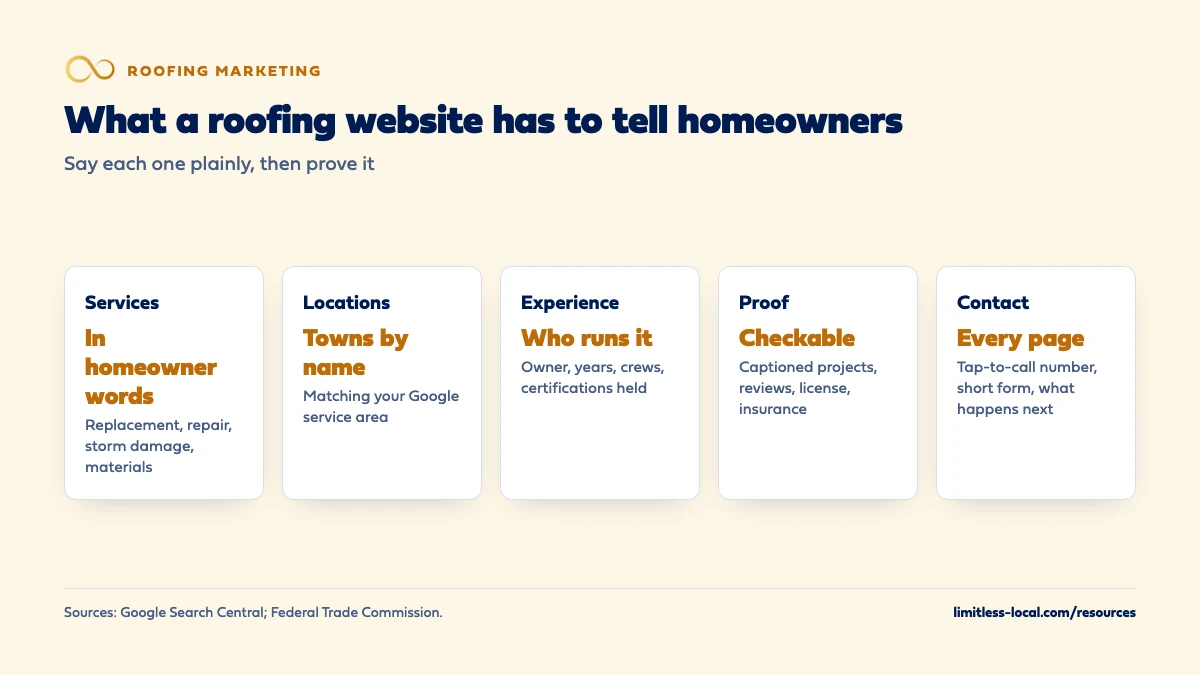
- Top of every page: what you do, where you do it, and a tap-to-call number.
- Services in homeowner words, including materials and what you don't do.
- Locations by name, matching your Google profile's service area.
- Proof that backs each claim: owner, license, insurance, warranty, real projects, reviews.
For roofing owners rewriting their website copy who want homeowners, and Google, to understand the work, the towns and the company behind it in seconds.
Get a free visibility audit · Book a growth call
How should my roofing website explain what I do, where I work and why homeowners can trust me?
A roofing website should say, in plain words near the top of every page, what roofing work you do, which towns you do it in, and how to reach you. Name each service the way homeowners search for it (roof replacement, roof repair, storm damage inspections, the materials you install), list the actual towns and counties you serve, and back it up with who runs the company, licensing and insurance, warranty terms, and real projects and reviews from those towns. Specific and true beats big and vague: “roof replacement in three named towns, with photos” earns more calls than “quality roofing serving the area.”
Writing a site that says all this clearly is part of the roofing marketing work we do, whether that’s rewriting the pages you have or building new ones: a themed website is $3,750, or $3,000 with any Limitless Engine package, with up to 25 pages. Our local SEO work then keeps the site and your Google profile saying the same thing. The roofing marketing guide covers the bigger plan, and the roofing marketing questions library takes each piece in turn.
What does a homeowner need to learn in the first few seconds?
Three things, before they scroll: what you do, where you do it, and how to reach you. A homeowner with a leak or hail damage is on a phone, comparing a few roofers, and they’ll leave the moment they have to hunt for any of the three.
So the top of your home page, and the top of every other page, should carry:
- A headline that names the work and the place. “Roof replacement and repair in Round Rock, Georgetown and Cedar Park” tells a homeowner they’re in the right spot. “Quality you can trust” tells them nothing.
- One line of proof. Years in business, family-owned, or the number of roofs you’ve done locally, whatever is true and specific.
- A tap-to-call number and a short estimate request button.
Everything else on the site expands on those three. Which pages you need to hold all of it is covered in what pages a roofing website should have; this page is about what those pages should say.
How should my website describe the roofing services I offer?
Name every job you want calls for, in the words homeowners use. Google’s SEO Starter Guide tells site owners to think about the words a user might search for, and notes that people new to a topic search differently from experts. Homeowners say “new roof” and “roof leak” before they ever say “reroof” or “flashing failure.”
For each service, say:
- What the job is: roof replacement, roof repair and leak repair, storm and hail damage inspections, gutters, skylights, whatever you actually sell.
- Which materials you install: asphalt shingles, metal, tile, flat and low-slope roofs. A homeowner who wants a metal roof needs to see the word “metal.”
- Who it’s for: homeowners, landlords, HOAs, commercial buildings.
- What you don’t do. If you don’t touch commercial flat roofs or tile, say so. It saves you calls you’d turn away anyway.
Each main service deserves real depth on its own page: signs a homeowner needs it, how your process works and what drives the price. What a roof repair or replacement service page should include goes section by section.
How should my website say where I work?
By name. List the city you’re based in and the towns, counties or parts of the metro you serve, and say it the same way everywhere on the site. “Serving the greater area” makes a homeowner guess. “Based in Round Rock, serving Williamson County: Round Rock, Georgetown, Cedar Park, Leander and Hutto” doesn’t.
A few rules:
- Match your Google profile. Google’s guidelines for representing your business ask service-area businesses for an accurate service area that, for most businesses, doesn’t extend farther than about 2 hours of driving time from where they’re based. The towns on your website should line up with the towns on your profile. The full cleanup is in whether your name, address and phone need to match everywhere.
- Only list towns you’ll actually drive to. Every town you name invites calls from it.
- Put your core towns first, the ones closest to your yard and where you want the most work.
- Show local work. A line like “we’ve replaced roofs on most streets in this subdivision” is only worth writing if it’s true, and if it is, it’s worth more than any list.
Whether a town deserves a page of its own is a separate decision, covered in how many city pages a roofing website should have.
What should my website say about my experience?
Who you are, how long you’ve done this, and what you know that a storm crew from three states away doesn’t. Google’s guidance on helpful, reliable, people-first content asks whether there’s background about the site, such as an About page, and whether the content shows first-hand expertise. It also says that of experience, expertise, authoritativeness and trust, trust is the most important.
For a roofer, that translates into a few concrete lines:
- The owner’s name and photo, and how they got into roofing.
- Years in business, and years in this area specifically.
- Who does the work: your own crews, and who supervises the job.
- Manufacturer certifications or training you actually hold.
- The roofs you know: the materials, slopes and weather you deal with every week.
Write it like you’d say it to a homeowner standing in the driveway. First-hand detail, like how you handle a tear-off when it rains mid-job, does more than a paragraph of adjectives.
Curious what your marketing is actually booking?
Get a free visibility audit — no obligation, no sales pitch.
What proof should back up those claims?
Every claim on the site should have something a homeowner can check sitting right next to it. A roof is a high-ticket purchase most homeowners make once or twice in their lives, and they look for reasons to trust you or rule you out.
- Project photos with a caption: the town, the job type and the material. “Hail damage replacement, architectural shingles, Georgetown” beats a gallery of unlabeled roofs.
- Reviews from real customers, ideally mentioning the town and the job, with a link to your Google reviews so a homeowner can see them in full.
- Before-and-after pairs from the same angle.
- License and insurance details, where your state or county issues a roofing license.
- Memberships and certifications, only the ones you hold today.
Put the proof where the claim is. A review about a fast, clean storm repair belongs on the storm damage page, not only on a reviews page nobody clicks.
What should a roofing website say about warranties?
Exactly what’s covered, by whom, and for how long. Homeowners hear “warranty” and assume it covers everything forever, so spell out the two kinds most roofers offer:
- Your workmanship warranty: what you’ll fix if your installation fails, and for how many years.
- The manufacturer’s warranty: what the shingle or metal maker covers, and any registration or certified-installer conditions.
Be careful with the word “lifetime.” The FTC’s guide to federal warranty law says it’s a violation of the FTC Act to advertise a warranty deceptively, and tells businesses to clarify what they mean when they advertise a “lifetime” warranty. If a homeowner could read your warranty line two ways, rewrite it until they can’t, and offer the full written warranty to read before they sign.
Which claims should a roofing website avoid?
Anything you can’t back up. The FTC’s advertising FAQ for small businesses says advertising must be truthful and not deceptive, and that before running an ad, a company needs a reasonable basis for its claims, meaning objective evidence. It also says endorsements must reflect the honest experience or opinion of the person giving them.
On a roofing site, that means dropping or fixing lines like:
- “The #1 roofer in town” or “the best-rated roofer” unless you can show exactly what makes it true.
- “We beat any quote” unless you’ll honor it in writing.
- “We’ll get your roof paid for” or anything else that promises what an insurance company will do. Describe your inspection and the documentation you provide instead.
- Reviews or testimonials you wrote yourself, or edited to say more than the customer said.
- Towns you’ve never worked in, listed only to rank there.
Specific, checkable statements read as more trustworthy anyway. A made-up line like “312 roofs replaced in Williamson County since we opened” lands harder than “the best,” as long as you can count them.
How should contact details appear on a roofing website?
The same way, on every page, and easy to use from a phone:
- Your main phone number, tappable, in the header of every page.
- A short estimate request form: name, phone, address or town, what’s going on with the roof. Every extra field costs you requests.
- Your hours, matching your Google profile, and what happens after hours, such as a form that gets answered first thing in the morning.
- Your business name and the city you’re based in in the footer, written exactly as they appear on your Google profile.
- What happens next: “We call you back within the business day to set up a free inspection,” if that’s what you actually do.
Only promise a response time you hit every week, including in storm season. A missed promise on the contact page costs more trust than no promise at all. What the form and the first screen need to turn visits into requests is covered in what a roofing website needs to get more estimate requests.
Should my website explain what happens after a homeowner calls?
Yes, and most roofing sites skip it. Homeowners are nervous about pushy salespeople and surprise costs, and a short, plain process answers that before they call:
- The call or form, and how quickly you respond.
- The inspection: who comes out, how long it takes, whether they need to be home.
- The written estimate: the scope of work, materials, timing and price.
- The install day: crew, protection for the yard and landscaping, how long it takes.
- Cleanup, final walk-through and the warranty paperwork.
That written estimate step matters more than you’d think. Federal advice to homeowners on avoiding home improvement scams tells them to consider only licensed and insured contractors and to get written estimates that describe the work, materials, completion date and price. When your site says you already do all of that, you’ve answered their checklist before they’ve finished reading it.
How do I check whether my website says all of this?
Give it the stranger test. Hand your phone to someone who’s never heard of your company, open the home page, and after ten seconds ask them three questions: What does this company do? Which towns does it work in? How would you contact them? Then let them browse for two minutes and ask one more: Why would you trust them over the next roofer?
Any question they can’t answer is a gap in the copy. Fix the answer at the top of the page first, then on each service page.
After that, let the numbers tell you whether the words are working. If visits hold steady but calls and estimate requests drop, something on the site isn’t landing. How to tell if your roofing website is losing leads walks through that check.
Not sure which of these is costing you jobs?
A free visibility audit checks the Google profile, reviews, site and tracking, and shows what to fix first.
What's different about website copy for a roofing company
Storm work needs careful words. After hail or wind, homeowners search for storm damage help, and your site should say clearly that you inspect and document damage. Keep it about the roof and the inspection. Promising insurance outcomes isn’t yours to promise, and it reads like the storm chasers homeowners are wary of.
Local beats big. Homeowners worry about out-of-town crews who vanish after the storm. Years in the area, a local base, and project photos going back several seasons say “we’ll be here when you call about the warranty.”
Repair and replacement buyers want different reassurance. A repair customer wants to know you’ll come out for a small job and won’t push a new roof. A replacement customer wants materials, warranties and how the job day works. Say both, on the right pages.
Residential and commercial don’t mix well. If you do both, separate them clearly so a homeowner doesn’t land on a page about TPO membranes and a property manager doesn’t land on shingle colors.
A worked example: rewriting the top of a roofing home page
This is a made-up company to show the rewrite, not a template to copy word for word. Here’s a typical before:
“Welcome to Smith Roofing! Quality roofing services you can trust. Serving the area and beyond. Call today!”
A homeowner learns the name and nothing else: not the work, not the towns, not why to trust it. Here’s the after, using only details the owner can stand behind:
“Roof replacement, repair and storm damage inspections in Round Rock, Georgetown and Cedar Park. Family-owned and based in Round Rock, with our own crews on every job. Licensed and insured, with a written workmanship warranty. Call or request a free inspection, and we’ll call you back the same business day.”
Same space on the screen, but now it names three services, three towns, who does the work, two trust signals and what happens next. Each phrase then points to a page that proves it: the service pages, the town pages, the about page, the warranty details.
Frequently asked questions
Should my roofing website list every town I've ever worked in?
No. List the towns you want work in and will drive to, core towns first. A town you’d turn down shouldn’t be there at all.
Can I use the same service descriptions as my competitors or my supplier?
Write your own, and don’t copy anyone else’s content in part or in full. A description of how your crews actually do the job is more convincing anyway.
Should my roofing website mention the brands of shingles I install?
Yes, if you install them regularly. Homeowners often search by brand or material, and naming them answers a question they’d otherwise call to ask.
Do I need to put my license number on my website?
If your state or county issues a roofing license, showing it makes you easy to check, and homeowners are told to check.
How often should I update what my website says?
Whenever something real changes: a new service, a new town, a new warranty, a new certification. Add new project photos as jobs finish, and remove anything that’s no longer true.
Can AI write my roofing website copy?
It can draft it, but the details that win calls, like your towns, crews, warranty terms and real projects, have to come from you. Read every line and cut anything that isn’t true for your company.
Key takeaways
- The top of every page should say what you do, where you do it, and how to reach you.
- Name services and materials the way homeowners search for them, and say what you don’t do.
- List towns by name, matching your Google profile’s service area, core towns first.
- Put checkable proof next to every claim: owner, license, insurance, captioned projects and reviews.
- Spell out warranty terms, and clarify what “lifetime” means if you use it.
- Cut claims you can’t back up; specific and true earns more calls than big and vague.
Want a second set of eyes on your setup?
We'll look at how you show up locally and where calls are leaking, then send you a plain-English breakdown.
More in this section
- Which services and cities should a roofer build website pages for?
- What should a roofing website include to get more estimate requests?
- What pages should a roofing website have to bring in leads?
- How does a roofing company get links from local websites?
- How can my roofing company stand out from other roofers online?
Sources
- Creating Helpful, Reliable, People-First Content — Google Search Central
- SEO Starter Guide: The Basics — Google Search Central
- Guidelines for representing your business on Google — Google Business Profile Help
- Advertising FAQ's: A Guide for Small Business — Federal Trade Commission
- Businessperson's Guide to Federal Warranty Law — Federal Trade Commission
- How To Avoid a Home Improvement Scam — FTC Consumer Advice