
How do local backlinks and citations help a roofing company?
- Which local links and citations are worth a roofer's time in 2026?
- What's the difference between a backlink and a citation for a roofer?
- How do citations help a roofing company show up?
- How do local backlinks help a roofing company rank?
- Which citations are worth a roofer's time?
- Which citations and directories can a roofer skip?
- Which local links are worth the time for a roofer?
- Which link tactics should a roofer stay away from?
- Do citations and links matter more than my Google profile and reviews?
- How much time do citations and link building take?
- How do I know if citations and links are helping my roofing company?
- In what order should a roofer work on citations and links?
- What's different about citations and links for roofing companies
- A worked example: a year of citation and link work for a roofer
- Frequently asked questions
- Key takeaways
- More in this section
- Sources
The short version
- Citations confirm who you are and where you work; links show you're known locally.
- Google weighs how many websites link to you, along with reviews, in local ranking.
- Fix about a dozen important listings first, not hundreds of directories.
- Earn links from suppliers, sponsorships, local news and partners; never buy them.
- Neither one replaces a strong Google profile and steady reviews.
For roofing owners who keep hearing “you need citations and backlinks” and want to know what each one actually does, which ones are worth the hours, and which ones to skip.
Get a free visibility audit · Book a growth call
Which local links and citations are worth a roofer's time in 2026?
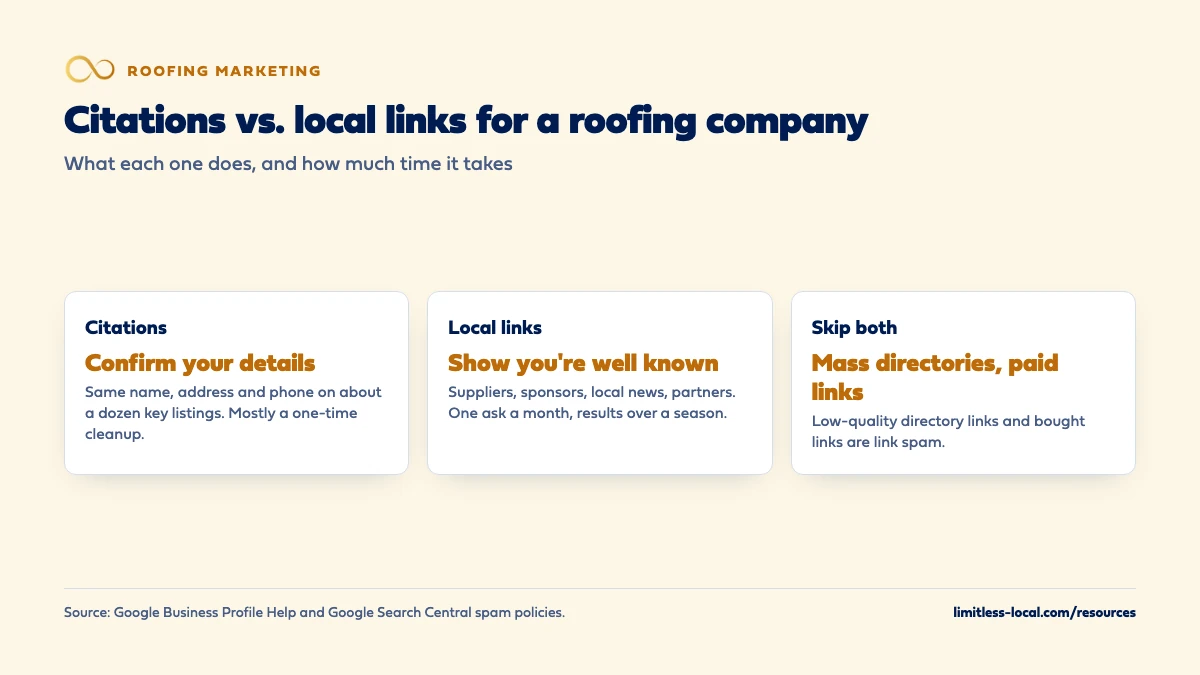
Local backlinks and citations help a roofing company in two different ways. Citations, the listings that show your company name, address or service area and phone number on maps apps, directories and local sites, help search engines confirm your details and stop homeowners from calling a dead number. Links from real local websites add to how well known Google thinks your company is, which it weighs along with your reviews when it ranks local results. Get the main citations right once, then spend steady time earning a handful of local links that come from real relationships.
Citations and links are part of the local SEO groundwork we build for roofing companies: listing cleanup and buildout plus link building are included in every local SEO package on our roofing marketing page. For the full picture of how search fits a roofing business, start with the roofing SEO guide, and the rest of the roofing marketing questions library takes it one question at a time.
What's the difference between a backlink and a citation for a roofer?
A citation is any place online that lists your company’s name, address (or service area) and phone number. Think Apple Maps, Bing, Yelp, the BBB, Facebook, Nextdoor, your chamber of commerce directory, and the contractor finder on a shingle manufacturer’s site. Some citations link to your website and many don’t. Their main job is to say the same true thing about your company everywhere.
A backlink is a clickable link from another website to yours. A local backlink is one from a site with a real connection to your area or your trade: the youth league you sponsor, a supplier’s “find a contractor” page, a local news story about a roof you donated, a property manager’s list of approved vendors.
The two overlap: a chamber listing with a link to your site is both. But treating them as one task is how owners end up paying for 300 directory submissions that do neither job well.
How do citations help a roofing company show up?
Search engines don’t take your word for your business details. Google says the information in Business Profiles is compiled from several sources, including publicly available web content such as your own website, licensed data from third parties, and people who contribute facts like addresses and phone numbers. Bing goes further on its Bing Places help page: your name, address, phone, website, hours and category are checked automatically, and changes you submit only apply if they match trusted outside data. If they don’t, the change may not publish or may be overwritten.
So citations do three jobs for a roofer:
- They back up your profile. When your company shows up the same way across the web, the details on Google, Apple and Bing are easier to confirm and harder for an old record to overwrite.
- They stop wrong numbers. An old phone number on a directory a homeowner finds is a lost inspection. That’s a booked-job problem, not a ranking theory.
- They put you where homeowners check. Plenty of homeowners look a roofer up on the BBB, Nextdoor or Yelp before calling, especially after a storm brings out-of-town crews.
The details of keeping your name, address and phone identical are covered in whether a roofer’s name, address and phone need to match everywhere.
How do local backlinks help a roofing company rank?
Google says local results are mainly based on relevance, distance and popularity, and that prominence, how well known a business is, is based on info like how many websites link to your business and how many reviews you have. Links are named right there next to reviews. That’s the clearest reason a roofer should care.
Links also help your website pages get found in the regular results below the map pack, where town-specific roof replacement pages compete. And a link from a site homeowners actually read sends real visitors who already know your name.
What links don’t do is outweigh the basics. A roofer with 15 reviews, the wrong primary category and no page for roof replacement won’t climb past a well-reviewed competitor because of a few new links. The factors behind map rankings are laid out in what makes a roofing company rank higher in Google Maps.
Which citations are worth a roofer's time?
A short list done right beats a long list done carelessly. Work through these in order:
- Google Business Profile. It’s the citation everything else gets checked against.
- Apple Business and Bing Places. They feed Apple Maps, Siri and Bing, and both let you claim and correct your listing.
- The sites homeowners check before they call: Facebook, Yelp, the BBB and Nextdoor.
- Manufacturer and supplier contractor finders. If you hold a shingle or metal roofing manufacturer certification, make sure the listing has your current name, phone and website.
- Local groups you belong to: your chamber of commerce, home builders association or roofing contractors association.
- Anywhere an old version of your company still lives: a previous business name, an old shop address, a phone number from a past campaign.
That’s roughly a dozen listings for most roofers, plus whatever old records turn up. Get those right and you’ve done most of the citation work that matters.
Which citations and directories can a roofer skip?
Skip anything nobody in your town would ever visit. Mass directory submission services promise hundreds of listings for a flat fee, and most of those sites have no homeowners on them and no connection to your area. Google’s spam policies list low-quality directory or bookmark site links as an example of link spam, so a pile of them is at best wasted money.
A simple test for any directory: would a homeowner looking for a roofer in your town ever land on this site? If yes, list yourself and get it right. If no, move on. Paid “featured” listings are ads; judge them by the signed jobs they bring.
Curious what your marketing is actually booking?
Get a free visibility audit — no obligation, no sales pitch.
Which local links are worth the time for a roofer?
The best local links come from places that already know you. For most roofers, that means:
- Suppliers and manufacturers that list certified or preferred contractors.
- Sponsorships of youth teams, school events and charity drives that show sponsors on their website.
- Local news and community sites covering a roof you donated to a veteran, a storm cleanup your crew helped with, or a new hire from the local trade school.
- Business partners such as gutter, siding and solar installers, home inspectors, property managers and builders who refer work both ways and list trusted contractors.
- Associations like your chamber, home builders association and trade groups with member directories.
Each one also puts your name in front of people who might hire you. How to ask for each of these, step by step, is covered in how a roofing company gets links from local websites.
Which link tactics should a roofer stay away from?
Google treats links built mainly to move rankings as spam. Its list includes buying or selling links, trading goods or services for links, excessive “link to me and I’ll link to you” swaps, automated link services, and keyword-stuffed links dropped into guest posts and press releases.
Two practical rules keep a roofer safe:
- Never pay for a link by itself. Paying to sponsor a team is fine. If the sponsor page links to you, that link can be marked as paid, and Google’s guidance on qualifying outbound links says paid placements should carry
rel="sponsored". Don’t ask the team to remove it. - Never trade a discount for a link. “$200 off your roof if you link to us from your blog” is exactly the goods-for-links swap Google calls spam.
If someone sells you a bundle of “high-authority backlinks” for a flat fee, you’re paying for the kind of links that can hurt you.
Do citations and links matter more than my Google profile and reviews?
No. They support the profile and the reviews; they don’t replace them. If you have limited hours, spend them in this order:
- A verified, complete Google Business Profile with the right primary category and every roofing service you do.
- A steady flow of new reviews from real customers, and a reply to each one.
- A website with a clear page for each main service and the towns you actually want work in.
- Your core citations, cleaned up once.
- Ongoing local links, a few a year from real relationships.
Steps four and five are what keep a strong profile believable and well known. They rarely rescue a weak one.
How much time do citations and link building take?
Citations are mostly a one-time cleanup with light upkeep. Claiming and correcting a dozen key listings takes an afternoon or two, longer if you find duplicates or an old business name that has to be closed out. After that, check them when something changes: a new phone number, a move, a new service area, a rebrand.
Links are slower and never really finished. A realistic pace for an owner doing it alone is one or two hours a month: one sponsorship, one supplier listing, one story pitched to the local paper. Because SEO typically takes 3 to 6 months to show meaningful organic growth, judge link work over a season, not a month.
How do I know if citations and links are helping my roofing company?
Use free tools before paying for any. Google Search Console, a free Google service, can show you which sites link to your website, along with the searches your site shows up for and how often people click. Your Google Business Profile’s performance report shows calls, website clicks and searches over time.
Look for these signs over a few months:
- New links show up in the links report from the places you asked.
- Your profile appears for more searches in the towns you serve, not only your own company name.
- Calls from the profile and organic visits to your town pages trend up.
- Fewer homeowners mention finding an old number or a wrong address.
If links are growing but calls aren’t, the bottleneck is usually somewhere else, often the site itself. Why a roofing website isn’t on the first page of Google walks through those checks in order.
In what order should a roofer work on citations and links?
- Write your master listing. One exact company name, one main phone number, one address or service-area setup, one website address, and a one-paragraph description.
- Fix Google first, then Apple and Bing.
- Fix the sites homeowners check: Facebook, Yelp, the BBB and Nextdoor.
- Hunt down old records: search your old phone numbers, old addresses and any previous company name, and correct or close what you find.
- Claim manufacturer and association listings you already qualify for.
- Start a monthly link habit: one ask a month to a supplier, sponsor, partner or local reporter.
- Check once a quarter: new links, listing accuracy, and calls by source.
Not sure which of these is costing you jobs?
A free visibility audit checks the Google profile, reviews, site and tracking, and shows what to fix first.
What's different about citations and links for roofing companies
Storms bring out-of-town crews. After hail or high winds, homeowners get flooded with door knockers and new names. A roofer whose company shows up the same way on Google, the BBB, Nextdoor and a manufacturer’s contractor finder looks like what it is: a local company that will still be around for the warranty call.
Manufacturer certifications are built-in citations. Many roofers hold a manufacturer certification and never check the contractor-finder listing that comes with it. It’s often one of the most trusted links a roofer can have, and it’s free.
Tracking numbers on yard signs and trucks. Roofers use a lot of print. If a yard-sign tracking number ends up on a directory listing, it becomes a citation that disagrees with your main number. Keep tracking numbers on signs, mailers and ads, and keep your main number on your listings.
Commercial work runs on vendor lists. If you do commercial roofing, property managers, building owner groups and general contractors often keep approved-vendor pages. Getting onto those is both a link and a lead source.
A worked example: a year of citation and link work for a roofer
These numbers are made up to show the math, not a benchmark and not a client result. A two-crew roofer spends one afternoon cleaning up 12 key listings and finds 3 still showing a phone number from an old yard-sign campaign. Fixing those 3 is the most valuable hour of the year, because every homeowner who found one was calling a dead line.
Then the owner sets aside 2 hours a month for links. Over a year that’s 24 hours and one ask a month. Say a third of those asks land: 4 links, from a supplier’s contractor page, a youth league sponsor page, a local news story about a donated roof, and a builder who refers repair work. Modest, but every one is on a site where homeowners might actually find the company.
Here’s how we’d handle it. Listing cleanup and buildout, with your name, address and phone synced across 50+ directories, plus ongoing link building, are part of our Essentials package at $3,500 a month, which also covers your Google profile, content and Google Ads management. It’s the same groundwork behind one roofing client’s 3x map pack visibility in its target towns, where better presence and consistent info across the web increased inbound calls. That’s a past result for one company, not a promise; we don’t guarantee rankings or lead counts.
Frequently asked questions
Do citations still matter for roofers now that Google has my profile?
Yes. Google builds profiles from several sources, including web content and third-party data, and Bing only applies basic detail changes that match trusted outside data. Consistent citations keep those sources agreeing with you.
Should a roofer pay for a citation-building service?
Only if it fixes the listings that matter, like Apple, Bing, Yelp, the BBB and Facebook, and cleans up old records. Paying for hundreds of directories nobody visits isn’t worth it.
Is a link from my manufacturer's contractor finder good?
Usually, yes. It’s on a site homeowners use to find certified roofers, and it comes from a real business relationship. Make sure the listing shows your current name, phone and website.
Can I swap links with other local contractors?
A link to a partner you genuinely refer work to is fine. Google lists excessive “link to me and I’ll link to you” swaps and partner pages built only for cross-linking as link spam.
Do Facebook and Nextdoor listings count as citations?
Yes. Any place that lists your company name, address or service area and phone counts, and homeowners often check both before calling a roofer.
Should my roofing website link out to my suppliers and partners?
If it helps homeowners, yes. A page showing the manufacturers you’re certified with is useful to them. If any of those links are paid placements, mark them as sponsored.
Key takeaways
- Citations make your name, address and phone consistent; local links show Google your company is well known.
- Google names the number of websites linking to a business, along with reviews, as part of local prominence.
- About a dozen well-chosen listings matter more than hundreds of directories.
- Earn links through suppliers, sponsorships, local news and partners; never buy them or trade discounts for them.
- Fix the Google profile, reviews and service pages first; citations and links support them.
Want a second set of eyes on your setup?
We'll look at how you show up locally and where calls are leaking, then send you a plain-English breakdown.
More in this section
- How does a roofing company get links from local websites?
- Can a roofing company do its own SEO?
- Do Local Services Ads help a roofer rank on Google Maps?
- Which keywords should a roofing company target for local leads?
- What makes a roofing company rank higher in Google Maps?
Sources
- Tips to improve your local ranking on Google — Google Business Profile Help
- Understand how Google sources & uses info in Business Profiles & local search results — Google Business Profile Help
- Spam Policies for Google Web Search — Google Search Central
- Qualify Outbound Links for SEO — Google Search Central
- Bing Places for Business: Manage your listing — Bing Places for Business
- About Search Console — Search Console Help