
How does a roofer manage a new marketing agency better?

- How should a roofing owner work with a new marketing agency week to week?
- What should I set up in the first two weeks with a new agency?
- What access should a new agency get, and what stays with me?
- Who should be the agency's contact at my company?
- What does the agency need from me every week?
- How often should I meet with a new agency?
- What should be on the agenda for a monthly review?
- How do I see what the agency actually changed?
- Which questions keep a new agency on track?
- What should I approve, and what should I leave alone?
- How do I give feedback without micromanaging?
- When is it fair to judge a new roofing agency?
- What's different for roofing companies
- A worked example: one monthly review on one page
- Frequently asked questions
- Key takeaways
- More in this section
- Sources
The short version
- Spend the first two weeks on goals, towns, job types, access and a tracking test.
- Keep ownership of every account; give the agency the level of access it needs to do the work.
- Tell the agency every week which leads were junk, which booked and which signed.
- Run one monthly review built around cost per signed roof, not clicks.
For roofing owners who just hired an agency and want it working on the right jobs and towns without turning it into a second job.
Get a free visibility audit · Book a growth call
How should a roofing owner work with a new marketing agency week to week?
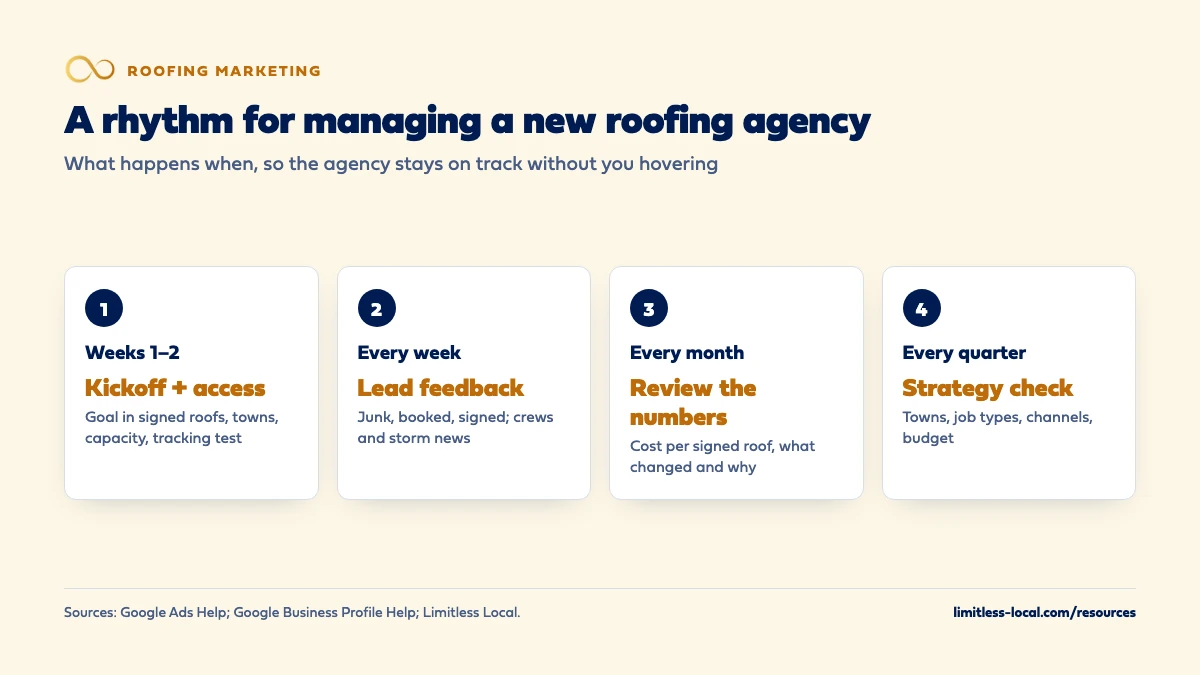
Manage a new roofing marketing agency by setting it up properly in the first two weeks, then keeping a steady rhythm. Give the agency the access it needs while your company keeps ownership of every account, agree on one goal measured in signed roofs, and name one point of contact on each side. Feed it what only you know, like which towns and jobs you want, when crews have room and which leads actually signed, and hold a short monthly review around leads, inspections and cost per signed job. Ask for the reason behind every change instead of tinkering with the campaigns yourself.
That rhythm is how we like to work with roofers, too: accounts in your name, a clear goal in signed jobs, and a plain-English reason for every change. Every one of our marketing packages includes monthly reporting and a real-time dashboard, with strategy calls quarterly on Essentials and monthly on Growth, and our roofing marketing page shows how we work with roofers. The roofing marketing guide covers every channel, and the rest of the roofing marketing questions library goes question by question.
What should I set up in the first two weeks with a new agency?
The first two weeks decide how the next six months go, so spend real time on them. Cover these in the kickoff:
- The goal, in signed roofs. Not clicks or leads. Something like: more replacement contracts in these towns at or under this cost per signed job.
- Towns and job types. Where your crews want to work, which jobs make you money, and which you’d rather not get calls for.
- Capacity. How many inspections and installs you can handle in a normal week and in storm season.
- The budget ceiling, and who can approve going over it.
- What’s off-limits: claims you don’t make, insurance wording you avoid, warranties you don’t offer.
- A tracking test. Call every tracking number and submit every form, and confirm each lead shows up in the report and in your office.
With us, onboarding takes your team about 2–3 hours, and campaigns go live in weeks 1–2. Whoever you hire, that kickoff time is the best-spent time of the whole relationship.
What access should a new agency get, and what stays with me?
Give the agency enough access to do the work and keep the top level yourself.
- Google Ads. Standard access can edit campaigns; Admin is the level that can add and remove people and change access levels (About access levels in your Google Ads account). Keep Admin with your company.
- Google Business Profile. Managers can edit info, reply to reviews and post; only owners can add or remove users or delete the profile (Manage your Business Profile owners & managers). Make the agency a manager.
- Website, domain, hosting and call tracking stay in your company’s name, with the agency added as a user.
Everyone on the agency side should use their own login, not a shared one. That way you can see who did what, and you can remove someone without locking out everyone else. How much control a roofer should keep over marketing decisions covers the decisions side of the same question.
Who should be the agency's contact at my company?
One person. When the agency hears from the owner, the office manager and a sales rep, each with different priorities, nobody gets what they want.
Pick someone who:
- Knows which leads came in and what happened to them.
- Knows the schedule: when crews are full and when they need work.
- Can answer the agency within a day or two.
- Can make small decisions, like approving a new ad or a town page, without waiting for you.
That’s often the office manager, with you joining the monthly review. Ask the agency for the same thing in return: one named person who knows your account and answers your questions, not a rotating inbox.
What does the agency need from me every week?
The things only your company knows. An agency can see clicks and calls; it can’t see what happened after the phone was answered. A few minutes a week covers it:
- Lead feedback. Which leads were junk, which booked an inspection, which signed. This is the single most useful thing you can send.
- Capacity changes. “Crews are booked for three weeks” or “we need work next month” should change the budget and the ads.
- Storm news. If hail hit a town last night, the agency should hear it from you first.
- Photos and job details from finished roofs, for the Google profile and website.
- What homeowners are asking on calls and at inspections. Those questions make good ads and pages.
If you can tag each lead’s source and outcome in your field software, the weekly feedback becomes a report instead of a phone call. Tracking which roofing leads turn into signed jobs covers the setup.
How often should I meet with a new agency?
More often at the start, then less once things settle:
- First month: a short check-in every week or two. Is tracking working? Are leads the right kind? Is anything going to the wrong place?
- After that: a monthly review, around half an hour, with numbers in front of you.
- Every quarter: a bigger look at strategy. Which towns, which job types, which channels, and whether the budget should change.
Between meetings, email or a shared message thread works for quick questions. Save anything that changes the plan for the review, so changes are made on purpose and not in a rush.
On our side, Essentials includes quarterly strategy calls and Growth includes monthly strategy calls with a dedicated account manager, alongside the monthly report and the real-time dashboard.
Curious what your marketing is actually booking?
Get a free visibility audit — no obligation, no sales pitch.
What should be on the agenda for a monthly review?
Keep it to the numbers that move your business, in this order:
- Leads by source, and how many were real roofing leads.
- Inspections booked from those leads.
- Signed jobs, with their value, including late signings from earlier months.
- All-in cost: ad spend plus the agency fee.
- Cost per real lead and cost per signed roof.
- What changed this month and why.
- What’s planned next month, and what result each change is meant to bring.
If a report spends pages on impressions, clicks and rankings and never gets to signed roofs, ask for the order above. Activity is fine to see, but it isn’t the result. How to know if your roofing marketing agency is getting results goes deeper into reading the numbers.
How do I see what the agency actually changed?
Ask, and check. In Google Ads, change history lists the changes made to your account, campaigns and ad groups over the past two years, including who made each one when people use their own logins (About change history). A quick look before the monthly review tells you whether the account is being worked or left alone.
It’s also worth asking whether Google’s automatically applied recommendations are turned on. Google Ads can apply some recommendations on its own, like adding keywords or changing ads, and lets you choose which ones (About applying recommendations automatically). Some are useful, but you want a person deciding what changes in a roofing account, not a setting nobody remembers turning on.
For your Google profile and website, ask for a short list each month: posts published, photos added, pages built or updated, reviews replied to.
Which questions keep a new agency on track?
Good questions do more than any amount of watching. Bring a few of these to each review:
- What did each signed roof cost us this month, and which source did it come from?
- Which search terms or towns did you cut, and why?
- What are you testing right now, and how will we know if it worked?
- Which leads were junk, and what are you doing about them?
- If you had another $500 next month, where would it go, and if you had $500 less, what would you cut?
- What do you need from us that you’re not getting?
- What would make you recommend spending less?
A good agency answers these plainly and sometimes tells you something you didn’t want to hear. If every answer is vague or upbeat no matter what the numbers say, that’s worth noticing.

What should I approve, and what should I leave alone?
Approve what carries your company’s name and promises: offers, warranty and financing wording, anything about insurance claims, and the general look and tone of ads and pages. You’re on the hook for those. The FTC says advertising must be truthful and non-deceptive, and that besides the advertiser, the advertising agency may also be held legally responsible for misleading claims in ads (Advertising FAQ’s: A Guide for Small Business). Both of you have reasons to get the claims right.
Leave the how to the agency: keywords, bids, ad tests, page layouts, posting schedules and moving money between campaigns under your ceiling. That’s what you’re paying for. Approve a pattern once, like the template for town pages or a set of ad messages, rather than every single ad.
How do I give feedback without micromanaging?
Batch it, write it down and explain the why. Three habits help:
- Save changes for the review unless something is broken. A broken tracking number is urgent; wanting to try a new headline isn’t.
- Describe the problem, not the fix. “We’re getting too many repair calls from the north side” gives the agency room to find the best fix. “Turn off the north-side campaign” doesn’t.
- Don’t stack big changes. Google says major structural changes to an ad campaign, like a new bid strategy or new conversion goals, can show a “Learning” status for up to seven days, and that performance typically settles over one to two conversion cycles (About Smart Bidding learning). Rebuilding things every week means they never settle.
Budget changes are different: Google says they don’t trigger learning, so raising or lowering spend for storm weeks or slow months is fine.
When is it fair to judge a new roofing agency?
Judge different things at different times:
- Week two: is tracking working, are leads reaching the office, and is the account set up the way you agreed?
- Month one or two: are ads bringing real roofing leads at a cost you can work with? Ads can generate leads within days of launch.
- Month three onward: cost per signed roof, once early leads have had time to close. SEO typically takes 3 to 6 months to show meaningful organic growth.
We ask for three months and put it in our contract for that reason, but if you want to leave, we won’t make you stay. What a roofer should expect in the first 90 days of marketing lays out each stage, and if it’s clearly not working, how to switch roofing agencies without losing leads covers the exit.
Want to see where your company stands?
A free visibility audit shows where you show up on Google, Maps and AI answers, and what it's costing you in calls.
What's different for roofing companies
Storm season needs a fast lane. Agree in the kickoff how storm weeks will work: who calls whom, how fast budgets can go up, which towns to add. Waiting for the monthly review after a hailstorm means missing it.
Late signings change the scorecard. Roof replacements and insurance jobs can sign weeks or months after the first call. Make sure the monthly review counts jobs that signed this month from earlier leads, or the agency’s numbers will always look worse than they are.
Crew capacity is the real budget. If crews are booked out, the best thing the agency can do may be to aim for future work or pull back spend. Tell them, and judge them on whether they adjust.
Insurance wording is yours to approve. Ads and pages that mention claims or adjusters should never go live without your sign-off.
A worked example: one monthly review on one page
These numbers are made up to show the format, not a benchmark for your market. Say last month the agency reports 40 leads. Your office marked 30 of them as real roofing leads, and 15 of those booked inspections. Five homeowners signed, including two from leads that came in the month before.
The all-in cost was $3,000 in ad spend plus a $4,500 agency fee, the price of our Growth package, for $7,500 in total. That’s $250 per real lead and $1,500 per signed roof.
Now the conversation has something to work with. Is $1,500 per signed roof under your target? Why were a quarter of the leads junk, and what’s being done about it? Which towns did the signed jobs come from? That’s a thirty-minute meeting that actually changes next month. A free visibility audit can set up the same scorecard for your company.
Frequently asked questions
Should I give my new agency my Google password?
No. Add each person at the agency as a user with their own login. Google Ads and Google Business Profile both support this, and it lets you see who changed what and remove access cleanly.
How much of my time does managing an agency take?
After setup, a few minutes a week for lead feedback and around half an hour a month for the review. Most of the time is in the first two weeks, when the agency needs your goals, towns and capacity.
Should the agency talk to my sales team?
Yes, at least now and then. Salespeople hear what homeowners ask and why deals are lost, which helps the agency write better ads and pages. Keep one point of contact for decisions, though.
What if the agency's numbers don't match mine?
Compare lead by lead for one week: the agency’s list against your call log and software. Gaps usually come from untracked numbers, leads counted twice or jobs logged without a source. Fix the cause, then agree which number you’ll both use.
Can I ask the agency to pause ads when crews are booked out?
Yes. A good agency should suggest it, or suggest aiming at work for later in the season. Budget changes don’t reset Google Ads learning, so pulling back and stepping up again is low-risk.
Is it okay to ask an agency for references from other roofers?
It’s a fair question before you sign. Once you’re working together, judge the agency on your own numbers rather than anyone else’s.
Key takeaways
- Use the first two weeks for goals in signed roofs, towns, job types, capacity, access and a tracking test.
- Keep Admin and owner access with your company; give the agency Standard or manager access with their own logins.
- Send weekly lead feedback: junk, booked and signed. It’s the most useful thing you can give an agency.
- Hold a monthly review built around cost per signed roof and the reason for every change.
- Approve claims and offers; leave keywords, bids and tests to the agency, and don’t stack big changes.
Not sure what's working right now?
Start with a free visibility audit: rankings, Google profile, reviews and tracking, checked against your service area.
More in this section
- How should a roofing company choose a marketing agency?
- How does a roofer run a profitable business with marketing?
- Will a marketing agency understand my local roofing market?
- How do I know a roofing marketing agency is worth the cost?
- How do I know if my roofing marketing agency is getting results?
Sources
- About access levels in your Google Ads account — Google Ads Help
- Manage your Business Profile owners & managers — Google Business Profile Help
- About change history — Google Ads Help
- About applying recommendations automatically — Google Ads Help
- About Smart Bidding learning — Google Ads Help
- Advertising FAQ's: A Guide for Small Business — Federal Trade Commission