
Is $1,000 a month enough ad spend for an electrician?

- Is $1,000 a month in ad spend enough for a small electrical shop to get steady calls?
- What does $1,000 a month in ad spend actually buy?
- How many calls and booked jobs can $1,000 bring in?
- Where do I find what clicks cost for electricians in my area?
- Should $1,000 go to Google search ads or Local Services Ads?
- How should a small shop spend $1,000 so it isn't spread too thin?
- When is $1,000 a month not enough?
- Is $2,500 a month enough ad spend in a competitive city?
- Should $1,000 go to ads or to someone to run them?
- What has to be in place before spending $1,000?
- How long should I run $1,000 a month before deciding?
- What should I track each month at $1,000?
- What's different about a $1,000 ad budget for electricians
- A worked example: what $1,000 might book
- Frequently asked questions
- Key takeaways
- More in this section
- Sources
The short version
- $1,000 a month is about $33 a day in Google Ads.
- Enough for one campaign, one or two job types, your closest towns.
- Not enough for several channels, a big metro or every service you offer.
- Clicks bought = $1,000 ÷ the cost per click in your area.
- Judge it on cost per booked job after two to three months.
For electricians running a small shop who want to know whether $1,000 a month on ads can keep the phone ringing, or just run dry by mid-month.
Get a free visibility audit · Book a growth call
Is $1,000 a month in ad spend enough for a small electrical shop to get steady calls?
Often, yes, if you keep it narrow: $1,000 a month is enough for one well-run Google search campaign or Local Services Ads covering one or two job types in your closest towns. It isn’t enough to run several channels at once, cover a large metro or answer every kind of electrical work. Work out what it buys by dividing it by what a click costs in your area, then judge it on cost per booked job after two to three months, not on clicks.
At $1,000 a month, you don’t need an agency to run it; a focused campaign you manage yourself is a sensible start. When you’re ready to spend more, our Essentials package is $3,500 a month and covers Google Ads management up to $2,500 a month in ad spend, with call tracking and Google Business Profile work included. Ad spend is paid directly to Google, and we recommend a budget after a quick audit. Our local ads page covers Google Ads and Local Services Ads, our electrical contractor marketing page explains how we work with electrical shops, and the rest of the electrical marketing questions library goes question by question.
What does $1,000 a month in ad spend actually buy?
In Google Ads you set an average daily budget, not a monthly one. Google’s article on average daily budgets says you’ll never pay more than 30.4 times your average daily budget in a month for most campaigns, and that on a single day spend can reach twice the daily budget. So $1,000 a month works out to an average daily budget of about $33.
How far that goes comes down to one division:
Clicks per month = $1,000 ÷ your average cost per click
If clicks on your searches cost a few dollars, $1,000 buys a lot of visits. If they cost $20 or more, it buys a few dozen. That’s why the same budget works well for an electrician in a small town and runs out by mid-month for one in a crowded metro.
The money is only ad spend. Whoever runs the campaign, a landing page, call tracking and your field software are all on top, so count your own time as part of the cost if you’re doing it yourself.
How many calls and booked jobs can $1,000 bring in?
Follow the chain from click to job:
- Clicks: $1,000 divided by your cost per click.
- Leads: the share of clicks that call or fill out a form.
- Booked jobs: the share of leads that turn into work on the schedule.
Every link in that chain is yours to improve. A landing page about the exact job, a click-to-call button and a phone that gets answered raise the share of clicks that call. Fast follow-up on quotes raises the share that book. Two shops with the same $1,000 and the same click price can end up with very different numbers of jobs.
Small budgets also mean small numbers, and small numbers swing. One good week and one dead week can look like a trend when they’re just noise, so judge the result on a few months, not a few days.
Where do I find what clicks cost for electricians in my area?
Use Keyword Planner inside Google Ads. It shows estimates of the searches a keyword gets and the cost to target it, and you can set it to the towns you serve.
Look up the searches that match the work you want, not just “electrician”:
- “electrician near me” and “emergency electrician” for service calls
- “panel upgrade” and “electrical panel replacement”
- “EV charger installation”
- “whole house generator installation”
Divide $1,000 by the cost you see for the searches you’d actually bid on. If the answer is only a few dozen clicks, plan on a narrower test: fewer towns, one job type and tighter hours.
Should $1,000 go to Google search ads or Local Services Ads?
They charge differently. With Local Services Ads you pay for valid leads, such as a call you answer or a message, rather than for clicks, and you set an average weekly budget instead of a daily one. $1,000 a month is roughly $230 a week.
- Local Services Ads suit an electrician who is verified, has a solid set of reviews and mostly wants residential service calls. You don’t pick keywords; you pick job types and areas.
- Search ads suit a shop that wants to target specific jobs, like panel upgrades or EV chargers, send them to a matching page and control the wording.
Local Services Ads are also changing. Google is moving Local Services Ads into Google Ads as Performance Max campaigns with pay-per-lead goals, starting with select home service advertisers, including electrical, in August 2026. You’ll still pay per valid lead, but you’ll manage it inside Google Ads.
At $1,000, pick one. Splitting it into two halves usually leaves both too small to judge.
How should a small shop spend $1,000 so it isn't spread too thin?
- One or two job types. Choose the work with the best gross profit that you can do this week, not everything on your services page.
- Your closest towns. Target the area your trucks reach in a reasonable drive. Each extra town shares the same $1,000.
- The hours you answer. Run ads when someone picks up the phone. A paid call that goes to voicemail is money spent on someone else’s job.
- A page that matches. Send panel upgrade clicks to a panel upgrade page, not the home page.
- Negative keywords from day one. Block searches for jobs, training, wiring diagrams and free advice. Which negative keywords electricians should add first has a starter list.
A narrow campaign that books jobs gives you something to grow from. A wide one that books a few of everything tells you nothing.
Curious what your marketing is actually booking?
Get a free visibility audit — no obligation, no sales pitch.
When is $1,000 a month not enough?
- You’re in a large, competitive metro where click prices mean $1,000 buys too few visits to book steady work.
- You want several job types at once, each with its own ads and pages.
- You want around-the-clock emergency coverage across a wide area.
- Your campaign is held back by budget. Google may show a Limited by budget status when a campaign is underperforming because its budget is limited.
- Your impression share is low and the reason is budget. Impression share is the share of eligible impressions your ads actually got, and it shows whether your ads might reach more people with a higher bid or budget.
If those are true and the jobs you do get are profitable, the next step is more budget, not a different channel. How much an electrician should spend on Google Ads each month works the budget out backward from the jobs you want.
Is $2,500 a month enough ad spend in a competitive city?
Use the same chain. $2,500 a month is an average daily budget of about $82, and the question is what that buys at your city’s click prices.
In a big, crowded market, $2,500 is often enough to run one or two job types well, such as service calls plus panel upgrades, in the parts of the city closest to your shop. It’s rarely enough to cover the whole metro for every service. Narrow by neighborhoods and job types first, and add more only once the first campaigns book jobs at a cost per job you can live with.
If you’re thinking about a bigger jump, whether $5,000 a month is too much for electrical marketing covers that budget and the capacity it takes.
Should $1,000 go to ads or to someone to run them?
At this level, most of it should go to ads. If you pay someone a monthly fee as big as the ad budget, or bigger, the fee eats the money that was supposed to make the phone ring.
Running $1,000 yourself is realistic if you can give it an hour or two a week: checking the searches your ads showed for, adding negative keywords, listening to call recordings and adjusting bids. If you don’t have that time, look for light, low-cost help with a clear scope rather than a full-service retainer.
Full-service management makes more sense once the ad budget is large enough that better management saves or earns more than it costs.

What has to be in place before spending $1,000?
- Someone answers. Live calls during ad hours, with a callback plan for anything missed.
- Tracking. Calls and forms counted as conversions, so you can see which searches lead to calls. Which conversion tracking an electrician should set up first covers the order.
- A matching page for each job type you advertise, with your phone number at the top on mobile.
- A complete Google Business Profile with recent reviews, since many people check it before they call.
- A way to log booked jobs by source in ServiceTitan, Housecall Pro or Jobber.
Spend $1,000 without these and you’ll know you spent it, but not what it bought.
How long should I run $1,000 a month before deciding?
Ads can generate leads within days of launch, so you’ll know fast whether the phone rings. Whether the money pays takes longer. The first month goes to trimming wrong searches and fixing tracking, and a small budget gives you few calls to judge from.
Plan on two to three months, and judge on tracked booked jobs, not clicks. If you need more data than $1,000 can buy, narrow the test further rather than ending it early. How much ad spend an electrician needs to judge Google Ads goes deeper on test size.
What should I track each month at $1,000?
- Cost per lead: spend divided by real calls and forms, junk removed.
- Booked jobs from those leads, matched in your field software.
- Cost per booked job: $1,000 divided by booked jobs.
- Gross profit on those jobs, compared with the $1,000.
- The search terms report, so you can see what people actually typed.
Cost per lead on its own can mislead: a cheap lead that rarely books costs more per job than a pricier one that usually does. What cost per lead electricians should target shows how to set a target from your own numbers.
Not sure which of these is costing you jobs?
A free visibility audit checks the Google profile, reviews, site and tracking, and shows what to fix first.
What's different about a $1,000 ad budget for electricians
Emergency searches arrive at odd hours. A small budget can disappear on evening and weekend clicks. If nobody answers after hours, keep the ads to the hours you cover.
Job values vary widely. One panel upgrade can cover a month of $1,000 spend; a dozen small service calls might not. Pointing the budget at the work with the best margin stretches it furthest.
Do-it-yourself searches are common. People search for wiring diagrams, breaker sizes and how to install an outlet. Negative keywords keep a small budget away from them.
Your license sets the map. Only advertise where you’re licensed and can get to the job in a reasonable time.
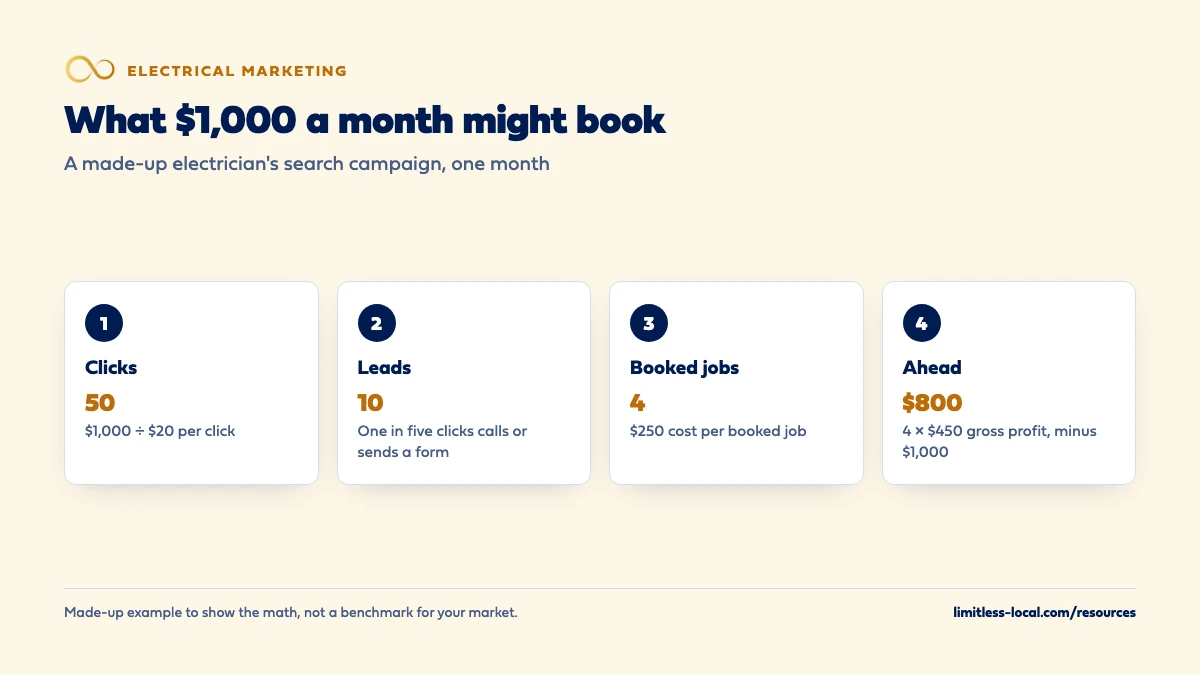
A worked example: what $1,000 might book
These numbers are made up to show the math, not a benchmark for your market. Say an electrician spends $1,000 in a month on one search campaign for service calls and panel upgrades in four nearby towns, and clicks average $20.
- Clicks: $1,000 ÷ $20 = 50 clicks.
- Leads: one in five clicks calls or sends a form = 10 leads.
- Booked jobs: four of those leads book = 4 jobs.
- Cost per booked job: $1,000 ÷ 4 = $250.
If those four jobs leave an average of $450 in gross profit each, that’s $1,800, and the month is $800 ahead of the ad spend. If the same four jobs left $200 each, the month would lose money. Same clicks, same leads; the job mix decides the result.
Frequently asked questions
Can $1,000 a month keep a one-truck electrician busy?
It can add steady work if your click prices are moderate and you keep it to one or two job types nearby. Whether it fills the schedule depends on how many jobs you already have and how many the ads book.
Is $500 a month too little to bother with?
Not always. It’s a narrow test of one job type in your closest towns, and it leaves even fewer clicks to judge from, so give it longer before deciding.
Does $1,000 a month include what I pay someone to run the ads?
On this page, no. $1,000 is what goes to Google. Management, landing pages and tracking tools are on top.
Should I spend the $1,000 evenly or save it for busy weeks?
Set a steady daily budget and let it run. Google already spends more on days with more searches and less on quiet days, within the monthly limit.
What if $1,000 runs out halfway through the month?
Your daily budget is set too high for the monthly amount, or the campaign is too broad. Lower the daily budget to about $33, tighten the towns and hours, and add negative keywords.
Key takeaways
- $1,000 a month is an average daily budget of about $33 in Google Ads.
- It’s enough for one narrow campaign: one or two job types, closest towns, hours you answer.
- Divide $1,000 by your local cost per click to see how many visits it buys.
- At this level, most of the money should reach the ads, not management fees.
- Judge it on cost per booked job after two to three months, not clicks.
Want a second set of eyes on your setup?
We'll look at how you show up locally and where calls are leaking, then send you a plain-English breakdown.
More in this section
- Is $500 a month too much for electrician marketing?
- Is $1500 a month too much for electrician marketing past referrals?
- How much should an electrician spend on Google Ads each month?
- How much ad spend does an electrician need to judge Google Ads?
- How many jobs a month does an electrician need to hit a revenue goal?
Sources
- About average daily budgets — Google Ads Help
- Use Keyword Planner — Google Ads Help
- How leads work — Google Local Services Help
- Local Services Ads transition to Performance Max campaigns with pay-per-lead goals — Google Ads Help
- Fix “Limited by budget” status — Google Ads Help
- About impression share — Google Ads Help