
How can a pool builder trust a new marketer after a bad experience?

- How do I give a new pool marketing agency a fair shot without getting burned twice?
- Why is it so hard to trust a marketer after getting burned?
- What should I sort out before I talk to anyone new?
- How do I start small enough that a mistake won't hurt?
- What contract terms should a pool builder look for?
- How much access should a new marketer get on day one?
- Should I let a new marketer audit my setup first?
- What should the first two months look like?
- Which early numbers tell me it's working before a pool is signed?
- What should a monthly report show a pool builder?
- How do I check a new marketer's claims before I sign?
- Which red flags mean I should walk away?
- When should I give a new marketer more budget or more work?
- What's different about trusting a marketer as a pool builder
- A worked example: a 90-day test with a new marketer
- Frequently asked questions
- Key takeaways
- More in this section
- Sources
The short version
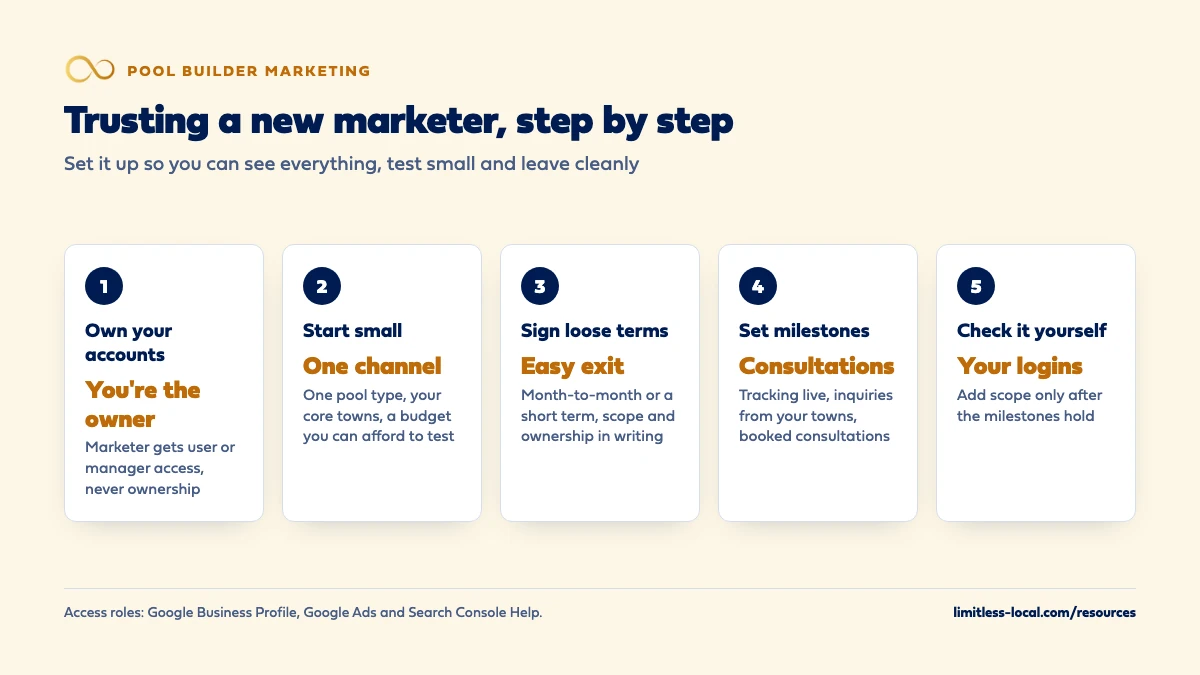
- Own every account yourself and give the marketer user access, not ownership.
- Start with one channel, one service and a budget you can afford to test.
- Agree on early milestones tied to calls and consultations, not traffic.
- Check the numbers in your own logins every month, and widen the scope only after the milestones hold.
For pool builders who got burned by an agency or a freelancer and want to try again without betting the season on someone new.
Get a free visibility audit · Book a growth call
How do I give a new pool marketing agency a fair shot without getting burned twice?
Don’t hand over trust up front; set things up so you never need much of it. Keep every account in your company’s name and give the new marketer user access, start with one channel and a budget you could lose without hurting the business, and sign only terms you can walk away from. Then agree before work starts on what you should see in the first two months, such as tracking live, inquiries from your towns and booked design consultations, and check those numbers in your own logins, not just in their report.
That’s how we’d want a pool builder to hire us too: everything in your name, terms that let you leave, and reports built on calls, leads and what they cost. Our packages are month-to-month, and every one includes call tracking, a real-time dashboard and a monthly report with a cost-per-lead breakdown. The pool builder marketing page shows how we work with pool companies, and the pool builder marketing questions library takes the rest one question at a time.
Why is it so hard to trust a marketer after getting burned?
Because last time you paid for months, got reports full of clicks and impressions, and couldn’t tell whether a single signed pool came from the work. Maybe the agency owned your Google Ads account, or a contract kept billing long after you’d stopped believing in it.
That doesn’t mean marketing doesn’t work for pool builders. It means the last setup asked you to trust someone without giving you a way to check. Build the next one so you can see everything, test small and leave cleanly. Then trust gets earned month by month instead of handed over on day one.
What should I sort out before I talk to anyone new?
Three things, and none of them needs a marketer:
- Get your accounts back. Your Google Business Profile, Google Ads account, website and domain, Google Analytics, Search Console and tracking phone numbers should all be in your company’s name. If the old agency still controls any of them, start there. Restarting marketing after a bad agency walks through getting them back.
- Know your own numbers. Pull the last year from your CRM or your notebook: how many inquiries came in, how many booked a design consultation, how many signed, and where each signed pool came from. Rough numbers are fine; without them you can’t tell if the next marketer is doing better.
- Decide what you want more of. Fiberglass installs, custom gunite, remodels, a new town? A marketer who hears “more leads” gets you leads; one who hears “six more custom builds next season” can plan for them.
How do I start small enough that a mistake won't hurt?
Give the new marketer one job, not your whole marketing. Pick one channel, one type of pool work and the towns you most want, and run it long enough to judge. A few ways that tends to look for pool builders:
- Google Ads for one pool type in your core service area, with tracking set up first. Ads can bring inquiries within days, so you see the marketer’s work quickly.
- Your Google Business Profile and reviews, if your Maps presence is weak.
- Website fixes, such as a working consultation form, call tracking and a proper project gallery, before anything else gets turned on.
Set the test budget at a number you could lose without it changing how you run the business. Adding later is a lot easier than unwinding a big contract.
What contract terms should a pool builder look for?
Terms you can walk away from. Look for:
- Month-to-month billing, or a short initial term with a clear, written way out after it.
- A written list of what you get each month, so “we’re working on it” has something to be measured against.
- Ownership in writing: the accounts, website, domain, content, photos and lead records stay yours if you leave.
- Ad spend paid straight to Google or Meta from your own card, so you always see what was spent.
Here’s how we handle it: no long-term contracts, and month-to-month means we earn the business every month. We do ask for three months, and it’s written into the contract, because the first month is mostly foundation work. But if you want out, we won’t make you stay. 92% of our clients stay year over year, and no client has left before month 6.
How much access should a new marketer get on day one?
Enough to do the work, and no more. You stay the owner; they become a user. Every major platform is built for this:
- Google Business Profile. Google’s help page on Business Profile owners and managers says a manager can edit info, reply to reviews and publish posts, but can’t add or remove users or remove the profile. Add the marketer as a manager, not an owner. Each person uses their own Google Account, so nobody needs your password.
- Google Ads. You invite users and pick their access level, and Google’s page on managing access to your Google Ads account says you can edit or remove that access later. If the marketer creates a brand-new account from its own manager account, that manager account automatically becomes the owner, according to Google’s article on ownership of client accounts. So create the account yourself and link it, or confirm in writing who will own it.
- Search Console. Search Console’s permission levels run from owner to full user to restricted user. If someone only needs to look, a restricted user can view most data without changing anything.
A marketer that insists on owning your accounts is showing you what the breakup would look like. Who owns a pool builder’s ad accounts and website covers each account in more detail.
Curious what your marketing is actually booking?
Get a free visibility audit — no obligation, no sales pitch.
Should I let a new marketer audit my setup first?
Yes, as long as you control what they can touch while they look. Google’s guide Do you need an SEO? says that if someone offers to audit your site, you should grant only read access to Search Console at that stage, not write access. The same idea works everywhere: during an audit, view-only access to Ads and Analytics is enough.
An audit should give you realistic estimates of improvement and of the work involved. A useful one also says what isn’t worth fixing yet.
What should the first two months look like?
Agree on this in writing before work starts, so you both know what “on track” means. A reasonable shape for most pool builders:
- First two weeks: access granted, tracking set up (calls, forms and consultation requests), and the first piece of work live, whether that’s a campaign, a profile cleanup or the website fixes.
- End of month one: a short report on what was set up and the first inquiries, with each lead’s source.
- Month two: inquiries from the towns and pool types you asked for, booked design consultations you can match to those inquiries, and a list of what’s being changed and why.
You’re not testing whether pools are getting signed yet; it’s too early for that. You’re testing whether the marketer does what they said, shows you everything and brings in the right kind of inquiry. Ads can generate leads within days of launch, while SEO typically takes 3-6 months to show meaningful organic growth, so set milestones that fit the channel you started with.
Which early numbers tell me it's working before a pool is signed?
Watch the numbers closest to a signed contract:
- Inquiries from your service area for the work you want, not total clicks or visits.
- Booked design consultations from those inquiries. This is the best early sign that the leads are real.
- Junk rate: how many calls were spam, out of area, wrong service or price shoppers far below your work.
- Cost per booked consultation: what you spent divided by consultations booked from that channel.
Compare each one with your own numbers from before, not with a national average. If you booked two consultations a month from Google before and you’re booking more now at a cost per consultation your average pool can carry, it’s working, even before the first contract signs. How to know if your pool marketing agency is working goes further into checking those numbers yourself.

What should a monthly report show a pool builder?
A report you could read in five minutes and act on. It should show:
- Inquiries, booked consultations and, as the months go on, signed contracts, each with its source.
- What was spent, and what each booked consultation cost.
- What the marketer changed this month and why.
- What they plan to do next month, and what they need from you.
Ask up front whether they’ll share every change they make and explain the reasoning behind it. If the report is mostly impressions, rankings for words nobody searches and charts with no dollar signs, ask for the consultation numbers. If they can’t produce them, that’s your answer.
How do I check a new marketer's claims before I sign?
Ask these, and listen to how they answer:
- Can you show me examples of your work and results?
- What results do you expect, in what timeframe, and how do you measure success?
- What’s your experience in my industry, and in my area?
- Will you share every change you make, and explain why?
Then call references and ask past clients whether the work was useful and whether it produced results. A good marketer will also ask you plenty: who your buyers are, what you build and how customers find you now. If they pitch before they ask anything, they’re selling a package. For a longer list, see what a pool builder should ask before hiring a marketing agency.
Which red flags mean I should walk away?
Some warning signs are worth acting on the first time you see them:
- A promised ranking or lead count. No one can guarantee a #1 ranking on Google, and Google never accepts money to rank sites in its search results.
- They need to own your accounts or won’t give you a login to your own data.
- They’re secretive or won’t clearly explain what they intend to do. You’re responsible for what the companies you hire do on your behalf.
- Long contracts with steep exit fees, especially paired with pressure to sign this week.
- Reports with no inquiries or consultations in them, month after month.
If you see one, ask once, plainly. If the answer doesn’t fix it, you’ve learned what you needed while the cost is still small.
When should I give a new marketer more budget or more work?
When the first piece has hit its milestones for a couple of months in a row, and you’ve checked them yourself. Then add one thing at a time: a second channel, a second pool type, a wider service area or more ad spend. Each addition should come with its own milestone, so you can tell which change did what.
Don’t expand because a marketer says the next service will fix what the first one didn’t; that usually spreads the same problem over more money. But don’t wait for signed contracts either, since with a long sales cycle that can cost you most of a season. How long a pool builder should wait to judge a marketing agency covers the timing in more detail.
Not sure which of these is costing you jobs?
A free visibility audit checks the Google profile, reviews, site and tracking, and shows what to fix first.
What's different about trusting a marketer as a pool builder
The sales cycle hides results. A homeowner who fills out a form in February may not sign until spring. If you judge a new marketer only on signed pools, you’ll either fire a good one too early or keep a bad one too long. Booked consultations are the number that shows up in time to decide.
The season sets the deadline. Starting a new marketer just as the busy season hits leaves no time to test. Starting in the slower months gives you time to check the setup before the inquiries matter most.
We’ve sat on your side of this. We were an equity partner in a pool construction company, where we streamlined back-office operations, built the lead-generation engine and ran sales and marketing. That business did $2M+ revenue in year one.
A worked example: a 90-day test with a new marketer
These numbers are made up to show how to judge a test, not a benchmark for pool builders. Say a builder used to book two design consultations a month from Google. They hire a new marketer for Google Ads only, for fiberglass pools in their core towns, at $2,000 a month in ad spend paid to Google from their own card.
- Month one: tracking and the campaign go live. 9 inquiries, 4 booked consultations.
- Month two: the marketer cuts out-of-area searches and adds negative keywords. 12 inquiries, 5 booked consultations.
- Month three: 16 inquiries, 7 booked consultations, and the first contract signs from a month-one consultation.
By month three, the ad spend works out to about $286 per booked consultation ($2,000 ÷ 7). The builder checks that against their own close rate and profit per pool. If those consultations sign at the rate their consultations usually do, the test passed, and adding a second pool type is a reasonable next step. If the inquiries had stayed out of area, they’d have known by month two and stopped with a small loss. A free visibility audit is one way to get your own starting numbers before a test like this.
Frequently asked questions
Should I tell a new marketer about my bad experience?
Yes. Tell them what went wrong and what you need to see this time. A good marketer will build the reporting and access around it, and how they react tells you a lot.
Is a free trial month a good way to test a marketer?
It can be, but a short paid test with clear milestones is usually better. You get real work and real numbers, and the marketer has a reason to set it up properly.
Should I hire a freelancer instead of an agency this time?
Either can work. What protects you is the same: your accounts, written scope, early milestones and terms you can leave. Agency, freelancer or specialists for a pool company compares the options.
Can I run my own Google Business Profile while a marketer runs ads?
Yes, and many owners do. Keep yourself as the owner and agree on who replies to reviews and who posts, so nothing gets missed or doubled up.
How do I compare two marketers' proposals?
Put them side by side on what you’ll get each month, who owns what, how they’ll measure consultations and signed pools, and how you get out. Price only makes sense after those four are clear.
Key takeaways
- Don’t rely on trust up front: keep every account in your name and give marketers user or manager access only.
- Start with one channel, one pool type and a budget you can afford to test.
- Sign terms you can walk away from, with the monthly scope and ownership in writing.
- Agree on early milestones tied to booked consultations, and check them in your own logins.
- Walk away from promised rankings, secrecy and reports with no consultations in them; add scope only after the milestones hold.
Want a second set of eyes on your setup?
We'll look at how you show up locally and where calls are leaking, then send you a plain-English breakdown.
More in this section
- How does a pool builder restart marketing after a bad agency?
- What should a pool builder ask before hiring a marketing agency?
- What makes a pool builder look reputable to homeowners online?
- What videos and content build trust for a pool builder?
- How can a pool builder turn reviews and referrals into more jobs?
Sources
- Do you need an SEO? Tips for hiring an SEO — Google Search Central
- Manage your Business Profile owners & managers — Google Business Profile Help
- Manage access to your Google Ads account — Google Ads Help
- Manager Accounts (MCC): About ownership of client accounts — Google Ads Help
- Managing owners, users, and permissions — Search Console Help