
How should a small electrical company organize its lead handling?

- How should a small electrical shop handle leads from first call to booked job?
- Where do small electrical shops lose leads they already paid for?
- Step 1: Get every lead into one place
- Step 2: Give every lead one owner
- Step 3: Answer fast, and call back faster
- Step 4: Ask the same questions on every call
- Step 5: Book the job or send the quote the same day
- Step 6: Follow up on a schedule until you get a yes or a no
- Step 7: Close out every lead as won or lost, with a reason
- What should the owner check every week?
- Who handles what in a one-truck, three-truck and bigger shop?
- What tools does a small electrical shop need for lead handling?
- What's different about lead handling for electricians
- A worked example: what one leaky month costs
- Frequently asked questions
- Key takeaways
- More in this section
- Sources
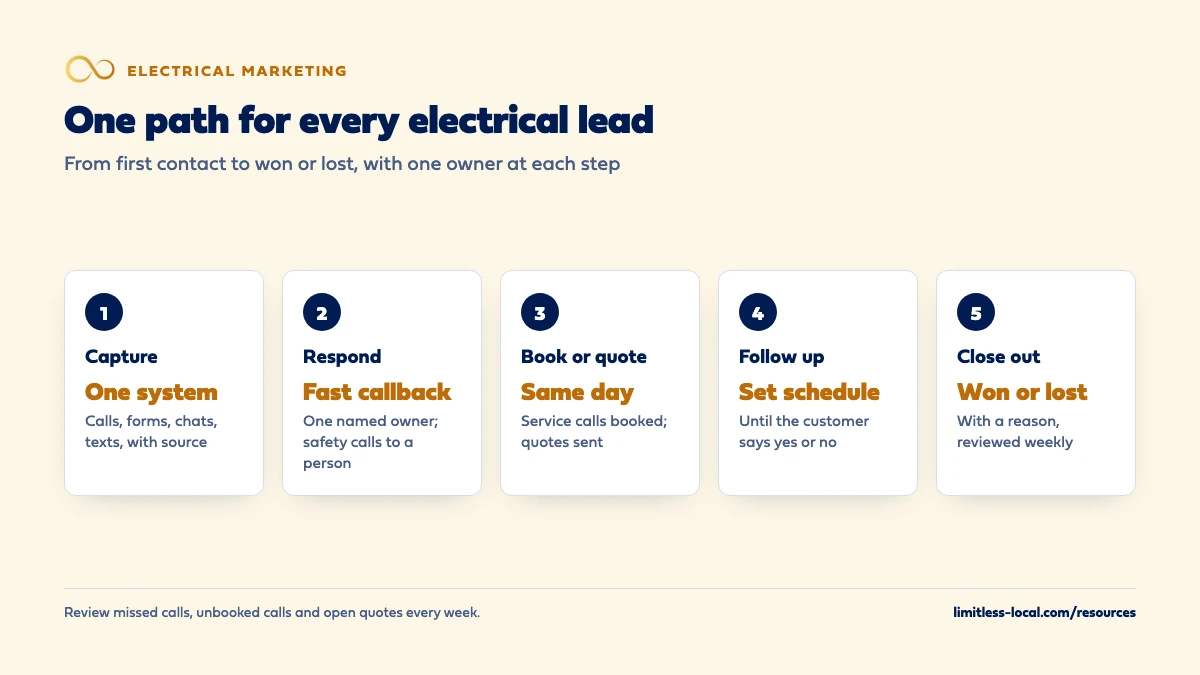
The short version
- Every lead goes into one system, with its source and job type.
- One named person owns each lead until it's won or lost.
- Book or quote the same day, then follow up on a set schedule.
- Review missed calls, unbooked calls and open quotes every week.
For owners of small electrical shops whose leads come in by phone, form, text and referral, and who suspect some of them never turn into the jobs they should.
Get a free visibility audit · Book a growth call
How should a small electrical shop handle leads from first call to booked job?
Organize lead handling as one path every lead follows: get every call, form, chat and message into one place with its source, give each lead one named owner who responds fast, book the job or send the quote the same day, and follow up on a schedule until the customer says yes or no. In a small shop the owner can’t run that from a ladder, so hand the phones and follow-up to one office person or a backup service and keep the owner as the backup. Then review the missed, unbooked and lost leads every week, because that’s where the jobs you already paid for slip away.
That’s the foundation we build before turning up any ads, because more leads into a leaky process just means more lost jobs. Every package includes call, web and form tracking with source tagging and call recording, and automation add-ons like a lead tracking dashboard, unified messaging, and calendar and reminders plug into any tier. Our packages page lists what each tier includes, and our electrical contractor marketing page shows how it fits an electrical shop. The rest of the electrical marketing questions library goes question by question.
Where do small electrical shops lose leads they already paid for?
Most lost leads aren’t lost to a competitor. They’re lost in the gaps between people and tools:
- Missed calls while the owner is in a panel or an attic, and voicemails nobody returns until the next evening.
- Web forms and Google messages landing in an inbox only one person checks.
- Texts to the owner’s cell from referrals, which never make it into the system at all.
- Quotes sent and forgotten, especially for planned work like panel upgrades and EV chargers.
- Calls that weren’t booked because the caller wanted a price, a time or a callback, and nobody followed through.
- No record of the source, so you can’t tell which marketing brings jobs and which brings tire-kickers.
Each of these is a process problem, not a marketing problem. Fixing them is usually cheaper than buying more leads, and it makes every marketing dollar after that work harder.
Step 1: Get every lead into one place
Pick one system as the home for every lead. For most electricians that’s the field software they already run jobs in, like Jobber, Housecall Pro or ServiceTitan. Calls, web forms, chats, Google and Facebook messages and referral texts should all end up there as a lead, not just as a memory.
Jobber’s help page on lead management shows how this works in one system: a person stays labeled as a lead until a job is created, an invoice is sent or their quote is approved, so you can tell at a glance who’s a prospect and who’s a customer. It also has a lead source field with options like Google, Facebook, referral and vehicle wrap, plus custom sources.
Make one rule non-negotiable: if it isn’t in the system, it didn’t happen. That includes the referral who texted the owner directly. Whoever receives a lead, on any channel, enters it or forwards it the same day.
Step 2: Give every lead one owner
A lead that belongs to everyone belongs to no one. Name one person who owns new leads until they’re booked, quoted or closed out, and a backup for when that person is out.
In a small shop, it usually looks like this:
- Phones and new leads: the office manager or dispatcher, with a backup service or the owner covering overflow and after hours.
- Quotes for planned work: whoever writes them, usually the owner or a lead tech, with the office tracking follow-up.
- Commercial and builder bids: the owner, since those run on relationships.
- Weekly review: the owner, every week, no exceptions.
Write the names down. When a lead slips, you want to know whose step it slipped in, so you can fix the step instead of blaming the marketing.
Step 3: Answer fast, and call back faster
Speed matters most on the first contact. Someone with a breaker that keeps tripping often calls the next shop on the list if you don’t pick up. Decide who answers during business hours, what happens when they can’t, and how fast missed calls and messages get a callback.
If you run Local Services Ads, missed calls also cost money. Google’s help page on how leads work says a missed call during your business hours counts as a valid lead when the customer stays on the line for more than 20 seconds. You pay for that lead whether or not anyone calls back.
Set a callback target, such as within minutes during business hours and first thing the next morning for overnight calls, and make it one person’s job. How fast your office should answer calls and how to stop missing calls go deeper on both.
Step 4: Ask the same questions on every call
A short intake script keeps leads consistent no matter who answers. For an electrician, that’s usually:
- What’s going on? In the customer’s words.
- Is anything unsafe right now? Sparks, smoke, a burning smell or a hot outlet go straight to a person who can dispatch or advise.
- What kind of job is it? Service call, panel or upgrade, EV charger, generator, remodel wiring or commercial.
- Where is it? Address or town, so you know it’s in your area.
- When do they need it? Today, this week, or planning ahead.
- How did they hear about you? Recorded as the lead source.
The job type and source fields are what make your reports useful later. The answers also help sort real jobs from tire-kickers fast; how electricians tell a junk lead from a real job covers the warning signs.
Curious what your marketing is actually booking?
Get a free visibility audit — no obligation, no sales pitch.
Step 5: Book the job or send the quote the same day
Different leads need different next steps, and each should happen the same day:
- Service calls: book a time on the call. A caller who hangs up with “we’ll call you back” is a lead at risk.
- Planned residential work: book the estimate visit on the call, or ask for photos of the panel and the spot for a charger so you can send a quote quickly.
- Commercial and builder work: get the drawings, scope and bid date, and log the deadline.
- Out-of-area or work you don’t do: say so kindly, refer them if you can, and close the lead as not a fit.
If your software lets customers approve a quote online, use it. The fewer steps between a quote and a yes, the fewer quotes go quiet.
Step 6: Follow up on a schedule until you get a yes or a no
Most quotes don’t get a yes on the first touch. A follow-up schedule turns “we’ll think about it” into an answer.
Housecall Pro’s Pipeline is a good picture of what this looks like. Its leads board sorts leads into columns for New Lead, First Contact, Second Contact, Third Contact, Won and Lost, and the help page recommends regularly updating each lead’s status so none fall through the cracks. Jobber and ServiceTitan have their own versions, and a whiteboard with the same columns works for a one-truck shop.
A simple rhythm for planned work: a call or text the next day, again a few days later, and a final check about a week after that. Big quotes, like a service upgrade or a commercial bid, deserve a phone call from a person, not just an automatic text. Following up on quotes automatically covers how to set up the routine reminders.
Step 7: Close out every lead as won or lost, with a reason
Every lead should end up in one of two places: won, with a job attached, or lost, with a reason. Keep the reasons short and the same every time, such as price, timing, chose another electrician, no response, out of area or not a job we do.
Those reasons are free market research. If “price” keeps coming up on panel upgrades, look at how you present the quote. If “no response” is the top reason, the problem is follow-up, not price. If “out of area” keeps showing up from one ad, that ad is aimed at the wrong towns.
Lost leads aren’t dead, either. A homeowner who wasn’t ready for a generator in spring may be ready before storm season. Keep them in the system so a later check-in is easy.

What should the owner check every week?
Block a short, fixed time every week to look at four lists:
- Missed calls and messages without a callback.
- Calls that didn’t book. In ServiceTitan’s help page on abandoned and unbooked calls, a call that lands in the Unbooked tab requires the manager’s attention, and you can listen to the recording, tag it or reclassify it from there. Most systems have something similar.
- Open quotes older than a week, and who owns each one.
- New leads by source compared with last week.
Listen to two or three unbooked calls each week. You’ll hear whether the problem is pricing, scheduling, how the phone was answered or junk leads, and each points to a different fix.
Who handles what in a one-truck, three-truck and bigger shop?
- One truck: the owner does almost everything, so the system has to be simple. Forward unanswered calls to a backup, keep one list of open leads and quotes, and block time each evening for callbacks and follow-up.
- Two to five trucks: this is usually when a dedicated office person pays for themselves. They own phones, intake, booking and follow-up; the owner owns big quotes and the weekly review.
- Bigger shops: split the roles: customer service reps for phones and booking, a sales or estimating role for planned and commercial work, and a manager who reviews unbooked calls and lost reasons each week.
Whatever the size, the path stays the same. What changes is who walks each lead down it.
What tools does a small electrical shop need for lead handling?
Fewer than most owners think:
- Field software with a lead or request list, so every lead, quote and job lives in one place. The software an electrician needs to run jobs and get paid covers choosing it.
- Call tracking, so calls carry their source. CallRail’s help page on source tracking explains the idea: a unique tracking number for each marketing campaign, each forwarding to your main business line.
- A shared inbox or unified messaging, so web forms, Google messages and social messages don’t sit in one person’s email.
- Overflow or after-hours answering, a person or service that picks up when the office can’t.
If you’re still on a notebook and a spreadsheet, whether a CRM is worth it for a small electrical business helps you decide when to move.
Not sure which of these is costing you jobs?
A free visibility audit checks the Google profile, reviews, site and tracking, and shows what to fix first.
What's different about lead handling for electricians
Safety questions come first. An electrical lead can be a hazard, not just a job. Your intake script needs a safety question at the top, and a clear rule for who gets those calls right away.
Two very different kinds of lead. Emergency service calls are won by whoever answers and shows up. Planned jobs like panel upgrades, EV chargers and generators are won by quotes and follow-up. Handle them on separate tracks, with different follow-up.
Builder and commercial leads have deadlines. A missed bid date is a lost job no matter how good the price was. Log bid dates and walkthroughs the day the invite comes in.
The owner is often the best electrician on the crew. That’s exactly why the owner shouldn’t be the only one answering phones. Every hour on the tools is an hour the phone isn’t covered unless someone else owns it.
A worked example: what one leaky month costs
These numbers are made up to show the math, not a benchmark or a forecast for your shop. Say a three-truck shop gets 80 leads in a month:
- Missed calls with no callback: 12. If half of those would have booked a service call at an average of $400, that’s 6 times $400, or $2,400.
- Planned-work quotes never followed up: 8 of the month’s 20 quotes. If steady follow-up wins just 2 of those at an average of $2,500, that’s $5,000.
Together that’s $7,400 in work slipping away in a single month, from leads the shop already paid to get. Your numbers will differ, and not every missed lead was a real job. But the math shows why fixing who answers and who follows up often pays back faster than adding ad spend.
Frequently asked questions
Should the owner answer the phones in a small electrical company?
Only as the backup. If the owner is the main person answering, calls get missed every time they’re on a job. Give phones to an office person or a backup service, and keep the owner on big quotes and the weekly review.
Is a spreadsheet good enough for tracking leads?
For a one-truck shop with a handful of leads a week, it can be, as long as every lead goes in with a source and a status. Once leads come from several places or quotes start slipping, move to field software that ties leads to quotes and jobs.
How many times should I follow up on an electrical quote?
A few times over about a week for residential work, with a person calling on the larger quotes. After that, close it as lost with a reason, and keep the customer in your system for a later check-in.
What's the most important field to fill in on every lead?
The lead source, followed closely by the job type. Without them you can’t tell which marketing brings in booked jobs, or which kinds of work it brings.
Should I call back leads that came in after hours?
Yes, first thing the next morning, before they call someone else. If after-hours calls are a big share of your leads, an answering service or AI receptionist can capture details overnight.
How do I get my techs to log leads they get on the job?
Make it one step: a text or a quick entry in the field app with the customer’s name, number and the job. Then thank them when those leads turn into work, so they keep doing it.
Key takeaways
- Most lost leads leak between people and tools, not to competitors.
- Put every call, form, chat and referral text into one system, with its source and job type.
- Give each lead one named owner, and keep the owner as the backup, not the front line.
- Book or quote the same day, then follow up on a set schedule until you get a yes or a no.
- Close every lead as won or lost with a reason, and review the gaps every week.
Want a second set of eyes on your setup?
We'll look at how you show up locally and where calls are leaking, then send you a plain-English breakdown.
More in this section
- How can a large electrical company filter out junk leads?
- Easiest channel for a small electrical company to run alone?
- How do I run an electrical business that gets steady calls?
- How can an electrical contractor get more leads?
- Which electrical marketing tasks should an owner outsource or keep?
Sources
- Lead Management — Jobber Help Center
- Getting Started with Pipeline — Housecall Pro Help Center
- Find and manage abandoned and unbooked calls — ServiceTitan Help
- How leads work — Google Local Services Help
- Source tracking basics — CallRail Help Center