
Restoration lead cost: Google Ads vs LSAs vs SEO vs Maps?
- How does the cost of a restoration lead compare across Google Ads, Local Services Ads, SEO and Google Maps?
- Why can't anyone give me one lead cost per channel?
- How does a Google Ads lead get priced?
- How does a Local Services Ads lead get priced?
- What does an SEO lead cost?
- What does a Google Maps lead cost?
- Why isn't the cheapest lead always the cheapest job?
- How do I compare the four channels fairly?
- What pushes restoration lead costs up or down in my market?
- Which channel should carry most of my budget?
- How do I find my real numbers in the first few months?
- What's different about lead costs for restoration companies
- A worked example: one month, four channels
- Frequently asked questions
- Key takeaways
- More in this section
- Sources
The short version
- Google Ads: pay per click; cost per lead depends on how many clicks call you.
- LSAs: pay per valid lead; the price comes from an auction and varies.
- SEO and Maps: no per-lead charge; the cost is the work, spread over the leads it brings.
- The fair comparison is cost per booked job, tracked the same way for every channel.
For restoration owners trying to compare channels that charge in completely different ways.
Get a free visibility audit · Book a growth call
How does the cost of a restoration lead compare across Google Ads, Local Services Ads, SEO and Google Maps?
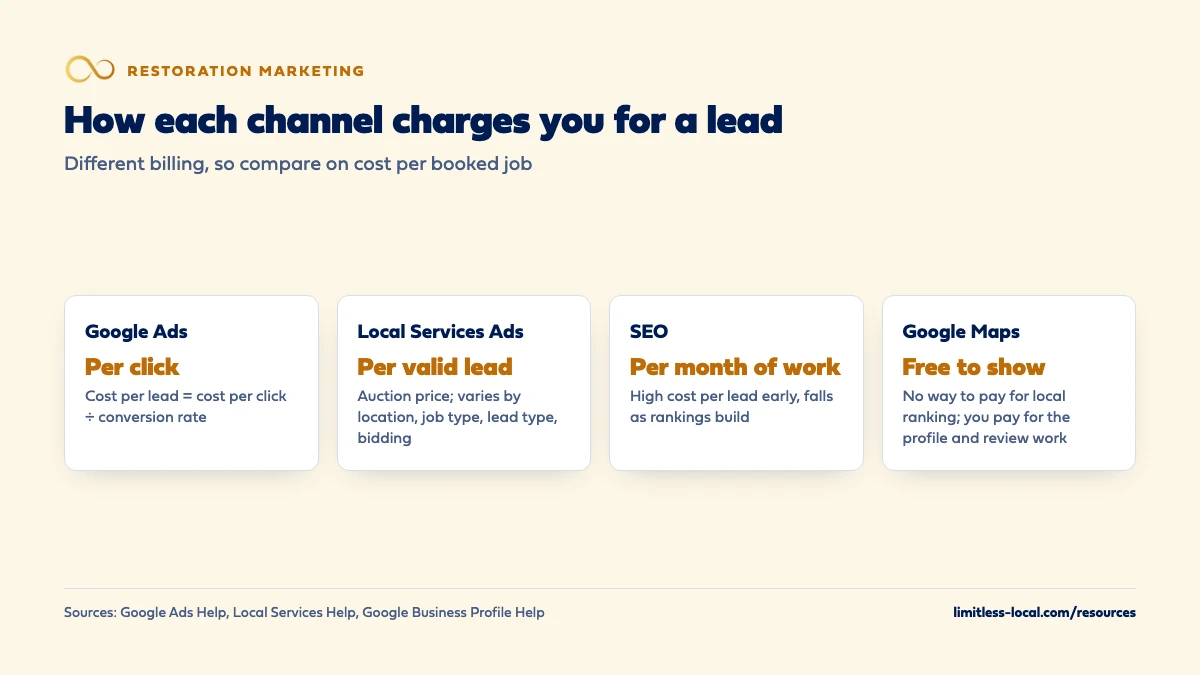
There’s no reliable average for any of the four, because each charges differently: Google Ads charges per click, so your cost per lead is your cost per click divided by the share of clicks that turn into calls or forms, while Local Services Ads charge per valid lead at a price set in an auction that varies by location, job type, lead type and bidding. SEO and Maps don’t charge per lead at all: your cost is the monthly work divided by the leads it brings, which runs high in the first months and falls as rankings build. Compare them on your own tracked cost per booked job, over the same months.
That comparison is built into how we report. Every package includes call tracking with recording, source tagging and a monthly report with a cost-per-lead breakdown, so Google Ads, Local Services Ads, SEO and your Google profile are measured side by side. Our Growth package, at $4,500 a month, covers local SEO, Google Ads management up to $5,000 a month in spend and Local Services Ads management; ad spend is paid to Google separately. Compare the packages, see our restoration marketing page, read the restoration marketing guide, or browse more restoration marketing questions.
Why can't anyone give me one lead cost per channel?
Because two of the four are auctions that change by town and by week, and the other two don’t have a per-lead price at all. A water damage click in a big, crowded metro during a freeze isn’t priced like a mold click in a small town in July. A national “average restoration lead cost” blends all of that into a number that may look nothing like your market.
What you can compare is how each channel charges and what drives the cost up or down. Once you’re running them, your own numbers settle the question. The sections below cover each channel, then how to line them up fairly.
How does a Google Ads lead get priced?
With search ads you typically pay per click. Google’s cost-per-click definition explains that your maximum bid is the most you’ll typically be charged for a click, and you’ll often be charged less. A click isn’t a lead, though. Your cost per lead is:
cost per click ÷ conversion rate
Conversion rate here is the number of conversions, such as calls and form fills, divided by the ad interactions that can be tracked to a conversion over the same period. Google’s conversion rate definition uses the example of 50 conversions from 1,000 interactions, which is a 5% rate.
So two things move your Google Ads lead cost: what the clicks cost in your area, and how well your ads and landing page turn clicks into calls. The second one is in your hands. A fast page with the phone number up top, real photos and clear service areas can lower your cost per lead without changing a single bid. How much a restoration company should spend on Google Ads covers sizing the budget.
How does a Local Services Ads lead get priced?
Local Services Ads charge per valid lead, not per click. Google’s page on how bidding works for Local Services Ads says a bid is the most you’d pay for a lead, that bids from similar local businesses on the same lead determine what the lead is worth, and that you only pay when you get a lead. Its page on how leads work adds that lead prices may vary depending on your location, the job type, the type of lead and your bidding mode, and that message leads are typically priced lower than phone leads, though not always.
That makes LSA lead cost easier to read than Google Ads lead cost, because the platform already counts the lead for you. It also means your answer rate and reviews matter: responsiveness and reviews still count toward where you show. What a restoration lead costs on Local Services Ads goes into bid modes, credits and disputes.
What does an SEO lead cost?
There’s no charge per click or per lead from organic search. Your cost is what you put into the work each month, whether that’s an agency fee, a freelancer or your own time, divided by the leads that come from organic search that month.
That number behaves differently from ads. In the first months, while pages are being built and rankings are still climbing, it’s high, because you’re paying for work that hasn’t paid off yet. SEO typically takes 3-6 months to show meaningful organic growth. After that, the same monthly cost is spread over more leads, so the cost per lead tends to fall, and rankings you’ve earned don’t switch off the day a bill goes unpaid.
That’s why judging SEO on its first quarter’s cost per lead is unfair to it, and judging it on its second year without looking at the first is unfair the other way.
Curious what your marketing is actually booking?
Get a free visibility audit — no obligation, no sales pitch.
What does a Google Maps lead cost?
Showing up in the Maps results costs nothing directly. Google’s page on improving your local ranking says there’s no way to request or pay for a better local ranking. The cost is the work that earns the spot: keeping your Google Business Profile complete and current, steady review requests after every job, photos, and the website and listings that back it up. That work is often done alongside SEO, so many owners count the two together.
Your Google profile reports some of what it brings in. Google’s Business Profile performance page lists calls, counted as the number of times a customer clicked the call button on your profile, and website clicks. Divide your monthly profile and review work by those calls, and you have a rough Maps cost per lead.
One thing to keep straight: ads can also show on Maps. Those are paid placements and belong in the ads columns, not here.
Why isn't the cheapest lead always the cheapest job?
Because the leads aren’t the same. A few differences that change how many of them book:
- Phone calls vs forms. An emergency water call books far more often than a form someone filled in to ask about mold testing prices.
- Urgency. Ads and the Maps results catch people mid-emergency. Organic pages also catch people researching, comparing or planning a rebuild, who book later or not at all.
- Fit. LSA and ad leads from the edge of your service area, or for job types you don’t want, look cheap until you count the ones you turn down.
- Repeat and referral value. A homeowner who found you through your reviews may send you the next job too.
That’s why the number to compare is what each booked job cost. What a good cost per booked job looks like for a restoration company covers how to set your ceiling.
How do I compare the four channels fairly?
- Count leads the same way everywhere. Decide what counts as a real lead (for example, a call long enough to be a real conversation, or a form with a real phone number) and use that definition for every channel, including LSAs.
- Include all the costs. Ad spend plus management for the ads; agency fees or staff time for SEO and Maps.
- Tag every booked job with its source in your job software, whether that’s Jobber, Housecall Pro or ServiceTitan.
- Use the same months for all four, and long enough to cover a storm and a quiet stretch.
- Give SEO a fair window. Compare it on its trend, not just one early month.
Separate tracking numbers for your website, your Google profile and each ad channel make the source tagging much easier. Tracking which marketing brings booked restoration jobs covers the setup.

What pushes restoration lead costs up or down in my market?
- Competition. More restoration companies bidding on the same searches and LSA leads means higher prices for both paid channels.
- Weather. Freezes, floods and storms bring a burst of searches and bidders at once.
- Service mix. Water, mold, fire and sewage searches don’t cost the same, and they don’t book at the same rate.
- Service area. A wide area brings more leads, including ones too far to run well.
- Answer rate. Missed calls lose paid leads outright and can hurt where your LSAs show.
- Reviews and rating. They help in Maps and LSAs, and they lift how many clicks turn into calls everywhere.
Which channel should carry most of my budget?
It depends on where your company is:
- New, or few reviews: ads and LSAs carry the load, because they can bring calls within days while SEO and Maps are still building. Start the SEO and Maps work anyway, at a steady smaller amount.
- Established, strong reviews and rankings: SEO and Maps can carry more, with ads filling gaps, storm weeks and towns you don’t rank in yet.
- Somewhere in between: most restoration companies run all four and shift the mix a little each quarter based on cost per booked job.
Whether a restoration company should run Google Ads, LSAs or both covers the paid side in more detail.
How do I find my real numbers in the first few months?
- Local Services Ads: once your account has moved into Google Ads, the transition page says the Cost / conv. column is your average cost per lead.
- Google Ads: set up call and form conversion tracking, then read cost per conversion, checked against what your office actually logged.
- SEO: a separate tracking number on your website, plus your job software’s lead sources, gives you organic calls and booked jobs.
- Maps: profile calls from your performance report, plus a tracking number on your Google profile if you use one.
After three months, line up all four. After six, you’ll have a fair read on SEO too.
Not sure which of these is costing you jobs?
A free visibility audit checks the Google profile, reviews, site and tracking, and shows what to fix first.
What's different about lead costs for restoration companies
Emergencies concentrate the money. Water and sewage calls are urgent and high-ticket, so they tend to draw more bidders and higher prices. They also book at the highest rate, which is why a pricey emergency lead can still be your cheapest booked job.
Storm weeks distort the averages. A freeze can push up your call volume and your click prices at the same time. Compare channels over months that include both storm weeks and quiet ones, or you’ll pick a winner based on the weather.
Big jobs hide behind small ones. A lead that starts as a small water call can turn into mitigation plus a rebuild. Track the full job value by source, not just the first invoice, or the channels that bring bigger losses will look worse than they are.
A worked example: one month, four channels
These numbers are made up to show the math, not a benchmark for your market.
- Google Ads: $3,000 buys 120 clicks, so each click costs $3,000 ÷ 120, or $25. If 24 of those clicks become calls or forms, that’s a 20% conversion rate and $125 per lead. Eight of them book, so each booked job cost $3,000 ÷ 8, or $375.
- Local Services Ads: $1,800 brings 18 charged leads, or $100 per lead. Eight book, so each booked job cost $225.
- SEO and Maps, month three: $2,400 of work brings 6 leads, or $400 per lead.
- SEO and Maps, a year in: the same $2,400 brings 30 leads, or $80 per lead. Twelve book, so each booked job cost $200.
In month three, SEO looks like the worst channel. A year in, it’s the cheapest per booked job, and the paid channels are still doing what they do best: bringing emergency calls this week. That’s why one month’s cost per lead is never the whole answer.
Frequently asked questions
Are LSA leads cheaper than Google Ads leads for restoration?
Sometimes, sometimes not. It depends on your market, your bids, your answer rate and how well your Google Ads landing page turns clicks into calls. Run both for a few months with the same lead definition and compare cost per booked job.
Can I get credits back for bad leads?
On Local Services Ads, Google doesn’t charge for leads it decides are invalid or low quality, and may credit charged leads it later judges low quality. On Google Ads you pay for clicks, so bad leads show up as a lower conversion rate instead.
Does SEO ever stop costing money?
The work doesn’t stop, but rankings you’ve earned keep bringing calls between payments in a way ads don’t. As organic leads grow, the cost per lead usually falls.
Should I count Google profile calls as SEO or separately?
Either works, as long as you’re consistent. Many owners count the profile and review work with SEO, because the same work helps both.
What's a good cost per lead for restoration?
One that leaves room for profit once you divide by your booking rate. Work backward from what a booked job is worth to you, not from a national average.
Key takeaways
- Google Ads charges per click, LSAs per valid lead, and SEO and Maps charge nothing per lead; you pay for the work.
- Google Ads cost per lead is cost per click divided by the share of clicks that call or fill a form.
- LSA lead prices are set by auction and vary by location, job type, lead type and bidding.
- SEO’s cost per lead starts high and falls as rankings build; judge it over months, not weeks.
- Compare every channel on cost per booked job, tracked the same way over the same months.
Want a second set of eyes on your setup?
We'll look at how you show up locally and where calls are leaking, then send you a plain-English breakdown.
More in this section
- Should a restoration company run Google Ads, LSAs or both?
- What does a restoration lead cost on Local Services Ads?
- Can a restoration company rely on SEO and Maps without ads?
- Do Google Ads help a restoration company's SEO rankings?
- How much should a restoration company spend on Google Ads?
Sources
- Cost-per-click (CPC): Definition — Google Ads Help
- Conversion rate: Definition — Google Ads Help
- How bidding works for Local Services Ads — Local Services Help
- How leads work — Local Services Help
- Tips to improve your local ranking on Google — Google Business Profile Help
- Understand your Business Profile performance & insights — Google Business Profile Help
- Local Services Ads transition to Performance Max campaigns with pay-per-lead goals — Google Ads Help