
Should electricians use LSAs, Search Ads or lead sites?
- Should an electrician pick Google Local Services Ads, Google Search Ads or lead-generation websites?
- What's the difference between LSAs, Search Ads and lead sites?
- How does each one charge an electrician?
- Which one gives me the most control over the jobs I pay for?
- Who owns the lead and the customer?
- What happens with junk and bad leads on each?
- Which one gets an electrician calls fastest?
- Which one fits emergency calls, and which fits planned jobs?
- What's changing with Local Services Ads?
- Can I run more than one at the same time?
- How do I decide where my budget goes?
- What's different about this choice for electricians
- A worked example: the same budget on all three
- Frequently asked questions
- Key takeaways
- More in this section
- Sources
The short version
- LSAs: pay per valid lead, best for urgent electrician searches.
- Search ads: pay per click, best control for panel upgrades, EV chargers and generators.
- Lead sites: pay per lead whether you win or not; a gap-filler.
- Compare all three on cost per booked job.
For electrical contractors deciding where paid leads should come from, comparing how each option charges, how much control you get and what happens to the customer afterward.
Get a free visibility audit · Book a growth call
Should an electrician pick Google Local Services Ads, Google Search Ads or lead-generation websites?
Most electricians do best with Local Services Ads for urgent calls and Google search ads for planned, higher-value jobs, using lead sites only to fill gaps in the schedule. LSAs charge per valid lead and screen out junk, but you can’t choose keywords and electricians go through extra screening before the ads run. Search ads charge per click and give you the most control over which searches, towns and jobs you pay for, while lead sites charge for each lead whether or not you win the job. Judge all three on what each booked job cost, not what each lead cost.
We manage the first two. Google Ads management is in every package, and Local Services Ads management is part of our Growth and Scale tiers, with call tracking and source tagging so you can see which channel booked each job. Ad spend is paid to Google directly. Our local ads page explains how we run them together, our electrical contractor marketing page covers the bigger picture, and the electrical marketing questions library has more on each channel.
What's the difference between LSAs, Search Ads and lead sites?
All three put you in front of homeowners who need an electrician. They differ in what you pay for and who controls the conversation.
- Local Services Ads (LSAs) are the listings at the top of Google Search and Maps, with your name, your rating and, for eligible businesses that pass Google’s checks, a Google Verified badge. The homeowner calls or messages you from the ad, and you pay per valid lead.
- Google search ads are text ads that show for the keywords you choose. The homeowner clicks through to your website or taps to call, and you pay per click.
- Lead sites like HomeAdvisor, Angi and Thumbtack collect a homeowner’s request on their platform and pass it to pros who serve that job and area. You pay per lead.
None of them is the answer for every shop. The right mix depends on which jobs you want, how fast you answer the phone and how much control you want over the spend.
How does each one charge an electrician?
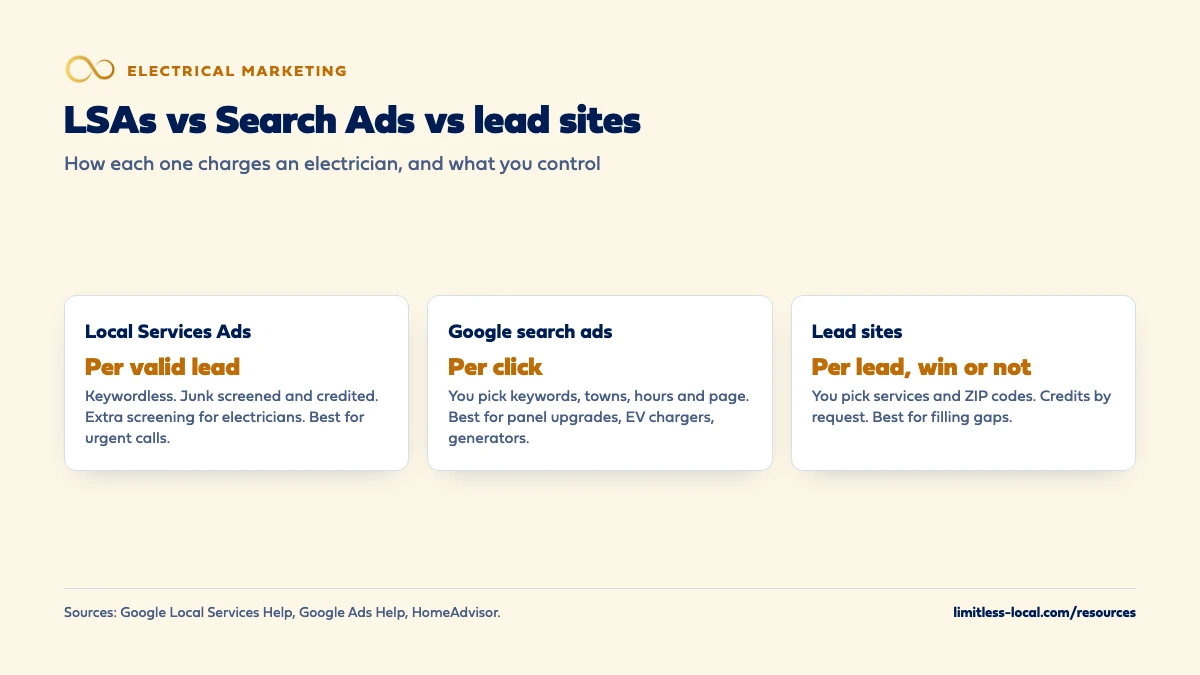
LSAs: per valid lead. Google’s page on how leads work lists what counts: an answered call, a text or email, a voicemail, a booking request, or a missed call during business hours where the caller stays on the line more than 20 seconds. Lead prices vary with your location, the job type, the type of lead and your bidding.
Search ads: per click. Your actual cost per click is the final amount charged, and it’s often less than your maximum bid, because, as Google’s definition of actual cost-per-click explains, you pay only what’s needed to clear the auction’s thresholds and beat the advertiser below you. A click isn’t a lead, so your cost per lead depends on how many clicks call or fill in a form.
Lead sites: per lead, win or lose. HomeAdvisor’s page on how it works for contractors says lead prices vary by type of work and region, that you’re charged for each lead whether or not you win the job, and that its monthly spend target is an estimate, not a hard cap, so it’s possible to go over it.
Which one gives me the most control over the jobs I pay for?
Search ads, by a distance.
- Search ads let you choose keywords, add negative keywords, pick the towns, set the hours and send each ad to its own page. The search terms report shows the actual searches that triggered your ads, so you can see whether you paid for “panel upgrade near me” or “electrician jobs hiring.”
- LSAs are keywordless. You choose service categories, job types and service areas, and Google matches the searches. Simpler to run, but you can’t pick the exact searches.
- Lead sites like HomeAdvisor let you choose services and ZIP codes, change your spend target and mark yourself busy. The platform decides which requests reach you.
Control matters most when you want specific jobs. If panel upgrades and EV chargers are the work you want more of, search ads let you target those searches directly and send them to a page about that job. Which negative keywords electricians should add first shows how to keep the junk out.
Who owns the lead and the customer?
With LSAs and search ads, the homeowner contacts you directly. The call rings your phone, the message comes to you, and with search ads they’ve been on your website. LSA leads can be downloaded from Google Ads into your own CRM, and the customer’s next call can come straight to you.
With lead sites, the homeowner asked the platform, not you. Win the job and do it well, then make sure the customer leaves with your number, a magnet or invoice with your name on it, and a review request for your Google profile. That’s how a paid lead turns into a customer you don’t pay for twice.
Either way, keep every lead in your own system, tagged by source. A customer list you own is worth more than any channel.
Curious what your marketing is actually booking?
Get a free visibility audit — no obligation, no sales pitch.
What happens with junk and bad leads on each?
- LSAs screen leads when the customer first makes contact and don’t charge for invalid or low-quality ones, such as spam and duplicates. Google keeps assessing lead quality over a 30-day period and credits poor-quality leads automatically. If you keep getting the wrong leads, narrow your service areas and job types.
- Search ads charge for clicks whether the click becomes a customer or not. Your protection is setup: negative keywords, tight location targeting and a landing page that says clearly what you do and where.
- Lead sites handle it by request. The same platform’s lead credit guidelines say credits must be requested within 30 days, are issued as store credit that expires six months after it’s issued, and don’t cover a customer who’s just shopping, already found someone, changed their mind or never calls back.
That last list is the everyday reality of a lot of leads, which is why a lead site’s price per lead understates its price per job.
Which one gets an electrician calls fastest?
Search ads, usually. They can bring leads within days of launch once the account, tracking and ads are set up.
LSAs take longer for electricians. Google treats the electrician category as urgent, since people call about things like exposed wiring, so electricians go through an extra level of screening that includes background checks, plus license, insurance and business checks for select users. Its screening and verification requirements put the process at 3–4 weeks on average after you submit documents, and you need a public, verified Google Business Profile. How electricians get verified for Local Services Ads walks through it.
Lead sites depend on the platform’s own sign-up and on how many requests come in for your services and ZIP codes. Ask how soon leads typically start before you commit a budget.
Which one fits emergency calls, and which fits planned jobs?
Urgent work leans LSA. Someone with no power searches “electrician near me” and calls the first trustworthy name at the top. LSAs sit there, show your rating and connect the call directly. They reward a shop that answers, because missed calls during business hours can still be charged.
Planned work leans search ads. Panel upgrades, EV chargers, generators and rewires are searched by name, compared and quoted. Search ads let you bid on those exact searches and send them to a page that answers the homeowner’s questions before they call.
Lead sites fill gaps. They can help a new shop or a slow week, if you can respond within minutes and your margins can carry paying for leads you don’t win. Whether electricians should pay for leads from Angi or Thumbtack goes deeper on that choice.
What's changing with Local Services Ads?
Where you manage them. Google’s page on the Local Services Ads transition says existing LSA campaigns are moving into Google Ads as Performance Max campaigns with pay-per-lead goals, and electrical is named in the first phase, which began in August 2026 for select advertisers.
What stays: you still pay only for valid leads, the ads still show only on Google Search and Maps, and targeting is still based on service categories and areas, not keywords. What changes: budgets go from weekly to daily, manual bidding such as a maximum cost per lead is no longer supported, and your old LSA performance reports don’t carry over, so save them before your account moves. Your business name, address and hours sync one way from your Google Business Profile.
For the choice on this page, the practical effect is that LSAs and search ads now sit in the same Google Ads account, which makes it easier to compare them side by side.
Can I run more than one at the same time?
Yes, and many shops should. A common order:
- Search ads first, because they start fastest and let you target the jobs you want.
- Start LSA screening at the same time, and turn LSAs on once you’re verified and someone reliably answers the phone.
- Lead sites only if there’s still room on the schedule, with a clear monthly cap.
Running more than one only works if you can tell them apart. Give each its own tracking number or source tag, and record which source each booked job came from. Otherwise the busiest channel gets the credit and the cheapest one gets cut. Whether to run Google Ads and LSAs at the same time covers how to split the work between them.
How do I decide where my budget goes?
By cost per booked job, channel by channel. For each one, add up what you spent, divide by the jobs it booked, and compare. Cost per lead is a warning light, not the score, because a cheap lead that rarely books is the expensive one. Whether $25 per lead is good for electrical ads shows how to test any lead price against your booking rate.
Then look at the kind of jobs, not just the count. A channel that books fewer jobs can still win if those jobs are panel upgrades instead of outlet swaps. Move money toward what books the work you want, a step at a time, and give each change a few weeks before judging it.
Skip a channel when its weak spot matches yours: LSAs if nobody can answer during the day, search ads if you have no page worth sending traffic to, and lead sites if you can’t reply within minutes.
Not sure which of these is costing you jobs?
A free visibility audit checks the Google profile, reviews, site and tracking, and shows what to fix first.
What's different about this choice for electricians
Extra screening. Electricians face background checks for Local Services Ads because Google treats the category as urgent, so LSAs start later than they do for some other trades.
A wide job mix. A dead outlet and a whole-home rewire can come from the same search. Search ads let you separate them; LSAs and lead sites mostly don’t.
Plenty of searches that aren’t customers. Apprentices, job seekers and do-it-yourselfers search electrician terms too. Negative keywords keep them out of search ads; LSA screening and credits catch some of them.
Quoted jobs take time. Panel upgrades and generators often sign weeks after the first call, so judge each channel on a long enough window to see them land.
A worked example: the same budget on all three
These numbers are made up to show the comparison, not a benchmark for your market. An electrician spends $1,500 in one month on each channel.
- LSAs: $60 a lead, so 25 leads. 10 book, mostly service calls. Cost per booked job: $150.
- Search ads: 20 leads, so $75 a lead. 6 book, and 4 of them are panel upgrades or EV chargers. Cost per booked job: $250.
- Lead site: $30 a lead, so 50 leads. 5 book. Cost per booked job: $300.
The lead site had the cheapest leads and the most expensive jobs. LSAs booked the most work per dollar, and search ads booked the bigger tickets, which can make $250 the best deal on the list once you look at profit per job. Your numbers may land in a different order. That’s the point of running the math on your own results.
Frequently asked questions
Do LSAs replace Google search ads?
No. They show in a different spot, charge differently and target differently. Many electricians run both: LSAs for urgent general searches, search ads for specific jobs.
Are lead-site leads exclusive to me?
Ask each platform before you buy. Whether a request goes to you alone or to several pros changes how fast you need to respond and what the lead is really worth.
Do I need a website for Local Services Ads?
Google’s requirement is a public, verified Google Business Profile. Customers contact you straight from the ad, but a good website still helps homeowners who check you out before calling.
Can I pause any of these in a slow month?
Yes. LSA and search ad campaigns can be paused in Google Ads, and lead sites let you change your spend target or mark yourself busy.
Which one is easiest to run without an agency?
LSAs are the simplest to set up because there are no keywords to manage. Search ads take more skill to keep the junk out, and lead sites take the most time answering requests fast.
Key takeaways
- LSAs charge per valid lead, screen out junk and suit urgent electrician searches, but electricians face extra screening first.
- Search ads charge per click and give the most control, which makes them best for planned jobs like panel upgrades and EV chargers.
- Lead sites charge per lead whether you win or not, so treat them as a gap-filler with a cap.
- Give every channel its own tracking so each booked job is credited to the right source.
- Move budget by cost per booked job and job type, not by cost per lead.
Want a second set of eyes on your setup?
We'll look at how you show up locally and where calls are leaking, then send you a plain-English breakdown.
More in this section
- Should my electrical company start with LSAs, Google Ads or SEO?
- How do leads work in Google Local Services Ads for electricians?
- Should an electrician add budget to LSAs, Google Ads, SEO or GBP?
- Can an electrician get enough leads without paid ads?
- Are Google Local Services Ads worth it for electricians?
Sources
- How leads work — Google Local Services Help
- Local Services Ads transition to Performance Max campaigns with pay-per-lead goals — Google Ads Help
- Business screening and verification requirements – United States — Google Local Services Help
- Actual cost-per-click (CPC): Definition — Google Ads Help
- About the search terms report — Google Ads Help
- How does HomeAdvisor work for contractors? — HomeAdvisor
- Lead Credit Guidelines — HomeAdvisor Pro