
How much should an electrical contractor spend on marketing?

- What's a realistic monthly marketing budget for an electrical contractor?
- What percentage of revenue should an electrical business spend on marketing?
- Should I set the budget by percentage or by the jobs I need?
- What's a good cost per booked job for an electrician?
- What should an electrical marketing budget cover?
- How should I split the budget between Google Ads, Local Services Ads and SEO?
- How do I estimate what Google Ads will cost in my area?
- Should a new electrical contractor spend more on marketing?
- How much does it cost to hire a marketing agency for an electrical business?
- When should I raise or cut my marketing budget?
- What's different about marketing budgets for electricians
- A worked example: the percentage check and the job math
- Frequently asked questions
- Key takeaways
- More in this section
- Sources
The short version
- Rule of thumb: about 2-5% of revenue for business-to-business work, 5-10% for consumer work.
- Mostly residential sits higher in that range; mostly commercial sits lower.
- Check it against job math: jobs you need each month times what a booked job costs you.
- Budget for ad spend, management, website and tracking, then move money to what books jobs.
For electrical contractors setting or resetting a marketing budget, whether they mostly do residential service, project work, commercial jobs or a mix.
Get a free visibility audit · Book a growth call
What's a realistic monthly marketing budget for an electrical contractor?
There’s no fixed number, but a widely quoted small-business rule of thumb, not one specific to electricians, is a percentage of revenue: about 2-5% for businesses that sell mainly to other businesses and 5-10% for those that sell to consumers, so a mostly residential electrician usually sits toward the higher range and a mostly commercial one toward the lower. A better check is the job math: decide how many more booked jobs you need each month, multiply by what a booked job costs you in marketing, and see whether that fits inside the percentage. Then track cost per booked job by channel and move money toward what actually books work.
That’s how we set budgets with owners: start from the jobs you need, check the math against what you earn, and report cost per booked job every month so the budget follows results. Our packages page lists what each tier costs and includes, and our electrical contractor marketing page shows how it applies to electricians. The rest of the electrical marketing questions library goes question by question.
What percentage of revenue should an electrical business spend on marketing?
There’s no official number. A 2019 SBA blog post on getting the most from your marketing budget says there’s no hard and fast answer, that many businesses use a percentage of revenue as a guide, and that the percentage varies widely.
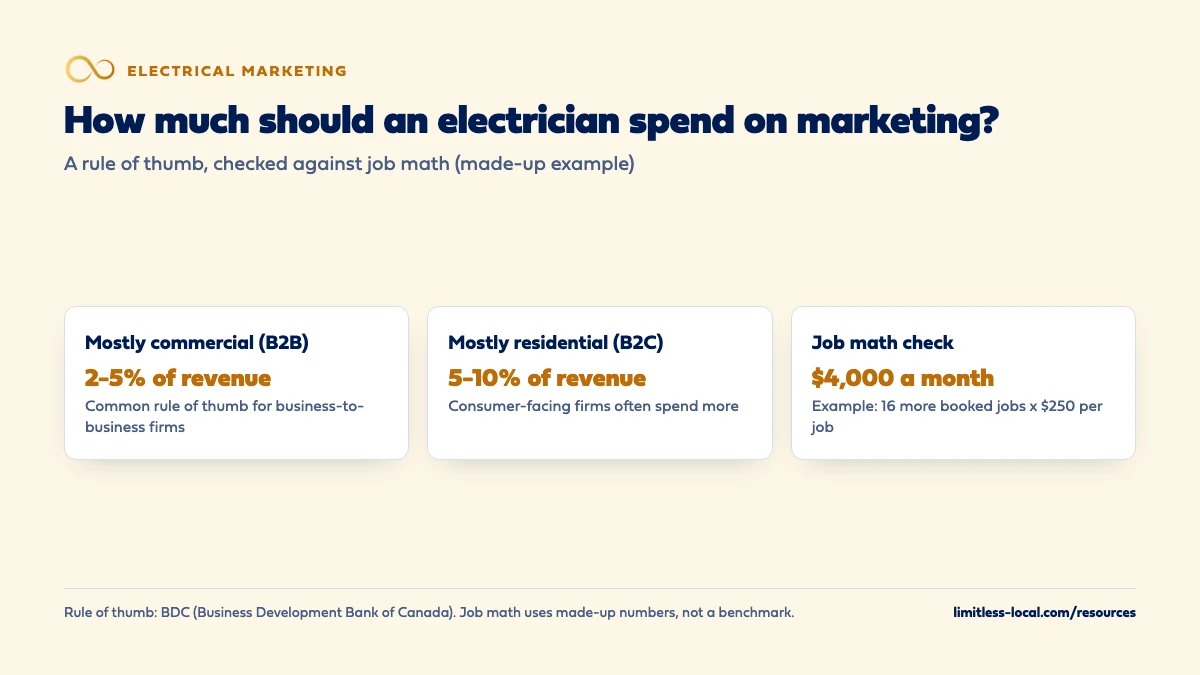
The most quoted rule of thumb comes from BDC, Canada’s business development bank, and it’s written for small businesses in general, not for electricians. BDC’s article on small business marketing budgets says business-to-business companies commonly spend between 2% and 5% of revenue on marketing, and consumer-facing companies often spend more, between 5% and 10%, because they usually need more channels to reach different kinds of customers. The article was last updated in 2023, so treat it as a starting point, not a benchmark for your trade.
Electrical contractors are often both. In our view:
- Mostly residential (service calls, panel upgrades, EV chargers, generators): closer to the consumer range, because you’re winning homeowners one at a time.
- Mostly commercial or new construction (bids for general contractors, property managers, builders): closer to the business range, because a few relationships can carry a lot of revenue.
- A mix: budget each side separately, so the commercial revenue doesn’t make the residential marketing look affordable when it isn’t.
Should I set the budget by percentage or by the jobs I need?
Use both, and let the job math decide. A percentage tells you what you can afford. It doesn’t tell you what it will take to fill the schedule.
The job math has three inputs:
- How many more booked jobs you want each month, by type (service calls, panel upgrades, EV chargers, commercial work).
- What a booked job costs you in marketing today, from your own tracking. If you don’t know yet, start tracking before you set a big budget.
- How many jobs your crews can actually take. Licensed electricians are the limit in a lot of shops. Spending for work you can’t staff just buys leads you’ll lose.
Multiply the first two and you have a monthly budget that’s tied to results. Then compare it with the percentage. If the job math says you need far more than the rule of thumb allows, the answer may be to fix conversion first (answering the phone, following up on quotes) rather than to spend more. The worked example below runs both numbers side by side.
What's a good cost per booked job for an electrician?
The honest answer is the one your margins allow. We don’t quote a national benchmark for cost per booked job, because it swings with your market, the job type and how well your office books calls, and an average from somewhere else won’t tell you whether your own marketing is working.
Work it out from your own numbers instead. For each kind of work, take the gross profit on a typical job (the invoice minus labor, materials and other job costs). The most you can spend in marketing to win that job, and still make money, has to sit comfortably below that profit. A small service call leaves little room. A panel upgrade, a generator install or a commercial job leaves much more, which is one reason to track job types separately.
Once you’re tracking, your own cost per booked job by channel becomes the number to beat. Tracking which marketing brings in real jobs covers how to set that up.
What should an electrical marketing budget cover?
More than ad spend. BDC’s article suggests splitting a marketing budget across categories such as your website, social media, online advertising, traditional media, email newsletters and video, and adjusting over time based on what works. For an electrical contractor, the list usually looks like this:
- Ad spend paid to Google (and Meta, if you use it), including Local Services Ads.
- Management, if an agency or freelancer runs the ads, SEO and Google profile.
- Your website: the build, hosting and keeping it current.
- Tracking: call tracking and the reporting that ties leads to jobs.
- Reviews and follow-up: review requests, quote follow-up and missed-call handling, whether in your field software or an add-on.
- Offline: truck wraps, yard signs, mailers and sponsorships.
Count your own time too. An owner spending evenings on ads is paying for marketing with hours that could have gone to estimates.
Curious what your marketing is actually booking?
Get a free visibility audit — no obligation, no sales pitch.
How should I split the budget between Google Ads, Local Services Ads and SEO?
There’s no fixed split, but the channels behave differently, and that should shape where the first dollars go:
- Google Ads can start producing calls within days of launch. You pay per click and choose which searches and which pages, which suits project work like panel upgrades and EV chargers.
- Local Services Ads charge per lead instead of per click. Google says lead prices vary with your location, the job type, the type of lead and your bidding. Electrical is one of the categories in the first phase of Google’s move of Local Services Ads into Google Ads, which began in August 2026 for select advertisers, and budgets there become daily instead of weekly.
- SEO and your Google profile typically take 3-6 months to show meaningful growth, but the calls they bring don’t carry a per-click or per-lead price.
In our view, a common pattern is to put early money into ads for the jobs you want now and steady money into SEO and reviews for the calls you want next year. Whether to start with LSAs, Google Ads or SEO goes through that choice in detail.
How do I estimate what Google Ads will cost in my area?
Use Google’s own tools instead of someone else’s average. Google’s guide to the Keyword Planner says it can give click and cost forecasts for a list of keywords based on your budget, location and bids, so you can see whether searches like “electrician near me,” “panel upgrade” or “EV charger installation” in your towns fit your budget.
When you set the budget, know how Google spends it. Google Ads uses an average daily budget: on busy days it can spend up to two times that amount, but for most campaigns you won’t pay more than 30.4 times the daily budget in a month. To turn a monthly budget into a daily one, divide by 30.4. Which Google Ads campaigns work best for electricians covers how to split that spend across campaigns.
Should a new electrical contractor spend more on marketing?
Usually, as a share of revenue, yes. The same 2019 SBA blog post says businesses that are just starting out need to budget more for marketing because they’re still building awareness and attracting customers, and that an established business can spend less once it has a steady customer base. If you’re a startup, it suggests using projected revenue for the percentage.
The catch for a new shop is that the percentage is of a small number, so the job math matters more. Spend first on the things that make every other channel work: a Google Business Profile, a basic website with a page for each kind of work, and a way to ask every customer for a review. How a new electrical contractor gets its first customers covers that early stage.
How much does it cost to hire a marketing agency for an electrical business?
It depends on what’s included, so compare scope, not just the monthly fee. Ask every agency what the fee covers, whether ad spend is included or paid to Google separately, how many locations it covers, what you’ll see in a report, and what the contract says about leaving.
Our own prices are public. Essentials is $3,500 a month for one location, including Google Ads management for up to $2,500 a month in ad spend, Google Business Profile management, review response and basic review generation, call and form tracking, and a monthly report. Growth is $4,500 a month and adds Local Services Ads management, Meta remarketing, SEO for up to two locations and Google Ads management for up to $5,000 a month in spend. Scale is custom. In every tier, ad spend is paid directly to Google or Meta and isn’t part of the fee.
Whoever you hire, judge them on cost per booked job, not activity. Knowing whether your agency is getting results covers what to ask for.
When should I raise or cut my marketing budget?
Raise it when a channel is booking jobs at a cost per job you’re happy with and you have crew capacity to take more. Cut or move it when a channel’s cost per booked job stays too high after you’ve given it a fair test and fixed the obvious problems, such as missed calls or slow quote follow-up.
The 2019 SBA post warns about the opposite mistake: sales drop, you cut marketing, and sales drop further. If the schedule is thinning out, that can be the time to spend more on what’s working, not less. In our view, judge ads on a month or two of data and SEO on at least three to six months, and compare a rolling three months instead of a single month before making a big change. What to expect in your first three months lays out that ramp.
What's different about marketing budgets for electricians
Residential and commercial need separate budgets. Residential work is won homeowner by homeowner through search, Maps and reviews. Commercial work is often won through bids and relationships with builders, general contractors and property managers. One blended percentage hides which side is paying its way.
Service calls and projects have different math. A small service call can’t carry much marketing cost; a panel upgrade, generator or EV charger install can carry far more. Set what you’re willing to pay per booked job by job type, not one number for everything.
Crew capacity is the real ceiling. If you can’t hire licensed electricians fast enough, the right budget is the one that fills the schedule you have, aimed at the work with the best margins.
New-technology work can justify its own line. EV chargers, generators and smart-home upgrades are the growth areas our electrical page calls out. If that’s the work you want, give it its own campaign and budget so you can see what it costs to win.
Talk it through with someone who runs this every day
A 15-minute growth call: your market, your numbers, and what a realistic budget looks like. No pressure.
A worked example: the percentage check and the job math
These numbers are made up to show the math, not a benchmark for your market. Say your shop does $1,000,000 a year in mostly residential revenue.
- The percentage check. At 5% of revenue, that’s $50,000 a year, or about $4,200 a month. At 10%, it’s $100,000 a year, or about $8,300 a month.
- The job math. You want 16 more booked jobs a month, and your tracking says a booked job costs you about $250 in marketing. That’s 16 times $250, or $4,000 a month, near the low end of the range.
The job math fits, so the budget is realistic. If tracking had said each booked job cost $600, the same 16 jobs would need $9,600 a month, above the range, and the first move would be to fix conversion before spending more.
Now add management. With our Essentials package at $3,500 a month and the full $2,500 of Google Ads spend it covers, the total is $6,000 a month, or $72,000 a year: 7.2% of that $1,000,000. Whether that’s the right call depends on whether it books more jobs than you’d book on your own, which is what a free visibility audit is meant to help you judge.
Frequently asked questions
Does the marketing budget include ad spend?
It should. Count everything you pay to get jobs: ad spend, management fees, website, tracking and offline marketing. With most agencies, including us, ad spend is paid to Google or Meta separately from the fee.
Is $1,000 a month enough for electrical marketing?
It can be enough to start, depending on your market and goals. Run the job math: if a booked job costs you a few hundred dollars in marketing, that budget buys a handful of jobs a month, which may be plenty for a one-truck shop and far too little for a growing crew.
Should my marketing budget change with the seasons?
It can. Demand for some electrical work rises and falls through the year, so many owners raise budgets ahead of their busy stretch and trim them when crews are booked out. Google Ads lets you change the daily budget at any time.
Where can I find a benchmark for electrical contractors specifically?
The 2019 SBA blog post suggests asking your industry trade association or reading trade publications for budget benchmarks. Treat any average as a starting point and let your own cost per booked job decide.
Do I have to sign a long contract with a marketing agency?
Not with us. We work month to month; we ask for three months, written into the contract, but if you want to leave we won’t make you stay. Elsewhere, read the cancellation terms before you sign.
Key takeaways
- A common rule of thumb is 2-5% of revenue for business-to-business work and 5-10% for consumer work.
- Mostly residential electricians usually sit higher in that range; mostly commercial ones lower.
- Check the percentage against job math: booked jobs you need times what a booked job costs you.
- Count ad spend, management, website, tracking and offline marketing, and budget residential and commercial separately.
- Move money toward the channels with the best cost per booked job, within what your crews can handle.
Ready to compare options?
Book a short growth call and we'll walk through the math for your service area, including when we're not the right fit.
More in this section
- How should an electrical contractor market to commercial customers?
- What should I expect from electrical marketing in the first 90 days?
- How do I know if my electrical marketing agency is getting results?
- How should a new electrical contractor get its first customers?
- How do I track which electrical marketing brings in real jobs?
Sources
- How to Get the Most From Your Marketing Budget — U.S. Small Business Administration
- What is an average marketing budget for a small business? — BDC (Business Development Bank of Canada)
- About average daily budgets — Google Ads Help
- How to Find Keywords with Keyword Planner — Google Ads
- How leads work — Google Local Services Help
- Local Services Ads transition to Performance Max campaigns with pay-per-lead goals — Google Ads Help