
Does my HVAC company website need a blog?

- Is blogging worth it for an HVAC company, or should I focus on service pages?
- What does a blog actually do for an HVAC company?
- When should an HVAC company skip the blog for now?
- When does a blog start to pay off for an HVAC company?
- What should an HVAC company blog about?
- What makes an HVAC blog a waste of time?
- How often should an HVAC company post on its blog?
- Do blog posts help my HVAC service pages rank?
- Can I use AI to write HVAC blog posts?
- How do I tell if my HVAC blog is working?
- Is a blog part of SEO, or something separate?
- What's different about blogging for HVAC companies
- A worked example: what a year of posting looks like
- Frequently asked questions
- Key takeaways
- More in this section
- Sources
The short version
- Service pages, a contact page and reviews come first; a blog is not where most HVAC calls start.
- A blog earns its keep when it answers questions your office actually hears, written by someone who knows the work.
- Posting often to look fresh doesn't help; Google says so directly.
- Judge it in Search Console and in booked jobs, not by how many posts went up.
For HVAC owners who’ve been told they need to blog and want to know whether it’s worth the time before the service pages are done.
Get a free visibility audit · Book a growth call
Is blogging worth it for an HVAC company, or should I focus on service pages?
Not at first. An HVAC website books jobs through its service pages, its contact page and the reviews and proof around them, so those come before a blog. A blog starts to pay off once those pages are solid and you can answer real customer questions with first-hand knowledge, such as repair-or-replace decisions or what a maintenance visit covers, and keep it up. Google says it has no preferred word count and that publishing content mainly to make a site look fresh won’t help, so a few useful posts beat a steady stream of filler.
That’s the order we follow, and it’s why blog posts in our packages sit on top of the service-page and Google profile work, not in place of it. Blog content is part of our local SEO work for HVAC companies, aimed at questions homeowners actually search. The HVAC marketing guide shows where content fits among the other channels, and the rest of the HVAC marketing questions library goes question by question.
What does a blog actually do for an HVAC company?
A blog answers the questions homeowners ask before they’re ready to book: why the AC is blowing warm air, whether a 15-year-old furnace is worth fixing, what a heat pump costs to run. Those searches don’t usually mean “send a tech now”, which is why a service page isn’t the right place to answer them in depth.
Done well, a post does three things. It can show up for searches your service pages won’t. It shows a homeowner you know the work, before they’ve met you. And it gives you a natural place to link to the service page that matches the next step. Google’s SEO Starter Guide says that creating content people find compelling and useful will likely influence your presence in search more than any of its other suggestions, and that’s the bar each post has to clear.
What a blog rarely does is bring in the urgent no-heat call at night. Those homeowners search for a company, not an explanation, and they land on service pages and the map pack.
When should an HVAC company skip the blog for now?
Put it off if any of these are true:
- You don’t have a separate page for each main service yet, or those pages are a few sentences long.
- Your Google Business Profile hasn’t been cleaned up and nobody is asking for reviews.
- Calls and forms aren’t being answered quickly, so more visitors would mostly mean more missed leads.
- Nobody on the team has time to write, or to review what someone else writes.
Every one of those is closer to a booked job than a blog post is. If the site is missing pages, start with which pages an HVAC website needs, then making those service pages rank. Deciding the blog can wait is a perfectly good answer.
When does a blog start to pay off for an HVAC company?
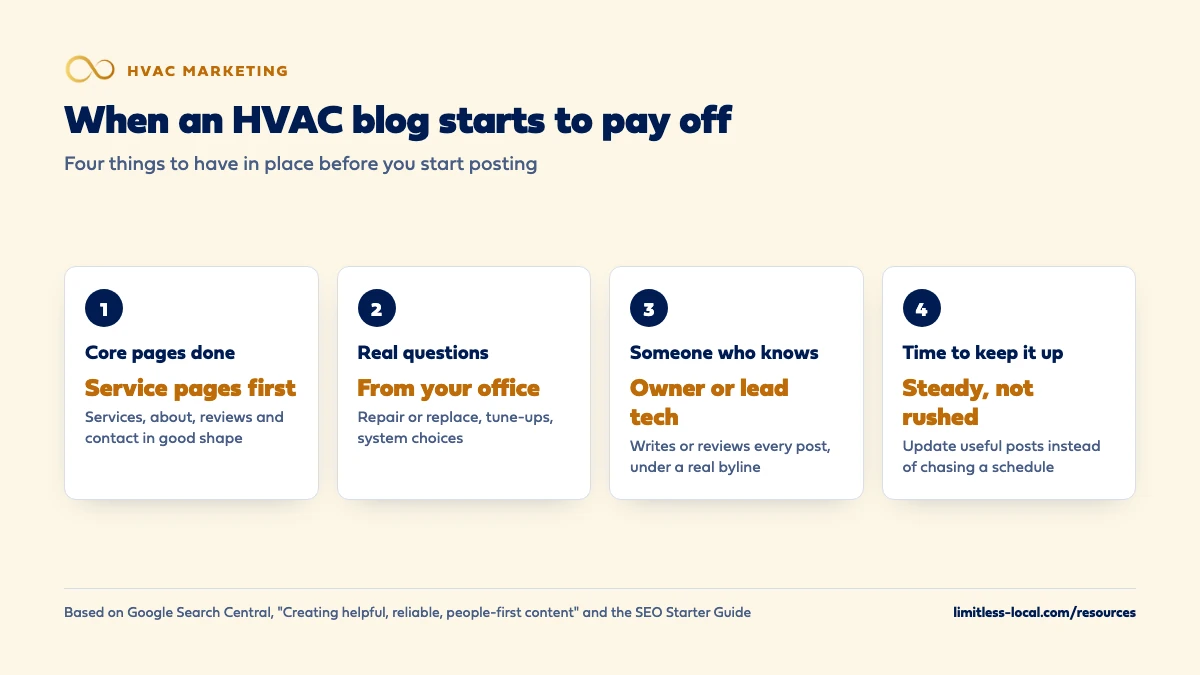
In our view, when four things are in place:
- The core pages are done. Service pages, about, reviews and contact are in good shape.
- You have real questions to answer. Your office hears the same questions every week: repair or replace, what’s included in a tune-up, heat pump or furnace.
- Someone who knows the work is involved. The owner or a senior tech writes the posts or reviews every one before it goes up.
- You can keep it up. Not on a rigid schedule, but steadily enough that the blog doesn’t stop after three posts.
Google’s guidance on helpful, people-first content asks whether content shows first-hand expertise, such as from having actually used a product or service, and whether it’s written or reviewed by an expert who knows the topic well. An HVAC company is in a strong position there, if the people who do the work are part of the writing.
What should an HVAC company blog about?
Start with what homeowners already ask your office and techs:
- Repair-or-replace decisions, with how you think about them.
- What a maintenance visit covers and why it matters for their equipment.
- Choosing between system types, from the installs you’ve done.
- Seasonal prep before the first heat wave or cold snap.
- How your estimates, warranties or financing work, in plain terms.
- Real jobs: the problem, what you found and what you did, with photos.
Google’s Starter Guide suggests thinking about the words people would search for, noting that someone new to a topic may use different words than an expert. A homeowner types “AC blowing warm air”, not “low refrigerant charge”. For more on how homeowners word those searches, see what homeowners type into Google when their AC breaks.
Curious what your marketing is actually booking?
Get a free visibility audit — no obligation, no sales pitch.
What makes an HVAC blog a waste of time?
Google’s helpful content guidance lists warning signs of content made for search engines first. Several describe the typical contractor blog:
- Producing lots of content on many different topics in the hope that some of it performs.
- Mainly summarizing what others have said without adding much value.
- Writing about things because they’re trending, not because your audience needs them.
- Writing to a particular word count because you’ve heard Google prefers one. Google says it doesn’t.
- Content that leaves readers needing to search again for better information.
In practice, that’s the blog full of generic “5 tips to save energy this summer” posts that could be on any HVAC site in the country. They take time to produce, they say nothing a homeowner can’t find anywhere, and in our view they rarely bring in a single call.
How often should an HVAC company post on its blog?
Often enough to keep answering real questions, and no faster than you can do it well. There’s no posting frequency in Google’s guidance. What it does say is that adding a lot of new content, or removing a lot of older content, mainly because you believe it makes a site seem fresh won’t help, and that changing the dates on pages that haven’t substantially changed is a warning sign.
A useful post updated when your prices, equipment or advice change is worth more than a new one every week. The Starter Guide recommends checking previously published content and updating it as needed, or deleting it if it’s no longer relevant.
Do blog posts help my HVAC service pages rank?
They can help, mainly through links. Google’s link best practices recommend linking to related pages on your own site in context, with link text that describes the page you’re linking to, and Google’s ranking systems guide says it uses how pages link to each other to understand what they’re about. A post on repair-or-replace decisions that links to your AC replacement page with the words “AC replacement” gives both readers and Google a clear path.
Watch for the opposite problem. If a blog post and a service page answer the same search, they compete. The ranking systems guide says that when pages are very similar, Google’s systems show only the most relevant ones. Keep “hire someone” searches on service pages and “help me understand” searches on the blog.
Can I use AI to write HVAC blog posts?
Carefully. Google’s spam policies describe using generative AI tools or similar tools to generate many pages without adding value for users as scaled content abuse. Its helpful content guidance doesn’t ban automation, but suggests that if automation substantially generated a piece of content, you consider being open about how it was used and why.
The same guidance strongly encourages accurate authorship, such as bylines where readers would expect them, and warns that made-up names or AI-generated headshots are deception. In our view the workable setup for an HVAC company is: a tool can help with a first draft or cleanup, but the experience, examples and photos come from your jobs, and the owner or a lead tech reads every post and puts their name on it.
How do I tell if my HVAC blog is working?
Two places. Google Search Console’s Performance report shows clicks, impressions, click-through rate and average position, grouped by page and by search query. Filter to your blog posts to see which ones Google shows and for what searches. Posts with no impressions after several months probably aren’t answering anything people search for.
The second place is your call and form tracking. A post that brings visitors who go on to call, or who click through to a service page and book, is doing its job. A post with traffic and no calls may still help homeowners trust you, but it isn’t a reason to write ten more like it. Setting that tracking up is covered in tracking whether your HVAC marketing is paying off.
Is a blog part of SEO, or something separate?
It’s one piece of SEO, and not the first one. For a local HVAC company, the order that usually gets closest to booked jobs is the Google Business Profile and reviews, then service pages, then town pages where you have real material, then a blog. A blog that sits on top of strong service pages adds to them; a blog in place of them doesn’t.
If you’re still deciding whether SEO is worth the effort for a shop your size, whether SEO is worth it for a small HVAC company covers that question first.
Not sure which of these is costing you jobs?
A free visibility audit checks the Google profile, reviews, site and tracking, and shows what to fix first.
What's different about blogging for HVAC companies
Questions come in seasons. Cooling questions arrive with the first hot week and heating questions with the first cold one. Publish or update seasonal posts ahead of the season, because Google can take weeks to reflect new content.
Replacement shoppers research. A system replacement is a big decision, and homeowners take time with it. That’s where a blog does its best work for HVAC: explaining options, efficiency and costs in your own terms before they ask for an estimate.
Emergency calls skip the blog. A no-heat call at night goes to a service page or the map pack. Don’t expect blog posts to fill the schedule in a cold snap.
Your techs are the content. The questions your techs answer in driveways every day are the best post ideas you’ll get. A short list kept in the office is worth more than any topic generator.
A worked example: what a year of posting looks like
These numbers are made up to show how to judge a blog, not a benchmark. Say you publish 2 posts a month for a year, which is 24 posts. After the year, Search Console shows that four of them get steady impressions and clicks, mostly repair-or-replace and heat pump questions, and your call tracking shows people reading those four go on to visit your replacement page and call.
The other twenty posts may still help homeowners who find them, but the four that work tell you what to write next: more posts like those, and updates to keep them current, instead of another year of general tips.
For reference, our Essentials package ($3,500 a month) includes 2 blog posts a month and our Growth package ($4,500 a month) includes 4, alongside the service-page, Google profile and ad work that usually matters more. We’d still tell an owner to fix missing service pages before worrying about the blog, which is what a free visibility audit checks first.
Frequently asked questions
Should my blog be on my main website or a separate site?
On your main site. Google’s SEO Starter Guide says to do whatever makes sense for your business on subdomains versus folders, but in our view a blog at yoursite.com/blog/ keeps everything in one place and makes linking to your service pages simple.
How long should an HVAC blog post be?
Long enough to answer the question well. Google says the length of content alone doesn’t matter for ranking and it has no preferred word count.
Should I delete old blog posts?
Update the ones that are still useful and remove the ones that are out of date or were never relevant. Google’s SEO Starter Guide recommends checking older content and updating or deleting it as needed.
Do I need to put a name on each blog post?
Google strongly encourages accurate authorship information, such as bylines where readers would expect them. A post signed by the owner or a lead tech also tells a homeowner who’s giving the advice.
Can I republish articles from equipment manufacturers on my blog?
Not as-is. Google’s spam policies treat republishing content from other sites without adding original content or value as scraping. Link to the manufacturer and write your own take instead.
Will a blog get my HVAC company into the map pack?
Not directly. The map pack runs on your Google Business Profile. A blog can support your website in the regular results, but profile work and reviews matter more for Maps.
Key takeaways
- Most HVAC companies don’t need a blog first; service pages, contact, reviews and the Google profile come before it.
- A blog pays off once core pages are done and someone who knows the work answers real customer questions.
- Google says it has no preferred word count and that publishing to look fresh won’t help.
- Link posts to the matching service pages, and keep ‘hire someone’ searches on service pages, not the blog.
- Judge the blog in Search Console and in calls, then write more of what works.
Want a second set of eyes on your setup?
We'll look at how you show up locally and where calls are leaking, then send you a plain-English breakdown.
More in this section
- Should my HVAC website have an FAQ page?
- What pages should an HVAC company website have?
- Does my HVAC company need landing pages for Google Ads?
- How does an HVAC company earn backlinks?
- Should I fix my HVAC website and reviews before paying for ads?
Sources
- Creating helpful, reliable, people-first content — Google Search Central
- Search Engine Optimization (SEO) Starter Guide — Google Search Central
- Spam policies for Google web search — Google Search Central
- Link best practices for Google — Google Search Central
- A guide to Google Search ranking systems — Google Search Central
- Performance report (Search results): Overview and basic setup — Search Console Help