
What should a pool builder expect in the first 90 days of marketing?

- What happens in the first 30, 60 and 90 days of pool builder marketing?
- What happens before the first ad goes live?
- What should the first 30 days look like?
- When will the phone start ringing?
- What should the second month look like?
- What should I be able to see by day 90?
- Why might I not have a signed pool by day 90?
- What does my team need to do in the first 90 days?
- How does the time of year change the first 90 days?
- What are the red flags in the first 90 days?
- Is 90 days long enough to judge pool marketing?
- What's different about the first 90 days for pool builders
- A worked example: reading a pool builder's 90-day scorecard
- Frequently asked questions
- Key takeaways
- More in this section
- Sources
The short version
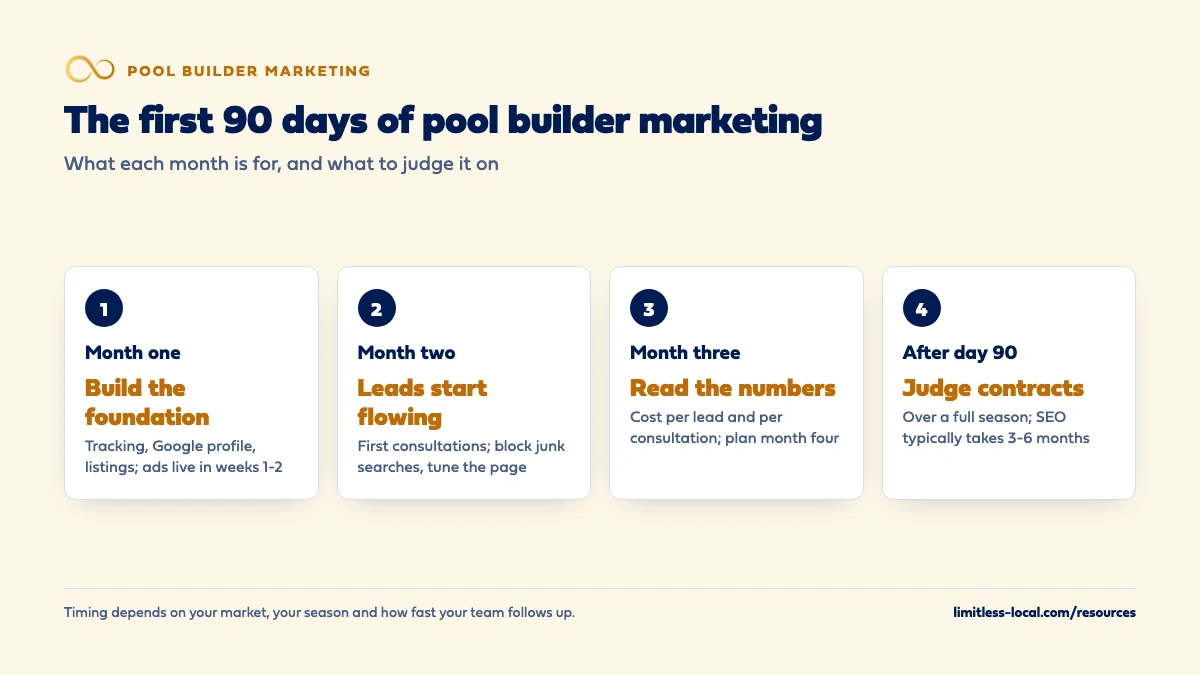
- Month one is setup: tracking, your Google profile, listings and campaigns going live.
- Month two brings the first ad calls and consultations, and a lot of cleanup.
- By day 90 you should have real cost per lead and cost per consultation numbers.
- SEO is usually still building at day 90, and contracts follow the sales cycle.
For pool builders who just started marketing, or are about to, and want to know what a normal first three months looks like before they judge it.
Get a free visibility audit · Book a growth call
What happens in the first 30, 60 and 90 days of pool builder marketing?
In the first 90 days, a pool builder should expect setup in the first month (tracking, a cleaned-up Google profile and listings, and ads going live), early ad calls and consultations in the second, and real numbers to judge by the third: cost per lead, cost per consultation and which searches bring the right homeowners. Ads can bring calls within days of launch, but SEO typically takes 3-6 months to show meaningful organic growth, so organic results are usually still building at day 90. Because pool buyers take months to decide, a few signed contracts by then is a good sign, and none yet isn’t a failure if consultations are booking.
We run the first three months in the same order: build the foundation (tracking, follow-up and a clean online presence), turn on lead flow with local SEO and ads around the towns and pools you want, then improve every month from calls, leads and revenue. Our packages page lists what’s included in each tier, our pool builder marketing page covers how that works for pool companies, and the pool builder marketing questions library goes question by question.
What happens before the first ad goes live?
Mostly paperwork and access, and it goes faster than most owners fear. With us it starts with a 15-minute discovery call, and onboarding takes your team about 2-3 hours in total. That time goes into a few things that are hard to do without you:
- Access to your Google Business Profile, website, any old ad accounts and your phone system.
- Your best work: photos and videos of finished pools, and the pool types and towns you want more of.
- Your numbers: rough close rate from consultation to contract, average contract size, and how many pools your crews can take on this season.
- How leads are handled now: who answers the phone, how consultations get booked, and what software you use.
One thing worth settling on day one: who owns the accounts. Your ad account, your Google profile and your website should be in your name, with your marketing help added as a user. Who should own a pool builder’s ad accounts and website covers why it matters if you ever switch.
What should the first 30 days look like?
Setup, with ads switching on partway through. With us, campaigns go live in weeks 1-2. Before and around that, the first month usually covers:
- Tracking: call tracking, form tracking and a way to tag every lead by source, so nothing that follows is guesswork.
- Your Google Business Profile: categories, service area, description, photos and hours checked and cleaned up.
- Your listings: your name, address and phone made consistent across the web; we sync them across 50+ directories.
- Search campaigns built around the pool types and towns you want, with obvious junk searches blocked from the start.
If your profile isn’t verified yet, that comes first. Google’s page on verifying your business says verification reviews take up to 5 business days, and occasionally longer. And don’t panic if a new ad campaign shows a “Learning” status: Google’s Smart Bidding learning page says the status can show for up to 7 days and your ads keep running as normal during it.
When will the phone start ringing?
From ads, usually soon after they launch. Ads can generate leads within days of launch, because you’re paying to show up for homeowners who are searching right now. Early ad leads are often a mixed bag, though. You’ll get some great calls and some people asking about pool cleaning or above-ground pools, and the first weeks are partly about finding and blocking those searches.
From SEO and Google Maps, later. SEO typically takes 3-6 months to show meaningful organic growth. Google’s SEO Starter Guide says some changes take effect in a few hours and others could take several months, and suggests waiting a few weeks before judging whether a change helped. So at day 90, expect early signs from organic search, not a full calendar.
That’s the reason most builders run ads while SEO ramps up. How SEO, paid ads and social differ in timeline for pool builders compares the clocks side by side.
What should the second month look like?
Busy, and a bit messy, in a good way. By now ads have a few weeks of real searches behind them, and that data is gold. Month two is usually about:
- Cleaning up searches. Reading the actual searches that triggered your ads and blocking the ones that will never become a pool contract.
- Listening to calls. Recorded calls tell you whether leads are the right homeowners and whether they’re being booked.
- Tuning the landing page. If people click but don’t call, the page is the first suspect.
- First consultations. Homeowners from month one start sitting down with you.
- SEO groundwork. Pages for your pool types and towns, project galleries and fixes to slow or broken pages.
- Reviews. Asking every recent customer, so your profile grows month over month.
Your job this month is feedback. Tell your marketing help which leads were great and which were junk. That one habit makes month three a lot better.
Curious what your marketing is actually booking?
Get a free visibility audit — no obligation, no sales pitch.
What should I be able to see by day 90?
Real numbers, for the first time. By the end of the third month, you should be able to answer these from a report, not a hunch:
- How many leads came from ads, Google Maps and your website, by month.
- What each lead cost, and what each booked consultation cost.
- Which searches, towns and pool types brought the best homeowners.
- How your Google profile is trending. Google’s Business Profile performance report shows views, the searches people used to find you, calls and website clicks, and notes the searches metric updates at the start of each month.
- How many proposals are out and still in play.
Every package we run includes a monthly report with a cost-per-lead breakdown and source tagging, plus a real-time dashboard, so you’re not waiting for a meeting to see where things stand. How to know if your pool marketing agency is working lists what a good report should show.
Why might I not have a signed pool by day 90?
Because pool buyers don’t sign on marketing’s schedule. A homeowner who calls you in week three still needs a design consultation, a design, a proposal, maybe changes, financing and sometimes HOA approval. Plenty of them also compare you with another builder or two. That can easily take longer than the time left in your first three months.
Ad reports can make it look worse. Google’s page on conversion measurement notes that Google Ads attributes call conversions to the date of the ad click. A contract that signs months later only shows up if you bring it back in yourself, which is why recording each lead’s source and first-contact date matters from day one.
So read day 90 by the steps before the contract: leads, consultations held and proposals out. If those are moving, contracts usually follow. Why pool builder marketing takes so long to produce jobs goes deeper on the wait.
What does my team need to do in the first 90 days?
More than most owners plan for, and it’s the part that decides whether good leads turn into pools. The short list:
- Answer the phone, or call back fast. A homeowner who reaches voicemail calls the next builder.
- Ask every caller how they found you and log it, even when tracking already did.
- Book consultations quickly, ideally on the first call.
- Follow up on every proposal with a date for the next conversation.
- Send photos of builds in progress and finished pools.
- Ask for reviews when a pool is finished and the family is happy.
- Give feedback on lead quality every couple of weeks.
None of that is marketing in the usual sense, but every one of them changes what your marketing produces. If your team does all seven, you’ll have a much clearer picture at day 90 than if it’s all left to the agency.
How does the time of year change the first 90 days?
A lot, because pool demand follows the calendar. Homeowners plan in late winter and spring for summer swimming, and searches drop off later in the year.
- Start in fall or early winter and your first 90 days are a runway: setup is done, SEO has time to build, and ads are tuned before spring searches pick up. Lead volume may be modest, but the homeowners who call are often planning next season’s pool.
- Start in late winter and you hit the rising season with fresh campaigns. Leads come quickly, and so does the pressure on your phones and consultation calendar.
- Start in late spring or summer and the early numbers can look strong, but many callers want a pool next year, not this one, so contracts may land after your 90 days.
None of these is wrong. Just judge your first 90 days against the season you started in, not against a calendar that was already full.
What are the red flags in the first 90 days?
Slow contracts are normal. These aren’t:
- No tracking by the end of month one. If nobody can tell you where leads came from, nothing after that can be judged.
- No report, or a report full of clicks and impressions but no leads, consultations or cost per lead.
- You don’t have access to your own ad account or Google profile.
- The same junk leads, month after month, after you’ve flagged them.
- Promises of rankings, lead counts or a timeline. Nobody can honestly guarantee those, because the platforms change how they work.
- No plan for month four. By day 90 you should know what’s working and what changes next.
If you’re seeing several of these, it’s worth a hard conversation before the next invoice. Restarting marketing after a bad agency covers what to do if it comes to that.
Is 90 days long enough to judge pool marketing?
Long enough to judge the work, not always the contracts. By day 90 you can fairly judge whether tracking is in place, whether ads are bringing the right homeowners at a cost that makes sense, whether consultations are booking, and whether the SEO groundwork is done. Those are the things that predict contracts.
Signed pools and organic results often need longer. SEO typically takes 3-6 months to show meaningful organic growth, and pool buyers can take months to decide on top of that. A full selling season is the fairest test of cost per signed contract.
That’s also why our standard ask is three months, written into the contract. We’re month-to-month after that, and if you want to leave, we won’t make you stay. Three months is simply the least time it takes to set things up properly and have numbers worth reading.
Not sure which of these is costing you jobs?
A free visibility audit checks the Google profile, reviews, site and tracking, and shows what to fix first.
What's different about the first 90 days for pool builders
The contract lags the lead. In a service trade, a lead in week three is often a paid job by week four. For a pool builder, it’s a consultation, a design and a proposal, so the first 90 days are judged on what comes before the contract.
The season sets the pace. The same three months can look slow or busy depending on whether they fall before, during or after the spring planning rush.
Photos do a lot of the selling. Homeowners buy a pool partly on what your past pools look like, so getting real project photos onto your profile and site early pays off in every channel.
We’ve run this from the builder’s side. We were an equity partner in a pool construction company, where we streamlined back-office operations, built the lead-generation engine and ran sales and marketing. That business did $2M+ revenue in year one.
A worked example: reading a pool builder's 90-day scorecard
These numbers are made up to show how to read the first three months. They aren’t a forecast or a benchmark. Say a builder starts in February with $2,500 a month in ad spend:
- Month one: campaigns go live in week two. 14 leads, 4 consultations.
- Month two: junk searches blocked, landing page tuned. 22 leads, 8 consultations.
- Month three: 25 leads, 9 consultations, 2 signed contracts and 6 proposals still open.
Over 90 days, that’s $7,500 in ad spend, 61 leads and 21 consultations, or about $357 per consultation. Judged only on contracts, it’s $3,750 per signed pool, which might look high. But 6 proposals are still open. If just 2 more of them sign in the next couple of months, the same spend works out to $1,875 per signed pool.
Same marketing, two very different verdicts, depending on when you look. That’s why day 90 is the time to judge leads and consultations, and a full season is the time to judge contracts.
Frequently asked questions
Should I see more Google Maps calls by day 90?
Maybe a few more, especially if your profile was incomplete or unverified before. Bigger moves in Maps usually take longer, because reviews and mentions from other websites build up over months.
Can I speed up the first 90 days by spending more on ads?
More ad spend can bring more leads sooner, but it won’t make homeowners sign faster or SEO ramp quicker. Spend more only once tracking is in place and your team can handle the extra calls.
What if my calendar is already full when marketing starts?
Use the first 90 days to build for next season: tracking, profile, pages and reviews. Keep ads light and point them at homeowners planning ahead.
How much of my time does the first month take?
With us, onboarding takes your team about 2-3 hours. After that, the time that matters most is answering leads and following up on consultations.
Should I change agencies if I have no contracts at day 90?
Not on that alone. If leads and consultations are growing and the reporting is clear, contracts usually follow the sales cycle. Switching restarts parts of the ramp.
Will my old website hold back the first 90 days?
It can slow SEO and lower how many ad visitors call. Ads can still run to a new landing page while the site gets fixed, so it doesn’t have to delay everything.
Key takeaways
- Month one is setup; ads usually go live in weeks 1-2 and bring calls within days.
- Month two is cleanup and first consultations; your feedback on lead quality speeds it up.
- By day 90, judge cost per lead, cost per consultation and proposals out, not just contracts.
- SEO typically takes 3-6 months, so organic results are usually still building at day 90.
- Judge the first 90 days against the season you started in.
Want a second set of eyes on your setup?
We'll look at how you show up locally and where calls are leaking, then send you a plain-English breakdown.
More in this section
- How should a pool builder prepare marketing before peak season?
- How much should a pool builder spend on marketing?
- Why does pool builder marketing take so long to produce jobs?
- How do I grow a pool construction business with marketing?
- What should a pool builder ask before hiring a marketing agency?
Sources
- Verify your business on Google — Google Business Profile Help
- About Smart Bidding learning — Google Ads Help
- SEO Starter Guide: The Basics — Google Search Central
- Understand your Business Profile performance & insights — Google Business Profile Help
- About conversion measurement — Google Ads Help