
How many reviews does a pool builder need if rivals have 20 to 50?

- If the pool builders in my map pack have 20 to 50 Google reviews, how many do I need to compete?
- What does a 20-to-50 review range tell me about my market?
- Do I need more reviews than the builder with 50?
- Why is 20 the first number to hit?
- How do I size up the top three builders properly?
- Do recent reviews matter more than the total?
- What if I have fewer than 10 reviews?
- How fast can I close the gap without breaking Google's rules?
- Does my star rating change the target?
- When should I stop chasing the count?
- What if a rival's count jumps overnight?
- Why review gaps look different for pool builders
- A worked example: closing a 20-to-50 gap
- Frequently asked questions
- Key takeaways
- More in this section
- Sources
The short version
- First milestone: 20 reviews. In a 2026 survey, 47% of US consumers said they won't use a business with fewer.
- Next target: the middle of the range held by the top three builders in your map pack.
- Recency counts: keep reviews arriving through the season, not in one burst.
- Past the middle of the range, what the reviews say beats one more on the count.
For pool builders sizing up a review gap against the builders already showing in their towns’ map pack.
Get a free visibility audit · Book a growth call
If the pool builders in my map pack have 20 to 50 Google reviews, how many do I need to compete?
Get past 20 first, then aim for the middle of your rivals’ range, around 35 if they sit between 20 and 50, with a steady flow of new reviews so your newest one is weeks old, not months. You don’t need to pass the builder with 50 to compete, because Google ranks local results on relevance, distance and popularity, and reviews are one part of popularity. Once you’re inside the range, recent, detailed reviews and replies to them do more for you than a few extra on the count.
A 20-to-50 range is a gap you can close in a season or two with a steady ask at every handover. Review response and review generation are part of our local SEO packages: basic review generation in Essentials, advanced in Growth. The pool builder marketing page shows how it fits with the rest of what we run for pool companies. We don’t guarantee rankings from any number of reviews; nobody honestly can, because platforms change how they work. More answers are in the pool builder marketing questions library.
What does a 20-to-50 review range tell me about my market?
That the gap is reachable. Pool builders finish far fewer jobs than service trades, so a map pack where the leading builders hold 20 to 50 reviews is a market where nobody has run away with it. A builder who asks every customer, every time, can get into that range without anything clever.
It also tells you what the homeowner sees. When someone searches for a pool builder in your town, they’re comparing a handful of profiles side by side. If yours shows a handful of reviews next to rivals with 30 and 45, you look newer or quieter even if your work is better. If yours shows 28, you’re in the conversation and the decision moves on to photos, reviews and how fast you call back.
Use the range to set targets, not to panic. The question isn’t “how do I beat 50?” It’s “how do I get into the range and stay current?” For the wider question of how many reviews a builder needs in any market, see how many Google reviews a pool builder needs.
Do I need more reviews than the builder with 50?
No. Google’s local ranking help says local results are mainly based on relevance, distance and popularity, and that prominence, how well-known a business is, is based in part on how many reviews you have. It also says more reviews and positive ratings can help your local ranking.
So reviews matter, but they’re one input among several. A builder with 30 reviews can show above one with 50 when it’s closer to the person searching, or when its profile, categories and website match the search better. If a rival keeps outranking you with a similar count, the gap is probably somewhere else; why a competitor outranks your pool company in Maps walks through the usual suspects.
Matching the top builder’s count is a fine long-term goal. It’s just not the line between showing up and not.
Why is 20 the first number to hit?
Because that’s where a lot of homeowners draw a line. In BrightLocal’s Local Consumer Review Survey 2026, a survey of 1,002 US adult consumers about local businesses in general, 47% said they won’t use a business with fewer than 20 reviews, and only 9% said they were willing to use one with five or fewer.
That survey covers every kind of local business, not pool builders, so read it as a direction rather than a rule for your trade. But it lines up with what your own rivals’ counts are telling you: below 20, you’re the outlier in a 20-to-50 map pack.
If you’re below 20 now, make it the only review goal for the next few months. Everything else on this page comes after.
How do I size up the top three builders properly?
Check what homeowners actually see, from the towns you want work in:
- Search “pool builder” plus each of your two or three main towns, from a phone if you can.
- For the three builders in the map pack, note the review count, star rating, the date of the newest review and whether the owner replies.
- Leave out pool service companies and supply stores. They collect reviews from weekly customers and aren’t your comparison.
- Write it all in one place and repeat every quarter.
Count and rating get the attention, but the newest review date often tells you more. A builder with 50 reviews whose latest is eight months old is a softer target than one with 25 who got three last month.
Your near-term target is the middle of the range; your longer-term one is the top. Rivals keep collecting too, so the quarterly check keeps the targets current.
Curious what your marketing is actually booking?
Get a free visibility audit — no obligation, no sales pitch.
Do recent reviews matter more than the total?
To homeowners, recency carries a lot of weight. In that same 2026 survey, 74% of consumers said they only care about reviews written in the last three months, and a review posted within the last month was one of the factors consumers rated most important.
That changes how you close a gap. Ten reviews spread across the season, arriving as pools are handed over, do more than ten collected in one push and then nothing for six months. A steady pace also looks natural, which matters on its own; review velocity for pool builders covers why bursts can look odd.
For a builder, recency follows the build calendar. Reviews bunch up when pools are finished and thin out in the slow months, which is why renovation, repair and past customers are worth asking in the off-season.
What if I have fewer than 10 reviews?
Start with the customers you already have. Most builders with a thin profile simply never asked consistently, and every pool you’ve built is a homeowner who might say yes:
- Past build customers from the last few seasons, with a short personal message.
- Renovation and repair customers, who are genuine customers too.
- Every new handover from now on, asked the same way at the same point.
Google lets you create a review link or QR code so customers can go straight to your profile. Put the link in a text, not a long email, and send one reminder a few days later.
Don’t wait until you have time to do it perfectly. A plain, personal ask to past customers this week will do more than a polished campaign next spring. Asking past pool customers for reviews has wording that works.
How fast can I close the gap without breaking Google's rules?
As fast as real customers will write them, and no faster. Google’s tips to get more reviews say reviews must reflect a genuine experience, and that offering incentives such as free or discounted goods or services in exchange for posting, changing or removing reviews counts as fake and misleading content. Its prohibited and restricted content policy covers fake engagement too.
For a pool builder, that rules out:
- A discount on the final payment in exchange for a review.
- Reviews from family, friends or crew members who aren’t customers.
- Swapping reviews with other contractors.
- Buying reviews from anyone, for any reason.
The gap you’re closing is a few dozen reviews, not hundreds. Asking every real customer covers it in a season or two, and it’s the only approach that doesn’t put the profile at risk.

Does my star rating change the target?
A little. In the same survey, 68% of consumers said they’ll only use a business with four stars or more and 31% only one with 4.5 or more, while just 10% said they’d only use a five-star business.
So if your rivals sit at 4.8 and you’re at 4.1, the rating gap may matter more than the count gap, and the fix is different: look at what the critical reviews say, fix the cause, and keep asking happy customers so the average reflects your current work. A calm, specific reply to a bad review also helps the next homeowner who reads it; responding to negative reviews covers how.
Don’t chase a perfect 5.0. Google itself says a mix of positive and negative feedback often feels more trustworthy.
When should I stop chasing the count?
Once you’re in the middle of the range. From there, more of the same rarely changes much. What moves homeowners is what the reviews say and how you respond:
- Reviews that describe the build: the design process, the crew, the timeline, the finished backyard. Ask customers to describe their experience in their own words.
- Reviews that match the work you want more of, whether that’s custom gunite, fiberglass or renovations.
- Photos customers add of their finished pool.
- Replies to every review. Google’s help on managing customer reviews says helpful and positive replies can show you’re responsive to customers.
Keep asking at every handover so the count keeps growing on its own. Just stop measuring success by whether you’ve passed the builder with 50.
What if a rival's count jumps overnight?
Leave it alone and keep doing your own work. A sudden jump can be a builder finally asking past customers, which is fair game. It can also be bought or incentivized reviews, which Google’s policies prohibit and which tend to read the same: short, vague and posted in a cluster.
Either way, matching it isn’t the answer. Homeowners read pool builder reviews closely because the job is big and long, and a profile full of detailed reviews from real builds holds up better than a pile of one-liners. Keep checking the range each quarter, and if a rival pulls away for good, set the new middle as your target and keep asking.
Not sure which of these is costing you jobs?
A free visibility audit checks the Google profile, reviews, site and tracking, and shows what to fix first.
Why review gaps look different for pool builders
Fewer jobs, slower counts. A pool builder finishes a fraction of the jobs a service company does, so a 20-to-50 range in a builder map pack is a real spread, not a small one.
Reviews follow handovers. Most arrive when pools are finished, so the count grows in season and stalls in winter unless you ask renovation and past customers.
Each review is read closely. Homeowners making a large, months-long purchase read for communication, timelines and how problems were handled.
Service companies aren’t your benchmark. Weekly route customers give them reviews much faster. Compare builders with builders.
A worked example: closing a 20-to-50 gap
These numbers are made up to show the method, not a benchmark.
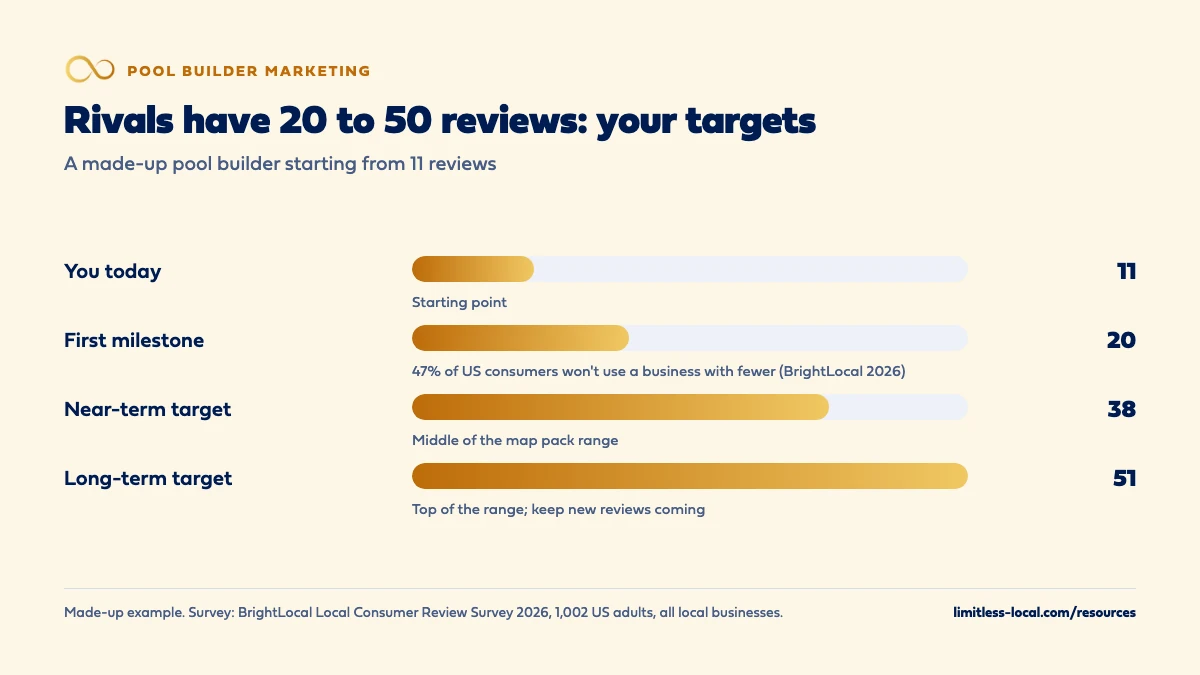
A builder has 11 reviews. The three builders in the map pack for “pool builder” in its main town have 22, 38 and 51. The 51-review builder’s newest review is eight months old; the 22-review builder got two last month.
- First milestone: 20 reviews, 9 more.
- Near-term target: the middle of the range, 38, which is 27 more than today.
- Longer-term target: the top of the range, 51.
The builder finishes 26 pools a year. Asked at every handover with one reminder, say half leave a review: 13 a year, arriving across the season. A one-time ask to past build customers brings 8 more, and asking renovation customers adds 6. That’s 27 in the first year, putting the builder at 38, in the middle of the range, with a newer latest review than the builder at the top. Swap in your own build count and response rate.
Frequently asked questions
Is 35 reviews enough for a pool builder?
If the builders in your map pack hold 20 to 50, 35 puts you in the middle of the range, which is enough to be compared on your work rather than your count. Keep new ones coming.
Do Houzz or Facebook reviews count toward the gap?
Google’s local ranking help talks about reviews on your Business Profile. Reviews elsewhere still help homeowners decide, but put your asks into Google first.
Should my salesperson or my project manager ask for the review?
Whoever the homeowner dealt with most at the end of the build, usually the project manager at handover. Keep the ask the same on every job.
Can I ask for reviews from customers whose pool I built years ago?
Yes, if they’re genuine customers. Older customers often write the most useful reviews, because they can say how the pool has held up.
Will replying to reviews raise my count?
Not directly. Replies show homeowners you’re responsive, and some customers are more willing to write one when they see the owner reads them.
How often should I re-check my rivals' counts?
Once a quarter is enough. Your targets move as they add reviews, and a quarterly check catches it without turning it into a daily worry.
Key takeaways
- In a 20-to-50 map pack, get past 20 first; a 2026 consumer survey found 47% won’t use a business with fewer.
- Then aim for the middle of the range; you don’t need to pass the top builder to compete.
- Check count, rating, newest review date and replies for the top three builders every quarter.
- Keep reviews arriving through the season; recency matters to homeowners.
- Never incentivize, buy or swap reviews; asking every real customer closes a gap this size in a season or two.
Want a second set of eyes on your setup?
We'll look at how you show up locally and where calls are leaking, then send you a plain-English breakdown.
More in this section
- Google reviews a pool builder needs: how many is enough?
- How can a pool builder turn reviews and referrals into more jobs?
- When should a pool builder ask for a review during the build?
- How does a pool builder scale past referrals and a single crew?
- How do reviews affect a pool builder in Maps and AI search?
Sources
- Tips to improve your local ranking on Google — Google Business Profile Help
- Local Consumer Review Survey 2026 — BrightLocal
- Create a Google link or QR code to request reviews — Google Business Profile Help
- Tips to get more reviews — Google Business Profile Help
- Prohibited & restricted content — Google Maps User Contributed Content Policy Help
- Manage customer reviews — Google Business Profile Help