
What monthly budget does each roofing marketing channel need?

- What's the least each roofing marketing channel needs each month to work?
- Why does each roofing channel need its own minimum?
- What does Google Ads need each month for a roofer?
- What do Local Services Ads need each month?
- What does local SEO need each month?
- What do the Google profile and reviews need?
- Does the website need a monthly budget?
- What about Facebook ads and bought leads?
- What does too little look like in each channel?
- How do I build a monthly budget from the channels up?
- Should management fees count in each channel's budget?
- What's different about budgeting each channel for roofing
- A worked example: a roofer's channel budget for one month
- Frequently asked questions
- Key takeaways
- More in this section
- Sources
The short version
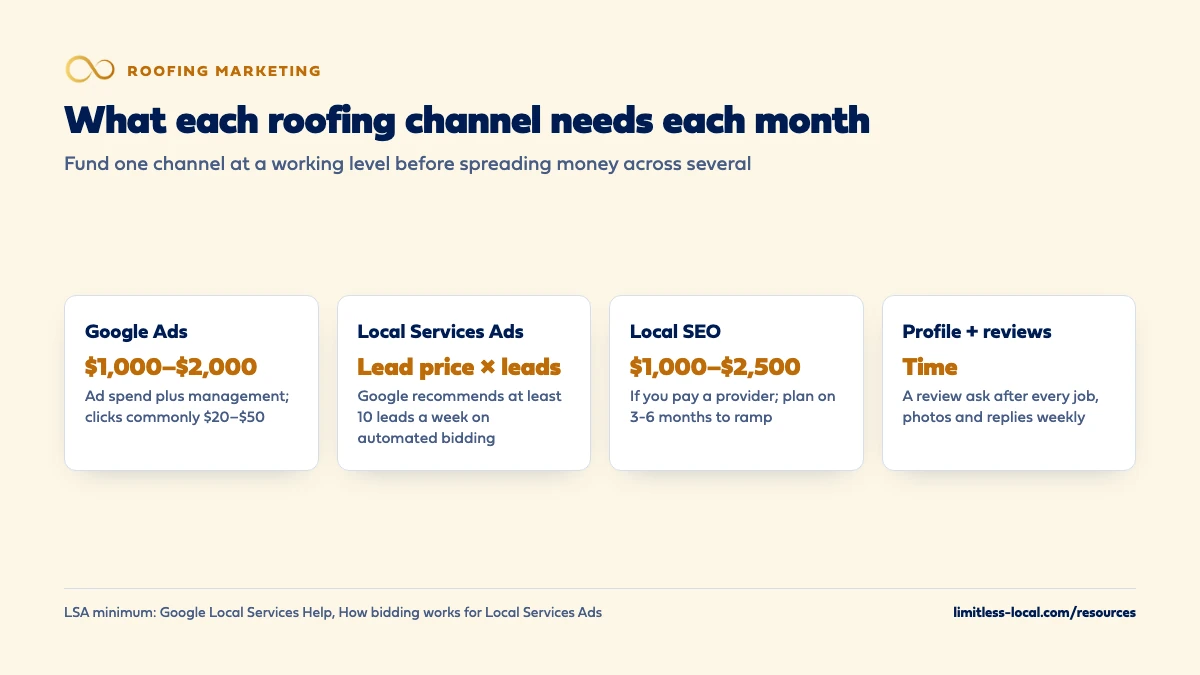
- Google Ads: about $1,000 to $2,000 a month in ad spend, plus management.
- Local Services Ads: your local lead price times the leads you want, with 10 a week as Google's recommended floor.
- Local SEO: about $1,000 to $2,500 a month if you pay someone.
- Google profile and reviews: a few hours a week, little or no money.
- Too little looks like budgets that run out by noon, a handful of leads, or SEO reports with no new work.
For roofing owners deciding which channels they can afford to run properly, and what it looks like when a channel is getting too little.
Get a free visibility audit · Book a growth call
What's the least each roofing marketing channel needs each month to work?
Google Ads for a roofer usually needs about $1,000 to $2,000 a month in ad spend before management, because roofing clicks commonly run $20 to $50 each and you need enough of them to judge results. Local Services Ads need enough budget for a steady flow of leads at your local lead price, and Google recommends a minimum of 10 leads a week on its automated bidding. Local SEO from an outside provider typically runs about $1,000 to $2,500 a month, while your Google Business Profile and reviews cost time more than money. If you can’t fund a channel at that level, run fewer channels properly instead of all of them thinly.
We build budgets the same way, channel by channel, and judge each one by cost per booked job. Our packages list exactly what’s covered, from Google Ads management up to a set spend to Local Services Ads on Growth, and ad spend is always paid to Google directly. See how that fits a roofing company on our roofing marketing page, read the roofing marketing guide for the bigger picture, or browse the rest of the roofing marketing questions library.
Why does each roofing channel need its own minimum?
Each channel needs enough money, or enough work, to produce results you can judge. Spread $1,600 across Google Ads, Local Services Ads, SEO and Facebook, and each one gets so little that after three months you still can’t tell which one works. You end up cutting a channel that might have paid off, or keeping one that never will.
Paid channels need enough clicks or leads each month to show a pattern. SEO needs enough hours each month to build pages, earn links and keep your profile active. Your Google profile and reviews need steady time, not money.
So the useful question isn’t “what’s the total?” It’s “which channels can I fund at a working level, and in what order?” The roofing marketing cost guide covers the market ranges for every piece; this page is about the floor under each channel and the warning signs when you’re below it.
What does Google Ads need each month for a roofer?
Roofing search clicks commonly run about $20 to $50 each as of 2026, so a working Google Ads budget usually starts around $1,000 to $2,000 a month in ad spend, plus management. Below that, you buy too few clicks to learn which searches turn into inspections.
Run the numbers for your own market. At $40 a click, $1,000 buys about 25 clicks a month. If one in five clicks calls or fills out a form, that’s five leads, and maybe one or two signed roofs. That’s enough to start learning, not enough to judge keyword by keyword.
Google Ads works on an average daily budget. Per Google’s help page on average daily budgets, for most campaigns you can be charged up to two times your daily budget on a busy day, but no more than 30.4 times your daily budget in a month. So divide your monthly number by 30.4: $1,000 a month is about $33 a day.
For your own click prices, check Keyword Planner, which shows search volume and forecasts for the keywords you enter in your towns.
What do Local Services Ads need each month?
Local Services Ads charge per valid lead, not per click, so the budget is really a count of leads. Google’s Local Services help on how bidding works recommends a minimum budget of 10 leads per week for its automated Maximize leads bidding. That’s about 43 leads a month.
What those leads cost depends on your market. Lead prices may vary by location, job type, the type of lead and how you bid, so there’s no national number worth quoting. Once you have a few weeks of data, multiply your average lead price by the leads you want.
The setup is also moving. Google is shifting Local Services Ads into Google Ads as Performance Max campaigns with pay-per-lead goals; roofing is in the first phase, which began in August 2026 for select advertisers. After the move, your weekly budget is divided by 7 into a daily average, and monthly spend is capped at that daily average times 30.4.
If 10 leads a week is more than your crews can handle or your budget can carry, run less and expect slower learning. How a roofer should split budget between Google Ads and LSAs covers running both.
What does local SEO need each month?
For a roofing company paying an outside provider, local SEO typically runs about $1,000 to $2,500 a month. The low end usually covers one location and a few core towns. The high end covers more towns, more pages and more link work in a crowded market.
What that money has to buy each month, at minimum:
- New or improved pages for the jobs and towns you want.
- Google Business Profile updates: posts, photos, services, answering questions.
- Fixing listings so your name, address and phone match everywhere.
- Earning links from real local and trade sources.
- A report that reaches calls and leads, not just rankings.
SEO typically takes 3-6 months to show meaningful organic growth, so whatever you budget, plan to hold it at least that long. How much a roofer should expect to pay for SEO goes deeper on what changes the price.
Curious what your marketing is actually booking?
Get a free visibility audit — no obligation, no sales pitch.
What do the Google profile and reviews need?
Mostly time. A Google Business Profile is free, and so is asking for reviews. What it takes is a habit:
- A few minutes after every job to send a review request while the homeowner is happy.
- An hour or so a week to post job photos, update services and reply to every review.
- A quick check each month that hours, categories and service areas are still right.
If you hand it off, it’s usually part of an SEO package rather than a separate budget line. The minimum here is consistency: a profile with no new reviews for six months tends to slip behind roofers who get a few every month. How many Google reviews a roofer should get each month sets a realistic pace.
Does the website need a monthly budget?
Not much of one. A website is mostly a one-time cost, commonly a few thousand dollars and up to $10,000 or more for a build, plus hosting and small updates. The ongoing work of adding job and town pages usually sits inside your SEO budget.
The minimum is a site that works on a phone, loads fast, and has a page for each job you want with a phone number and a short form. If your ads send homeowners to a slow or confusing site, every channel above costs more per signed roof. For reference, our themed websites are $3,750, or $3,000 with any monthly package.
What about Facebook ads and bought leads?
Facebook and Instagram. For most roofers these work best as remarketing: showing ads to homeowners who already visited your site or watched your videos. That audience is small, so the budget is usually a fraction of search ad spend. Starting cold on Facebook before search is working rarely makes sense for a roofer. Our Growth package includes Meta remarketing, not cold Facebook campaigns.
Bought leads. Shared roofing leads from lead sellers run from the low tens of dollars to over $100 each, and the same homeowner is often sold to three or four roofers. The budget is simply lead price times leads, but the real cost is the share you sign. Whether a roofer should buy leads from a lead-selling company covers the trade-offs.
What does too little look like in each channel?
Each channel has its own warning signs:
- Google Ads: ads stop showing by midday, a campaign marked “Limited by budget”, or fewer than a couple dozen clicks a month. Google flags a campaign as “Limited by budget” when it’s underperforming because of its budget, and often suggests a higher one.
- Local Services Ads: a trickle of leads, long gaps between them, and too few to see which job types book.
- Local SEO: the same report every month, no new pages, no new links, and no change in calls after six months.
- Google profile and reviews: no new reviews for months, old photos, unanswered questions.
- Website: ad clicks that rarely turn into calls or forms.
When you see these, you have two honest options: raise that channel to a working level, or pause it and put the money into one that is working.
How do I build a monthly budget from the channels up?
Fund channels in order, each to a working level, until the money runs out:
- Google profile and reviews. Start now; it costs time.
- One paid channel at a working level, usually Google Ads or Local Services Ads, for calls this month.
- Local SEO, so you’re less dependent on ads in a year.
- The second paid channel, once the first one shows a cost per signed roof you’re happy with.
- Remarketing and everything else, last.
Then cap it at what your crews can handle. There’s no point buying 40 leads a month if you can only inspect 20. If your whole budget is small, read whether a small monthly budget is enough for roofing marketing before splitting it.
Should management fees count in each channel's budget?
Yes. A channel’s real cost is ad spend plus whatever you pay someone to run it, plus your own time. Leaving fees out makes a channel look cheaper per signed roof than it is.
That’s also why managed packages often pair a fee with a spend ceiling. Our Essentials package is $3,500 a month and covers Google Ads management, Google profile management, SEO and tracking. Growth is $4,500 a month and adds Local Services Ads management and a higher Google Ads spend ceiling, up to $5,000 a month. In both, ad spend is separate and paid to Google. To compare channels fairly, use one definition of a lead for all of them; cost per lead for roofing SEO, Google Ads and LSAs shows how.
Talk it through with someone who runs this every day
A 15-minute growth call: your market, your numbers, and what a realistic budget looks like. No pressure.
What's different about budgeting each channel for roofing
Storm months break the averages. After hail or high wind, search volume and lead flow jump in the hit towns. Keep a storm reserve you can add to ads for a few weeks, instead of setting your everyday budget to storm levels.
High tickets mean small counts. One signed replacement can pay for a month of ads, so a channel with only a few leads can still be profitable. Judge it over a quarter, not a week.
Repairs and replacements behave differently. Repair leads come faster and cheaper but are worth less. If replacements are what you want, give that ad group and that page enough budget on their own.
A worked example: a roofer's channel budget for one month
These numbers are made up to show the math, not a benchmark for your market. Say a roofer in a mid-size market wants about 6 signed roofs a month and builds the budget channel by channel:
- Google Ads: $1,500 in ad spend at $40 a click buys about 37 clicks. If 1 in 5 becomes a lead, that’s about 7 leads.
- Local Services Ads: at a made-up $70 a lead, 10 leads a week is about 43 leads and $3,010 a month. That’s more than this roofer can afford, so they start at $1,050, or 15 leads, and accept slower learning.
- Local SEO: $1,250 a month with an outside provider.
- Google profile and reviews: two hours a week of the office manager’s time.
Total cash: $3,800 a month for about 22 paid leads, plus whatever SEO adds as it ramps. If 1 in 4 of those leads signs, that’s about 5 roofs, one short of the goal, or $760 per signed roof before SEO leads start to show. Whether that works depends on your gross profit per roof.
Frequently asked questions
Can I run Google Ads for a roofing company on $500 a month?
You can, but at $20 to $50 a click that’s a couple dozen clicks a month at most, which is too few to learn much. If that’s the budget, aim it at one job type in your closest towns, or put the time into your Google profile and reviews first.
Is ad spend included in an agency's monthly fee?
Usually not. Ad spend is typically paid to Google directly, and the fee covers managing it. Ours works that way in every package.
Should my budget be the same every month?
Not necessarily. Keep SEO steady, since it needs months of consistent work, and flex ad spend for storm season, slow months and how booked your crews are.
What if I can only afford one channel?
Start your Google profile and reviews either way, then fund one paid channel at a working level. Most roofers who need calls soon pick Google Ads or Local Services Ads first and add SEO when they can.
How long should I fund a channel before deciding it doesn't work?
For ads, give it a couple of months at a working budget with tracking in place. For SEO, plan on 3-6 months before judging it on calls.
Key takeaways
- Google Ads for a roofer usually needs about $1,000 to $2,000 a month in ad spend, plus management.
- Local Services Ads budgets are lead price times leads; Google recommends at least 10 leads a week on automated bidding.
- Local SEO typically runs about $1,000 to $2,500 a month from a provider and needs 3-6 months to ramp.
- Your Google profile and reviews cost time, not money, and belong in every budget.
- Fund fewer channels at a working level rather than all of them thinly, and judge each by cost per signed roof.
Ready to compare options?
Book a short growth call and we'll walk through the math for your service area, including when we're not the right fit.
More in this section
- How much work does each roofing marketing channel take from me?
- What ROI should a roofer expect from a monthly marketing budget?
- Is $1,000 a month enough for roofing marketing?
- How quickly can each roofing marketing channel produce leads?
- What does a roofing marketer actually do each month?
Sources
- About average daily budgets — Google Ads Help
- Fix “Limited by budget” status — Google Ads Help
- How bidding works for Local Services Ads — Local Services Help
- How leads work — Local Services Help
- Local Services Ads transition to Performance Max campaigns with pay-per-lead goals — Google Ads Help
- Use Keyword Planner — Google Ads Help