
How does a new pool company get its first customers?
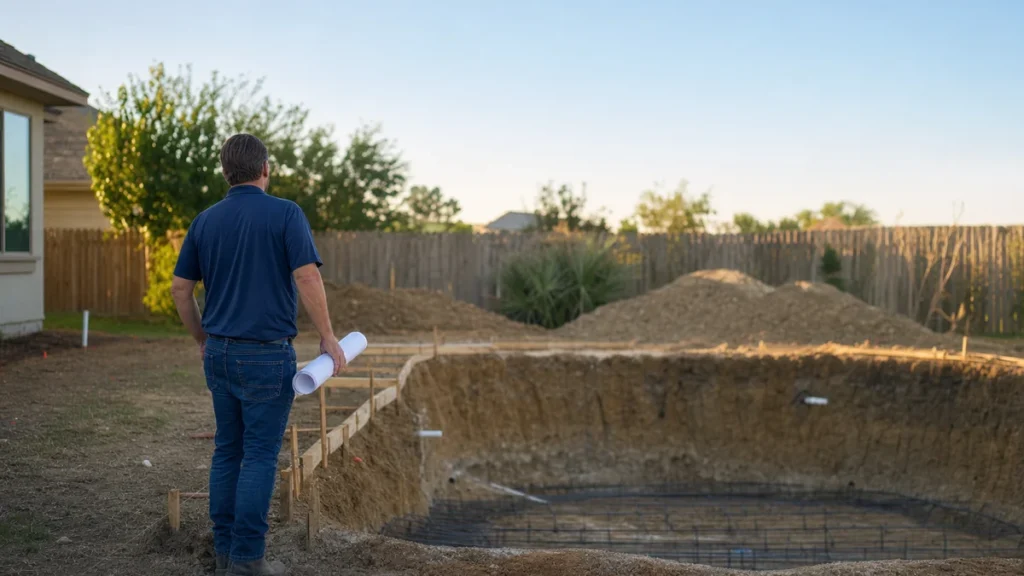
- Where do a brand-new pool builder's first signed pools come from?
- Where do a new pool company's first customers usually come from?
- Step 1: Who already knows my work?
- Step 2: Which trade partners can send a new pool builder work?
- Step 3: How do I set up a Google Business Profile with no showroom?
- Step 4: How do I win trust with no reviews and few finished pools?
- Step 5: Do I need a website before the first customer?
- Step 6: Should a new pool company run ads right away?
- Step 7: How do I handle the first leads so they sign?
- Step 8: How do I turn the first pool into the next three?
- What should a new pool company hold off spending on?
- How long until a new pool company's phone rings on its own?
- What's different about getting the first customers as a pool builder
- A worked example: where a new builder's first six pools could come from
- Frequently asked questions
- Key takeaways
- More in this section
- Sources
The short version
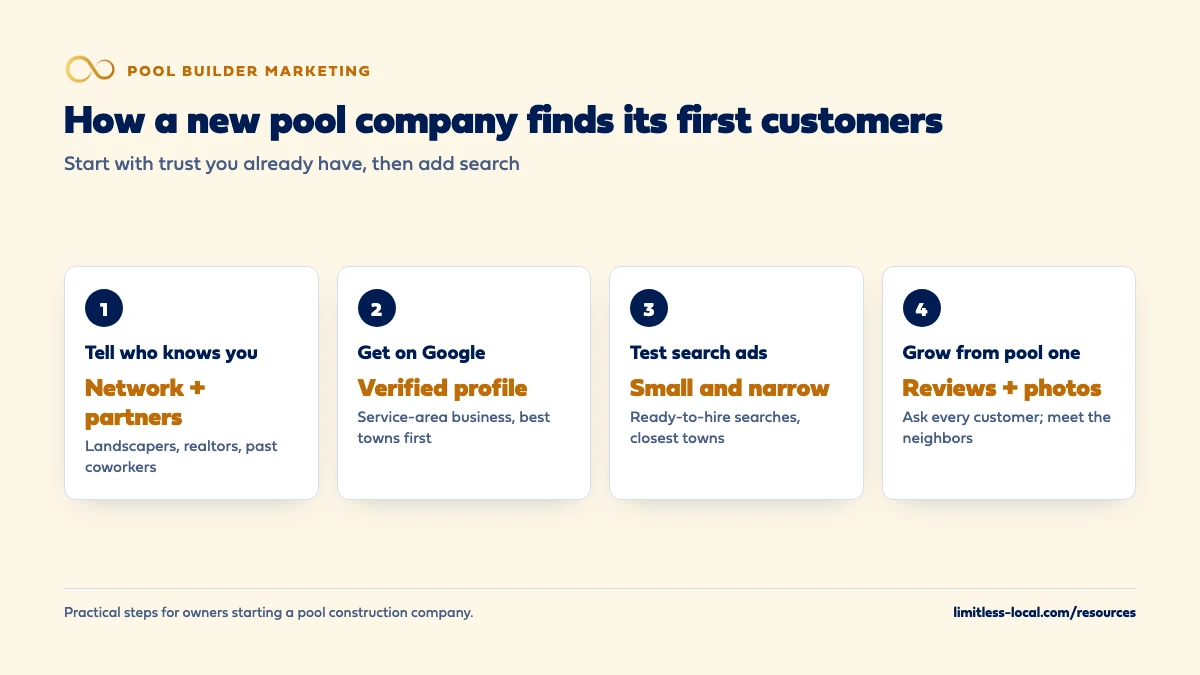
- Start with people who already trust you: your network and trade partners.
- Set up and verify a Google Business Profile as a service-area business on day one.
- Run a small, tight search ad campaign on your best towns while reviews build.
- Turn every finished pool into reviews, photos, referrals and neighbor interest.
For owners who have just opened a pool construction company, with no reviews, few finished pools to show and a crew that needs work.
Get a free visibility audit · Book a growth call
Where do a brand-new pool builder's first signed pools come from?
A new pool company’s first customers usually come from people who already know the owner and the work, and from homeowners already searching nearby: friends and past contacts, trade partners like landscapers and realtors, a verified Google Business Profile and a small search ad budget aimed at the closest towns. After that, the first finished pools do the selling: ask every customer for a review and a referral, photograph every stage, and let the neighbors see the build. Expect the first contracts to come from relationships and the steady flow from Google to build over the first seasons.
We’ve built this from zero ourselves: Limitless Local was an equity partner in a pool construction company, where we streamlined the back office, built the lead-generation engine and ran sales and marketing, and that business did $2M+ revenue in year one. If you’re still at the first-few-pools stage, most of what’s on this page you can do yourself. When you’re ready for help, our packages show what each tier covers, our pool builder marketing page explains how we work with pool companies, and the pool builder marketing questions library has the rest of this topic.
Where do a new pool company's first customers usually come from?
Mostly from trust you already have, then from search. A homeowner about to spend serious money on a pool wants proof that the builder is real, competent and still going to be in business next year. A brand-new company has little public proof, so the first contracts tend to come from people who can vouch for you directly.
In rough order of how fast they tend to turn into signed pools:
- People who know you: friends, family, neighbors, past coworkers and anyone who has seen your work on other jobs.
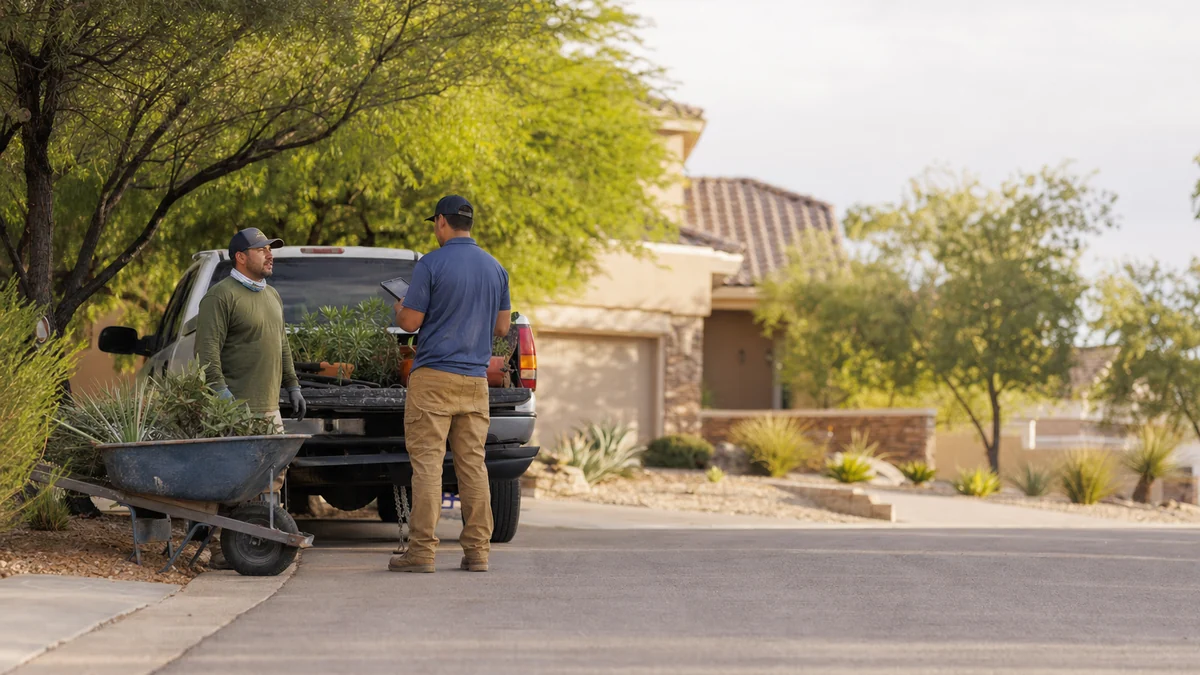
- Trade partners: landscapers, hardscapers, fence and outdoor-kitchen companies, realtors and home builders who meet homeowners before you do.
- Google search ads: homeowners actively looking for a pool builder in your towns, reached within days of launch.
- Your Google Business Profile and Maps: slow at first, then steady as reviews and photos pile up.
- Your own job sites: once the first pool is in the ground, the neighbors become your next audience.
You don’t need every one on day one. Pick the few you can do well this month and add the rest as pools finish.
Step 1: Who already knows my work?
Start with a list, not an ad. Write down everyone who could plausibly hire you or send someone your way: friends who own homes, past coworkers, suppliers, the people you’ve done side work for, your kids’ coaches, your church or club, your own neighbors.
Then tell each of them, personally, three things: that you’ve opened your own pool company, what kinds of pools you build, and which towns you serve. A short call or a text with a photo of a pool you built does more than a mass post. Ask one simple question: do you know anyone thinking about a pool this year?
Follow up when you have something new to show, like your first finished pool, so people remember you when a friend mentions a pool.
Step 2: Which trade partners can send a new pool builder work?
The businesses that meet pool buyers before you do. Landscapers and hardscapers hear “we’re thinking about a pool” all the time. Fence companies, outdoor-kitchen and patio builders, realtors who’ve just sold a house with a big backyard, custom home builders and pool service companies all talk to homeowners who may need a builder.
What makes a partner send you work is simple: they need to trust you won’t make them look bad. So start small and be easy to work with:
- Introduce yourself in person, with photos of your work and a clear idea of the towns and pool types you take on.
- When a referral comes in, call fast, show up on time and tell the partner how it went.
- Send work back their way when your customers need landscaping, fencing or a patio.
For a deeper look at building these relationships, see how pool builders get referrals from landscapers and home builders.
Step 3: How do I set up a Google Business Profile with no showroom?
Set it up as a service-area business on day one. You can add and verify your Business Profile at no charge, and once it’s verified, homeowners can find you on Google Search and Maps. If you don’t serve customers at your address, which is true of most pool builders working from home or a yard, Google says to remove the address from the profile and list your service area instead.
A few settings matter for a new builder:
- Service areas: you can list up to 20 cities, postal codes or other areas, and the boundaries of your overall area shouldn’t be more than about 2 hours of driving time from where you’re based. Start with the towns you’d most like to build in, not every town you could reach.
- Category and services: pick the category that fits pool construction and list the pool types you actually build.
- Photos: real photos of your crew, trucks, equipment and any work you personally did.
- Hours and phone: a number someone actually answers.
Google lists relevance, distance and popularity as the main factors in local results, and says complete, accurate information makes a profile more likely to show up. A new profile with few reviews won’t rank at the top right away, but it gives every referral a place to check you out. Setting up and verifying a pool company’s Google profile walks through the steps.
Step 4: How do I win trust with no reviews and few finished pools?
Show the homeowner everything else that proves you’re the real thing. With no track record under your own name, the things that usually reassure a pool buyer are:
- You. Your years in the trade, the kinds of pools you’ve built and your role on them. Homeowners hire people, especially from a new company.
- Work you personally did. Show only pools you actually built or led, and say plainly what your part was. Never present another company’s pools as yours.
- Your process. A simple page or handout that walks through design, permits, dig, steel, shell, plumbing, tile and coping, and startup, with what the homeowner does at each stage.
- Your credentials. Licenses, insurance and any training or certifications, shown clearly. Which credentials a pool builder should show on the website covers what to include.
- Your paperwork. A clear written proposal and contract, with the payment schedule and what’s included spelled out.
A homeowner who can see your face, your process and your paperwork can take a chance on a new builder.
Curious what your marketing is actually booking?
Get a free visibility audit — no obligation, no sales pitch.
Step 5: Do I need a website before the first customer?
You need a simple one, and it doesn’t have to be fancy. Referrals and partners will look you up before they call, and a company with no website looks less established than it is. A good first site has:
- Who you are, with a real photo of you and your crew.
- The pool types you build and the towns you serve.
- Photos of work you personally did, and your build process.
- A short contact form that asks the property’s town, the kind of pool they’re picturing and when they hope to swim.
- Your phone number, on every page.
Add a page for each finished pool as you go; that gallery is what eventually helps the site show up in search.
Step 6: Should a new pool company run ads right away?
A small, tight Google search campaign is usually worth it, because ads can generate leads within days of launch, while your Google profile and website take months to build up. The trick is to keep it narrow while you have no reviews:
- Target the closest, best-fit towns. Fewer miles per build, and neighbors who can see your work later.
- Bid on ready-to-hire searches like “pool builder” plus a town or the pool type you build, not broad searches like “pool ideas”.
- Set a daily budget you can live with. Google Ads runs on an average daily budget: spend varies day to day, but in a month you won’t pay more than 30.4 times that daily average for most campaigns.
- Send clicks to a page about the pools you build, with photos and a short form.
Judge it by consultations booked, not clicks.
Step 7: How do I handle the first leads so they sign?
Treat each one as precious, because early on, it is. A new company can’t afford to lose a good lead to a slow callback:
- Call back the same day, ideally within the hour. Homeowners often contact more than one builder.
- Ask a few qualifying questions before the design visit: the town, what they’re picturing, their timing and whether they’ve thought about a budget range.
- Show up on time and send the proposal when you said you would.
Being new can help: the owner is the one on the phone, at the design visit and on the job site. How fast a pool builder should respond to a new lead explains why speed matters even on a long sale.
Step 8: How do I turn the first pool into the next three?
Your first build is your best marketing asset, so plan for it before you dig:
- Ask the homeowner up front if you can put a sign in the yard during the build and photograph the work.
- Take photos at every stage: layout, dig, steel, shell, tile, coping and the finished pool with water in it.
- Meet the neighbors. A friendly word or a short note on nearby doors, letting them know who’s building next door, starts conversations.
- Ask for a review at handover, with your Google review link or QR code. Google says offering incentives for reviews, like free or discounted services, is strictly prohibited, so ask every customer and offer nothing in return.
- Ask for a referral at handover and again after their first swim season.
- Ask if a future buyer could see the pool, on the homeowner’s terms.
For more ways to grow from your own work without buying clicks, see how to find pool clients without spending on ads.
What should a new pool company hold off spending on?
Anything big that doesn’t put you in front of a ready buyer in your towns. Early cash matters more than ever, and a few things can wait:
- Long contracts or big retainers for marketing you can’t yet measure.
- Expensive brand work like a full truck wrap or a custom website before you have finished pools to put on it.
- Broad social media ads aimed at everyone in the county.
- Shared lead services, where the same lead goes to several builders, before you have the reviews to win on something other than price.
The Small Business Administration’s marketing plan guidance suggests breaking down every marketing cost and comparing it to the revenue it brings in. For a new pool builder, that means tracking where each consultation and each signed pool came from, from the very first lead.
How long until a new pool company's phone rings on its own?
Longer than ads, shorter than most owners fear. Search ads can bring leads within days, but SEO typically takes 3-6 months to show meaningful organic growth, and Maps rankings climb as reviews and photos build. Because pool buyers take weeks or months to decide, a lead in spring may not sign until summer.
A realistic first-year picture: relationships and partners sign the first pools, ads fill the gaps, and by the second season, reviews, photos and referrals from the first customers start bringing work in without you chasing it. What to expect in the first 90 days of pool builder marketing breaks down the early months.
Not sure which of these is costing you jobs?
A free visibility audit checks the Google profile, reviews, site and tracking, and shows what to fix first.
What's different about getting the first customers as a pool builder
The ticket is big, so trust comes first. A homeowner will try a new plumber for a leaky faucet. A pool is one of the largest purchases most families make for their home, so a new builder has to prove more before anyone signs.
Each pool ties up the crew for weeks. A new company only has a handful of build slots in its first season, so a few signed pools can fill the calendar. That makes the right first customers matter more than lots of leads.
The season sets the clock. Homeowners plan pools months ahead. A company that opens in late summer is often marketing for next spring, and design consultations in the slow months turn into builds when the weather turns.
Every build is on display. A pool under construction is visible to the whole street for weeks.
A worked example: where a new builder's first six pools could come from
These numbers are made up to show the math, not a benchmark for your market. A new builder wants to sign 6 pools in the first season and closes about 1 in 4 design consultations, so it needs 24 consultations.
The owner’s network and two trade partners produce 10 consultations over the season. That leaves 14 to come from Google. If about 1 in 3 ad leads books a consultation, that’s 42 leads. At a made-up $100 per lead, that’s $4,200 in ad spend across the season, or $700 a month over six months.
The point isn’t the exact figures. It’s that relationships carry a big share of a new company’s first pools, and ads only have to fill the gap. Once you know your own numbers, a free visibility audit is a quick way to see what that gap costs in your towns.
Frequently asked questions
Should I discount my first pools to get started?
Price them so you make money; a pool built at a loss is an expensive portfolio photo. If you do offer an early-customer price, never tie it to a review, because Google prohibits offering discounts in exchange for reviews.
Can I show pools I built while working for another company?
Show only work you personally did, and say plainly what your role was. If you’re not sure you’re allowed to use the photos, ask the company or the homeowner first.
Do I need a Google Business Profile if I work from home?
Yes. Set it up as a service-area business, hide your home address and list the towns you serve, so homeowners can still find and check you out on Google.
Is Facebook worth it for a brand-new pool company?
Posting build progress on your own page and in local groups where business posts are allowed costs nothing but time and shows you’re active. Paid social ads usually make more sense once you have finished pools to show.
When should a new pool company start marketing?
Before the season you want to build in. Homeowners plan pools months ahead, so design consultations in the slow months are what fill the spring and summer calendar.
Key takeaways
- A new pool company’s first contracts usually come from relationships: your network and trade partners.
- Set up and verify a Google Business Profile as a service-area business right away, starting with your best towns.
- A small, narrow search ad campaign fills the gap while reviews and rankings build.
- Win trust with you, your process, your credentials and work you personally did.
- Plan every early build as marketing: photos, a yard sign, neighbors, a review and a referral ask.
Want a second set of eyes on your setup?
We'll look at how you show up locally and where calls are leaking, then send you a plain-English breakdown.
More in this section
- What should a pool builder expect in the first 90 days of marketing?
- How do I grow a pool construction business with marketing?
- How do I market for the pool projects I want more of?
- How do I advertise a pool construction company?
- How should a pool builder respond when a new competitor opens nearby?
Sources
- Add or claim your Business Profile — Google Business Profile Help
- Manage your service areas for service-area & hybrid businesses — Google Business Profile Help
- Tips to improve your local ranking on Google — Google Business Profile Help
- Tips to get more reviews — Google Business Profile Help
- About average daily budgets — Google Ads Help
- Manage your business: Marketing and sales — U.S. Small Business Administration