
Should a pool builder wait for more reviews before raising prices?
- How many reviews do I need before I raise my pool construction prices?
- Do reviews decide when I can raise my prices?
- What signals say it's time to raise my pool prices?
- What job do reviews do once my prices go up?
- Is there a number of reviews I should hit first?
- Does my star rating need to be perfect before I charge more?
- What should my reviews show to support a premium price?
- How do I build up reviews quickly without breaking the rules?
- How do I raise prices without losing the leads already in my pipeline?
- How do I tell whether the new price is working?
- What should change in my marketing after a price rise?
- What if my close rate drops after the raise?
- What's different about reviews and pricing for pool builders
- A worked example: fewer pools, more profit
- Frequently asked questions
- Key takeaways
- More in this section
- Sources
The short version
- Close rate, backlog and price pushback decide when to raise; reviews help the new price stick.
- There's no review count that unlocks a higher price.
- What reviews say about process, communication and finish matters more than the total.
- Raise on new consultations and watch close rate for a season.
For pool builders who think their prices are too low but worry their Google reviews can’t carry a higher number yet.
Get a free visibility audit · Book a growth call
How many reviews do I need before I raise my pool construction prices?
Usually not. Reviews help a higher price stick, but the signals that say it’s time to raise are your close rate at today’s price, how far ahead you’re booked and whether leads push back on price. If you’re signing most of the homeowners you meet and the calendar is full months out, raise prices now and keep collecting reviews alongside; if your reviews are few, old or silent about what a premium buyer pays for, work on them in the same season instead of waiting for a magic count.
Reviews are one piece of how you show up on Google, and our local SEO work treats them that way: every package includes review response and review generation alongside Google Business Profile management, with advanced review generation in Growth and automated review requests in Scale. The rest of the plan for the trade is on our pool builder marketing page, and the pool builder marketing questions library covers the decisions around it.
Do reviews decide when I can raise my prices?
No. They help decide whether a higher price holds once you’ve raised it. The decision itself comes from your own numbers: how many of the homeowners you meet end up signing, how far ahead you’re booked, and what you hear in consultations about price.
Waiting for reviews has a real cost in this trade. A pool builder finishes a limited number of pools a year, and each one takes weeks to months to build, so reviews pile up slowly. If you hold your price until you hit some count, you can spend a season or two underpriced while the calendar stays full, which is money you don’t get back.
The better order is to raise prices when the business says you can, and to treat reviews as part of the same project: making sure everything a homeowner checks before a big purchase backs up the new number.
What signals say it's time to raise my pool prices?
Look for two or three of these at once:
- You sign most of the consultations you run. A very high close rate often means the price is the easiest part of the decision for your buyers.
- You’re booked well ahead. If new contracts are scheduled many months out and homeowners still sign, demand is outrunning your capacity.
- Price rarely comes up. Homeowners ask about design, timing and financing, not whether you can do better on the number.
- Your costs went up and your price didn’t. Materials, labor or subs climbed and your margin quietly shrank.
- Leads are the right kind. Most inquiries are for the size and style of pool you want to build, not price shoppers.
None of these is about reviews. That’s on purpose: they tell you what the market will pay you right now. Measure the first one properly before you lean on it, using what a good close rate looks like for pool construction leads.
What job do reviews do once my prices go up?
They lower the risk a homeowner feels about paying more. A bigger number on the proposal makes a buyer look harder for proof that you’re worth it, and reviews from people who went through the same build are some of the best proof there is.
Research on online shopping points the same way. In 2017 research from the Medill Spiegel Research Center at Northwestern, using retail product data, displaying reviews lifted conversion rates by 190% for a lower-priced product and 380% for a higher-priced one. That’s online product shopping, not pool construction, but the pattern fits: the more something costs, the more buyers lean on what others say.
So the question isn’t whether reviews matter more after a price rise. They do. It’s whether yours are good enough to carry the new number, and that’s mostly about what they say, not how many there are.
Is there a number of reviews I should hit first?
There’s no count that unlocks a higher price. Google doesn’t publish one for rankings either, and the homeowner deciding between you and two other builders isn’t counting to a threshold. They’re comparing.
Two practical checks work better than a number:
- Against the builders you’re priced against. If you’re raising prices to sit with the premium builders in your area, look at their profiles. If they have far more recent, detailed reviews than you, close that gap as part of the plan.
- Against the questions buyers ask. If homeowners keep asking in consultations whether you finish on time or how you handle problems, and none of your reviews speak to that, you have a content gap, not a count gap.
In retail, the first few reviews did the most, and the extra benefit of more reviews shrank quickly after the first five. For a pool builder past that early stage, freshness and detail usually matter more than the total. How many Google reviews a pool builder needs covers the count question for Maps.
Does my star rating need to be perfect before I charge more?
No, and a perfect rating isn’t the goal. In retail, purchase likelihood peaked at ratings around 4.0 to 4.7 and dropped as ratings approached 5.0, because a perfect score can look too good to be true. A few honest, imperfect reviews with calm, specific replies can make the good ones more believable.
For a premium price, what matters is how problems were handled. A review that mentions a delay and then praises how you communicated and made it right does more for a high-budget buyer than another one-line five-star review.
Reply to reviews, good and bad. Google’s local ranking tips say positive reviews and helpful replies can help your business stand out, and that more reviews and positive ratings can help your local ranking. For a buyer weighing your new price, a thoughtful reply shows the kind of builder they’d be dealing with.
Curious what your marketing is actually booking?
Get a free visibility audit — no obligation, no sales pitch.
What should my reviews show to support a premium price?
The things a high-budget buyer is paying extra for, in the customer’s own words:
- The design process and how well the finished pool matched the plan.
- Communication during the build: updates, responsiveness, who they could reach.
- The crew: cleanup, respect for the property, how they treated the neighbors.
- How problems were handled, from weather delays to a punch-list item.
- Follow-through after the build: start-up, the first season, warranty service.
You can’t script any of that, because asking customers for specific content is against the review rules covered in the next section. The way to get these details is to ask every customer openly at the right moment and let them write what’s true for them. What pool customers should mention in their reviews explains what you can and can’t say when you ask.
How do I build up reviews quickly without breaking the rules?
Ask every customer, at the moments they’re happiest, and make it easy. For a pool builder that’s usually right after the first swim, and again after the first season once the pool has proved itself.
What you can’t do matters as much. Google’s prohibited and restricted content policy doesn’t allow businesses to offer incentives such as payment, discounts or free goods or services in exchange for a review, to discourage negative reviews or selectively ask only happy customers, or to request specific content. Reviews that break those rules can be removed, which is a bad trade right when you’re trying to support a higher price.
Two more sources of reviews pool builders often miss: past customers from earlier seasons who were never asked, and renovation and resurfacing customers, whose jobs finish faster. How to get more Google reviews for a pool company walks through the ask.
How do I raise prices without losing the leads already in my pipeline?
Separate new conversations from open ones. A clean way to do it:
- Pick a date. Consultations booked after it get the new pricing.
- Honor open proposals for a set window, and tell those homeowners when the current price expires. A real deadline often helps undecided buyers sign.
- Update everything homeowners see before they call: the price ranges on your website, any starting-at figures in ads, and the numbers your team quotes on the phone.
- Brief whoever sells. They should be able to explain what’s included and why it costs what it does, without apologizing for the number.
Avoid raising the price on a proposal already in a homeowner’s hands. That’s the fastest way to lose a contract and earn the kind of review you’re trying to avoid.

How do I tell whether the new price is working?
Watch the same numbers that told you to raise, for at least a season:
- Close rate on consultations at the new price, compared with the same months last year.
- Gross profit signed, not just contracts signed. Fewer pools at a better margin can be the better year.
- What you hear in consultations. More price objections, or more homeowners comparing you with cheaper builders, tell you something.
- Lead mix by source. If your ads or listings still say the old price or attract budget buyers, the close rate will drop for reasons that aren’t the price.
A dip in close rate isn’t automatically a failure. The worked example below shows how signing fewer pools at a higher price can still leave you ahead.
What should change in my marketing after a price rise?
Everything a homeowner sees before the consultation should match the new price, or you’ll keep attracting buyers who expect the old one:
- Ad wording and keywords: lead with design and process, add negatives for cheap and above-ground searches, and update any price ranges.
- Your portfolio: put the projects that justify the new price first, with the story behind each.
- Your Google profile: fresh photos of recent premium builds, an updated description and services that match the work you want.
- Your consultation step: a few screening questions about budget and timing before you drive out.
If you’re moving upmarket, not just keeping up with costs, positioning your pool company as a premium builder covers the bigger shift, and how pool builders stop attracting price shoppers covers the leaks.
What if my close rate drops after the raise?
First, check whether it’s the price or the leads. Pull the consultations that didn’t sign and ask:
- Did they come from a source that tends to bring budget buyers?
- Did they say price, or did they go quiet after the proposal?
- Did they choose a cheaper builder, or put the project off?
If the losses are mostly price shoppers from the wrong sources, fix the marketing, not the price. If good-fit homeowners are choosing someone else on price, look at what they saw: your reviews, photos and proposal next to the builder they picked. That’s where weak or thin reviews show up, and where working on them pays.
Give it a season before going back. One slow month is too small a sample in a business with few, large contracts.
Not sure which of these is costing you jobs?
A free visibility audit checks the Google profile, reviews, site and tracking, and shows what to fix first.
What's different about reviews and pricing for pool builders
Reviews come slowly. A builder finishes a limited number of pools a year, so waiting for a review count can mean waiting years. That’s the strongest reason not to tie a price rise to one.
The best reviews arrive late. A homeowner can judge the design and the crew at handover, but the first season tells them whether the equipment, finish and service hold up. Asking again after a season often gets the most detailed review.
Buyers check more than Google. Premium buyers often look at your portfolio, Houzz or social profiles and talk to neighbors you built for. Reviews on Google matter, but they’re one part of the proof.
Remodels feed the review count. Renovation and resurfacing jobs finish faster than new builds and add reviews between big projects, as long as you ask.
A worked example: fewer pools, more profit
These numbers are made up to show the math, not a benchmark for your market.
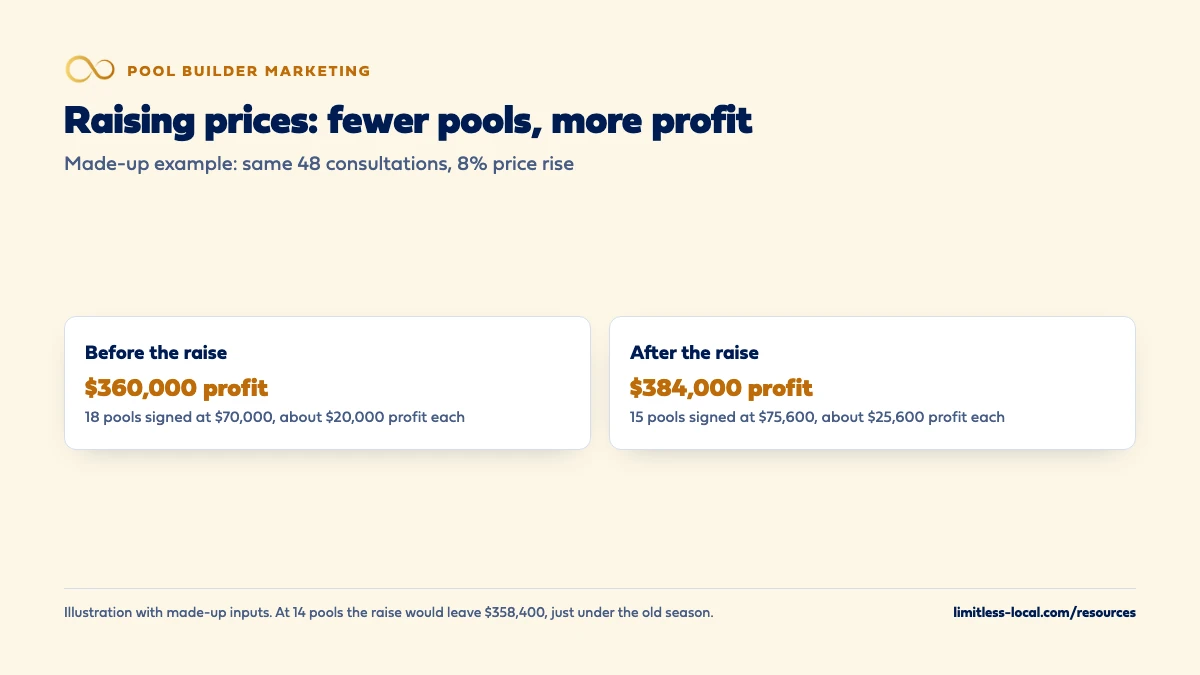
Last season a builder ran 48 design consultations and signed 18 pools at an average of $70,000. Each pool left about $20,000 in gross profit, so the season signed $360,000 in gross profit. The calendar is full seven months out, and price rarely comes up.
The builder raises prices 8%, or $5,600 on an average pool, to $75,600. The price rise adds straight to margin, so each pool now leaves $25,600.
Next season, with the same 48 consultations, the builder signs 15 instead of 18. That’s 15 × $25,600 = $384,000 in gross profit: more than before, with three fewer pools to build. At 14 pools it would be $358,400, just under last season, so 15 is roughly where the raise starts paying.
Reviews don’t appear in that math, and that’s the point. They’re what helps hold the close rate at 15 or better, which is why it’s worth working on them during the same season, not before it.
Frequently asked questions
Should I mention a price increase in my review requests?
No. Keep the review ask about the customer’s experience, and don’t connect it to pricing, discounts or anything else that could read as an incentive.
Do Houzz or Facebook reviews count the same as Google reviews?
For the homeowner checking you out, any honest, detailed review helps. For showing up in Google Maps, Google reviews are the ones on your Google profile.
Can a few bad reviews stop me from raising prices?
Not on their own. What a premium buyer reads is the pattern and your replies. A specific, calm reply that shows how you fixed the problem can help more than the bad review hurts.
Should I raise prices on renovations and new builds at the same time?
Not necessarily. They often have different close rates, backlogs and competitors, so check the signals for each line separately.
Is a full calendar enough reason to raise prices?
It’s a strong signal, especially if it’s paired with a high close rate and few price objections. A full calendar with a low close rate may mean you’re busy with the wrong mix of jobs instead.
Key takeaways
- Raise prices when close rate, backlog and price pushback say so, not at a review count.
- Reviews help a higher price hold, especially detailed ones about process, communication and problems handled.
- A perfect rating isn’t the goal; honest reviews with calm replies are more believable.
- Ask every customer without incentives, scripts or filtering, as Google’s policy requires.
- Judge the raise on gross profit signed over a season, not on contract count alone.
Want a second set of eyes on your setup?
We'll look at how you show up locally and where calls are leaking, then send you a plain-English breakdown.
More in this section
- When should a pool builder ask for a review during the build?
- When should a pool builder raise its monthly marketing budget?
- How do pool builders stop attracting price shoppers?
- Should a pool builder pause marketing when the schedule is full?
- How can a pool builder turn reviews and referrals into more jobs?
Sources
- How Online Reviews Influence Sales — Medill Spiegel Research Center, Northwestern University
- Prohibited & restricted content — Google Business Profile Help
- Tips to improve your local ranking on Google — Google Business Profile Help