
How do restoration companies stay top of mind with insurance agents?
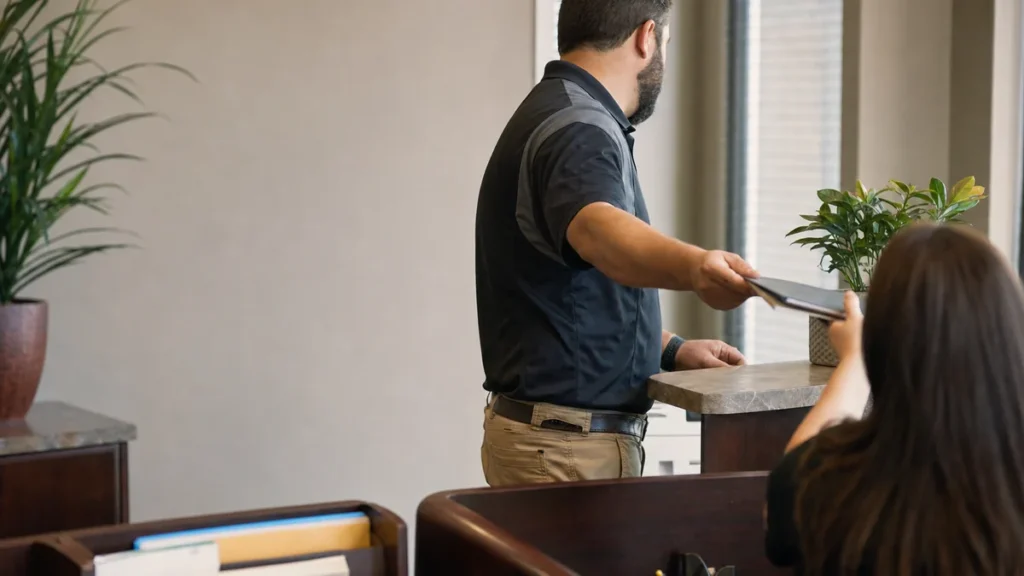
- How does a restoration company keep insurance agents recommending it, loss after loss?
- Why do insurance agents matter so much to a restoration company?
- What does an insurance agent actually want from a restoration company?
- Step 1: How should the first visit to an agent's office go?
- Step 2: How do I keep an agent posted on clients they send me?
- Step 3: What should I send agents between losses?
- Step 4: How often should I visit, and who should I see?
- Step 5: How do I stay their first call before and after a big storm or freeze?
- Step 6: How do I keep out of coverage questions?
- Step 7: Can I thank agents with gifts or pay them for referrals?
- Step 8: What will an agent check before giving out my name?
- How do I know which agents are actually sending jobs?
- What's different about agent relationships in restoration
- A worked example: a year of agent touchpoints
- Frequently asked questions
- Key takeaways
- More in this section
- Sources
The short version
- Agents recommend whoever makes their clients happy and never makes them look bad.
- Update the agent at arrival and at close on every client they send.
- Between losses, send useful seasonal material and visit the staff who take claim calls.
- Never pay for referrals or advise on coverage, and keep your online reputation solid.
For restoration owners who’ve met a few insurance agents and want their name to be the one an agent gives when a client calls about water, fire or mold.
Get a free visibility audit · Book a growth call
How does a restoration company keep insurance agents recommending it, loss after loss?
Restoration companies stay top of mind with insurance agents by making every client the agent sends look well looked after: answer fast, show up when promised, and send the agent a short update when the crew arrives and when the job closes. Between losses, keep a steady, useful rhythm of contact, like a seasonal prep sheet agents can pass to clients, a quick visit to the staff who take claim calls, and a check-in before storm or freeze season. Stay out of coverage advice, never pay for referrals, and keep your Google profile and reviews strong, because agents look you up before they give out your name.
The relationship with an agent is yours to build. What we handle is everything an agent sees when they look you up and everything that tells you which agents are sending jobs: your Google profile, reviews and site through our restoration marketing, plus call and source tracking in every one of our packages. For the full channel picture, read the restoration marketing guide, or browse more restoration marketing questions.
Why do insurance agents matter so much to a restoration company?
Because they often get the first call. The National Association of Insurance Commissioners’ Post-Disaster Claims Guide tells homeowners the easiest way to report a claim is to call their insurance company or agent, and not to make permanent repairs before talking with them. So when a pipe bursts or a kitchen fire leaves smoke through the house, a lot of homeowners ring their agent’s office before they search Google.
What happens next is a conversation, not a rule. The homeowner asks, “Who should I call?” and the agent, or the person who answers their phone, gives a name. In Washington, for example, the state insurance regulator tells homeowners they have the right to select their contractor, even when the insurer recommends preferred providers. That means the agent’s suggestion is just that, a suggestion, and a trusted one.
Your goal is simple: be the name that comes to mind first, every time, for years.
What does an insurance agent actually want from a restoration company?
Agents don’t need you to sell them on drying science. They want three things, and all of them are about their client:
- A happy client. The agent’s book of business depends on clients renewing. A client who had a smooth restoration job remembers the agent who pointed them your way.
- No surprises. An angry call from a client about a no-show, a mess or a confusing bill lands on the agent’s desk. They’ll quietly stop giving out your name after one of those.
- No claim drama. Agents don’t want a contractor making coverage promises, pushing a client into a fight with the carrier or creating paperwork problems.
Everything below is built around those three. Staying top of mind isn’t about being the loudest restoration company in the agent’s inbox. It’s about being the safest name to give.
Step 1: How should the first visit to an agent's office go?
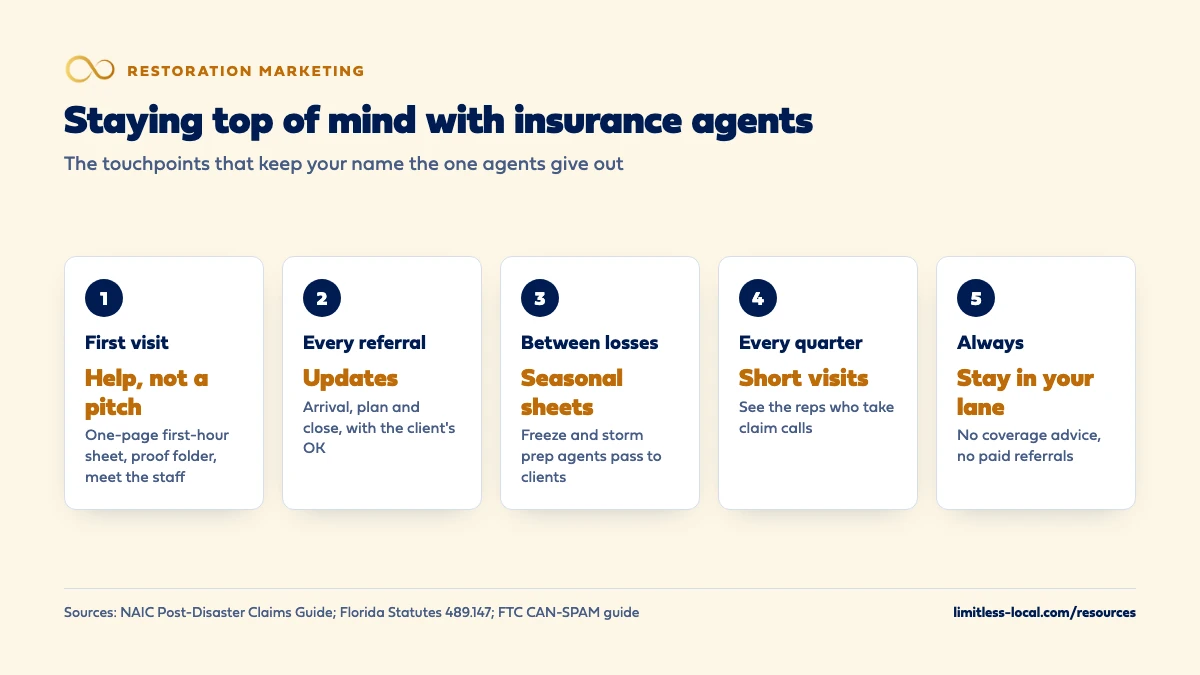
Make it about their clients, not your pitch. Walk in with something useful and short:
- A one-page sheet the office can hand clients: what to do in the first hour after water damage or a fire, and your one phone number at the top.
- Your proof folder: license, certificates of liability and workers’ compensation insurance, and your crew’s certifications.
- A plain promise you can keep, like how fast you call back and how soon a crew can usually be on site in their towns.
Ask who answers the phone when clients call about a loss. In many agencies it’s a customer service rep, not the agent. That person is the one who’ll actually say your name, so learn theirs. Keep the visit to ten minutes and leave before you’ve worn out your welcome.
If you’re still building your list of partners, building a referral network with plumbers and property managers covers the first conversations with every kind of partner.
Step 2: How do I keep an agent posted on clients they send me?
This is the single biggest thing that keeps an agent sending work. Most contractors go silent once they get the job. The agent never hears how it went until the client calls to complain or doesn’t call at all.
Send the agent short updates at three moments, with the client’s permission:
- When the crew arrives: “We’re on site at the Garcia home; water’s stopped and drying is set up.”
- When the plan is clear: roughly how long drying will take and what happens next.
- When the job closes: a thank-you and a note that the client is taken care of.
Keep it to a text or two-line email. Don’t include claim amounts, coverage opinions or anything the client wouldn’t want shared. The agent just wants to know their client is in good hands, and they’ll remember who told them.
Step 3: What should I send agents between losses?
Most months, nobody in an agent’s book has a loss. That’s when restoration companies fade from memory. Fill the gap with things the agent can pass to clients:
- A freeze-prep sheet before the first hard cold snap: how to find the water shutoff, when to drip faucets, what to do if a pipe bursts.
- A storm or hurricane-season reminder with your number and what to photograph before cleanup starts.
- A short note on hidden water damage after a leak: why wet drywall and flooring need checking even when they look dry.
Send it by email or drop it off, and keep it free of sales talk. If you email agents a newsletter or promotion, the FTC’s CAN-SPAM compliance guide says the law makes no exception for business-to-business email: include your valid physical postal address, identify the message as an ad, use honest subject lines and honor opt-out requests within 10 business days.
For what else to publish, what a restoration company should publish to look like an expert has more ideas.
Curious what your marketing is actually booking?
Get a free visibility audit — no obligation, no sales pitch.
Step 4: How often should I visit, and who should I see?
A rhythm beats a burst. A quick in-person stop every quarter does more than a big lunch once a year and silence after. Use a simple rotation:
- Quarterly drop-in: five minutes, a fresh prep sheet, a thank-you for any client they sent.
- Before your busy season: a check-in so they know you’re staffed and ready.
- After any job they referred: a handwritten thank-you note.
See the whole office, not just the agent. The customer service reps who answer claim calls, the office manager and newer producers are all people who might hand out a name. A short lunch-and-learn for the staff on what to tell a client in the first hour after a loss is useful to them and puts your face in front of everyone at once.
Step 5: How do I stay their first call before and after a big storm or freeze?
Big events are when agents get flooded with calls, and when they find out who’s reliable. Before the season, check in with every agent on your list and tell them honestly how many jobs your crews can take and how fast you can respond in their towns.
When the event hits, give agents a straight answer about capacity. If you’re booked for three days, say so. Agents remember the company that told them the truth far longer than the one that said yes and showed up late. If you bring in extra crews or equipment, tell them that too.
Afterward, thank every agent who sent clients, and send each one a short note on how their clients were handled. Restoration marketing during storm season covers the rest of the storm plan.
Step 6: How do I keep out of coverage questions?
Agents want restoration companies that fix the house and leave coverage to the people licensed to handle it. Some states write that into law. In Florida, section 489.147 bars contractors from interpreting policy provisions or advising an insured about coverages or duties under their property insurance policy, or adjusting a claim for them, unless the contractor holds a public adjuster license.
Whatever state you’re in, the safe habit is the same. When a homeowner asks “Will insurance cover this?”, the answer is “That’s a question for your agent or your insurance company. Here’s what we found and the photos and readings that show it.” Document the damage thoroughly, share it, and let the agent and carrier do their part.
Agents notice. A restoration company that sends clients back to them with clean documentation, instead of promises about what the policy will pay, is one they’re glad to recommend. How restoration companies get insurance-related water damage jobs covers more on working claim-paid jobs.
Step 7: Can I thank agents with gifts or pay them for referrals?
Never pay for referrals. In Florida, contractors are also barred from offering, delivering, receiving or accepting any compensation, inducement or reward for the referral of any services for which property insurance proceeds are payable. Other states have their own rules, so check yours before offering an agent anything of value.
A thank-you note, a prompt update and great work for their client are the thanks that matter. Agents who refer because you take care of their people will keep doing it. Agents who refer because of a gift will stop when someone offers a bigger one.
Step 8: What will an agent check before giving out my name?
Before an agent passes your name to a client, they’ll probably look you up, and so will the client. Make sure what they find matches the company that walked into their office:
- A complete Google Business Profile with your real service area, hours you actually answer and photos of your crew at work.
- Recent reviews from real customers. Google’s review guidelines say offering incentives for reviews is strictly prohibited, so ask every customer and never trade discounts for stars.
- A website with a clear page for each service and your phone number at the top.
- Your certifications and proof of insurance easy to request.
If an agent searches your name and finds a thin profile or a string of unanswered complaints, the visits and prep sheets won’t save the referral.
How do I know which agents are actually sending jobs?
Ask every caller how they heard about you and record the agent’s name, not just “insurance agent.” A referral-source field in your job software, whether that’s ServiceTitan, Jobber or a spreadsheet, is enough. Once a quarter, sort it: who sent jobs, how many booked, and what they were worth.
You’ll usually find a few agents sending most of the work. Those relationships get the most attention. Agents who’ve never sent a job after a year of visits get fewer stops and the seasonal emails only. And when a regular referrer suddenly goes quiet, call and ask how the last job went. Sometimes there was a problem nobody told you about.
If you don’t have a system to log sources and follow up, whether a restoration company needs a CRM for follow-up covers what’s worth setting up.
Not sure which of these is costing you jobs?
A free visibility audit checks the Google profile, reviews, site and tracking, and shows what to fix first.
What's different about agent relationships in restoration
Agents aren’t adjusters. The agent sold the policy and takes the first call; the adjuster works for the carrier, or is hired by it, and handles the claim. Both matter, but they want different things. Agents want happy clients; adjusters want clean documentation and a scope that holds up.
Your work happens on the worst day of their client’s year. Few trades get handed someone at that moment. That’s why a single bad job can end a relationship, and why consistent updates matter more here than in almost any other referral partnership.
Carrier programs are a separate track. Insurer and third-party administrator vendor programs have their own applications and rules. How restorers get into TPA and preferred vendor programs covers them; this page is about the independent agent down the street.
A worked example: a year of agent touchpoints
This plan is made up to show the rhythm, not a forecast. A restoration owner keeps a list of 15 independent agents in the towns the crews can reach quickly.
- Quarterly: a five-minute drop-in with a fresh seasonal sheet. That’s 4 visits per agent, or 60 short stops a year, about five a month.
- Before the busy season: one check-in call per agent about capacity.
- After each referral: an arrival text, a closing note and a handwritten thank-you.
At year end the owner sorts the referral log. Say 4 of the 15 agents sent jobs, and one of them sent more than the other three combined. Next year those 4 get monthly contact, the others stay on the quarterly rotation, and the owner adds 5 new agents to replace the ones who never engaged. No money changed hands for any referral; the work was the reason they called.
Frequently asked questions
Should I focus on independent agents or captive agents?
Both can refer. Independent agents work with several carriers and often have more local discretion; captive agents represent one carrier. Start with the agents closest to the towns your crews reach fastest.
Is it worth sponsoring an agent's client appreciation event?
It can be good visibility. Treat it as community marketing open to the whole office, never as payment tied to referrals.
Can I put an agent's logo or name on my website as a partner?
Only with their written permission. Many agents and carriers have rules about how their names are used, so ask before you list anyone.
How many agents should a small restoration company work with?
As many as you can keep in touch with properly. A dozen agents you visit every quarter beat fifty who got one brochure.
Should I send agents a monthly newsletter?
Only if it’s useful to their clients. A short seasonal email works better than a monthly sales update, and commercial email has to follow CAN-SPAM rules.
What if an agent's client was unhappy with our work?
Call the agent before the client does, explain what happened and what you’re doing to fix it. Owning a problem early often keeps the relationship.
Key takeaways
- Agents often take the first call after a loss, so their recommendation is worth earning.
- Update the agent at arrival, once the plan is clear and at close on every client they send.
- Between losses, send seasonal prep material and visit the reps who answer claim calls.
- Leave coverage questions to the agent and carrier; in Florida, advising on coverage needs a public adjuster license.
- Never pay for referrals; earn them with work and communication.
- Track referrals by agent name and put your time where the jobs come from.
Want a second set of eyes on your setup?
We'll look at how you show up locally and where calls are leaking, then send you a plain-English breakdown.
More in this section
- How should a restoration company market to real estate agents?
- How do restoration companies get insurance-related water damage jobs?
- How should a restoration company market to commercial properties?
- How should a restoration company get more customer referrals?
- How should a restoration company handle marketing during storm season?
Sources
- Post-Disaster Claims Guide — National Association of Insurance Commissioners
- Filing a homeowner insurance claim — Washington Office of the Insurance Commissioner
- 489.147 Prohibited property insurance practices; contract requirements — The Florida Senate
- CAN-SPAM Act: A Compliance Guide for Business — Federal Trade Commission
- Tips to get more reviews — Google Business Profile Help