
Which SEO tasks can be replaced by AI for roofing companies?
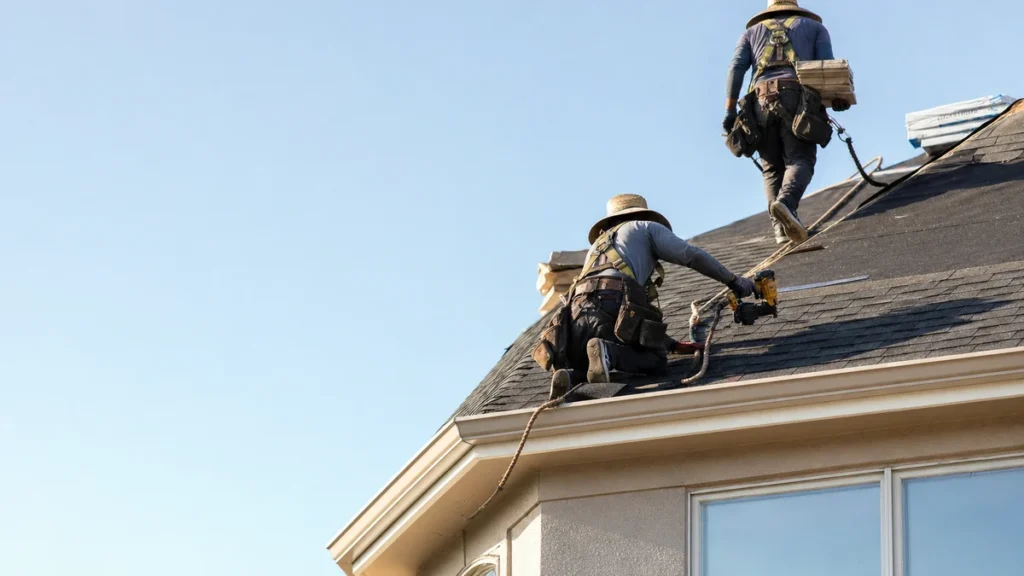
- Which parts of a roofer's SEO work can AI tools do, and which still need a person?
- Which SEO tasks can AI take over for a roofer?
- Can AI write my roofing service and town pages?
- Can AI do keyword research for my roofing company?
- Can AI handle the technical side of roofing SEO?
- Can AI manage my Google Business Profile?
- Can AI get or reply to my Google reviews?
- Which parts of roofing SEO can't AI replace?
- What goes wrong when a roofer lets AI run SEO on autopilot?
- Should I pay less for SEO now that AI does some of the work?
- How should a roofer split SEO work between AI, the office and a provider?
- What's different about using AI for roofing SEO
- A worked example: one month of roofing SEO tasks, split up
- Frequently asked questions
- Key takeaways
- More in this section
- Sources
The short version
- AI can draft pages, profile posts, review replies, title tags and markup.
- Photos, genuine reviews, profile verification, local links and tracking still need people.
- Google allows appropriate AI use, but mass-produced pages count as scaled content abuse.
- Check every AI-written fact before it goes live, and pay for the work AI can't do.
For roofing owners wondering whether ChatGPT and other AI tools can do their SEO work, and what still needs them, their office or a provider.
Get a free visibility audit · Book a growth call
Which parts of a roofer's SEO work can AI tools do, and which still need a person?
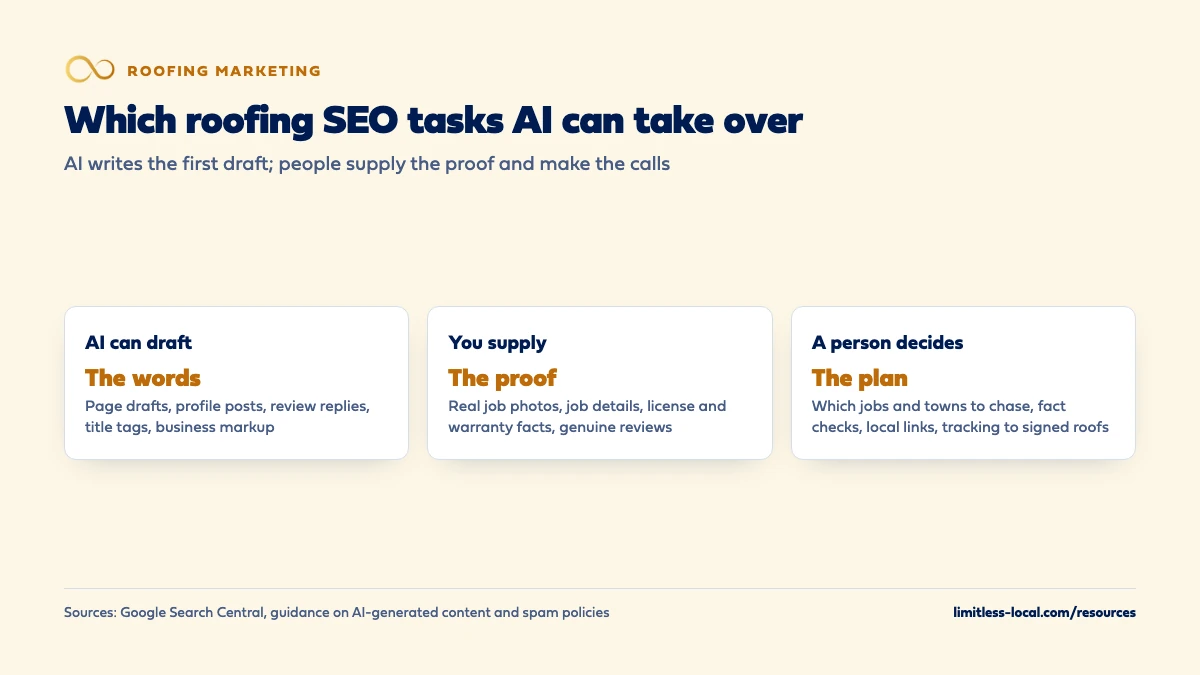
AI tools can take over the drafting in roofing SEO: first versions of service and town pages, Google profile posts, review replies, title tags and business markup code. They can’t take job photos, earn real reviews, verify your Google profile, build relationships for local links, decide which jobs and towns to chase, or tie calls to signed roofs, and that’s where most of the results come from. Use AI for the first draft, then have someone add real job details and check every fact before anything goes live.
That split is how we run local SEO: drafting goes fast, and the time goes into the Google profile, real job content, local links and tracking calls to booked jobs. It’s part of every one of our roofing marketing packages. For how to judge an SEO provider in the first place, the guide to roofing SEO companies covers what to ask, and the rest of the roofing marketing questions library goes question by question.
Which SEO tasks can AI take over for a roofer?
AI tools are good at the typing part of SEO. They can draft a service page from your notes, suggest title tags, write a first pass at a Google profile post, turn a job into a short review reply, and produce the code for business markup. That used to eat an owner’s evenings.
They can’t do the parts that make Google and homeowners trust a roofing company: take photos on your jobs, earn real reviews, verify your profile, build relationships with local suppliers and associations, decide which jobs and towns are worth chasing, or tie a phone call to a signed roof. Those parts are most of what moves calls.
Think about it task by task. AI writes the first draft. You, your office or your provider supply the facts, the proof and the decisions, and check the result before it goes live.
AI search hasn’t replaced SEO itself either. Google’s guide to optimizing for generative AI features says SEO is still relevant, because those features are rooted in its core Search ranking systems. The full case is in whether SEO is still worth it for roofers in 2026.
Can AI write my roofing service and town pages?
It can write the first draft, and that’s fine with Google. Its guidance on AI-generated content says appropriate use of AI or automation isn’t against its guidelines, as long as it isn’t used to generate content mainly to manipulate rankings.
Where roofers get in trouble is volume. Google’s spam policies call it scaled content abuse when many pages are generated mainly to manipulate rankings rather than help people, and the first example listed is using generative AI to create many pages without adding value. Fifty town pages that an AI tool spun from one template are exactly that.
A draft becomes a good roofing page when you add what only you know:
- The roofs you actually install and repair, and the ones you don’t.
- What’s included in an inspection, a repair and a replacement, in your words.
- Real jobs in that town, with your own photos.
- Your license, insurance, warranty terms and how long you’ve worked the area.
For the full how-to on prompts, editing and what to never let it write, see whether ChatGPT can write the content on your roofing website.
Can AI do keyword research for my roofing company?
It’s a decent brainstorming partner. Ask it how homeowners phrase questions about tile roof repair or storm damage inspections, and you’ll get a long list in seconds.
What it can’t tell you is what people in your service area actually search, or which of those searches already show your site. That data is free in Search Console. Its Performance report shows which queries bring traffic to your site and how that changes over time.
A simple routine works well. Export your queries, paste them into an AI tool and ask it to group them by job type and town. Then look at the groups yourself: which ones match the jobs you want more of, and which pages on your site should be answering them? The AI saves you the sorting. You still make the call on what to build next. How a roofer can see which searches and pages bring leads shows where to find the reports.
Can AI handle the technical side of roofing SEO?
Partly. AI tools are handy for small, checkable technical jobs:
- Title tags and meta descriptions for each service page, written to a length limit.
- Alt text for job photos, if you tell it what’s in the picture.
- Business markup. It can write the structured data code that describes your company, services and service area.
- Explaining an error you found in Search Console.
Check everything before it goes live. Google’s introduction to structured data tells site owners to test markup with the Rich Results Test during development. AI-written code often looks right and still has a wrong field or a missing property.
The bigger technical problems need someone who can see the site: pages that aren’t indexed, a slow site on phones, a redesign that broke old links, or tracking that double-counts calls. A chat tool only knows what you paste into it.
Curious what your marketing is actually booking?
Get a free visibility audit — no obligation, no sales pitch.
Can AI manage my Google Business Profile?
It can draft the words. It can’t own or run the profile.
Good uses: a business description in your voice, a weekly post about a finished job, answers to common questions, and a checklist of fields you haven’t filled in yet. Feed it the real details (the town, the roof type, the problem you fixed) or every post will sound like every other roofer’s.
The parts that matter most stay with you:
- Verification. Google says you need to verify your business to edit info like your name or hours and to interact with customers. That’s tied to you and your business, not a tool.
- Photos. Real crews on real roofs in your towns. Stock or generated images tell homeowners nothing about your work.
- Decisions. Your primary category, your service area and your hours are business choices, and getting them wrong costs calls.
Keeping your name, address and phone identical everywhere still pays off, too. A roofing client of ours got 3x map pack visibility in its target towns; better presence and consistent info across the web increased inbound calls. That came from careful cleanup work, not from generated text.
Can AI get or reply to my Google reviews?
Replying, yes, with your help. Getting them, no.
An AI tool can turn a five-star review into a short thank-you, or help you stay calm while drafting a reply to an angry one. Add one real detail from the job and sign it with a name, so it doesn’t read like a template. How a roofer should reply to Google reviews covers what to say and what to never put in a reply.
Reviews themselves have to come from real customers. Google’s Maps content policy says contributions should reflect a genuine experience, and fake engagement isn’t allowed and will be removed. That includes content that isn’t based on a real experience. An AI-written review, or one you write for a customer to post, falls on the wrong side of that.
What gets reviews is a habit: ask every happy customer on the day the job wraps up, send a direct link, and follow up once. AI can write the text message. Your crew earns the review.
Which parts of roofing SEO can't AI replace?
These are the jobs that still need a person, and they’re where most of the results come from:
- First-hand job detail. The leak you traced to a bad pipe boot, the decking you replaced, the HOA approval you handled. An AI tool has never been on a roof, and homeowners can tell.
- Photos and proof. Before-and-after shots, crew photos, license and warranty details.
- Local links and mentions. Supplier dealer pages, trade associations, sponsorships and local news. These come from relationships. Using automated programs or services to create links to your site counts as link spam, so AI link-building tools are a risk, not a shortcut.
- Choosing what to chase. Repairs or replacements, which towns, residential or commercial, storm work or retail. That’s strategy, and it depends on your crews and your margins.
- Tracking to signed roofs. Call tracking, form tracking and a lead-source question on every call, followed through to the contract.
- Answering the phone. SEO that brings calls nobody picks up is wasted.
What goes wrong when a roofer lets AI run SEO on autopilot?
The trouble is rarely one bad page. It’s months of unchecked output piling up:
- Wrong facts stated with confidence. OpenAI’s help page on whether ChatGPT tells the truth says it can produce incorrect or misleading outputs and may sound confident even when it’s wrong. On a roofing site that means a wrong warranty length, a material you don’t install, or a town you don’t serve.
- Pages nobody needed. Dozens of near-identical town pages and blog posts that never bring a call, and can drag the site toward scaled content abuse.
- Stale details. An AI tool doesn’t know you changed your hours, added gutters or stopped doing flat roofs. Somebody has to.
The fix is a simple rule: nothing AI writes goes live until someone at the company has read it and checked every fact against how you actually work.
Should I pay less for SEO now that AI does some of the work?
Maybe, if what you’re paying for is mostly writing. If a provider’s report is a list of pages and posts published, AI has made that part cheap, and it’s fair to ask why the price hasn’t moved.
The parts AI didn’t make cheaper are the ones that bring calls: profile cleanup, local links, real job content, review generation, tracking and someone checking it all each month. Those should be the bulk of what you pay for. Ask any SEO provider three questions:
- Which tasks do you use AI for, and who checks the facts before anything goes live?
- What do you do each month that an AI tool can’t, like links, profile work and tracking?
- How will I see which calls and signed roofs came from the work?
Good answers name people and reports. Vague ones are a sign you’re paying for volume. For what SEO usually costs and what should be included, see how much a roofer should expect to pay for SEO.
How should a roofer split SEO work between AI, the office and a provider?
It depends on how much time you have and how big the territory is:
- One-truck roofer, one or two towns. AI tools plus an hour or so a week can cover a lot: profile posts, review replies, a page for each service. Spend your own time on photos, asking for reviews and checking what the AI wrote.
- Office manager on staff. Hand them the AI drafting and the review routine. Keep the decisions on services, towns and budget with the owner.
- Several crews, several towns. The work outgrows evenings. Links, tracking, technical fixes and a monthly review of calls by source are where outside help earns its fee.
Whichever setup you pick, SEO still ramps slowly. It typically takes 3-6 months to show meaningful organic growth, and AI drafting doesn’t shorten that. Whether a roofing company can do its own SEO walks through the do-it-yourself path in more detail.
Want to see where your company stands?
A free visibility audit shows where you show up on Google, Maps and AI answers, and what it's costing you in calls.
What's different about using AI for roofing SEO
Proof does the selling. A roof is a big, rare purchase, and homeowners look hard for signs a roofer is real and local: job photos from their neighborhood, a license number, reviews that name their town. None of that can be generated, and it’s what separates you when every competitor’s AI-written page says the same thing.
Storms change the content calendar. After a hailstorm or hurricane, homeowners search for storm damage inspections right away. AI can help you have a storm page drafted and checked before the season, so it’s ready to switch on, instead of writing one in a rush.
A worked example: one month of roofing SEO tasks, split up
These tasks are made up to show how the split works, not a plan for your market. Say a roofer’s SEO to-do list for one month is: 4 Google profile posts, 12 review replies, 2 new job pages and new title tags for the service pages.
- AI drafts: the posts, the replies, a first version of each page and the title tags.
- The owner or office adds: a real photo and job detail to each post, one specific line to each reply, and the scope, photos and warranty facts on each page.
- Someone checks: every fact before it publishes, and the title tags against what the page actually covers.
- Still outside the AI’s reach: asking customers for reviews, local links, and matching calls to signed roofs.
The writing gets faster. The list of things that need a person barely gets shorter.
If you’d rather hand the whole list off, our Essentials package is $3,500 a month and covers Google profile management, a content sprint of up to 10 pages, blog posts, link building, review response and basic review generation, and call, web and form tracking, plus Google Ads management up to $2,500 a month in spend, which is paid to Google separately. Judge it like any channel: total cost divided by signed roofs.
Frequently asked questions
Can an AI tool tell me why my roofing site dropped in Google?
It can list likely causes, but it can’t see your site’s data. Look at Search Console first: which pages and queries lost clicks, and when. Then use AI to help explain what you found.
Is it OK to use AI to translate my roofing pages into Spanish?
Yes, if a fluent person checks the translation and your team can take those calls. An unchecked machine translation reads badly to native speakers, and a Spanish page that reaches an English-only phone loses the lead.
Can AI build backlinks for my roofing company?
It can draft an email to a supplier or association asking about a listing. Tools that create links automatically are a different story: they count as link spam.
Should my SEO provider tell me if they use AI?
It’s a fair question to ask. What matters more is the answer to the follow-up: who checks the facts, and what work they do each month beyond writing.
Can AI write the photo descriptions on my roofing website?
Yes. Tell it what’s in each photo, like the roof type, the town and the job stage, and it will write short, accurate alt text faster than you can type it.
Key takeaways
- AI can take over the drafting in roofing SEO: page drafts, profile posts, review replies, title tags and markup.
- It can’t take photos, earn reviews, verify your profile, build local relationships or tie calls to signed roofs.
- Google allows appropriate AI use, but mass-produced pages are scaled content abuse and fake reviews get removed.
- Nothing AI writes should go live until someone checks every fact against how you actually work.
- If you pay for SEO, pay for the work AI can’t do, and ask your provider which tasks it uses AI for.
Not sure what's working right now?
Start with a free visibility audit: rankings, Google profile, reviews and tracking, checked against your service area.
More in this section
- Is SEO still worth it for roofers in 2026 with AI search?
- What should a roofer track monthly for local SEO and AI visibility?
- Can a roofing company do its own SEO?
- What website changes help a roofer show up in AI results?
- Which questions should a roofing website answer for AI Overviews?
Sources
- Optimizing your website for generative AI features on Google Search — Google Search Central
- Google Search's guidance about AI-generated content — Google Search Central
- Spam policies for Google web search — Google Search Central
- Does ChatGPT tell the truth? — OpenAI Help Center
- Introduction to structured data markup in Google Search — Google Search Central
- Verify your business on Google — Google Business Profile Help
- Prohibited & restricted content — Maps User Generated Content Policy Help
- Performance report (Search results) — Search Console Help