
Which channels work best for residential vs commercial electricians?

- How should residential and commercial electrical marketing use different channels?
- Why do residential and commercial electricians need different channels?
- Which channels work best for residential electrical work?
- Are Local Services Ads a residential or commercial channel?
- Which channels work best for commercial electrical work?
- Can one Google Ads account serve both residential and commercial?
- Can one website and Google profile serve both?
- How should I split my budget between residential and commercial?
- Should I focus on residential, commercial or emergency work?
- How do I check demand for residential vs commercial terms?
- Does direct mail work for either side?
- How do I measure each side?
- What's different for electrical contractors who do both
- A worked example: one month in a mixed shop
- Frequently asked questions
- Key takeaways
- More in this section
- Sources
The short version
- Residential: search ads, LSAs, the map pack, reviews, your website and past-customer referrals.
- Commercial: relationships, bid lists, direct outreach and maintenance agreements, plus narrow commercial search.
- Doing both: separate campaigns, separate pages and negative keywords between them.
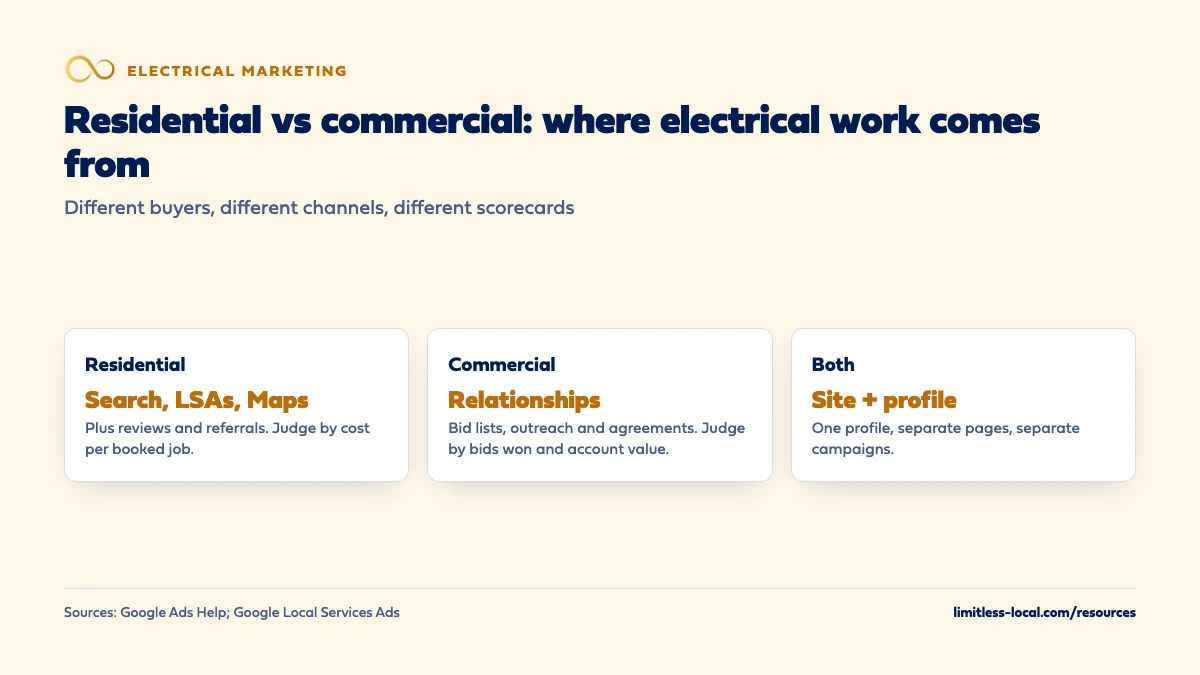
- Measure residential by cost per booked job and commercial by bids won and account value.
For electrical contractors who do both kinds of work, or are deciding which to grow, and want to know where each kind of customer actually comes from.
Get a free visibility audit · Book a growth call
How should residential and commercial electrical marketing use different channels?
Residential electrical work comes mostly from channels homeowners use when they need help: Google search ads, Local Services Ads, the Google map pack, reviews, your website and referrals from past customers. Commercial work comes mostly from relationships with the people who award it, such as general contractors, property managers and facility managers, through bid lists, direct outreach and maintenance agreements, with a narrow commercial search campaign catching emergencies. A shop that does both should keep the two separate in its ads, pages and tracking, and judge residential by cost per booked job and commercial by bids won and account value.
Which channels a package includes matters more for a mixed shop than for most: our packages page lays out what each tier covers, from Google Ads to Local Services Ads. Our electrical contractor marketing page explains how we approach the service-versus-project balance, and the electrical marketing questions library covers each channel in its own answer.
Why do residential and commercial electricians need different channels?
Because the buyer finds you in a different way. A homeowner with a tripping breaker searches Google, looks at the map, reads a few reviews and calls whoever looks trustworthy and answers. A property manager, facility manager or general contractor usually already has a list of electricians, and new names get onto that list through relationships, prequalification and a track record. The same Google ad that fills a residential schedule may barely touch the second group.
In our judgement, the biggest mistake mixed shops make is running one set of marketing for both and wondering why commercial work doesn’t come in. The detail on who awards commercial work and how to get in front of them is in marketing to commercial customers; this page is about where to put your channels, budget and time for each side.
Which channels work best for residential electrical work?
In our judgement, these carry most residential electrical work, roughly in this order of how quickly they can produce calls:
- Google search ads for the jobs and towns you want, which can bring calls soon after launch.
- Local Services Ads, where you pay per lead rather than per click.
- Your Google Business Profile and the map pack, which take longer to build but keep producing calls without a click cost.
- Reviews, which homeowners read before they call.
- Your website, with a page for each main service, because ads and your profile both send people there.
- Past customers and referrals, which cost the least and convert the best.
Search ads and LSAs answer demand that already exists. The profile, reviews and website make every other channel work better. Past customers are the cheapest jobs you’ll book.
Are Local Services Ads a residential or commercial channel?
Mostly residential, in our judgement. Google’s Local Services Ads page lists electricians among its eligible home services and says advertisers pay only when potential customers get in touch, not for clicks. Google is moving these ads into Google Ads as Performance Max campaigns with pay-per-lead goals, with electrical among the first industries in the August 2026 phase. Google says the campaigns stay keywordless, with targeting based on the service categories and areas you offer, and continue to show only on Google Search and Maps.
That setup suits a homeowner looking for an electrician today. It gives you little control over reaching a facility manager or a general contractor, so in our judgement don’t count on LSAs to grow commercial work. Check which job types your own account offers. Whether LSAs are worth it covers the residential case in full.
Which channels work best for commercial electrical work?
In our judgement, commercial work is won mostly by people and paperwork, not ads:
- General contractor bid lists, which is where most tenant build-out and new construction work is decided.
- Direct outreach to property managers, facility managers and business owners in your area, a list short enough to name.
- Maintenance and service agreements, which turn one-off calls into steady accounts.
- A narrow commercial search campaign for emergency and project terms, for buyers who don’t have an electrician yet.
- Your website and Google profile, showing commercial jobs clearly, because buyers check you out before they put you on a list.
The cost here is mostly the owner’s or an estimator’s time rather than ad spend. Getting steady work from general contractors covers the relationship side.
Can one Google Ads account serve both residential and commercial?
Yes, but not one campaign. Run residential and commercial work as separate campaigns, each with its own keywords, budget, ads and landing page, so you can see what each one costs and keep one from eating the other’s budget. Google’s guide to choosing a campaign type describes Search campaigns as text ads on search results, which suit both sides, while Performance Max reaches all Google Ads inventory from one campaign.
Use negative keywords to keep the two apart. Google says negative keywords let you exclude search terms from a campaign, and suggests looking for terms that are similar to your keywords but come from people looking for something else. In practice, that can mean adding residential terms like “ceiling fan” or “house” as negatives on the commercial campaign. Google also notes that negative keywords don’t match close variants, so add plurals and synonyms yourself. The negative keywords to add first has a starting list.
Curious what your marketing is actually booking?
Get a free visibility audit — no obligation, no sales pitch.
Can one website and Google profile serve both?
A website can, if it has separate pages for each side. A homeowner looking for a panel upgrade and a facility manager looking for a commercial service partner want different proof: one wants reviews and clear prices or estimates, the other wants project photos, the types of buildings you work in, licensing and insurance details, and how fast you respond. In our judgement, a clear residential section and a clear commercial section, each linked from the main menu, works better than one page trying to speak to both.
Your Google profile is one listing, so it has to cover both. Google lets you list services on your Business Profile, including custom services with descriptions, so add commercial services by name alongside residential ones, and add photos of both kinds of work. Google rejects custom service names that include prices or phone numbers.
How should I split my budget between residential and commercial?
Start from where each side spends. Residential growth mostly costs ad money: clicks, leads and the management to run them. Commercial growth mostly costs time: walking job sites, meeting general contractors, preparing bids and following up. In our judgement, a mixed shop should budget ad dollars mainly toward residential and the narrow commercial search campaign, and budget hours, not just dollars, toward commercial relationships.
Then let results move the split. If commercial search produces a few good calls a month at a reasonable cost, keep it. If it mostly produces homeowners, tighten the negatives or cut it and put the hours into outreach. How much to spend on marketing covers the overall budget.
Should I focus on residential, commercial or emergency work?
It depends on your crews, your cash flow and what you want the business to look like, and in our judgement there’s no single right answer. Residential work usually means more, smaller jobs, quicker payment and steady demand from search. Commercial work usually means fewer, bigger jobs, longer sales cycles, bids you’ll lose, and payment terms that can stretch your cash. Emergency work runs across both and rewards whoever answers the phone first, day or night.
A few questions help decide. Do you have the crew size, insurance and estimating capacity that commercial jobs need? Can you carry the cash while you wait to be paid? Who will build the relationships? If the honest answer is no, grow residential first and let commercial come from the residential customers who own businesses.

How do I check demand for residential vs commercial terms?
Use Keyword Planner on both sets of terms in your service area, such as “electrician near me” and “panel upgrade” on one side and “commercial electrician” and “tenant improvement electrician” on the other. It shows estimated monthly searches and what it costs to show your ad, and Google notes that results also depend on bid, budget, ad quality and location targeting. Keywords with very low search volume can’t be forecast.
In our judgement, most markets will show far more residential searches than commercial ones. That doesn’t mean commercial work is smaller; it means less of it starts with a search. Low commercial search numbers are a reason to lean on relationships, not a reason to skip commercial work.
Does direct mail work for either side?
It can for residential work tied to a place, such as older neighborhoods or new subdivisions. The Postal Service’s Every Door Direct Mail tool lets you map ZIP codes and carrier routes and filter routes using categories that include Residential and Total, along with age, household size and income from Census data. That’s built for reaching households on a route.
For commercial buyers, in our judgement, a mailer to every door is a weak fit. The list of people who award commercial electrical work in your area is short enough to reach by name, and a personal letter, a call or a visit with your prequalification packet will do more than a postcard.
How do I measure each side?
Use different scorecards. Residential: cost per booked job by channel, and how many calls turn into booked jobs. Commercial: bid invitations received, bids won, the value of each account over a year, and how many service calls each account brings. A commercial campaign with a high cost per lead can still be the best money you spend if one lead becomes a property manager with a dozen buildings. Set up job types and lead sources so the two never blur together; tracking which marketing brings real jobs covers the setup.
Not sure which of these is costing you jobs?
A free visibility audit checks the Google profile, reviews, site and tracking, and shows what to fix first.
What's different for electrical contractors who do both
The same crew, two kinds of buyer. Many electrical shops run residential service calls and commercial jobs from the same office and trucks. That makes it easy to blend the marketing, and blending is what hides which side is working.
Commercial buyers check credentials. Licensing, insurance and safety records come up before price for many commercial buyers. Put them where a buyer can find them, on the commercial pages and in the packet you hand over.
Residential customers own businesses too. Some of the best commercial accounts start with a homeowner who runs a shop or manages a building. Ask residential customers what they do; it costs nothing.
A worked example: one month in a mixed shop
These numbers are made up to show the math, not a benchmark for your market. Say a mixed shop spends $2,000 on residential search ads and gets 40 leads, of which 16 become booked jobs. Each residential job cost $2,000 divided by 16, or $125 to book.
The same month it spends $500 on a narrow commercial search campaign and gets 4 calls; one becomes a service account with a small property manager. The owner also spends a few hours a week visiting general contractors, which brings 2 bid invitations and one win. Judged by cost per lead, the commercial side looks expensive. Judged by account value and bids won, it may be the best month the shop has had.
For reference on what a package covers: our Essentials package is $3,500 a month and includes Google Ads management for up to $2,500 a month in ad spend, but not Local Services Ads or Meta. Growth is $4,500 a month and adds Local Services Ads management, Meta remarketing and Google Ads management for up to $5,000 a month in ad spend. Ad spend is paid to Google separately. A free visibility audit shows how both kinds of search look in your towns.
Frequently asked questions
Do Local Services Ads work for commercial electrical jobs?
In our judgement, rarely. Google lists electricians among its eligible home services and targets these ads by service category and area, which suits homeowners. Check which job types your account offers.
Should residential and commercial work share one Google Ads campaign?
No. Separate campaigns with their own keywords, budgets and landing pages let you see what each costs. Use negative keywords to keep homeowner searches out of the commercial campaign.
Do I need separate Google Business Profiles for residential and commercial?
Usually not; it’s one business. List both residential and commercial services on the profile and show photos of both kinds of work.
Is commercial electrical work worth it if Keyword Planner shows few searches?
It can be. Much commercial work is awarded through bid lists and relationships, not search, so low search numbers mean you lean on outreach, not that the work isn’t there.
Which side should a new electrical contractor start with?
In our judgement, usually residential, because search brings calls sooner and the jobs pay faster. Add commercial as your crew, insurance and estimating capacity grow.
Can Meta ads help with commercial electrical work?
In our judgement, they fit residential remarketing better. Commercial buyers are a short list better reached by name through outreach and relationships.
Key takeaways
- Residential work comes mostly from search ads, LSAs, the map pack, reviews, your website and past customers.
- Commercial work comes mostly from relationships, bid lists, outreach and maintenance agreements, plus narrow commercial search.
- Keep the two sides in separate campaigns and pages, with negative keywords between them.
- Spend ad dollars mostly on residential and owner time mostly on commercial relationships.
- Measure residential by cost per booked job and commercial by bids won and account value.
Want a second set of eyes on your setup?
We'll look at how you show up locally and where calls are leaking, then send you a plain-English breakdown.
More in this section
- How should an electrical contractor market to commercial customers?
- What Google Ads campaigns work best for electricians?
- Which Google Business Profile categories should an electrician choose?
- How can I get general contractors to send me steady electrical work?
- How should an electrician market lighting upgrades and LED retrofits?
Sources
- Reach Local Customers with Local Service Ads — Google
- Local Services Ads transition to Performance Max campaigns with pay-per-lead goals — Google Ads Help
- Choose the right campaign type — Google Ads Help
- About negative keywords — Google Ads Help
- Use Keyword Planner — Google Ads Help
- Manage your services on your Business Profile — Google Business Profile Help
- Every Door Direct Mail (EDDM) — United States Postal Service