
Which GBP categories should a restoration company pick?

- What Google categories should my restoration company use for water, fire, mold and sewage work?
- What's the difference between a primary and an additional category?
- Which primary category should a restoration company pick?
- What if most of my work is fire or mold, not water?
- Which additional categories fit a restoration company?
- Should I pick categories just because they contain the word "restoration"?
- Where do mold, sewage, odor and contents jobs go if not in categories?
- Will changing my categories knock me out of Maps?
- Why did Google change my restoration category without asking?
- Do my Google categories decide which Local Services Ads leads I get?
- How do I know if my categories are pulling the right calls?
- What's different about Google categories for restoration companies
- A worked example: a carpet cleaner that became a restoration company
- Frequently asked questions
- Key takeaways
- More in this section
- Sources
The short version
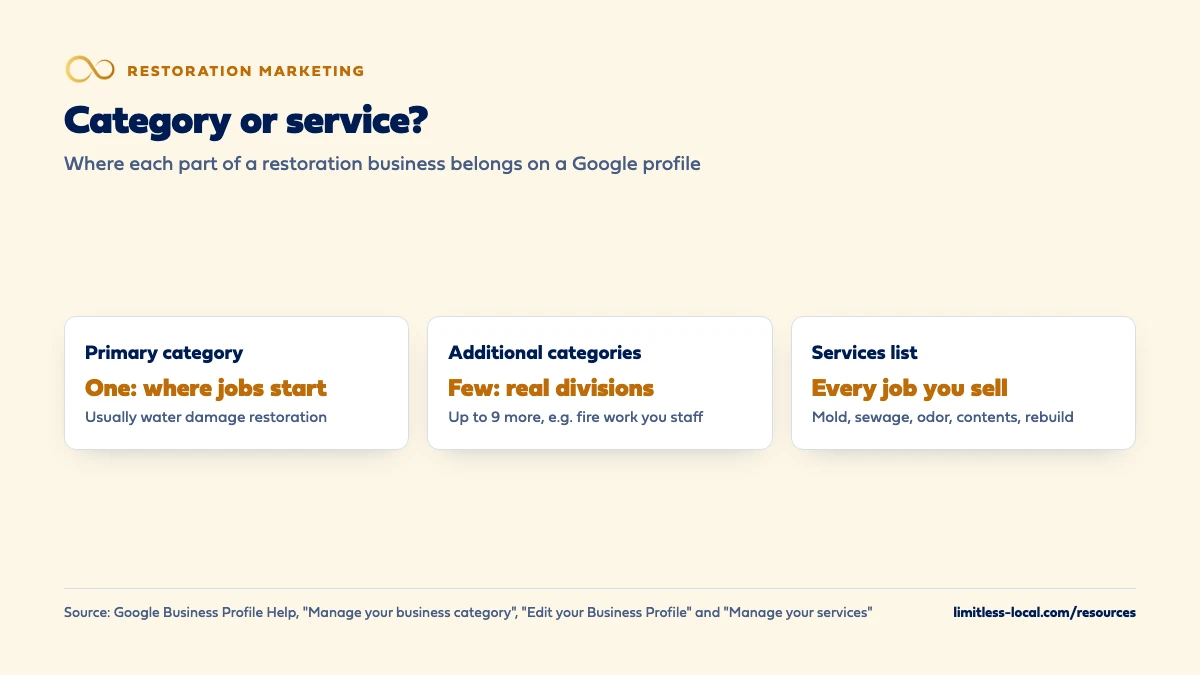
- Primary category: the work most of your jobs start with, usually water damage.
- Additional categories: only real divisions, such as fire work you staff and sell.
- Mold, sewage, odor, contents and rebuild jobs go in the services list.
- Never pick a category just because its name contains "restoration".
- Change categories one at a time, and not in the middle of a storm.
For restoration owners setting or fixing the categories on their Google Business Profile, and deciding what goes in a category and what goes in the services list.
Get a free visibility audit · Book a growth call
What Google categories should my restoration company use for water, fire, mold and sewage work?
For most restoration companies, the primary category should describe where most jobs begin, which in many shops means a water damage restoration category; a fire damage restoration category earns a place as an additional category only when fire and smoke work is a real, staffed part of the business. Mold, sewage, contents, odor and rebuild work usually belong in the services list unless Google’s live category list has a category that truly describes a real division of the business. Google says categories affect local ranking and that editing them can mean verifying again, so choose deliberately and change one thing at a time.
Categories are one of the first settings we check in the Google Business Profile management that’s part of our local SEO work for restoration companies, because a wrong one quietly sends the wrong calls. The restoration marketing guide covers how the profile and the map pack fit with ads, your website and follow-up, and the restoration marketing questions library takes the rest one question at a time.
What's the difference between a primary and an additional category?
Your primary category is the category in the first field, and Google asks that it be the one that best describes what your business does. You can select up to 9 more as additional categories. Google says the categories you select affect your local ranking on Google and help connect you with customers searching for what you offer.
Google’s own test for any category is whether it completes the sentence “This business is a” rather than “this business has a”. The goal, in Google’s words, is to describe the business as a whole, not to list every service it offers. It also says to use as few categories as possible to describe your overall core business. Sources: Edit your Business Profile, Manage your business category and Guidelines for representing your business on Google.
Which primary category should a restoration company pick?
Google asks for the most specific category that still represents your main business, picked from its list. You can’t create your own; if the exact one isn’t there, you choose a more general one.
When we pulled the Google profiles of restoration companies in four metro areas (Austin, Denver, Houston and Atlanta, October 2026), the primary category that came up far more than any other was Water damage restoration service. The next most common choices were a fire damage restoration category and a building restoration category, with a scattering of construction, carpet cleaning and contractor categories. That’s an observation from one sample, not a list Google publishes, and Google’s list changes, so type “water damage”, “fire damage” and “restoration” into the category box and see exactly what it offers you.
In our judgement, the right primary category is the work most of your jobs start with. For most restoration shops that’s water: burst pipes, appliance leaks, flooded basements. A fire or mold job may be bigger, but if most of your calls begin as water, a water damage category describes the business best. Sources: Manage your business category and Guidelines for representing your business on Google.
What if most of my work is fire or mold, not water?
Then the primary category should say so. A company built around fire and smoke work, with the crews, cleaning equipment and contents processing to match, is describing itself accurately with a fire damage restoration category up front and water as an additional category if it does water too.
Mold is harder, because in our sample we didn’t see a mold-specific category on any restoration profile. Type “mold” into the category box: if your country’s list offers a category that truly describes a mold remediation business and that’s most of your work, it’s a candidate. If the list doesn’t, Google’s rule is to choose a more general category that still describes you, and to put mold remediation in your services list, where it can still be matched to searches.
Either way, your website should tell the same story, in our view. If it lacks proper fire or mold pages, covering mold and fire on your website walks through what those pages need.
Which additional categories fit a restoration company?
Google says to add additional categories for real departments or parts of the business, not for every product or service. Its example is a grocery store with a bakery and deli: grocery store first, bakery and deli as additional categories. For restoration, that means a short list. These are categories we saw in our sample (confirm the wording in the category box); in our judgement each is worth adding only if it’s true:
- Fire damage restoration service, if your primary is water and you really staff and sell fire and smoke work. It was the most common additional category we saw.
- Water damage restoration service, if your primary is fire and you also do water.
- Building restoration service, which showed up often. Google’s help pages don’t define it, so add it only if it honestly describes a line of work you run, such as reconstruction after a loss.
- General contractor or a remodeling category, only if you run a real rebuild division that takes jobs from demo through finish work.
- Carpet cleaning service or Air duct cleaning service, only if those are lines of work you sell on their own, not just something your crew does during a water job.
Anything beyond that probably belongs in the services list. Sources: Manage your business category and Guidelines for representing your business on Google.
Curious what your marketing is actually booking?
Get a free visibility audit — no obligation, no sales pitch.
Should I pick categories just because they contain the word "restoration"?
No, and this is the trap that’s easiest to fall into in this trade. Google’s list has categories with “restoration” in the name that describe entirely different businesses. In our sample we found restoration companies listing categories such as art, doll and photo restoration services. Those describe people who restore paintings, dolls and old photographs, not water and fire work.
Google’s rules are direct: don’t use categories solely as keywords or to describe attributes of your business, and don’t use categories that belong to other nearby or related businesses. The same goes for categories that sound close to restoration work but describe a different trade. Sewage disposal, septic and drainage categories also turned up on a few profiles in our sample; in our judgement those describe businesses that pump, haul or install systems, not companies that clean up a sewage backup inside a home.
Google also says it can detect category information from your website and from mentions of your business across the web. Our view: a category nothing else supports doesn’t buy reach; it brings calls for work you don’t do. Sources: Guidelines for representing your business on Google and Edit your Business Profile.
Where do mold, sewage, odor and contents jobs go if not in categories?
Into your services list. Google says that when a local customer searches for a service you offer, that service may be highlighted on your profile, and Maps users can see your full list under Services. The services editor suggests options for your business type, lets you add custom services, and lets you group services under each of your categories with a description.
A full restoration list might include water extraction, structural drying, sewage backup cleanup, mold remediation, fire and smoke cleanup, odor removal, contents pack-out and cleaning, board-up and tarping, and reconstruction, if you do them. Give each one a plain sentence about what the job includes. Keep custom names clean: Google automatically rejects custom service names with prices, phone numbers, personal information, profanity or gibberish.
The rest of the profile, from service area to hours and phone number, is covered in optimizing your restoration Google profile. Source: Manage your services on your Business Profile.
Will changing my categories knock me out of Maps?
It can change where you show up, in either direction, because Google says categories affect local ranking. Two practical risks are worth planning around:
- Verifying again. Google says that if you add or edit a category, you might be asked to verify your business again.
- Review time. Edits to a verified profile are reviewed before they go live. Google says that usually takes up to 10 minutes but can take up to 30 days, and an edit may not be approved if Google can’t confirm it’s accurate.
So make the change once, from the Google Account that owns the profile, and leave the rest alone until it’s accepted. Write down your current categories first. If you change the category, the name and the service area in one sitting and calls drop, you won’t know which change did it. If you’ve already fallen out after an edit, getting back into the Map Pack walks through what to check. Sources: Manage your business category and Understand what happens to your Business Profile edits.

Why did Google change my restoration category without asking?
Google gathers business information from sources such as user reports and licensed content, and may update your profile if they say your info is wrong or outdated. In the profile editor, anything Google changed shows in blue, with a notification at the top of the page. For some suggested edits you get an email or in-product notice and have 4 days to accept or reject; if you don’t respond, Google may publish the change when other public information, such as your website, supports it.
In our judgement, the fix is to make the rest of the web agree with the category you chose. A restoration company that started as a carpet cleaner often still has a website and directory listings that say carpet cleaning; that mismatch is the first thing to fix. Then correct the category and reject suggested edits you disagree with. Source: Understand Google updates on your Business Profile.
Do my Google categories decide which Local Services Ads leads I get?
Not directly. In Local Services Ads you set your industries and job types inside the ads account, and adding a new industry sends you to business verification for that industry. Google also opts advertisers into their industry’s general category searches by default, which you can switch off with the broad search setting if you only want leads for specific job types.
So check both places. What verification involves for restoration is covered in getting verified for LSAs. Source: Edit your industries, service areas, and job types.
How do I know if my categories are pulling the right calls?
Open the Performance report in your profile and look at Searches, the search terms people used to find your business. Google says the list updates at the start of each month and that you can’t directly manage those queries. If it’s full of the jobs you want, such as water damage, flooded basement, fire damage or mold removal, your categories and services are pointing the right way. If it’s full of carpet cleaning, septic pumping or furniture repair, they aren’t.
Google also notes that performance data includes activity from both organic results and Google Ads, so account for ad changes. And restoration demand swings with storms and freezes, so compare the same months a year apart rather than one month to the next. Source: Understand your Business Profile performance & insights.
Want to see where your company stands?
A free visibility audit shows where you show up on Google, Maps and AI answers, and what it's costing you in calls.
What's different about Google categories for restoration companies
Don’t touch categories during a storm. In our judgement, adding a category to catch a freeze or hailstorm surge isn’t worth it: the edit can trigger verification and a review that may take weeks. Set categories in a quiet month.
One job leads to the next. A water job turns into a mold job and then a rebuild. That’s a reason to list all of that work as services, not to add a category for every step.
Rebuild divisions are real businesses. If you run reconstruction with its own crews and estimator, a contractor category can reflect it. If you hand rebuilds to a partner, leave it off.
Commercial work is a service, not a category. Large-loss and commercial drying usually belong in the services list and on your website; marketing to commercial properties covers the rest.
A worked example: a carpet cleaner that became a restoration company
This is an illustration with made-up details, not a real client. Say a company started as a carpet cleaner, added water extraction, and now does mostly water jobs plus some fire and mold. Its profile still has Carpet cleaning service as the primary category, with additional categories for upholstery cleaning, photo restoration, septic system service and general contractor. Its Searches list is full of rug cleaning, and the office turns away septic calls.
The cleanup: Water damage restoration service as the primary category, because water is where most jobs start. Fire damage restoration service as an additional category, because the company staffs fire jobs. Carpet cleaning service stays as an additional category only because the company still sells it on its own. Photo restoration and septic come off, and general contractor comes off because rebuilds go to a partner. Mold remediation, sewage backup cleanup, odor removal and contents cleaning go into the services list, each with a one-line description. The change is made once, in a quiet month.
Then the check: compare the Searches list for the same month a year apart and count how many terms are for jobs the company sells. That’s the measure, not a promise of a ranking change. Google Business Profile management, including categories and services, is part of our Essentials package at $3,500 a month.
Frequently asked questions
Can I create my own category, like "Flood cleanup company"?
No. Google says you can’t create your own category; choose from its list, and if the exact one isn’t there, pick a more general one. Put specific jobs in the services list. Source: Manage your business category.
Should I copy the categories of the restoration company that ranks first?
Their profile shows you what’s in Google’s list for your trade, which is useful. Copy the idea, not the list: if they carry categories for work you don’t do, those are wrong for you.
Will extra categories get my restoration profile suspended?
Google doesn’t say extra categories alone cause a suspension, but its guidelines ask for as few categories as possible and none used as keywords. Staying inside those rules is the safer habit. Source: Guidelines for representing your business on Google.
Can I appeal if Google rejects my category change?
Google says you might be able to appeal a rejected business information edit. Check the edit status first, and make sure your website supports the category before you appeal. Source: Understand what happens to your Business Profile edits.
Should every location of a multi-location restoration company use the same primary category?
Yes, if they do the same work. Google says all locations of a business must share the one category that best represents the business. Additional categories can differ where locations really do different work. Source: Guidelines for representing your business on Google.
Key takeaways
- Make the primary category the work most of your jobs start with; for most shops that’s water damage.
- Add categories only for real, staffed divisions, such as fire work or a rebuild crew.
- Put mold, sewage, odor, contents and rebuild jobs in the services list with plain descriptions.
- Ignore categories that merely contain “restoration” or sound close, like photo restoration or septic service.
- Change categories once, in a quiet month, and judge them by the Searches list year over year.
Not sure what's working right now?
Start with a free visibility audit: rankings, Google profile, reviews and tracking, checked against your service area.
More in this section
- What is a good cost per booked job for a restoration company?
- What do property managers look for in a restoration vendor?
- How should a restoration company market to commercial properties?
- How should a restoration company run Google Ads for fire damage?
- Should a restoration company run Google Ads, LSAs or both?
Sources
- Manage your business category — Google Business Profile Help
- Guidelines for representing your business on Google — Google Business Profile Help
- Edit your Business Profile — Google Business Profile Help
- Manage your services on your Business Profile — Google Business Profile Help
- Understand what happens to your Business Profile edits — Google Business Profile Help
- Understand Google updates on your Business Profile — Google Business Profile Help
- Edit your industries, service areas, and job types — Local Services Help
- Understand your Business Profile performance & insights — Google Business Profile Help