
How many water damage jobs a month do I need to hit my revenue goal?
- How many new water damage jobs and leads does a restoration company need each month to reach its revenue goal?
- Why work backward from a revenue goal instead of a marketing budget?
- Step 1: How much of my revenue goal has to come from marketing?
- Step 2: What is one water damage job actually worth to me?
- Step 3: How many signed jobs does that revenue take?
- Step 4: How many inspections do I need to sign that many jobs?
- Step 5: How many real leads turn into that many inspections?
- Step 6: How many total calls should I expect to get?
- Step 7: What should those calls cost me?
- Can my crews and equipment handle that many jobs?
- When will the revenue from those jobs actually show up?
- What if the math says my goal isn't realistic?
- What's different about this math for restoration companies
- A worked example: from a revenue goal to a monthly call target
- Frequently asked questions
- Key takeaways
- More in this section
- Sources
The short version
- Take out program, referral and repeat work first; plan only what marketing has to win.
- Use the average collected per job, not the estimate or the first invoice.
- Work back through signing rate, inspection rate and junk calls to a call target.
- Judge the plan on cost per signed job, then check crews can handle the volume.
For restoration owners who want a monthly job and call target they can plan crews and budget around, instead of a number that just feels right.
Get a free visibility audit · Book a growth call
How many new water damage jobs and leads does a restoration company need each month to reach its revenue goal?
Divide the revenue your marketing has to win each month by the average amount you collect on a water damage job to get the signed jobs you need. Divide that by your signing rate to get inspections, divide inspections by the share of real leads you get a crew out to, and divide again by the share of calls that are real to get the calls you need. Multiply calls by your cost per call to see what the plan should cost, and use your own job records at every step, because national averages won’t match your market.
Working backward like this only works if the inputs are real. Every one of our packages includes call tracking, source tagging and monthly reports with a cost-per-lead breakdown, which is where the inputs for this math come from, and our restoration marketing page covers what we offer restoration companies. For what water damage leads cost and whether to buy them, see the guide to water damage leads, and the rest of the restoration marketing questions library goes question by question.
Why work backward from a revenue goal instead of a marketing budget?
Because a budget on its own doesn’t tell you whether it’s enough. Working backward flips the order: you start with the revenue you need, and each step tells you how many signed jobs, inspections and calls it takes to get there. The last step tells you roughly what those calls should cost.
It’s the same thinking behind the break-even analysis the U.S. Small Business Administration describes in its guide to calculating startup costs: the SBA says setting revenue targets this way helps limit business decisions made on emotions. That matters in restoration, where one storm week can make any budget look brilliant and one dry month can make the same budget look like a waste.
Step 1: How much of my revenue goal has to come from marketing?
Start with a monthly water damage revenue goal, then take out the work that arrives whether or not you market:
- Program and TPA assignments you expect from insurance or third-party programs.
- Referral partners: plumbers, agents, property managers and adjusters who already send you jobs.
- Repeat and commercial accounts that call you every time.
- Rebuild and mold work that follows your own mitigation jobs.
What’s left is the revenue your marketing has to win from customers who don’t know you yet. Use your last twelve months of job records to estimate each piece, and be conservative; program volume in particular can move without warning. If you’re weighing how much to lean on program work at all, TPA work versus your own leads covers that trade-off.
Set the goal by month, not by year. A restoration company’s year isn’t flat, and a goal that ignores freeze season or storm season will be wrong in both directions.
Step 2: What is one water damage job actually worth to me?
Use the average amount collected on a water mitigation job from a new customer, not the estimate and not the first invoice. In restoration the three can be far apart: scope changes after the adjuster visits, some balances are paid late or in pieces, and some never get paid in full. Collected is the only number that’s revenue.
Check how your software counts it before you trust a report. Jobber’s Lead Source Report, for example, shows the value of the first invoice linked to each lead, on purpose. If you bill mitigation and rebuild separately, that column may show only part of what the customer was worth, so pull the full job totals yourself.
Keep mitigation, mold and rebuild as separate averages if you can. In our judgement it’s cleaner to plan the goal on mitigation jobs and treat the rebuild work they lead to as part of Step 1, because not every mitigation customer hires you for the rebuild.
Step 3: How many signed jobs does that revenue take?
Divide the revenue marketing has to win by your average collected value per job. The answer is the number of signed water damage jobs you need in a month.
Define “signed” once and use it everywhere. For most restoration companies, the cleanest line is a signed work authorization: the property owner has agreed to the work and you’re on site or scheduled. A call isn’t a job, and neither is an inspection that ends with “we’ll call you back.” If your office counts one way and your reports count another, every number after this step will drift.
Step 4: How many inspections do I need to sign that many jobs?
Divide the signed jobs you need by your signing rate: signed jobs divided by the inspections or site visits you ran. If half of your inspections sign, every signed job takes two inspections on the schedule.
Pull the rate from the last few months of your own records, and split it by source if you can. In our judgement, a homeowner who called you directly from a Google search and an occupant who found you through a property manager can sign at very different rates, and a blended number hides that.
Your signing rate is also where the people on your trucks show up in the math. How quickly the crew arrives, how clearly they explain the drying plan and the paperwork, and whether someone follows up on an inspection that didn’t sign all move this number, without spending another dollar on ads.
Curious what your marketing is actually booking?
Get a free visibility audit — no obligation, no sales pitch.
Step 5: How many real leads turn into that many inspections?
Divide the inspections you need by your inspection rate: the share of real, in-area leads that end up with a crew at the door. If your office gets an inspection on the calendar for half the real leads it gets, you need twice as many real leads as inspections.
This is the step most owners have never measured, and in our view it’s often the cheapest one to improve. A water damage caller who reaches voicemail at night usually calls the next company on the list. Call recordings and your job records will tell you where you stand, and how fast to answer emergency calls covers the part of this step that sits with your team.
Step 6: How many total calls should I expect to get?
Restoration ads and listings pull in calls that aren’t customers: people far outside your service area, people looking for disaster-aid or insurance answers, requests for work you don’t do, sales calls and job seekers. Count them, then divide the real leads you need by the share of calls that are real. If one call in five is junk, you need 100 calls to get 80 real ones.
How much of that junk you pay for depends on the channel. On Local Services Ads, Google charges for valid leads and says lead prices may vary with your location, the job type, the type of lead and your bidding. On regular Google Ads you pay for clicks, so junk calls cost you whatever the clicks behind them cost.
Step 7: What should those calls cost me?
Multiply the calls you need by what a call costs you on each channel, then divide the total by your signed jobs. That last number, cost per signed job, is the one to judge marketing by, and it should be comfortably below what a job is worth to you after the cost of doing the work.
If you’ve been tracking, you already have your cost per lead. If you haven’t, Google’s Keyword Planner forecasts estimate clicks and cost for a set of keywords; Google says forecasts take your bid, budget, seasonality and historical ad quality into account. Treat them as a starting estimate and replace them with your own numbers after a month or two.
What counts as a reasonable cost per signed job depends on your job values and margins, which a good cost per booked job works through. Whether to buy leads from a lead seller instead of generating your own is a separate question, covered in the guide to water damage leads.

Can my crews and equipment handle that many jobs?
Check before you buy the calls. Water mitigation ties up people and drying equipment for days at a time, so count how many jobs your techs and your dehumidifiers and air movers can run at once, and how many you can start in a week. If the plan needs more signed jobs than you can staff, extra marketing turns into calls you can’t take, slow arrivals and reviews you don’t want.
Avoiding paying for more leads than your crews can handle covers how to turn spend up and down with the schedule.
When will the revenue from those jobs actually show up?
Later than the jobs do. Insurance-paid work can be invoiced weeks after the drying is done and paid weeks after that, so a month that hits its signed-job target can still look thin in the bank. Plan cash and plan marketing separately: judge marketing on signed jobs in the month the leads came in, and fill in the collected value as payments arrive.
Each channel also has its own ramp. Ads can generate leads within days of launch; SEO typically takes 3-6 months to show meaningful organic growth, and nobody can honestly promise a date for either. If your plan leans on organic calls, give it that long before you decide it isn’t working. Tracking which marketing brings in booked jobs shows how to keep the lead source on the job until the last payment lands.
What if the math says my goal isn't realistic?
Change an input before you change the budget. In our judgement there are four levers, roughly in order of cost:
- Inspection rate. Answering every call, day and night, and getting a crew out fast costs less than buying more calls.
- Signing rate. Better follow-up on inspections that didn’t sign turns calls you already paid for into jobs.
- Relationships. Plumbers, property managers and agents who send work lower what marketing has to carry in Step 1.
- Call volume. More channels or a bigger budget, once the first three are working.
The SBA’s advice on marketing budgets adds a warning that fits a slow restoration month: cutting marketing because sales are down can push sales down further. If the plan doesn’t work at today’s numbers, fix the inputs you control first. Building a referral network with plumbers and property managers covers the third lever.
Talk it through with someone who runs this every day
A 15-minute growth call: your market, your numbers, and what a realistic budget looks like. No pressure.
What's different about this math for restoration companies
Weather sets the volume. A freeze or a storm can bring more calls in a week than a normal month. Plan a normal month and a storm month separately, and don’t let a storm month reset what you think your marketing produces.
Job values swing widely. A small supply-line leak and a whole-floor flood each count as one signed job. A few large losses can carry a month, so look at averages over several months before you set the value in Step 2.
Mitigation often leads to more work. Rebuild, contents and mold work can follow a water job. Count that follow-on revenue where it actually comes from, so marketing isn’t asked to win it twice.
Cash lags the work. Insurance payments arrive late and sometimes in pieces. This is general planning guidance, not insurance or financial advice; your accountant can help you plan cash around it.
A worked example: from a revenue goal to a monthly call target
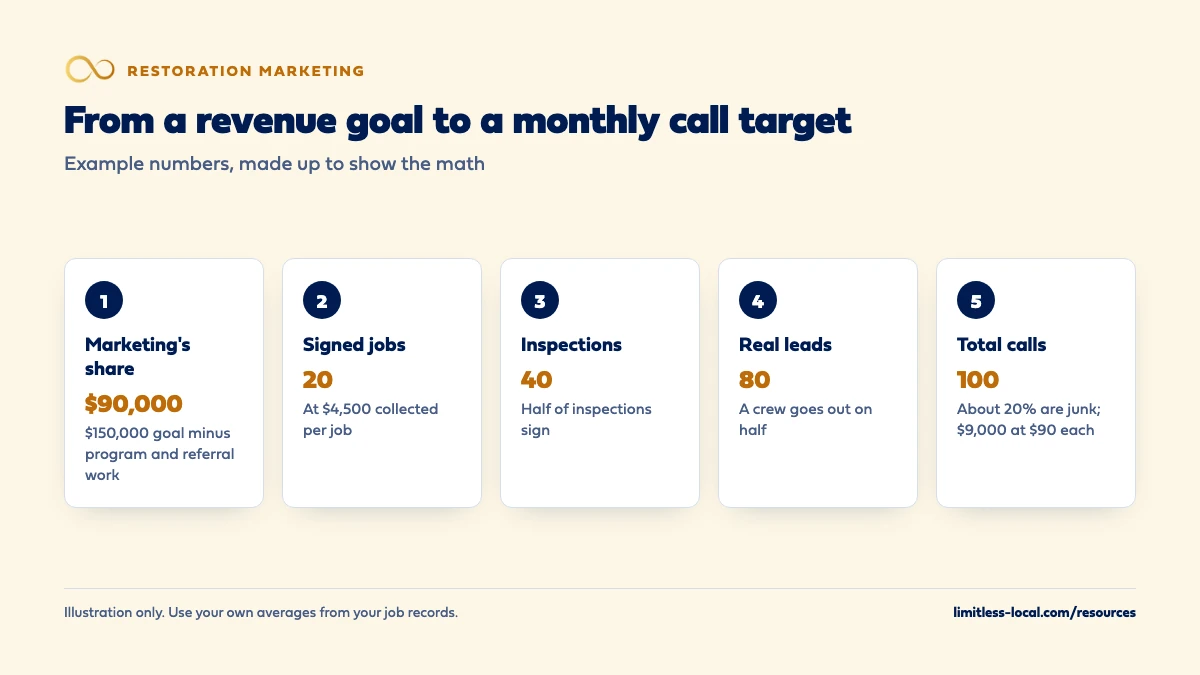
These numbers are made up to show the math, not a benchmark for your market. Say a restoration company wants $150,000 a month in water damage revenue. It expects about $60,000 of that from program work, referral partners and repeat accounts, so marketing has to win the other $90,000 from new customers.
- Signed jobs. At an average of $4,500 collected per mitigation job, $90,000 takes 20 signed jobs.
- Inspections. Half of its inspections sign, so 20 jobs take 40 inspections.
- Real leads. It gets a crew out on half of its real leads, so 40 inspections take 80 real leads.
- Total calls. About 20% of its calls are out of area, information seekers or wrong-service, so 80 real leads take 100 calls.
- Budget. At $90 per call, 100 calls cost $9,000 a month, or $450 per signed job: 10% of the $4,500 each job brings in.
Now improve one input. If faster answering at night lifts the inspection rate from half to two in three, the same 40 inspections take 60 real leads and 75 calls. At the same $90 per call that’s $6,750 a month, $2,250 less for the same 20 jobs on the schedule.
If you pay an agency, add its fee before you judge the result. Our Essentials package is $3,500 a month with ad spend paid to Google separately, which would bring this example to $12,500 in total, or $625 per signed job. Whether that’s worth it comes down to the same math.
Frequently asked questions
Should mold and rebuild jobs count toward the same goal?
Plan them separately. Set the water mitigation goal on its own, and count rebuild and mold work that follows your own jobs as revenue you expect anyway, so marketing isn’t asked to win it twice. Mold-only calls that come in cold can get their own small plan.
What if I don't know my signing rate or inspection rate yet?
Use a cautious guess for a month or two and label it as a guess. Start recording every call, inspection and signed job with its source now, and replace the guesses with real rates as soon as you have them.
Should I plan on invoiced revenue or collected revenue?
Collected. Invoices on insurance-paid work can be reduced or paid late, so a plan built on invoices will tell you you’re on target when the bank says otherwise.
Will a bigger ad budget always bring more water damage jobs?
Not in a straight line. Only so many people in your service area have water in the basement in a given month, and Google’s forecasts change with your bid, budget and season. Past a point, more money buys pricier clicks, not proportionally more jobs.
How many calls a month is normal for a restoration company?
There’s no honest national number. It depends on your market size, your service area, the weather and how many companies compete for the same searches, which is why the plan starts from your own goal and your own rates.
Should the agency fee count in my cost per signed job?
Yes. Add every cost of getting the job: ad spend, management fees, call tracking and any lead purchases. Otherwise a channel can look cheaper than it is.
Key takeaways
- Start from the revenue marketing has to win, after program, referral, repeat and follow-on work.
- Use the average collected per water damage job, not the estimate or the first invoice.
- Work back through signing rate, inspection rate and junk calls to a monthly call target.
- Improving the inspection rate is usually cheaper than buying more calls.
- Check crew and equipment capacity before you buy the volume the plan calls for.
- Judge marketing on cost per signed job by lead month, and plan cash around slower insurance payments.
Ready to compare options?
Book a short growth call and we'll walk through the math for your service area, including when we're not the right fit.
More in this section
- Which Google Ads keywords should a water damage company target?
- What is a good cost per booked job for a restoration company?
- How do I keep marketing steady while hiring restoration techs?
- How do restoration companies get insurance-related water damage jobs?
- How do I rank in Google for water damage restoration in my city?
Sources
- Calculate your startup costs — U.S. Small Business Administration
- Break-even point calculator — U.S. Small Business Administration
- How to Get the Most From Your Marketing Budget — U.S. Small Business Administration
- Lead Source Report — Jobber Help Center
- About Keyword Planner forecasts — Google Ads Help
- How leads work — Google Local Services Help