
Do coupons and discounts attract good plumbing customers?
- Will running plumbing coupons bring in customers worth keeping?
- What kind of customer does a plumbing coupon attract?
- Which offers tend to bring better plumbing customers?
- When does a discount make sense for a plumbing company?
- When do coupons hurt a plumbing company?
- What are the rules for "was $X, now $Y" and percent-off offers?
- What are the rules for "free" offers?
- How do I keep a cheap drain special from looking like bait and switch?
- Where should I put a plumbing offer: ads, my Google profile or my website?
- Should I bid on "plumbing coupon" searches?
- How do I tell whether a coupon actually worked?
- What's different about coupons for plumbing companies
- A worked example: what a coupon really costs per booked job
- Frequently asked questions
- Key takeaways
- More in this section
- Sources
The short version
- Dollars-off coupons on common jobs mostly attract price-driven customers.
- Value-add offers (priority, credited service fees, memberships) tend to bring better ones.
- "Was/now" and "free" claims have FTC guides behind them; keep them honest.
- Judge any offer by booked revenue and repeat work, not call count.
For plumbing owners deciding whether to run a dollars-off coupon, which offer to put in their ads, and how to keep it honest.
Get a free visibility audit · Book a growth call
Will running plumbing coupons bring in customers worth keeping?
Sometimes, but a dollars-off coupon on a common job like drain cleaning mostly attracts people who are choosing on price, and they’re the least likely to stay loyal or book bigger work. Offers that add value without cutting your price, such as priority service, a clear service fee credited to the repair, or a first visit tied to a maintenance plan, tend to bring better customers. If you do discount, tie it to work you want, state the terms plainly, keep any “regular” or “free” claim honest under FTC guidance, and judge it by booked revenue, not call count.
Which offer goes in your ads, and whether it pays, is part of the Google Ads management in every one of our plumbing marketing packages, along with call and form tracking so you can see which offer booked which jobs. Ad spend is paid to Google directly, separate from the package. The rest of the plumbing marketing questions library covers the other pieces.
What kind of customer does a plumbing coupon attract?
Mostly people looking for a deal, which is what a coupon is built to do. Google describes its own promotion assets, the ad feature for showing discounts, as a way to highlight sales and promotions for people that are searching for the best deals. That’s not a bad audience by definition. Some first-time deal seekers become loyal customers once they see your work.
The trouble, in our judgement, is what happens next. A customer who chose you because of $40 off (an illustrative amount) is likely to choose the next plumber for $50 off. They’re less likely to pay for a bigger repair without shopping it, and less likely to join a membership. If most of your new customers arrive through a coupon, you’ve trained your market to wait for one.
Which offers tend to bring better plumbing customers?
Offers that give the customer more instead of charging them less. In our judgement, these attract homeowners who care about the result:
- Priority or same-day service, if you can deliver it. For an emergency, that’s worth more than a discount.
- A service fee credited to the repair. The customer pays to have the problem diagnosed and gets that amount back if they go ahead. It screens out people collecting free opinions and rewards those who book.
- A first visit tied to a maintenance plan. The offer brings in customers who want an ongoing relationship. Selling more maintenance memberships covers how to build the plan.
- Something added to a job you want more of, such as an extra check with every water heater install, instead of a price cut on the install itself.
- Discounts with a reason behind them, such as for seniors, veterans or returning customers, offered every day rather than as a flash sale.
When does a discount make sense for a plumbing company?
When it fills a gap you’d otherwise leave empty, and you know what it costs you. In our judgement, the honest cases are:
- Slow stretches. A short, dated offer on drain cleaning or water heater checks can keep trucks moving when the phone is quiet. Keeping calls coming in during slow months covers the other options.
- A new service area or a new company. An introductory offer can get people to try you, as long as you plan to end it. How a new plumbing company gets its first customers covers the rest of that start.
- Existing customers. A thank-you discount for a returning customer or a member costs less than winning a stranger, and it rewards the behavior you want.
What doesn’t make sense, in our view, is a permanent coupon on your most common job. At that point it’s your real price, with a worse story attached.
When do coupons hurt a plumbing company?
- When they fill the schedule with low tickets. A truck doing three discounted drain cleanings may be unavailable for the water heater replacement that calls at noon.
- When they set the customer’s idea of your price. After a cheap first visit, a full-price repair can feel like a markup even when it’s fair.
- When competitors match them. Every company in town running the same discount on the same job leaves price as the only difference, which is the opposite of what you want.
- When the techs feel the pressure. If a coupon job loses money unless something else is sold, a tech is pushed to upsell. That’s a bad experience for the customer and, as the next sections show, a legal risk.
If price-first callers are already a problem, stopping price shoppers covers the ad settings and call handling that make it worse.
Curious what your marketing is actually booking?
Get a free visibility audit — no obligation, no sales pitch.
What are the rules for "was $X, now $Y" and percent-off offers?
The FTC’s Guides Against Deceptive Pricing cover advertising a reduction from your own former price. The core rule is simple: the “before” price has to be real. The guide says a former price is a legitimate basis for a comparison if it’s the actual price at which the item was offered to the public on a regular basis for a reasonably substantial period of time. A price inflated just so you can advertise a big cut makes the bargain false.
The guide also says that when an ad doesn’t state the former price or the size of the cut, the reduction can’t be so small it’s meaningless; its example is “Reduced to $9.99” from a former price of $10. For a plumbing company, that means a “regularly $199, now $149” drain cleaning (made-up prices, for illustration only) only works if you actually charge $199 for that job in the normal course of business. The FTC’s advertising FAQ also notes that every state has consumer protection laws that govern ads running there. This is general guidance, not legal advice.
What are the rules for "free" offers?
The FTC’s guide on the word “free” says such offers must be made with extreme care so consumers aren’t misled. A few points from it matter for plumbers:
- Free means free. When something is free with a purchase, the customer should pay nothing for it and no more than the regular price for the other service. Quietly raising the price of the paid job to cover the free one breaks that.
- Terms up front. All conditions should appear clearly at the outset of the offer, not in a footnote marked with an asterisk.
- Not forever. The guide says a single kind of service shouldn’t be advertised with a free offer in a trade area for more than six months in any 12-month period, with at least 30 days between such offers and no more than three in the same area in any 12-month period.
- Renaming doesn’t help. Calling it a “gift” or a “bonus” doesn’t fix an offer that would be deceptive as “free”.
A “free camera inspection with any drain cleaning” can be fine if the drain cleaning is at your regular price and the terms sit right next to the offer. This is general guidance, not legal advice.
How do I keep a cheap drain special from looking like bait and switch?
The FTC’s advertising FAQ defines bait and switch as advertising a product the company has no intention of selling, planning instead to sell the consumer something else, usually at a higher price, and says it’s illegal. A low-priced drain special that techs are expected to turn into something more expensive on every call is the plumbing version of the risk.
In our judgement, a few habits keep a special honest and keep customers’ trust:
- Do the advertised job at the advertised price whenever it fits the problem.
- Say in the offer what it covers, such as one accessible drain and the line length or access limits you use.
- If the job really needs more, show the customer why, with photos or a camera view, and give a written price before doing anything beyond the special.
- Don’t pay techs in a way that only works if every special becomes an upsell.
Where should I put a plumbing offer: ads, my Google profile or my website?
Each has its own tool:
- Google Ads. Promotion assets let you show a monetary or percentage discount under your ad, with requirements such as a code or spending limit and the dates the promotion runs.
- Your Google Business Profile. Google lets you create an offer post with a title and dates, and you can add a description, photo, coupon code, link, and terms and conditions.
- Your website. A page for the offer with the full terms, so ads and posts have somewhere to point.
Keep the website current. Google says its automated promotions feature sources deals and offers from your website and other sources and shows them in Search and Performance Max campaigns that use location assets. In our judgement, that’s a reason to take expired coupons down rather than leave them sitting on an old page.
Should I bid on "plumbing coupon" searches?
Usually not, unless you’re running a coupon on purpose and want those callers. Someone typing “coupon” or “cheap plumber” has told you what they care about before seeing your ad. Google Ads lets you exclude those words with negative keywords, and because negative keywords don’t match close variants, you have to add the plural and synonyms yourself (“coupons”, “discount”, “deal”).
If you do run a coupon, it’s reasonable to let those searches in for that campaign only and keep them out of the rest of your account, so you can see what they book on their own.
How do I tell whether a coupon actually worked?
Give every offer its own code and record it on the job, the same way you record a lead source. Then compare coupon jobs with full-price jobs on four things:
- Booked jobs and average ticket. Not calls.
- The real cost per booked job, counting the discount you gave away as well as the ad spend.
- Follow-on work: how many coupon customers booked a repair, a replacement or a membership within the year.
- Repeat rate: how many called you again without a coupon.
A coupon that brings in customers who come back at full price is doing its job. One that brings in customers who only ever book with a discount is a cost, not a channel. Tracking which marketing books jobs covers the setup.
Want to see where your company stands?
A free visibility audit shows where you show up on Google, Maps and AI answers, and what it's costing you in calls.
What's different about coupons for plumbing companies
Emergencies don’t need coupons. In our judgement, someone with a burst pipe is choosing on who can come now, not on a few dollars off. Discounts mostly move planned and minor work, which is where you’d least want to give margin away.
Drain cleaning is the classic coupon job. It’s common, easy to name and easy to compare, so it’s where coupon wars start. Bigger jobs that need a camera, a diagnosis or a written estimate are hard to discount sensibly in an ad.
Hidden problems behind the drain. A cheap drain special often turns up a root intrusion or a damaged line. That’s real work, but it’s also exactly the situation where a customer suspects bait and switch, so the photos and the written price matter more than usual.
Memberships beat coupons for loyalty. A member discount on repairs rewards customers for staying with you; a coupon rewards them for shopping around.
A worked example: what a coupon really costs per booked job
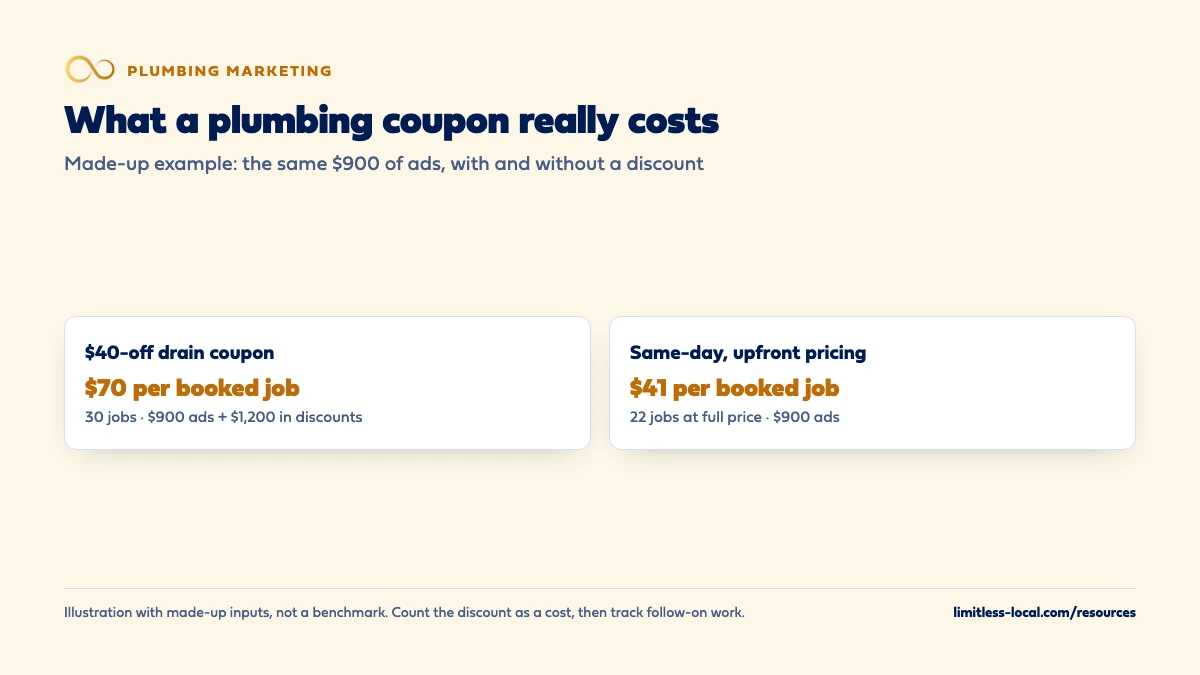
These numbers are made up to show the math, not a benchmark for your market. Say you run a $40-off drain cleaning coupon for a month on $900 of ad spend, and it books 30 jobs. The discounts cost you $1,200 and the ads $900, so the coupon month cost $2,100, or $70 per booked job. More than half of that is the discount.
Now say the same $900 of ads leads with same-day service and upfront pricing instead, with no discount, and books 22 jobs at full price. That’s about $41 per booked job. You did eight fewer jobs, but you didn’t give away $1,200, and the customers chose you for something you can keep offering.
Whether the coupon still wins depends on what happens next: how many of those 30 customers book bigger work or come back at full price. That’s why the follow-on numbers belong in the comparison.
Frequently asked questions
Can I give customers a discount for leaving a Google review?
No. Google’s help page on review links says offering incentives, like free or discounted goods or services, in exchange for reviews is strictly prohibited. Keep coupons and review requests completely separate.
Should I put an expiration date on plumbing coupons?
Yes. A dated offer is easier to measure and easier to stop. Google’s offer posts on your Business Profile require dates, and promotion assets in Google Ads let you set them.
Is a senior or military discount the same as a coupon?
Not in practice. A standing discount for a group is part of how you price, not a promotion that comes and goes, and in our judgement it reads as a value rather than a deal.
Do coupon mailers work better than online coupons?
We don’t have a reliable comparison to share. Track each one with its own code and compare booked revenue and repeat work, and your own numbers will answer it for your market.
Can I advertise a "free estimate" on water heaters?
Yes, if it’s truly free and has no hidden conditions. Keep any conditions next to the offer, as the FTC’s guide on “free” offers expects, and track whether those estimates close.
Key takeaways
- Dollars-off coupons on common jobs mostly attract price-driven customers who leave for the next deal.
- Offers that add value (priority, a credited service fee, a membership) tend to bring customers worth keeping.
- A “was/now” price has to be your real former price, and “free” offers need clear terms and limits under FTC guidance.
- Do the advertised job at the advertised price; a special built to be upsold invites bait-and-switch trouble.
- Count the discount as a cost and judge offers by booked revenue and repeat work.
Not sure what's working right now?
Start with a free visibility audit: rankings, Google profile, reviews and tracking, checked against your service area.
More in this section
- How do I get more repeat customers and referrals for plumbing?
- How should a new plumbing company get its first customers?
- How should a plumbing company market to commercial customers?
- How do I stop attracting price shoppers to my plumbing company?
- How do I get more plumbing leads?
Sources
- 16 CFR 233.1 — Former price comparisons — eCFR (Federal Trade Commission guides)
- 16 CFR Part 251 — Guide Concerning Use of the Word "Free" and Similar Representations — eCFR (Federal Trade Commission guides)
- Advertising FAQ's: A Guide for Small Business — Federal Trade Commission
- About promotion assets — Google Ads Help
- Create & manage posts on your Business Profile — Google Business Profile Help
- About negative keywords — Google Ads Help
- Create a Google link or QR code to request reviews — Google Business Profile Help