
How do I sell more plumbing maintenance memberships?

- How do plumbing companies get more customers to sign up for a maintenance plan?
- What is a plumbing maintenance membership, and is it worth selling?
- Why don't plumbing customers sign up?
- What should a plumbing membership include?
- How should I price and bill a plumbing membership?
- When is the best moment to offer a membership?
- What should my techs and CSRs actually say?
- How do I sell memberships to customers I've already served?
- What rules apply to plans that renew automatically?
- How much is a member worth compared with a one-time customer?
- How do I know if my membership program is working?
- What's different about memberships for plumbing companies
- A worked example: what offering the plan on every call can add up to
- Frequently asked questions
- Key takeaways
- More in this section
- Sources
The short version
- Offer it after an emergency fix, with every water heater install and on every estimate.
- Build it around one yearly visit plus a perk that matters in an emergency.
- Bill it monthly by card, and state the price, renewal and how to cancel up front.
- Track sign-ups per tech and renewals, not just total members.
For plumbing owners who have a membership or service plan on the books but can’t get many customers to sign up, or who are deciding whether to start one.
Get a free visibility audit · Book a growth call
How do plumbing companies get more customers to sign up for a maintenance plan?
Sell plumbing memberships at the moments a customer already sees the value: right after you fix an emergency, when you install a water heater, and on every estimate, offered by every tech the same way. Keep the plan simple enough to explain in a minute, built around one yearly visit with checks a homeowner can’t do themselves plus a perk that matters in an emergency, such as priority scheduling. Then email past customers about it, track sign-ups per tech, and make the price, the billing and how to cancel clear before anyone signs.
A membership is a follow-up system as much as a product: a list of customers, a reminder schedule and a reason to call before the next emergency. That’s the part we help build. Our automation add-ons (a lead tracking dashboard, unified messaging, calendar and reminders) plug into any tier of our plumbing marketing packages, and every package includes reporting so you can see which jobs came from members and which came from ads. The rest of the plumbing marketing questions library covers the other pieces.
What is a plumbing maintenance membership, and is it worth selling?
A maintenance membership (also called a service plan, maintenance plan or service agreement) is a standing arrangement where a homeowner pays you on a schedule and you perform set visits and give them member benefits. Housecall Pro describes service plans as contracts where customers pay for preventative maintenance, or as a form of insurance should an issue arise, and says they help generate dependable revenue, smooth out seasonal variations and keep you connected to your best customers.
ServiceTitan draws a line between two kinds. Memberships are for residential customers: simple, prebuilt packages sold over and over, usually in the field by technicians or by CSRs on the phone. Service agreements are for commercial customers: tailored to each building’s equipment and usually sold from the office after a site inspection. ServiceTitan says both are designed to give a business a steady flow of income and to get technicians back on site, where they can spot repair and replacement work.
For a residential plumbing company, in our judgement, that second benefit is the bigger one. A member who calls you first when the water heater starts leaking is worth more than the plan fee itself.
Why don't plumbing customers sign up?
Most of the reasons are on the seller’s side, not the customer’s:
- Nobody offered it. If only one or two techs mention the plan, sign-ups track those two people, not your customer base.
- The plan is hard to explain. A list of twelve inspection items reads like fine print.
- There’s no obvious reason to buy. HVAC has two seasonal tune-ups built in. Plumbing doesn’t, so the plan has to stand on what it prevents and what it gets the customer when something breaks.
- It was offered at the wrong moment. At 2 a.m. with water on the floor, the customer wants the leak stopped, not a pitch.
- The billing feels like a trap. Customers burned by subscriptions they couldn’t cancel are wary of anything that renews. Clear terms fix that.
What should a plumbing membership include?
Start with one plan, built around one yearly visit and one or two perks you can honor in your busiest week. The checks on the visit should be things a homeowner can’t easily do themselves or won’t do on their own. For example:
- A leak check of the whole house. The EPA’s WaterSense program says the average household’s leaks can waste more than 9,300 gallons of water a year, that nine percent of homes have leaks wasting 50 gallons or more a day, and that toilet flappers should be checked periodically and replaced at least every five years. A visit that finds and fixes those is easy to explain.
- A water heater check, including whatever routine service you’d recommend for that unit.
- Shutoff valves. Confirm the main and fixture shutoffs work, so the customer can stop water in an emergency.
- Drains, sump pump and outdoor faucets, timed for your climate: sump pumps before the rainy season, hose bibs before the first freeze.
Then the perks. The one that matters most in plumbing, in our view, is priority when something goes wrong: front of the line for members, or a waived after-hours or trip fee. A member discount on repairs is common too. Housecall Pro lets you apply a discount automatically to all jobs for customers on a plan, and ServiceTitan supports member pricing in the price book.
Plans are tied to an address, not a person. Housecall Pro assigns service plans to individual addresses, which makes a plan per property easy to sell to landlords with several rentals.
How should I price and bill a plumbing membership?
There’s no published plumbing benchmark worth copying. ServiceTitan’s comparison table says residential memberships typically range from $100 to $400, across all trades and without saying per year or per visit, so treat it as a rough range. Work out your own price from what the visit costs you in labor and drive time, what the perks cost when members use them, and what you’d want left over.
Billing matters more than most owners expect:
- Monthly billing keeps the price feeling small, and the field software supports it. Housecall Pro lets you bill every month, quarter, six months or year, and set a plan to continue until the customer cancels or end after a set duration.
- Take a card on file. Housecall Pro recommends that customers pay by credit card if you aren’t collecting the full price up front, so the office isn’t chasing payments.
- Decide how renewal works. ServiceTitan notes that ongoing memberships don’t expire, while fixed-term ones are renewed by selling the renewal on an estimate or invoice. An ongoing plan avoids a renewal conversation every year; a fixed term gives you a natural moment to sell it again.
Curious what your marketing is actually booking?
Get a free visibility audit — no obligation, no sales pitch.
When is the best moment to offer a membership?
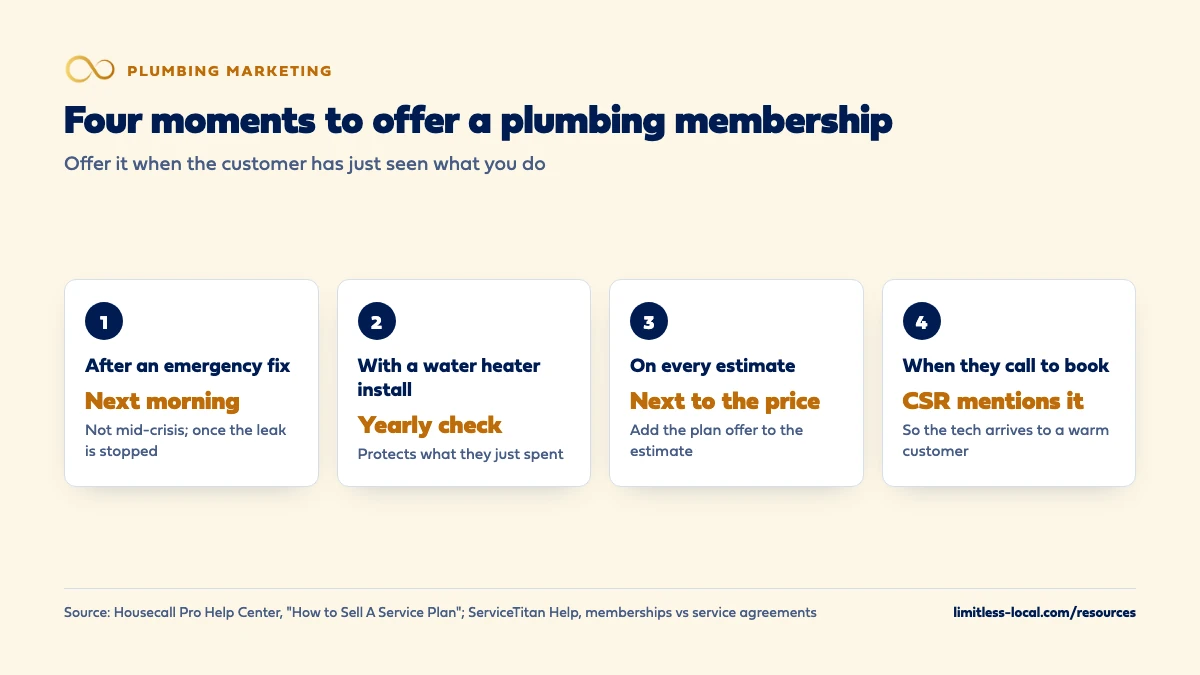
When the customer has just seen what you do. In plumbing, four moments stand out:
- After an emergency is fixed. The customer has just felt what a failure costs. Offer the plan at the end of the job or in a message the next morning, not mid-crisis.
- With every water heater install. A yearly check protects what they just spent, and they already trust the tech who installed it. If you’re working on more of those jobs, getting more water heater and repipe jobs covers the marketing side.
- On every estimate. Housecall Pro lets you add a service plan offer to an estimate or a job, and the offer shows up when the estimate is sent or presented, so the customer sees it next to the price of the work.
- When a customer calls to book. A CSR who mentions the plan while scheduling means the tech arrives to someone who has already heard of it.
There’s no proposal to write, so the limit is almost always whether anyone asks.
What should my techs and CSRs actually say?
A short, honest offer that a tech can say the same way on every call works better than a hard close. One way to put it:
- “Everything’s working now. A lot of our customers are on our maintenance plan: once a year we check the whole house for leaks, the water heater and your shutoffs, and if something breaks, members get priority. It’s [price] a month and you can cancel anytime. Want me to set it up?”
Three habits make the script stick:
- Offer it on every residential call, not only when the customer seems interested. Picking who to ask is how a plan ends up sold by one tech.
- Follow up in writing within a day with anyone who said “let me think about it”, with the plan details and a link to sign up.
- Track sign-ups per tech. If one person sells most of them, share their wording with the crew.
How do I sell memberships to customers I've already served?
Your past customers are the easiest audience you have: they know your name and you know what you did at their house. Most field software can pull them out by the work you did. Jobber’s email campaigns, for example, can filter clients by the services used on their jobs and by how long it has been since their last job with nothing scheduled, and can run automated campaigns that re-engage past clients who haven’t booked in a while.
Useful groups to start with:
- Water heater installs from the last few years, with an offer built around the yearly check.
- Emergency customers from the last year, with an offer built around priority service.
- Landlords and repeat callers, with a per-property plan.
Email is the default channel. Texting is faster but has stricter rules: the FCC says texts sent to a mobile phone with an autodialer need the owner’s prior consent, and commercial texts need written consent, and customers can opt out in any reasonable way. Text only the customers who agreed to marketing texts. This is general guidance, not legal advice.
Give the campaign a reason to go out now. The EPA runs Fix a Leak Week each March (March 16 through 22 in 2026), which is a natural hook for a leak-check offer. So is the run-up to your first freeze, which preparing your marketing for a winter freeze covers.
What rules apply to plans that renew automatically?
A plan that bills a card on a schedule until the customer cancels is a recurring charge, and the rules on those are getting attention. The FTC’s Negative Option Rule page shows the agency revised the rule in February 2026 to conform to federal court decisions, then in March 2026 asked for public comment on whether the rule needs amending to help consumers avoid recurring payments for things they didn’t intend to order and cancel them without unwarranted obstacles. Your state may have its own rules too.
Whatever comes of that, the safe habits are the same, and they also cut cancellations:
- State the price, how often it bills, how renewal works and how to cancel before the customer agrees.
- Get a clear yes, in writing or through your software’s sign-up, not a box that was already checked.
- Make cancelling about as easy as signing up.
This is general guidance, not legal advice. Have your plan terms checked by your attorney.
How much is a member worth compared with a one-time customer?
More than the plan fee. A member pays you on a schedule, books a visit you didn’t have to market for, and, if the plan does its job, calls you first instead of searching Google when something breaks. Add the yearly fee, times how many years members stay, plus the work they book, and compare it with what it costs to win a new customer from ads, which working out your customer acquisition cost walks through. The worked example below uses made-up numbers.
How do I know if my membership program is working?
Four numbers tell you most of what you need:
- Active members, and how many joined and cancelled this year.
- Sign-ups per tech, against the calls each tech ran.
- Renewals. ServiceTitan tracks renewal opportunities for memberships, so the list of plans coming up for renewal shouldn’t be a surprise.
- Member job revenue: the repairs and replacements members booked, kept separate from new-customer work.
Keep member calls out of your ad numbers. Members call your main line too, and if their calls get counted as ad leads, your ads look better than they are. Tracking which marketing books jobs covers how to separate them.
Want to see where your company stands?
A free visibility audit shows where you show up on Google, Maps and AI answers, and what it's costing you in calls.
What's different about memberships for plumbing companies
No built-in season. HVAC companies have a spring and a fall visit that sell themselves. Plumbing members need a reason you supply: the leak check, the water heater, the freeze prep. Pick the one that fits your market and lead with it.
Emergencies are the selling point. Plumbing customers remember the night the basement flooded. Priority service is what makes the plan worth paying for, so decide before you sell a single plan how many members you can actually put first on a bad night, and whether your after-hours coverage can keep that promise. If it can’t yet, stopping lost after-hours calls comes first.
Landlords and property managers. They own several addresses and call often. A per-property plan, billed together, can be one of the easier sales you make.
A worked example: what offering the plan on every call can add up to
These numbers are made up to show the math, not a benchmark for your market. Say your techs run 1,200 residential calls in a year and offer the plan on every one. If 1 in 20 customers says yes, that’s 60 new members.
Say the plan is $18 a month, or $216 a year. Sixty members bring in $12,960 a year in plan fees, and you have 60 visits on next year’s calendar that you didn’t spend anything on ads to book. If a member stays three years, their fees alone come to $648, before any repair or replacement work they book with you instead of a competitor.
The other side is cost: if the yearly visit and perks cost you less than $216 per member, the plan pays for itself before you count a single extra repair. If they cost more, fix the price or the perks before selling more.
Frequently asked questions
Should I call it a membership, a service plan or a maintenance agreement?
Whatever your customers understand. The field software uses all three names for the same idea; ServiceTitan uses “membership” for residential plans and “service agreement” for commercial ones.
How many visits a year should a plumbing plan include?
One is enough for most residential plans, in our view. Housecall Pro allows up to 12 included visits a year, but more visits mean more labor per member, so add a second visit only if it covers something the first one can’t, such as freeze prep.
Can I sell a plan to commercial customers?
Yes, but treat it differently. ServiceTitan describes commercial service agreements as tailored to each building’s equipment and usually sold from the office after a site inspection, not as a prebuilt package.
Should members get a discount on repairs?
It’s a common perk and the software supports it, but price it into the plan. A discount you can’t afford on a big repipe or sewer job is a problem you’ve sold in advance.
Can I offer members something for leaving a Google review?
No. Google prohibits offering incentives, like free or discounted services, in exchange for reviews. Ask members for reviews the same way you ask everyone, and keep member perks separate.
What if a member never uses the visit?
Schedule it for them. A member who never sees you is a likely cancellation, and the visit is where most of the value to you comes from.
Key takeaways
- Sell memberships after an emergency fix, with every water heater install and on every estimate.
- Keep one simple plan: one yearly visit, checks a homeowner can’t do, and priority when something breaks.
- Bill monthly by card, and state the price, renewal and how to cancel before anyone signs.
- Email past customers by the work you did for them; text only those who agreed to marketing texts.
- Track sign-ups per tech and keep member calls out of your ad numbers.
Not sure what's working right now?
Start with a free visibility audit: rankings, Google profile, reviews and tracking, checked against your service area.
More in this section
- How do I get more plumbing leads?
- How do I get more repeat customers and referrals for plumbing?
- How do I keep plumbing calls coming in during slow months?
- How should a plumbing company market to commercial customers?
- How do I stop attracting price shoppers to my plumbing company?
Sources
- Understand differences between memberships and service agreements — ServiceTitan Help
- Create Service Plan Templates — Housecall Pro Help Center
- How to Sell A Service Plan — Housecall Pro Help Center
- Campaigns | Marketing Tools — Jobber Help Center
- Fix a Leak Week — US EPA WaterSense
- Stop Unwanted Robocalls and Texts — Federal Communications Commission
- Negative Option Rule — Federal Trade Commission
- Create a Google link or QR code to request reviews — Google Business Profile Help