
Does direct mail still work for electricians?
- Are postcards and door hangers still worth it for an electrical contractor?
- Where does direct mail still earn its place for an electrician?
- How does Every Door Direct Mail work?
- Should I mail to a list or to whole neighborhoods?
- What should an electrician's postcard actually say?
- Do door hangers work, and are there rules about where they go?
- How many times should I mail the same neighborhood?
- How do I track whether a mailing brought in jobs?
- Is direct mail better than Google for an electrician?
- What's different about direct mail for electricians
- A worked example: did the postcards pay off?
- Frequently asked questions
- Key takeaways
- More in this section
- Sources
The short version
- Mail works best for past customers and for older neighborhoods likely to need planned electrical work.
- It's a weak tool for emergency repair; urgent calls start on Google.
- One card, one service, one reason to call, and a tracking number only that card uses.
- Judge each mailing by booked jobs and revenue, not by how many cards went out.
For electrical contractor owners deciding whether postcards and door hangers deserve a place next to Google, who to send them to, and how to tell whether a mailing paid for itself.
Get a free visibility audit · Book a growth call
Are postcards and door hangers still worth it for an electrical contractor?
Direct mail can still work for electricians, but mostly for two jobs: staying in front of past customers, and reaching neighborhoods where the housing stock points to planned work like panel upgrades, rewiring or generators. It rarely beats Google for urgent repair calls, because a homeowner with a problem right now searches rather than digging out a postcard. If you mail, send to a defined list or route, put one clear reason to call on the card, give it its own tracking number, and judge it by booked jobs.
We don’t print or mail postcards, but we do make sure every channel an electrical contractor pays for can be measured: every package includes call tracking with recording and source tagging, so a mailing gets its own number and shows up in the same monthly report as your Google calls. Our marketing packages page lists what’s included, our electrical contractor marketing page shows the full plan, and the electrical marketing questions library covers the rest.
Where does direct mail still earn its place for an electrician?
In our judgement, mail is worth testing in three situations:
- Past customers. They already trust you and have your work in their home. A card reminding them of a safety check, a surge protector or an EV charger reaches people most likely to say yes.
- Older neighborhoods. Homes of a certain age are more likely to need panel replacements and rewiring. Mail lets you reach those streets on purpose, which getting more rewiring jobs in older neighborhoods covers in depth.
- Around a job you just finished. Neighbors have seen your truck; a card to the surrounding homes ties a familiar face to a name.
Where mail is weak: emergency repair. A homeowner whose power just went out is searching on a phone, not looking for a card that went in the recycling last month. That’s why mail sits alongside Google, not in place of it.
How does Every Door Direct Mail work?
Every Door Direct Mail, or EDDM, is the Postal Service’s way to send a printed piece to every address on the carrier routes you choose, without buying a mailing list. USPS says you can use its online tool to map ZIP Codes and neighborhoods and filter by things like age, income or household size (USPS).
The basics, from USPS:
- EDDM Retail needs no postage permit and no names or addresses on the pieces; you drop the mailing off at the Post Office serving the area (USPS EDDM Retail fact sheet).
- With EDDM Retail you send at least 200 and up to 5,000 pieces per day per ZIP Code.
- Pieces must weigh 3.3 ounces or less, and USPS currently lists EDDM Retail postage at $0.26 per piece (USPS). Printing is separate.
The trade-off is that EDDM goes to every address on a route, renters and new builds included. In our judgement, that’s fine for broad offers like a safety inspection, and wasteful for a panel upgrade offer sent to a street of brand-new homes. Pick routes on purpose.
Should I mail to a list or to whole neighborhoods?
Both have a place. A targeted list, such as your own past customers, reaches people you’ve already served. Mail to them costs more per piece than saturation mail but is far more likely to be read. Some field service software can do this for you: ServiceTitan’s Marketing Pro, for example, can send a sequence of up to four postcards to customers in your system and skips anyone marked “Do not mail” (ServiceTitan Help).
A whole neighborhood through EDDM reaches new people at a lower cost per piece, with more waste.
In our judgement, start with past customers. They’re the cheapest jobs to win and the easiest to measure. If you’re thinking about recurring revenue from that list, selling maintenance agreements to past customers is the natural next step.
What should an electrician's postcard actually say?
In our judgement, the cards that work make one point and make it fast. A homeowner gives a postcard a few seconds on the way from the mailbox to the kitchen. Build it around:
- One service, matched to the street: panel upgrades in older areas, EV chargers in newer ones, generators where outages are common.
- One reason to call now: a safety inspection, a seasonal check before storm season, or a real offer with its conditions printed next to it.
- Proof: your license, your reviews, years in the area, a photo of real work.
- One way to respond: a tracking phone number and a short web address that goes to a page about that service.
If the card carries an offer, it’s an advertising claim. The FTC’s guide for small business says ads must be truthful, claims need backing before the ad runs, and qualifiers belong close to the claim, not in fine print (FTC). That’s our reading of general guidance, not legal advice; state rules apply too. Which offers get homeowners to call is covered in offers that get homeowners to call.
Curious what your marketing is actually booking?
Get a free visibility audit — no obligation, no sales pitch.
Do door hangers work, and are there rules about where they go?
Door hangers are the hand-delivered cousin of the postcard: no postage, but you pay in labor. The rule to know is about the mailbox. The Postal Service says no part of a mail receptacle may be used to deliver anything that doesn’t bear postage, including items placed on, attached to, hung from or inserted into it, quoting its Domestic Mail Manual. It also says its rules don’t govern a mail slot in a door (USPS FAQ).
So hang them on the door, never on or in the mailbox. Local rules on door-to-door advertising vary by city and neighborhood, so check with your town and any homeowners association before a crew walks a route; this isn’t legal advice.
In our judgement, door hangers work best right around a job you just did, the same day or the day after, when neighbors have seen your van. They’re slow and expensive for covering a whole town.
How many times should I mail the same neighborhood?
Rarely just once. In our judgement, one card on its own is a weak test; most homeowners need to see your name several times before they call, and the one with a problem this month isn’t the same one who had a problem last month. A short sequence to the same addresses, spaced a few weeks apart, gives a fairer read than one large drop.
Some software builds this in: ServiceTitan says a direct mail campaign can include a sequence of up to four postcards, that postcards are usually printed and handed to USPS within 48 hours of launch, and that USPS then takes five to seven business days on average to deliver them (ServiceTitan Help). Time your mailings with that lead time in mind, especially for seasonal offers like generator checks before storm season.
How do I track whether a mailing brought in jobs?
This is where most direct mail goes wrong. In our judgement, without tracking you’re guessing. Set it up before the cards go out:
- A tracking number used only on that mailing. Every call to it is a call from the card. Whether you need call tracking numbers explains how this works.
- A short web address or page used only on the card, for people who look you up instead of calling.
- An offer code or “how did you hear about us?” recorded in your field service software, because some people will search your name instead of using the number.
Expect some cards not to arrive. ServiceTitan says that, according to USPS, a typical return amount for direct mail is about 10% of the volume shipped, often because of expired forwarding or a missing unit number (ServiceTitan Help).
Then count booked jobs and revenue from each mailing, and compare cost per booked job with your other channels. The full method is in tracking which marketing brings real jobs.
Is direct mail better than Google for an electrician?
They do different jobs, in our judgement. Google reaches the homeowner at the moment they need an electrician; mail reaches them before they know they need one, or reminds a past customer you exist. For most residential electricians, Google’s map results, ads and website bring in the bulk of new calls, and mail is a supporting channel.
Timing differs too. Ads can bring calls within days of launch, while SEO typically takes three to six months to show meaningful organic growth. A mailing lands within a week or two and then fades. That makes mail a reasonable tool for a slow month or a seasonal push, but not a substitute for being findable when someone searches.
What's different about direct mail for electricians
Age of the home is a strong signal. Older homes are more likely to need panel and wiring work, so in our judgement mail targeted by neighborhood age can make sense for electricians in a way it doesn’t for every trade.
Safety is a message homeowners act on. Many homeowners don’t know what’s behind their walls. A card that explains a few warning signs, such as breakers that trip often, warm outlets or flickering lights, and offers an inspection, gives them a reason to call without sounding like a sales pitch. Keep it factual and avoid scare tactics.
Your best list is your own. Every customer you’ve served is a household with a panel, wiring and a future need. Keeping that list clean and mailing it a couple of times a year is, in our judgement, the cheapest mail an electrician can send.
Want to see where your company stands?
A free visibility audit shows where you show up on Google, Maps and AI answers, and what it's costing you in calls.
A worked example: did the postcards pay off?
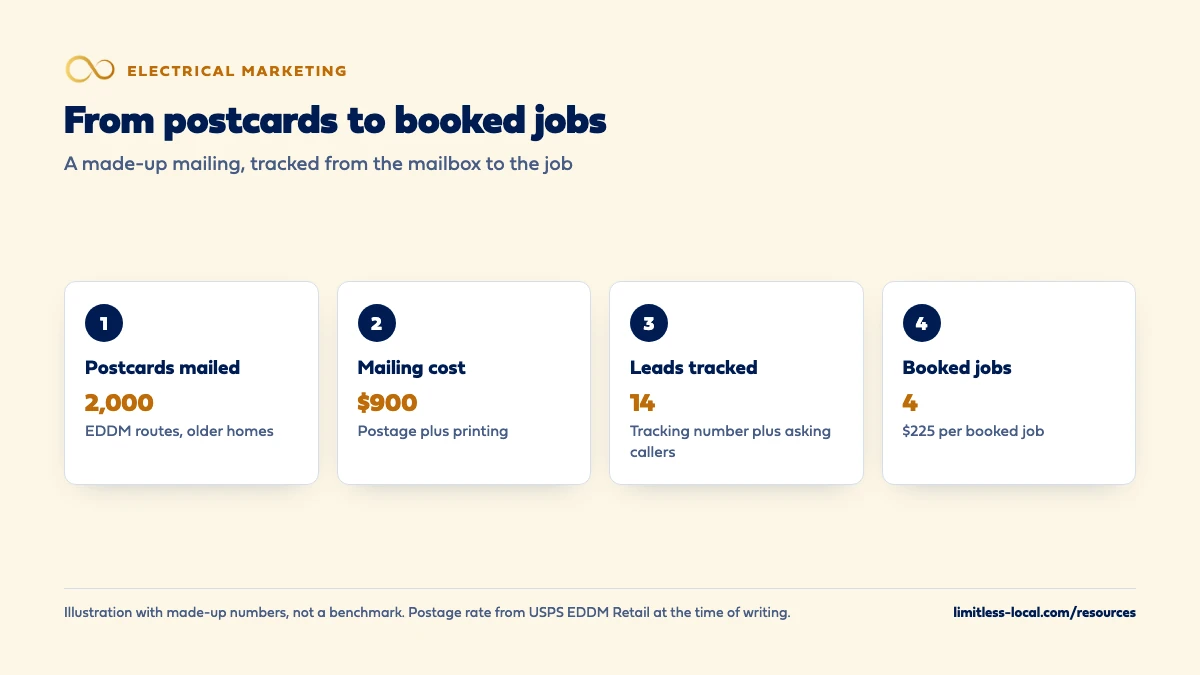
These numbers are made up to show the math, not a benchmark for your market. Say you send 2,000 postcards by EDDM to older neighborhoods with a panel safety inspection offer. Postage at the current EDDM Retail rate of $0.26 a piece is $520, and printing costs you $380, so the mailing costs $900.
The card’s tracking number gets 11 calls over the next month, and 3 more people mention the card when they call your main line. Of those 14 leads, 4 book an inspection and 2 go on to a panel upgrade.
Your cost per booked job (counting the inspections) is $900 divided by 4, or $225. If the two panel upgrades average $2,400 each, the mailing brought in $4,800 in panel revenue alone. On these made-up numbers it paid off, but only because it was tracked. Without the tracking number and the question at the phone, it would have looked like 2,000 cards and a guess.
Frequently asked questions
Do I need a mailing list to send postcards?
Not with EDDM Retail. USPS says it needs no names or addresses on the pieces; your printed piece goes to every address on the routes you pick.
Can I put flyers in mailboxes if I'm not using the mail?
No. The Postal Service says nothing without postage may be placed in, on or hung from a mailbox. Door hangers go on the door.
Is a postcard or a letter better for an electrician?
In our judgement, a postcard for most offers, because the message is seen without opening anything. A letter can suit a personal note to past customers, like a thank-you with a maintenance reminder.
Should I put a QR code on my postcard?
It can help people who’d rather look you up than call, as long as it goes to a page about that offer and the visit is tracked. Keep the phone number large; many homeowners will still call.
Can I mail commercial customers the same way?
In our judgement, commercial work comes more from relationships and bids than from postcards. A personal letter to a property manager can open a door, but a mass mailing rarely does.
Key takeaways
- Direct mail works best for past customers and for neighborhoods likely to need planned electrical work.
- It’s a weak tool for urgent repair calls, which start on Google.
- One card, one service, one reason to call, with conditions next to any offer.
- Never put unstamped flyers or hangers in or on a mailbox; hang them on the door.
- Give every mailing its own tracking number and judge it by booked jobs and revenue.
Not sure what's working right now?
Start with a free visibility audit: rankings, Google profile, reviews and tracking, checked against your service area.
More in this section
- What Google Ads campaigns work best for electricians?
- Are Google Local Services Ads worth it for electricians?
- How can I get general contractors to send me steady electrical work?
- What marketing mistakes do independent electricians make?
- Which local citations and directories matter for electricians?
Sources
- Every Door Direct Mail (EDDM) – Targeted Mail Marketing — United States Postal Service
- Every Door Direct Mail – Retail fact sheet — United States Postal Service
- Restrictions for attaching flyers, posters, etc. to a mailbox — USPS FAQ
- Create Direct Mail campaigns — ServiceTitan Help
- Advertising FAQ's: A Guide for Small Business — Federal Trade Commission