
How much does a pool marketing agency cost?

- What do pool marketing agencies charge per month, and what should that fee include?
- What do pool marketing agencies charge per month?
- How do agencies price their work?
- Is ad spend included in the agency fee?
- What costs come on top of the monthly fee?
- What should the fee include for a pool builder?
- What drives the price up or down?
- Is a cheap agency a false economy for a pool company?
- How much does a pool marketing agency cost compared with doing it myself?
- How long will I be locked in?
- How do I compare two agency quotes fairly?
- Why agency cost looks different for pool builders
- A worked example: what an agency costs per signed pool
- Frequently asked questions
- Key takeaways
- More in this section
- Sources
The short version
- Expect a monthly management fee, with ad spend paid separately to Google or Meta.
- No reliable published average exists for pool builders; compare what each quote covers.
- Watch for setup fees, website fees, add-ons and contract length on top of the monthly fee.
- Judge the total cost per signed pool contract, not the fee on its own.
For pool builders comparing agency quotes, who want to know what the monthly fee should cover, what costs sit on top of it, and how to tell whether it can pay for itself.
Get a free visibility audit · Book a growth call
What do pool marketing agencies charge per month, and what should that fee include?
A pool marketing agency usually charges a monthly management fee, and your ad spend is paid on top of it, directly to Google or Meta. There’s no reliable published average for pool builders, so compare quotes by what each fee covers: channels, locations, ad spend limits, reporting, contract length and who owns the accounts. Then work out what the total cost, fee plus ad spend, adds up to per signed pool contract, because that’s the number your profit per pool has to carry.
Our prices are public. Limitless Local’s Essentials package is $3,500 a month and Growth is $4,500 a month, Scale is custom, and ad spend is paid directly to Google and Meta in every case. The packages page lists exactly what each includes, and the pool builder marketing page shows how we apply it to pool companies. For agency pricing across the trades, see our guide to marketing agency pricing for contractors, and for the rest of the pool questions, the pool builder marketing questions library.
What do pool marketing agencies charge per month?
We haven’t found a reliable, published survey of agency fees for pool builders, so we won’t quote a market range. What we can do is show ours and explain how to compare others.
- Essentials, $3,500 a month: one location; business listing cleanup and buildout; Google Business Profile management with a post a week; a content sprint of up to ten pages; two blog posts a month; link building; review response and basic review generation; Google Ads management up to $2,500 a month in ad spend; one landing page; a three-email welcome flow; call, web and form tracking with basic attribution; a real-time dashboard, a monthly report and quarterly strategy calls.
- Growth, $4,500 a month: everything in Essentials, plus SEO for up to two locations, more blog posts and Google profile posts, advanced review generation, a higher Google Ads spend limit, Local Services Ads management, Meta remarketing, ad design and creative (limits apply), a longer welcome flow, advanced attribution, monthly strategy calls, a dedicated account manager and priority support.
- Scale: custom pricing for multi-location and multi-market work.
Use this as a reference point for what a monthly fee can cover, not as the market price.
How do agencies price their work?
In our judgement, most agency quotes a pool builder sees fall into a few models:
- Flat monthly fee. A set price for a defined scope. Easiest to compare and budget.
- Percentage of ad spend. The fee rises as your ad budget rises. Ask what stops the agency from recommending more spend than you need.
- Pay per lead. You pay for each inquiry. Ask who owns the ads, the website and the leads, and how a “lead” is defined, because a pool supply shopper and a homeowner ready for a design consultation both count as one.
- Project fees. One-time charges for a website, a setup or an audit.
None is automatically better. What matters is whether the model rewards the agency for the same thing you care about: signed contracts at a cost your margins can carry.
Is ad spend included in the agency fee?
Usually not, and it shouldn’t be hidden inside the fee. Ad spend is the money Google or Meta charges for your ads; the management fee pays for the people running them. Ad spend is never included in any of our packages: you pay Google and Meta directly.
Paying the platform directly also keeps the account and its billing in your hands. Google says billing information must be provided before a Google Ads account is created. Source: Add a new payment method in Google Ads. In our judgement, a pool builder should be the one whose card or invoice pays Google, so you can always see exactly what was spent. How much to spend on ads in total is covered in how much a pool builder should spend on marketing.
What costs come on top of the monthly fee?
Ask about each of these before you compare quotes:
- Setup or onboarding fees. Some agencies charge one; ask what it buys.
- Website. A new site is usually a separate project. Our themed websites are $3,750, or $3,000 with any of our packages, and custom websites start at $5,000.
- Add-ons. Tools such as after-hours answering, AI website chat or unified messaging are often extra. Ours plug into any package, and their pricing is shared on the discovery call.
- Ad creative and video. Ask whether design is included and how many versions you get.
- Software. Call tracking, CRM and review tools can be billed separately or bundled.
In our judgement, the honest quote is the one where you can add up every line and see the full monthly and one-time cost before you sign.
Curious what your marketing is actually booking?
Get a free visibility audit — no obligation, no sales pitch.
What should the fee include for a pool builder?
At minimum, in our judgement:
- Tracking from inquiry to contract. Call tracking, form tracking and a way to record which inquiries became consultations and signed pools.
- Google Ads management with search-term checks and location settings matched to the towns you build in.
- Google Business Profile management, including photos and review responses.
- Reporting you can read, ending in consultations and contracts by source, not just clicks.
A fee that buys only “SEO” or only “social posts” with no tracking leaves you guessing whether any of it works. The pool-specific questions to ask about scope are in what to ask before hiring a pool marketing agency.
What drives the price up or down?
The things that take more people-hours. In our own packages, the step from Essentials to Growth adds a second location, Local Services Ads, Meta remarketing, more content and a higher ad spend limit. In our judgement, the same drivers apply to most agencies:
- Locations and markets: two showrooms or two metro areas are more work than one.
- Channels: Google Ads alone costs less to manage than Google Ads plus Meta plus SEO.
- Ad spend: larger budgets usually mean more campaigns to manage.
- Content and creative: more pages, posts and ad designs mean more hours.
- Access to senior people: more strategy calls and a dedicated account manager cost more.
Is a cheap agency a false economy for a pool company?
Not always, but look at what’s missing. A low monthly fee that leaves out tracking, ad management or reporting can cost more in wasted ad spend and lost contracts than it saves. Be especially wary of any price that comes with a promise. Google says no one can guarantee a #1 ranking on Google, and to be wary of firms that won’t clearly explain what they intend to do. Source: Do you need an SEO?.
An expensive agency isn’t automatically better either. In our judgement, the right comparison is the scope you get for the fee, how clearly they report, and whether you keep ownership of everything if you leave.
How much does a pool marketing agency cost compared with doing it myself?
Doing it yourself saves the fee but costs your hours. Hiring an in-house marketer costs a salary: the U.S. Bureau of Labor Statistics reports a median annual wage of $78,760 for market research analysts in May 2025. That’s our comparison, not a BLS figure for marketers: we use it as the closest stand-in for an in-house marketer, and it’s before benefits, tools or ad spend. Source: Market Research Analysts, Occupational Outlook Handbook.
Which is cheaper depends on your size and how much of the work you can do well yourself. The trade-offs are in hiring an agency or doing it yourself and an in-house marketer versus an agency.
How long will I be locked in?
Read the contract before you compare prices, because a low fee with a long commitment can cost more than a higher fee you can walk away from. This is general information, not legal advice; have a lawyer review any contract you’re unsure about. We don’t do long-term contracts: ours is month-to-month, which means we earn the business every month. The standard ask is three months, written into the contract, but we won’t make you stay. Paid-annual clients get a reduced monthly rate; ask about it on the discovery call.
Also check what you keep when you leave: your Google Ads account, Google profile, website, domain and tracking numbers. That’s covered in who should own a pool builder’s ad accounts and website.
How do I compare two agency quotes fairly?
Put them side by side on the same lines: monthly fee, one-time fees, ad spend (and who pays the platform), channels managed, locations covered, ad spend limit, reporting, contract length, and account ownership. Then ask each agency the same question: “How will I know which signed contracts came from your work?” An agency that can answer that clearly is easier to judge at month six than one that can’t.
Whether a specialist pool agency or a general one is a better fit is a separate decision, covered in a pool-specific agency versus a general one.
Talk it through with someone who runs this every day
A 15-minute growth call: your market, your numbers, and what a realistic budget looks like. No pressure.
Why agency cost looks different for pool builders
Fewer, bigger sales. A pool builder may sign a few dozen contracts a year, not thousands of service calls. That makes the cost per contract the right way to judge the fee, and a few extra contracts can cover a lot of it.
Results take longer to show. The fee starts in month one, but contracts from that month’s inquiries may sign months later. Budget for that gap before you sign anything.
Seasonal demand. A flat fee runs through the slow months. Ask how the agency’s work changes in the off-season, and whether the ad spend can flex while the fee stays steady.
Tracking costs matter more. With a long sale, an agency that can’t connect an inquiry to a signed contract leaves you unable to judge whether its fee is worth paying.
A worked example: what an agency costs per signed pool
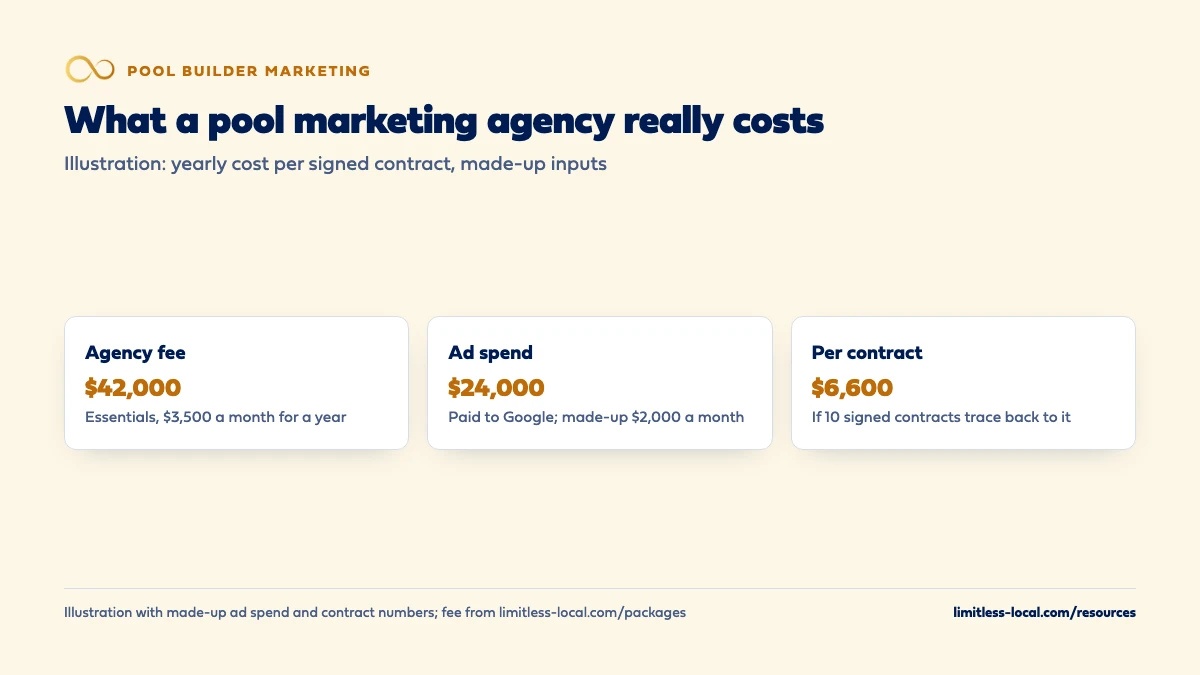
These numbers are made up to show the math, not a benchmark. Say a pool builder hires us on Essentials at $3,500 a month, which is $42,000 a year in fees. Say it spends $2,000 a month on Google Ads, paid to Google, which is $24,000 a year. The total is $66,000.
If that work produces 10 signed contracts the builder can trace back to it, the marketing cost per contract is $6,600. If the builder’s average gross profit on a pool is $15,000, each contract keeps a little over half its profit after marketing. If it produces only four, the cost per contract is $16,500, more than the profit on a pool, and something needs to change.
Run the same math on every quote you get, with your own profit per pool, and the cheapest monthly fee isn’t always the cheapest agency.
Frequently asked questions
Is a pay-per-lead agency cheaper for a pool builder?
Not necessarily. You pay for every inquiry whether it books a consultation or not, so judge it by cost per signed contract and check who owns the ads and leads.
Should I pay an agency a percentage of my ad spend?
It can work, but the fee rises whenever the budget does. Ask how the agency decides what to recommend spending.
Do agencies charge more for pool builders than for other trades?
We can’t point to published data either way. Price follows scope: locations, channels, ad spend and content.
Can I start with a smaller package and grow?
Yes, with most agencies, including ours. Starting with one location and Google Ads, then adding channels once tracking shows what works, is a sensible path.
Does the agency fee include my website?
Usually not. Ask for the website price separately and check who owns the site and domain after it’s built.
Will a more expensive agency get me more pool contracts?
No one can honestly guarantee that. Compare scope, reporting and account ownership, then judge the results by cost per signed contract.
Key takeaways
- Expect a monthly management fee with ad spend paid separately to Google or Meta.
- There’s no reliable published fee average for pool builders, so compare what each quote covers.
- Add up setup, website, add-on and software costs before comparing.
- Check contract length and account ownership as carefully as price.
- Judge the total, fee plus ad spend, per signed pool contract.
Ready to compare options?
Book a short growth call and we'll walk through the math for your service area, including when we're not the right fit.
More in this section
- Should I hire a pool marketing agency or do it myself?
- How much should a pool builder spend on marketing?
- What should a pool builder ask before hiring a marketing agency?
- Does a pool builder need a pool-specific or general marketing agency?
- How do I know if my pool marketing agency is working?
Sources
- Add a new payment method in Google Ads — Google Ads Help
- Do you need an SEO? — Google Search Central
- Market Research Analysts, Occupational Outlook Handbook — U.S. Bureau of Labor Statistics