
Which keywords should a roofing company target for local leads?
- What are the best local SEO keywords for a roofing company website?
- What makes a roofing keyword worth targeting?
- Which roofing keywords show a homeowner is ready to hire?
- Should I target "roofer near me"?
- Should my roofing keywords include town names?
- Which keyword should each page on my roofing website target?
- How do I find what homeowners in my area actually search?
- Should a roofer chase high-volume keywords or specific ones?
- Are question keywords worth it for a roofing company?
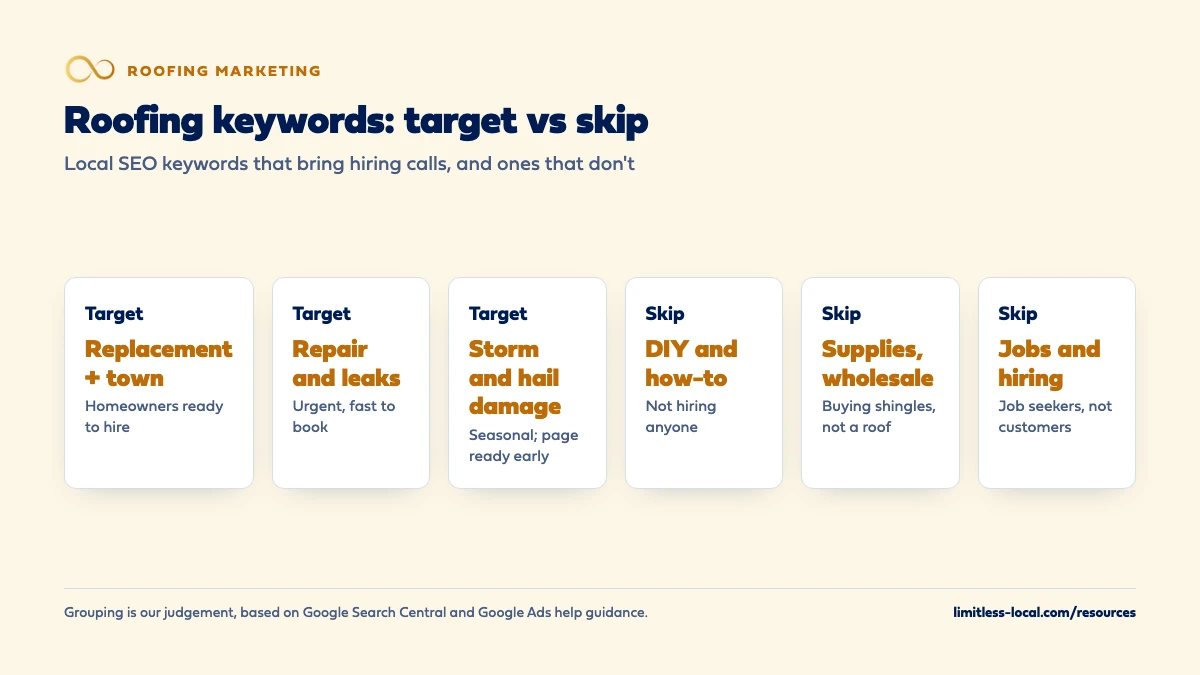
- Which keywords should a roofing company skip?
- Where should the keyword go on the page and on my Google profile?
- How do I know my keyword choices are working?
- What's different about keywords for roofing companies
- A worked example: a keyword map for a three-town roofer
- Frequently asked questions
- Key takeaways
- More in this section
- Sources
The short version
- Target hiring searches for jobs you want: replacement, repair, leaks, storm damage, your materials.
- Pair them with the towns you really serve, on pages that say something true about each town.
- One main job per page; list the same jobs as services on your Google profile.
- Check real searches in Keyword Planner and Search Console; skip DIY, supply and job searches.
For roofing owners planning their website and Google profile around the searches that bring local calls, not just traffic.
Get a free visibility audit · Book a growth call
What are the best local SEO keywords for a roofing company website?
A roofing company should target the searches of homeowners ready to hire for the roof work it wants, in the towns it actually serves: roof replacement, roof repair and leak repair, storm and hail damage, and the materials it installs, such as metal roofing, each paired with core town names. Give each job its own page and list it as a service on your Google Business Profile, then check what people really search with Google’s Keyword Planner and Search Console instead of guessing. Skip do-it-yourself, supply and job-seeker searches, and don’t build near-identical pages for every town on the map.
Choosing these keywords and building the pages around them is part of our local SEO work. The roofing marketing page shows how it fits a roofing company, the roofing SEO guide covers the whole plan this keyword list fits into, and whether SEO is worth it for roofers covers the cost and payoff. More owner questions are in the roofing marketing questions library.
What makes a roofing keyword worth targeting?
In our judgement, a keyword is worth a roofer’s time when it passes three tests:
- The searcher is ready to hire. “Roof replacement” and “roof leak repair” come from homeowners with a problem to fix. “What is roof flashing” usually doesn’t.
- It’s a job you want. If replacements make your year, put your effort there before small repair calls.
- It’s in a town you serve. Ranking in a town your crews won’t drive to brings calls you’ll turn down.
Search volume comes after those three. A keyword with a few searches a month that books replacements in your best town beats a big one that brings the wrong calls. This page covers keywords for your website and Google profile; if you’re choosing terms for paid ads, which search terms to target for the jobs you want covers the ad side.
Which roofing keywords show a homeowner is ready to hire?
Group your keywords by the job behind them. These are the groups that usually come from homeowners looking to hire:
- Replacement: roof replacement, new roof, reroof, plus your town.
- Repair: roof repair, roof leak repair, missing shingles, emergency roof repair.
- Storm work: hail damage roof repair, storm damage roofer, roof inspection after a storm.
- Materials: metal roofing, tile roof repair, flat roof or TPO, only if you install them.
- The trade name: roofer, roofing company, roofing contractor, plus your town.
Google suggests thinking about the words people might search, noting that people who know a lot about a topic search differently from people who are new to it. Homeowners rarely say “reroof” or “tear-off”; they say “new roof” and “roof replacement”. Write for their words, not the trade’s.
Should I target "roofer near me"?
You can’t really put “near me” into a page in a way that helps. Google says local results are mainly based on relevance, distance and popularity, and distance means how far each business is from the person searching. So “roofer near me” is decided mostly by where the homeowner is standing and how strong your Google profile is.
What you control is relevance and popularity: a verified profile with complete, accurate information, the right categories, services that match the jobs you do, and a steady flow of reviews. Google says more reviews and positive ratings can help your local ranking. Which Google Business Profile categories a roofer should choose is the first step.
Should my roofing keywords include town names?
Yes, for towns you serve and can say something real about. Town names in titles and headings tell homeowners and Google where you work, and pages for your core towns can carry local photos, jobs and details.
The trap is scale. Google’s spam policies list multiple pages targeted at specific cities or regions that funnel users to one page as an example of doorway abuse. Twenty pages with only the town name swapped can hurt more than help. How many city pages a roofing website should have covers where to draw the line.
Which keyword should each page on my roofing website target?
- Home page: roofing company or roofer, plus the town your business is based in.
- One service page per main job: roof replacement, roof repair, storm damage, and each material you install.
- A page for each core town: only where you have real work to show.
- Answer pages: a few of the questions homeowners ask before they call.
Giving each page one main job keeps two of your own pages from competing for the same search, and makes each one more useful to the homeowner who lands on it. What a roof repair or replacement service page should include covers what goes on those pages.
Curious what your marketing is actually booking?
Get a free visibility audit — no obligation, no sales pitch.
How do I find what homeowners in my area actually search?
Use two free Google tools:
- Keyword Planner (inside Google Ads) suggests related keywords and shows estimates of how many searches each gets a month. Google notes that keywords with very low search volume aren’t discoverable, which matters for small towns: no number doesn’t always mean nobody searches it.
- Search Console shows the actual queries that already bring your site impressions and clicks, which no planning tool can tell you. Google notes that results are specific to the time, place, device and recent history of the person searching, so you may not see your site when you search the same words yourself.
In our judgement, start from your job list, check the planner for wording and rough size, and then let Search Console tell you what’s working once pages are live.
Should a roofer chase high-volume keywords or specific ones?
Mostly specific ones. “Roofing” alone gets plenty of searches, but many come from people looking for supplies, jobs or definitions. “Roof leak repair” plus a town gets far fewer, and the person searching it has water coming through the ceiling.
Google’s starter guide also says not to worry if you don’t anticipate every variation, because its language matching can understand how a page relates to many queries even without the exact terms. So a strong page about roof replacement in one town can show up for many ways of asking, without a separate page for each one.
Are question keywords worth it for a roofing company?
Some are. Questions like whether to repair or replace, what drives the price of a new roof, or how long a replacement takes come from homeowners who are getting close to calling someone. Answering them on your service pages, or in a few focused articles, puts your company in front of them early.
Questions far from hiring, like how shingles are made, rarely bring calls. Those answers also matter for AI search results, which draw on the same pages; whether SEO is still worth it for roofers with AI search covers what that changes.
Which keywords should a roofing company skip?
- Do-it-yourself searches: how to install shingles, how to patch a roof.
- Supply searches: shingles for sale, roofing materials near me, wholesale.
- Job seekers: roofing jobs, roofer salary, hiring.
- Work you don’t do: materials you don’t install, commercial if you’re residential only.
- Towns you won’t drive to.
On your website, skipping them means not writing pages for them. In paid ads, the same list becomes negative keywords; which negative keywords a roofer should add to Google Ads has the list.
Where should the keyword go on the page and on my Google profile?
On the page: in the title, the main heading, and naturally in the text, along with the details a homeowner wants. Google says excessive repetition is tiring for users and that keyword stuffing is against its spam policies. It also says it doesn’t use the keywords meta tag, and that keywords in a domain name or URL path alone have hardly any effect beyond appearing in breadcrumbs, so there’s no need for a new domain with “roofing” and your town in it.
On your Google Business Profile: add the jobs you do as services. Google lets you group services into categories and add descriptions, which helps the profile match what homeowners search.
How do I know my keyword choices are working?
Check Search Console every month or so. Its Performance report shows clicks, impressions and average position by query and by page. Google’s branded queries filter splits searches with your company name from all the rest, and Google describes non-branded queries as the ones that show how new people find you. That split is only available for sites with enough search volume, so a small site may not see it yet.
Then follow the money: are calls and forms coming from the service and town pages you targeted, and are those leads booking inspections? A keyword that brings impressions but no calls needs a better page, or isn’t the right keyword.
Want to see where your company stands?
A free visibility audit shows where you show up on Google, Maps and AI answers, and what it's costing you in calls.
What's different about keywords for roofing companies
Repair and replacement are two different customers. The homeowner with a leak wants someone today; the homeowner comparing replacement bids wants proof and options. Separate keywords, separate pages.
Storm terms are seasonal. Searches for hail and storm damage jump after weather events. In our judgement, have a storm damage page ready before the season, not after the hail.
Insurance-claim wording needs care. Many storm searches mention insurance. Describe what you do without promising a claim outcome or a waived deductible.
Materials are regional. Tile, metal, slate and flat roofs vary by area and housing stock. Target the materials your crews install in your towns.
A worked example: a keyword map for a three-town roofer
This roofer is made up to show the planning, not a template for your market. They serve three core towns and want four kinds of work: replacement, repair, storm damage and metal roofing.
- Home page: roofing company in the town where the office is.
- Four service pages: roof replacement, roof repair, storm and hail damage, metal roofing.
- Three town pages: one for each core town, with real jobs and photos from that town.
That’s eight focused pages. The tempting alternative, a page for every job in every town, is 4 times 3, or 12 near-identical pages, which is exactly the pattern Google’s doorway policy warns about. The roofer also adds the four jobs as services on the Google Business Profile, then checks Search Console after a few months to see which queries the pages are earning.
How we’d approach it: we optimize for three places owners need to show up: the regular Google results, the Maps 3-pack, and AI answers. We don’t guarantee rankings, lead counts or revenue. Nobody honestly can; platforms change how they work.
Frequently asked questions
Do I need a separate page for every keyword?
No. Google says its language matching can understand how a page relates to many queries without the exact terms, so one strong page per job covers many ways of asking.
Should I put my town in my domain name?
Not for SEO. Google says keywords in a domain name or URL path alone have hardly any effect beyond appearing in breadcrumbs, so pick a name that works for your business.
Does the keywords meta tag still matter?
No. Google says it doesn’t use the keywords meta tag.
Why can't I see my site when I search my keyword?
Google says search results are specific to the time, place, device and recent history of the person searching. Search Console shows how your pages perform across all searchers.
How many towns should a roofer target?
In our judgement, start with the core towns your crews already work in and can show real jobs from, and add more as the work follows.
Should my Google Business Profile use the same keywords as my website?
It should list the same jobs. Add each job you do as a service, with a short description, so your profile and your pages tell Google and homeowners the same story.
Key takeaways
- Pick keywords by hiring intent, the jobs you want and the towns you serve, then by volume.
- Group them by job: replacement, repair, storm damage, materials and the trade name.
- “Near me” is won by your Google profile, reviews and distance, not by adding the words to a page.
- One main job per page, with town pages only where you have real work to show.
- Use Keyword Planner for wording and Search Console for what’s actually working.
Not sure what's working right now?
Start with a free visibility audit: rankings, Google profile, reviews and tracking, checked against your service area.
More in this section
- Which search terms should a roofing company target for jobs it wants?
- What pages should a roofing website have to bring in leads?
- How does a roofing company get links from local websites?
- What marketing should a roofing company add first to grow?
- Can a roofing company do its own SEO?
Sources
- SEO Starter Guide: The Basics — Google Search Central
- Spam Policies for Google Web Search — Google Search Central
- Use Keyword Planner — Google Ads Help
- Performance report (Search results): Overview and basic setup — Search Console Help
- Introducing the branded queries filter in Search Console — Google Search Central Blog
- Tips to improve your local ranking on Google — Google Business Profile Help
- Manage your services on your Business Profile — Google Business Profile Help