
How do I see what local competitors do to get their pool leads?

- Which marketing channels are the pool builders in my city using to get leads?
- What can I actually learn about how competitors get their pool leads?
- Step 1: Who are my real competitors for pool leads?
- Step 2: What does their Google Business Profile show?
- Step 3: What do their reviews tell me about how they win?
- Step 4: Are they running Google Ads, and what do the ads say?
- Step 5: Are they running Facebook and Instagram ads?
- Step 6: What's on their website that brings in leads?
- Step 7: Where else do they show up?
- What does auction insights show if I already run Google Ads?
- What shouldn't I do when researching pool competitors?
- How do I turn what I find into a plan?
- What's different about competitor research for pool builders
- A worked example: one afternoon of competitor research
- Frequently asked questions
- Key takeaways
- More in this section
- Sources
The short version
- Search like a homeowner from several towns and list who keeps showing up.
- Check their Google profiles, reviews and websites for categories, proof and offers.
- Look up their Google ads in the Ads Transparency Center and their Meta ads in the Ad Library.
- You'll see where they show up, not their budgets or results; look for the gaps.
For pool builders who keep losing consultations to the same few names and want to know, using public information only, where those builders show up and what they say.
Get a free visibility audit · Book a growth call
Which marketing channels are the pool builders in my city using to get leads?
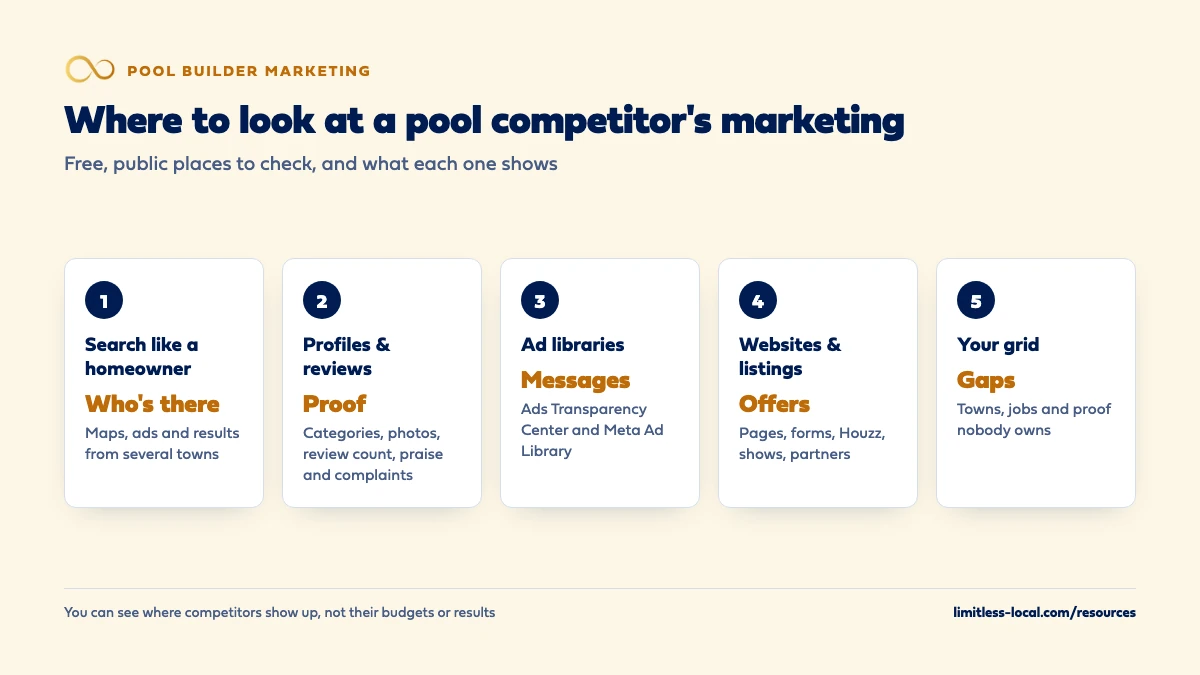
Search the way a homeowner would from several spots in your service area and list the three to five builders who keep showing up, then check each one’s Google Business Profile, reviews, website, Google ads in the Ads Transparency Center and Facebook and Instagram ads in the Meta Ad Library. Together those show where each competitor appears, what they offer and which messages they’re paying to run. You can’t see their lead counts, budgets or close rates, so use what you find to spot the channels and towns they’ve left open, not to copy them.
Knowing where competitors show up is useful; showing up better in the towns and jobs you want is the work. That’s what our local SEO and ads are built around, and our marketing for pool builders page shows how it fits with tracking and follow-up. The rest of the pool builder marketing questions library goes one question at a time.
What can I actually learn about how competitors get their pool leads?
More than most owners expect, and less than they’d like. Everything a competitor does to be found is public by design: their Google profile, their reviews, their website, the ads they run and the places they’re listed. You can see all of that in an afternoon, for free.
What you can’t see is the part that matters most: how many leads each channel brings them, what they spend, how fast they answer and how many consultations they close. A builder with ads everywhere might be losing money on every one. So treat the research as a map of where they show up and what they say, not a scorecard of what works.
Stick to public information. You don’t need anyone’s private data, and you’ll get further spending the time on your own marketing.
Step 1: Who are my real competitors for pool leads?
Not necessarily the builders you see at the supply house. Your real competitors are the ones homeowners find when they search. Search Google and Google Maps the way a homeowner would, such as “pool builder”, “inground pool” and “pool builder” plus a town name, from your phone while you’re in different parts of your service area. Results change with the searcher’s location, so a builder who dominates near your yard may barely show up two towns over.
Write down the three to five builders who keep appearing across those searches, and note where each one shows up: the ads at the top, the Maps results or the regular results below. Skip the directories and lead-selling sites for now; they’re a separate question.
If one name keeps landing above you in Maps, why a competitor outranks your pool company in Google Maps walks through the likely reasons.
Step 2: What does their Google Business Profile show?
Open each competitor’s profile in Maps and note:
- Categories and services: do they list themselves as a pool contractor, a swimming pool builder, a renovation specialist?
- Location: a showroom address or a service area, and how close it sits to the towns you want.
- Photos: how many, how recent, and whether they’re real projects or stock.
- Reviews: total count, average rating and how recent the latest ones are.
- Posts and updates: whether anyone has touched the profile this season.
This lines up with how Google ranks local results. Its local ranking tips say local results are mainly based on relevance, distance and popularity, and that more reviews and positive ratings can help. A competitor with a complete profile, a few hundred reviews and fresh photos is telling you exactly what you’re up against in Maps.
Step 3: What do their reviews tell me about how they win?
Read the last 20 or so reviews for each competitor, not just the star rating. Homeowners tell you what made them pick a builder and what they’d warn a neighbor about.
- What gets praised: communication, the design process, a crew lead by name, finishing on time, financing help.
- What gets complained about: long waits between stages, slow callbacks, surprise costs, a messy yard.
- How often reviews come in: a steady stream every month means they ask every customer at handover.
- How they reply: personal answers or the same line pasted under every review.
The complaints are the useful part. If three builders in your market keep getting dinged for going quiet mid-build, weekly updates and a named project lead are something you can promise and prove.
Step 4: Are they running Google Ads, and what do the ads say?
Use Google’s Ads Transparency Center. Google describes it as a searchable hub of ads served from verified advertisers, where you can see the ads an advertiser has run, which ads were shown in a certain region, the last date an ad ran and the ad’s format. Search the competitor’s business name and set the region to your state.
Look at what they’re saying, not just whether they advertise. Do the ads push new construction, renovations or both? Do they lead with financing, a design consultation, a warranty or a season deadline? Do they name towns? That tells you which buyers they’re paying to reach.
It won’t tell you their budget, how many clicks they get or whether the ads are profitable. An ad that’s been running a long time is a hint that it’s working for them, not proof.
Curious what your marketing is actually booking?
Get a free visibility audit — no obligation, no sales pitch.
Step 5: Are they running Facebook and Instagram ads?
Check the Meta Ad Library. Meta says it contains all active ads shown across its technologies, and anyone can search it by any term, name or Page. Search each competitor’s business name or Facebook Page.
For ordinary ads in the United States, the library shows the ad creative, the Page the ad ran from and the date it started running. It doesn’t show how much they spent or who they targeted. Click See ad details on a lead ad and you can often see more about the lead form, which tells you what they ask homeowners before a consultation.
Watch for patterns: before-and-after videos, financing offers, a spring-build deadline, a free design consultation. If every builder in town runs the same message, a different one stands out.
Step 6: What's on their website that brings in leads?
Walk through each competitor’s site like a homeowner ready to book:
- Pages: separate pages for each pool type, renovations, outdoor living and the towns they serve, or one page for everything?
- Proof: a real gallery of their own pools, project stories, reviews on the page, warranty details.
- The ask: a consultation request, a quote form, a phone number, a chat box, a financing application.
- The form: how many questions they ask, and whether they ask about budget or timeline to filter out tire-kickers.
- Speed and phone: how the site loads and looks on a phone, since that’s where most homeowners first see it.
To see which searches their content targets, open Google’s Keyword Planner, choose Discover new keywords and start with their website. Google looks for keywords related to the content on that site, which gives you a rough picture of the searches their pages are built around.
Step 7: Where else do they show up?
Plenty of pool leads never start with a Google search. Check:
- Houzz and other directories: do they have a full profile, project photos and reviews there? How a pool builder uses Houzz to get leads covers whether it’s worth matching.
- Nextdoor and local Facebook groups: are homeowners recommending them by name?
- Home and garden shows: are they exhibiting every year?
- Trade partners: are landscapers, outdoor kitchen builders or home builders sending them work? Their websites sometimes list partners.
- The street: yard signs during builds, wrapped trucks and mailers in your own mailbox.
A competitor who’s quiet online but busy may be living on referrals and partners. Getting referrals from landscapers and builders covers how to compete for those.

What does auction insights show if I already run Google Ads?
If you run Google Search ads yourself, the auction insights report shows how you compare with other advertisers in the same auctions. For Search campaigns it covers impression share, overlap rate, outranking share, position above rate, top of page rate and absolute top of page rate.
In plain terms, it shows which pool builders keep showing up when you do, how often their ad lands above yours and how often you show up and they don’t. Run it by campaign, so new builds and renovations stay separate. It won’t show insights when your impression share is under 10%, so a very small campaign may not have enough data yet.
What shouldn't I do when researching pool competitors?
- Don’t pose as a homeowner to get a competitor’s proposal or tie up their salesperson. It wastes their time and yours, and their proposal won’t tell you what wins in your consultations.
- Don’t copy their photos, text or reviews. Use what you learn to sharpen your own proof.
- Don’t read activity as success. A builder running ads on every channel might be overspending; one with no ads might be booked a year out on referrals.
- Don’t chase every move. Pick the one or two gaps that suit the jobs you want.
If a new builder has just opened near you, how to respond when a new competitor opens nearby covers what to do first.
How do I turn what I find into a plan?
Put it all in one simple grid: competitors down the side, and across the top Maps, reviews, Google ads, Meta ads, website, directories and partners. Mark each box strong, weak or absent.
Then look for three kinds of opening:
- Towns nobody owns. Places where the strong competitors don’t show up in Maps or ads.
- Jobs nobody talks about. If everyone pushes new construction, renovation or a specific pool type may be wide open.
- Proof nobody shows. Detailed project stories, a clear build timeline or a warranty spelled out.
Pick one or two and put your effort there. Redo the research once or twice a year, ideally before spring, since competitors’ ads and offers change by season.
Not sure which of these is costing you jobs?
A free visibility audit checks the Google profile, reviews, site and tracking, and shows what to fix first.
What's different about competitor research for pool builders
The sale is long, so the ad is only the start. Seeing a competitor’s ad doesn’t show you their design consultation, proposal or follow-up, which is where most pool contracts are won. Don’t assume the builder with the loudest ads is the one signing the most pools.
Seasons change what everyone does. Competitors’ ads, offers and posting habits look very different in March than in October. Check in the run-up to your busy season, when it matters.
New builds and renovations are separate races. The builder who dominates new-construction searches may ignore resurfacing and remodels entirely. Look at each line of work on its own.
Franchises and local builders play differently. A national brand may run heavy ads with generic messages; a local builder may win on reviews and referrals. How a local pool builder competes with national franchises covers that matchup.
A worked example: one afternoon of competitor research
The builders and numbers here are made up to show how the grid works, not a description of any real market. Say a pool builder checks three competitors.
- Builder A has about 180 reviews, shows up in Maps across the whole metro, runs Google ads for new construction in two counties and runs no Meta ads. Its reviews praise the design process but complain about slow callbacks mid-build.
- Builder B has about 45 reviews, a strong renovation section on its website and Meta ads leading with financing that have been running since early spring.
- Builder C is a franchise location with generic ads and few local project photos.
The gaps jump out. Nobody runs ads for renovation work in the north county, nobody shows detailed local project stories, and the review leader has a communication weakness. This builder’s plan for the spring: renovation pages and ads aimed at the north county, a project story for every finished pool, and a promise of weekly updates during every build, written into the proposal.
Frequently asked questions
Can I see how much a competitor spends on Google or Facebook ads?
Not for ordinary home-service ads. The Ads Transparency Center shows ads, regions, formats and the last date shown, and the Meta Ad Library shows active ads and their start dates, but neither shows spend for this kind of ad.
Should I copy an offer a competitor keeps running?
Only if it fits the jobs you want and you can deliver it better. A financing or free-design offer that works for a high-volume builder can attract the wrong buyers for a custom builder, so test your own version and judge it by signed contracts.
Is it worth paying for a competitor research tool?
For most local pool builders, not at first. The free sources on this page cover where competitors show up; paid tools add estimates, and estimates for small local markets are rough.
How often should I check what competitors are doing?
Once or twice a year is enough for most builders, ideally in late winter before the spring rush, plus a quick look whenever a new builder opens nearby.
What if a competitor seems to be breaking Google's rules?
Keep notes and screenshots, and fix your own profile first. Fake reviews or a keyword-stuffed business name can be reported to Google, but your time usually pays off more on your own reviews and photos.
Should I respond if a competitor copies my photos or wording?
Ask them to take it down, and keep dated copies of your originals. The bigger win is publishing new project photos and stories faster than anyone can copy them.
Key takeaways
- Your real competitors are the builders homeowners find when they search from different parts of your service area.
- Profiles, reviews, websites and ad libraries show where competitors appear and what they promise.
- Reviews are the most useful part: complaints show the promise you can make and prove.
- You can’t see budgets, lead counts or close rates, so don’t read activity as success.
- Put it in one grid and pick the one or two towns, jobs or kinds of proof nobody owns.
Want a second set of eyes on your setup?
We'll look at how you show up locally and where calls are leaking, then send you a plain-English breakdown.
More in this section
- What tracking shows a pool builder cost per qualified lead?
- How competitive is local SEO for a pool builder in my city?
- How does a pool builder use Houzz to get leads?
- How do I track which marketing produces signed pool contracts?
- How do pool builders qualify leads before the design consultation?
Sources
- Tips to improve your local ranking on Google — Google Business Profile Help
- Announcing the launch of the new Ads Transparency Center — Google The Keyword
- About the Meta Ad Library — Meta Business Help Center
- Use Keyword Planner — Google Ads Help
- Use auction insights to compare performance — Google Ads Help