
What does cost per lead mean for a pool builder’s ad budget?

- How should a pool builder use cost per lead to set an ad budget?
- How do I calculate cost per lead?
- What should count as a lead for a pool builder?
- Is Google Ads' Cost / conv. the same as my cost per lead?
- How is cost per lead different from cost per click?
- Why doesn't a low cost per lead mean cheap pools?
- How do I turn cost per lead into an ad budget?
- Should cost per lead include agency fees and software?
- Why does my cost per lead jump around from month to month?
- Can I compare cost per lead across Google, Facebook and lead services?
- Is there a typical cost per lead for pool builders?
- What's different about cost per lead for pool builders
- A worked example: from cost per lead to an ad budget
- Frequently asked questions
- Key takeaways
- More in this section
- Sources
The short version
- Cost per lead = ad spend ÷ leads, for the same channel and period.
- Decide in writing what counts as a lead before you trust the number.
- It says how many inquiries a budget buys, not how many pools.
- Set the budget backward from contracts, and judge it on cost per signed contract.
For pool builders looking at an ad report, or an agency proposal, and trying to work out what the cost per lead number actually says about their budget.
Get a free visibility audit · Book a growth call
How should a pool builder use cost per lead to set an ad budget?
Cost per lead is what you spent on ads divided by the leads they brought in over the same period, so $1,200 in ad spend that brings 16 inquiries is $75 per lead. For a pool builder it’s a planning number: it tells you how many inquiries a budget buys, not how many pools, because only some leads book a design consultation and fewer still sign. Use it to work backward from the contracts you want to the budget you need, then judge that budget on cost per signed contract over a full season.
We report cost per lead every month, but we treat it as a step on the way to cost per signed contract. Every package includes monthly performance reports with a cost-per-lead breakdown, call tracking with recording and transcription, form tracking and source tagging, so you can see which leads were real. Our local ads page explains how we run paid search, our pool builder marketing page covers the trade, and the pool builder marketing questions library goes deeper on tracking and budgets.
How do I calculate cost per lead?
Take what you spent on a channel over a period and divide it by the leads that channel brought in over the same period. That’s it. If Google Ads cost you $1,200 last month and brought 16 inquiries, your cost per lead was $75.
Three habits keep the number honest:
- One channel at a time. Google Ads, Facebook and Instagram ads, and a lead service each get their own number. A blended figure hides which one is carrying the others.
- The same period on both sides. This month’s spend over this month’s leads, not a mix.
- The same definition of a lead every month. If you count differently in spring than in fall, the trend means nothing.
What should count as a lead for a pool builder?
Write it down. A useful starting rule: a homeowner in your service area who called, filled in a form or messaged you about a pool you build. Then list what doesn’t count:
- Spam, robocalls and sales pitches from vendors.
- Job seekers and subs looking for work.
- Pool cleaning, repair or supply questions, unless you sell that work.
- Homeowners outside the area you’ll drive to.
- Repeat contacts from someone who’s already a lead.
Your ad platform won’t apply that rule for you. Google’s page About phone call conversion tracking says that for calls from ads, you set a minimum call length, and every call that lasts at least that long counts as a conversion. A long call from a vendor counts; a short call from a real homeowner who hangs up to call back later might not.
That’s why it helps to keep two numbers: cost per lead (everything that counted) and cost per qualified lead (only the ones that passed your rule). The tracking that shows cost per qualified lead walks through setting that up.
Is Google Ads' Cost / conv. the same as my cost per lead?
Only if your conversions are leads. Google’s page Understand your conversion tracking data explains that cost per conversion (“Cost / conv.”) is your total cost divided by the number in the Conversions column, and that the Conversions column counts your primary conversion actions.
So the number is only as good as what you’ve told Google to count. If a page view, a click on a phone number or a visit to your gallery is set as a primary conversion, Cost / conv. will look cheap and mean very little. Google’s page on primary and secondary conversion actions explains how to mark the extra actions as secondary, so they’re reported in All conversions but left out of the Conversions column used for bidding.
One more difference: those primary columns are reported by the time of the click, not the time of the conversion. A click last week that turned into a form this week counts toward last week. That’s handy for matching spend to results, but it means your own lead log and Google’s report won’t always line up by date.
How is cost per lead different from cost per click?
Cost per click is what you pay each time someone clicks an ad. Google’s cost-per-click definition puts it simply: with CPC bidding, you pay for each click on your ads. Cost per lead adds one more step, because only some of those clickers call or fill in a form.
The link between them is your conversion rate. If one in ten clicks becomes a lead, your cost per lead is roughly ten times your cost per click. That’s why a cheap click isn’t automatically good news. A slow website, a page that doesn’t match the pool type someone searched for, or a form nobody can find on a phone will turn cheap clicks into expensive leads. Fixing the page can lower your cost per lead without touching the bids.
Curious what your marketing is actually booking?
Get a free visibility audit — no obligation, no sales pitch.
Why doesn't a low cost per lead mean cheap pools?
Because a lead is a question, not a contract. Between the two sit a design consultation, a proposal, often financing and a lot of thinking. A source that brings cheap leads can be full of people who want an above-ground pool, live two counties over or are years from buying. A source with pricier leads can sign more pools for less in the end.
So read cost per lead next to two other numbers: cost per design consultation held and cost per signed contract. If cost per lead falls but consultations don’t rise, you’re buying cheaper questions, not more customers. What a good cost per signed pool contract is covers the number that settles it.
How do I turn cost per lead into an ad budget?
Work backward from the pools you want to sign:
- Contracts: how many signed pools you want from this channel, and when.
- Consultations: divide by your close rate from consultation to contract.
- Leads: divide by the share of leads that book a consultation.
- Budget: multiply the leads by your cost per lead.
Before you commit, check the result against what you can afford per contract. Divide the budget by the contracts it should sign; if that’s more than an average pool can carry after materials, labor and overhead, the budget won’t pay no matter how good the leads are. How much you can afford to spend to win one pool customer shows how to set that ceiling, and how many leads a pool builder needs for a revenue goal runs the same math from a revenue target.
Expect cost per lead to rise a bit as you spend more. The first dollars go to your best searches; extra dollars go to broader ones. Plan with some headroom instead of assuming this month’s number holds at twice the budget.
Should cost per lead include agency fees and software?
Keep two versions. Ad-only cost per lead (ad spend divided by leads) tells you whether the ads themselves are efficient and is the number to compare month to month inside the platform. All-in cost per lead adds management fees, call tracking, landing page costs and anything else the channel needs, and tells you what a lead really costs the business.
The same goes further down the line. Canada’s Business Development Bank (BDC), in Do you know the lifetime value and cost of acquisition of your customers?, calculates cost of acquisition as sales costs plus marketing costs, divided by the number of new customers. For a pool builder, the all-in cost per signed contract is the one to hold up against your profit per pool.

Why does my cost per lead jump around from month to month?
A few reasons, and most aren’t a problem:
- Small numbers. With a modest budget, two or three leads more or fewer swing the average a lot. Look at three-month stretches as well as single months.
- The season. More homeowners search for pool builders in some months than others, and more builders advertise then too.
- Late conversions. Google’s page About conversion lag reporting says that because Google Ads reports conversions by the date of the search that led to the click, recent numbers aren’t always up to date and can make cost per acquisition look inflated. Last week’s cost per lead often improves once late forms and calls come in.
- Changes you made. New keywords, towns or landing pages reset the comparison.
Leads usually come in close to the click. Signed contracts don’t. Google’s conversion windows default to 30 days for click-through conversions, which is plenty for a lead and often too short for a pool contract, so judge contracts in your own records, not just in Google Ads.
Can I compare cost per lead across Google, Facebook and lead services?
Carefully. The same words mean different things on each:
- Google search ads reach homeowners who searched for a pool builder, and a lead is whatever you set as a conversion.
- Facebook and Instagram ads reach people while they scroll, often earlier in their planning, and an instant form fill is easier to submit than a phone call.
- Lead services sell you a lead at a set price, and the homeowner may be talking to other builders at the same time.
A lead from each isn’t the same thing, so compare them on cost per consultation and cost per signed contract instead. Whether Angi and HomeAdvisor leads work for pool builders covers the lead-service side.
Is there a typical cost per lead for pool builders?
Not one worth planning around. Cost per lead depends on your market, how many other builders bid on the same searches, the pool types you sell, your website and what you count as a lead. A national average blends huge metros with small towns and fiberglass installers with custom builders, so it can be wildly off for you.
Your own number is easy to find once ads are running with call and form tracking. Give it a couple of months, read it alongside consultations and contracts, and that becomes the benchmark that matters.
Want to see where your company stands?
A free visibility audit shows where you show up on Google, Maps and AI answers, and what it's costing you in calls.
What's different about cost per lead for pool builders
Leads are a long way from money. A plumber’s lead can be a paid job the same afternoon. A pool lead is the start of a sales process that can run for months, so cost per lead says less about profit than it does in most trades.
Pool searches attract a lot of the wrong people. Cleaning, supplies, above-ground pools and job seekers all type “pool”, so a written definition of a lead matters more.
Higher ceilings. Because each contract carries a lot of profit, a pool builder can afford a cost per lead that would alarm a service trade, as long as enough of those leads sign.
Few leads, big swings. Monthly lead counts are small, so cost per lead jumps around more than it does for high-volume trades. Read it over months, not weeks.
A worked example: from cost per lead to an ad budget
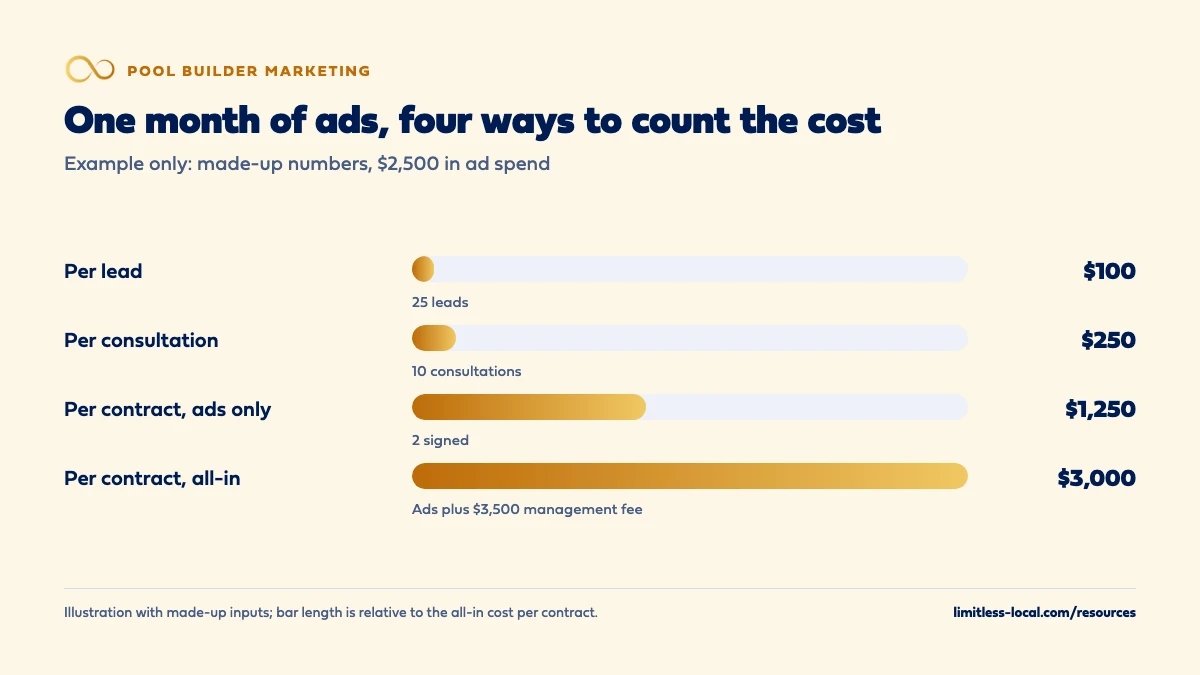
These numbers are made up to show the math, not a benchmark for your market. Say you spend $2,500 a month on Google Ads, the most our Essentials package manages, and it brings 25 leads.
- Cost per lead: $2,500 / 25 = $100.
- Cost per consultation: 10 of those leads book a design consultation, so $2,500 / 10 = $250.
- Cost per contract, ad spend only: 2 sign, so $2,500 / 2 = $1,250.
- Cost per contract, all-in: add the $3,500 Essentials fee and the month cost $6,000, so $6,000 / 2 = $3,000.
Now the budget question. You want 4 contracts a month in season. At the same rates, that takes 50 leads, or $5,000 in ad spend, if cost per lead holds (it usually creeps up as you spend more). That’s within the Growth package, $4,500 a month, which manages Google Ads up to $5,000 in spend. Ad spend is always paid to Google directly. Whether either option pays comes down to the last line: is $3,000 per signed pool comfortably under what an average pool leaves you?
Frequently asked questions
Is cost per lead the same as cost per acquisition?
Not for a pool builder. In Google Ads, cost per acquisition is cost per conversion, so it’s only cost per lead if your conversions are leads. Acquiring a customer means a signed contract, which costs far more.
Should I count calls under a minute as leads?
Count them in your log if they were real homeowners, even if Google didn’t. Set your call conversion length so most real inquiries count, then check a sample of recorded calls to see what’s getting through.
Do repeat calls from the same homeowner count twice?
No. Count each homeowner once per project, or your cost per lead will look better than it is.
What if my cost per lead goes up but contracts go up too?
That’s often a good trade. Higher-intent searches can cost more per lead and still sign more pools for less. Cost per signed contract is the tiebreaker.
How many leads do I need before cost per lead means anything?
There’s no fixed count, but with only a handful of leads a month, read the number across several months before you change the budget.
Should referral leads go into cost per lead?
No. Track them, but keep them out of your paid numbers, or they’ll make your ads look cheaper than they are.
Key takeaways
- Cost per lead is ad spend divided by leads, for one channel over one period.
- Write down what counts as a lead, because ad platforms count calls and forms, not real homeowners.
- Google Ads’ Cost / conv. is only cost per lead if your primary conversions are leads.
- Set a budget backward from contracts, then check it against what an average pool can carry.
- Judge the budget on cost per signed contract over a season, not cost per lead alone.
Not sure what's working right now?
Start with a free visibility audit: rankings, Google profile, reviews and tracking, checked against your service area.
More in this section
- What tracking shows a pool builder cost per qualified lead?
- What does a pool builder budget beyond ad spend?
- How many leads are needed for a pool builder to hit its revenue goal?
- How much should a pool builder spend on marketing?
- Are Google Ads worth it for pool builders?
Sources
- Understand your conversion tracking data — Google Ads Help
- About primary and secondary conversion actions — Google Ads Help
- About phone call conversion tracking — Google Ads Help
- Cost-per-click (CPC): Definition — Google Ads Help
- About conversion lag reporting — Google Ads Help
- About conversion windows — Google Ads Help
- Do you know the lifetime value and cost of acquisition of your customers? — BDC (Business Development Bank of Canada)