
Should my restoration website explain the insurance claims process?

- Should a restoration company's website explain insurance claims, or leave that to the insurer?
- Why explain the insurance claims process on a restoration website at all?
- What's the difference between explaining the process and giving insurance advice?
- What can a restoration claims page safely cover?
- What should a restoration website never say about insurance?
- Can my website say "we work with all insurance companies"?
- Should the page explain what homeowners insurance covers for water damage?
- Should I tell homeowners they can choose their own contractor?
- Should my website mention assignment of benefits or direct payment?
- Where should claims content live on a restoration website?
- Will a claims process page help my site rank or show up in AI answers?
- Who should review a restoration claims page before it goes live?
- What's different for restoration websites
- A worked example: rewriting three risky lines
- Frequently asked questions
- Key takeaways
- More in this section
- Sources
The short version
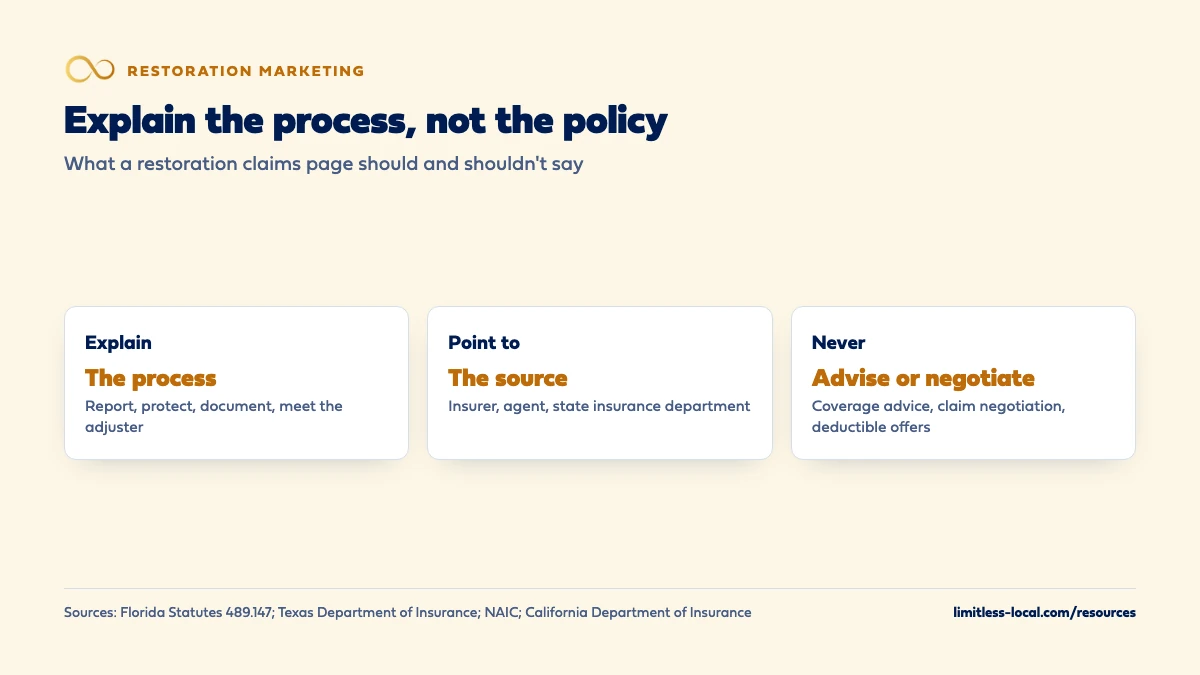
- Explain the process: report, protect, document, meet the adjuster.
- Don't interpret coverage; send owners to their insurer, agent or state insurance department.
- Never offer to negotiate the claim or cover the deductible; Texas, for one, prohibits both.
- Have an attorney who knows your state's rules review the page.
For restoration owners deciding how much to say about insurance on their website: what helps owners in a crisis, and what crosses into advice your state may not allow. General information, not legal or insurance advice; rules differ by state, so check yours with an attorney.
Get a free visibility audit · Book a growth call
Should a restoration company's website explain insurance claims, or leave that to the insurer?
Yes, explain how the claims process generally works, but don’t tell anyone what their policy covers. A page that walks owners through reporting the loss, protecting the property, documenting the damage and meeting the adjuster answers the questions people search in a panic, and it can link to their state insurance department for the rest. Copy that offers to negotiate the claim, promises to recover every dollar, or covers the deductible is different: Texas, for example, bars contractors doing the work from advertising that they’ll adjust the claim and calls deductible waivers illegal, and that kind of copy reads as a red flag to anyone who has read their regulator’s advice.
A claims page is one of the most useful pages a restoration site can have, and one of the easiest to get wrong. When we build or rework a site through our website design work, we write it to answer owners’ questions without crossing into advice, and we ask you to have it checked against your state’s rules. More on how we approach the trade is on our restoration marketing page; the restoration marketing guide covers every channel, and the restoration marketing questions library goes one question at a time.
Why explain the insurance claims process on a restoration website at all?
Because it’s what people are asking when they find you. Someone with water on the floor wants to know whether to call the insurer first, whether they can start drying before the adjuster comes, and what to keep. A clear page that answers those questions keeps them on your site long enough to call you, and it shows you’ve done this before.
It also helps the people who refer you. A plumber or property manager can send a customer to a page that walks through the first steps, instead of trying to explain claims themselves. In our view, that page often does more for trust than another paragraph about your equipment.
What's the difference between explaining the process and giving insurance advice?
Process is what generally happens and in what order. Advice is telling a specific owner what their policy covers, what they’re owed, or how to negotiate. The first is helpful. The second can be restricted for contractors.
In Florida, section 489.147 of the contracting statutes bars contractors from “interpreting policy provisions or advising an insured regarding coverages or duties under the insured’s property insurance policy,” or adjusting a claim for the insured, unless the contractor holds a public adjuster license. The section is written for contractors; if your company does mitigation only, confirm with a Florida attorney whether and how it applies to you. In Texas, the Texas Department of Insurance says Texas doesn’t allow a contractor to act as a public adjuster on a job they’re doing, or to advertise that they will, and that a website counts as an advertisement. Other states write their own rules. This is general information, not legal or insurance advice, so have an attorney who knows your state review the page.
What can a restoration claims page safely cover?
The steps state regulators already give homeowners, presented as general information and linked to the source:
- Report the loss promptly. The NAIC tells homeowners to notify their insurer right away and notes the time allowed to report varies by state.
- Protect the property. California’s Residential Property Claims Guide says to make temporary repairs to prevent further damage and to save receipts, since insurers reimburse reasonable protection costs.
- Document everything. Photos and video of the damage, and a list of damaged items. California adds: don’t throw out damaged items until the adjuster says to.
- Hold off on permanent repairs. The NAIC’s Post-Disaster Claims Guide says not to make permanent repairs before talking with the insurer, because it may not pay for repairs it didn’t authorize.
- Meet the adjuster. The NAIC notes it might help to have the contractor meet with the homeowner and the adjuster.
Then say what your company does at each step, in plain terms, and stop there.
What should a restoration website never say about insurance?
The Texas Department of Insurance gives a useful list of improper language for a roofer or contractor in Texas:
- Offering to negotiate claim settlements or file a claim for the policyholder.
- Promising to recover “every dime you are owed” from an insurer.
- Advertising that you’ll help homeowners avoid “incorrect settlement pricing.”
- Saying you represent the policyholder or can speak for them on coverage.
Add to that any offer to waive, rebate or absorb a deductible, which Texas says is illegal for contractors, and any promise that insurance will pay for the job. You don’t know what a policy covers until the insurer decides, and saying otherwise is the kind of claim the FTC expects advertisers to back up with objective evidence before they run it.
Can my website say "we work with all insurance companies"?
Only if it’s literally true and you can explain what you mean. Most restoration companies mean they’ll document the damage, write an itemized estimate, and talk with whichever adjuster is assigned. That’s worth saying in those words.
In Florida, section 489.147 says a contractor may not give an insured an agreement authorizing repairs under a property insurance claim without a good faith, itemized estimate, so “itemized estimates on every insurance job” is both accurate and reassuring there. What to avoid is wording that implies you’re on the owner’s side of the claim against the insurer, such as “we fight your insurance company for you.” That’s the role Texas says a contractor doing the work can’t take.
Curious what your marketing is actually booking?
Get a free visibility audit — no obligation, no sales pitch.
Should the page explain what homeowners insurance covers for water damage?
Keep it general and send people to the source. Washington’s page on leaks, water damage and mold says homeowner insurance often covers sudden, accidental water damage, such as a burst supply line, while most policies don’t cover gradual leaks, and that mold coverage is often limited and tied to a covered loss. California’s guide notes homeowners policies don’t cover flood damage, which needs a separate policy.
Quoting a regulator’s general explanation, with a link and a line telling owners to check their own policy with their insurer or agent, is very different from telling a caller “your policy will cover this.” The first informs; the second is the kind of coverage advice Florida’s section 489.147 restricts for contractors.
Should I tell homeowners they can choose their own contractor?
Only where your state’s regulator says so, and with a link. Washington’s Office of the Insurance Commissioner tells homeowners, “You do have the right to select your own contractor to complete the work on your home,” even when the insurer suggests preferred providers. That’s a strong line for a Washington company’s page, quoted and linked.
Don’t copy it onto a site in another state as if it were universal. If your state’s insurance department has a similar statement, use theirs. If it doesn’t, leave the claim out. How restoration companies get insurance-related jobs covers what this means for your marketing.
Should my website mention assignment of benefits or direct payment?
If you use those agreements, describe them accurately and have your attorney approve the wording. Know what owners are hearing from regulators: Washington tells homeowners an assignment of benefits could let a contractor negotiate and settle the claim directly with the insurer without their approval, and the NAIC says to be cautious and take time to review one. A page that pressures owners to sign quickly will read badly next to that advice.
It’s also worth explaining the payment side owners don’t expect. California’s guide notes the first insurance check is often an advance, and that for a mortgaged home the repair check is usually made out to the owner and the lender. A plain explanation of that helps owners plan and cuts down on confused calls mid-job.
Where should claims content live on a restoration website?
One main guide page that covers the process, linked from every water, fire and mold service page, plus a short version of the first steps on the water damage page itself. Keep coverage questions in a FAQ that points to the insurer, agent or state insurance department.
Date the page and review it at least once a year. Florida’s section 489.147 alone was created in 2021 and amended in 2022, 2024 and 2025, so rules can move faster than websites. What a restoration website should say about mold and fire damage covers how the service pages handle insurance mentions.
Will a claims process page help my site rank or show up in AI answers?
It can’t be promised, and nobody can promise it. What a good claims page does is answer real questions clearly, which is what search engines and AI tools look for when they choose pages to show or quote. Plain headings that match how owners ask (“Should I call my insurance company first?”), short direct answers, and links to the state source all help.
The bigger payoff is usually after someone lands: a page that calms a panicked owner and makes the next step obvious turns more visits into calls. Make sure that call gets answered; how fast you answer emergency calls covers why that matters.
Who should review a restoration claims page before it goes live?
An attorney who knows your state’s contractor and insurance rules, especially in states with specific laws like Florida and Texas. Florida’s statute even sets formatting rules for some contractor advertising: a communication that encourages a consumer to contact a contractor to make a roof damage claim must state certain notices in a font of at least 12 points and at least half as large as the largest font used.
Also have someone who answers your phones read it. If the page says one thing and your intake script says another, the owner notices. The page, the script and your estimates should all describe the same process.
Not sure which of these is costing you jobs?
A free visibility audit checks the Google profile, reviews, site and tracking, and shows what to fix first.
What's different for restoration websites
Your visitors are mid-crisis. Most service-business visitors are comparing options. Restoration visitors often have water on the floor right now, so the first steps belong near the top of the page, not under a long introduction.
Insurance comes up constantly. In our view, it comes up on a large share of restoration calls. That’s why the topic can’t be avoided, and why restoration sites are where contractor-advertising rules like Texas’s and Florida’s bite hardest.
Regulators have already written the homeowner’s guide. State insurance departments and the NAIC publish plain-language claim steps. Building on them, with links, is more accurate and more trustworthy than writing your own version of the rules.
A worked example: rewriting three risky lines
Here are three lines of the kind that show up on restoration sites, and safer versions. These are illustrations, not legal review.
- Risky: “We handle your insurance claim from start to finish.” Safer: “We document the damage, write an itemized estimate, and can meet with you and your adjuster.”
- Risky: “We’ll make sure insurance pays for everything.” Safer: “Your insurer decides what your policy covers. Here’s how the claims process generally works, and here’s your state insurance department’s guide.”
- Risky: “No out-of-pocket cost, we’ll take care of your deductible.” Safer: say nothing about the deductible beyond “Your deductible is set by your policy.” Texas requires contracts of $1,000 or more involving an insurance settlement to include a notice that the policyholder must pay it.
If you’re rebuilding your site anyway, a claims guide fits inside a normal build: our themed websites are $3,750 for up to 25 pages, or $3,000 if you’re also on one of our monthly marketing packages. Whether you build it with us or not, have the final wording checked against your state’s rules.
Frequently asked questions
Can I put a deductible special on my restoration website?
Don’t. In Texas, the Department of Insurance says it’s illegal for contractors to offer to waive, rebate or absorb a policyholder’s deductible, and in Florida, section 489.147 requires certain roof-claim ads to warn that a contractor paying, waiving or rebating a deductible with intent to defraud is insurance fraud punishable as a felony.
Can my website say we're a preferred vendor for an insurance company?
Only if it’s true and current, and only in words the program allows. If the relationship ends, update the page the same day.
Should I link to my state insurance department?
Yes. It gives owners the official version of their rights and keeps your page from having to state the rules itself.
Can my office staff answer coverage questions on the phone?
Train them to explain your process and refer coverage questions to the owner’s insurer or agent. In Florida, for example, section 489.147 bars contractors from advising insureds about coverage unless they hold a public adjuster license; other states have their own rules.
Do I need different claims pages for different states?
If you work in more than one state, yes, at least for the parts that cite rights or rules, because each state writes its own.
Is it okay to explain what an adjuster does?
Yes, in general terms. California’s guide explains that a claims adjuster assesses the damage and may do a brief first inspection, called scoping the loss, before a full estimate.
Key takeaways
- Explain the claims process; owners in a crisis are searching for it.
- Don’t interpret coverage or promise insurance will pay; in Florida, section 489.147 restricts coverage advice from contractors.
- Never offer to negotiate the claim or cover the deductible; Texas lists both as improper.
- Build on state regulator and NAIC guidance, with links, instead of writing your own rules.
- Have an attorney who knows your state review the page, and review it again every year.
Want a second set of eyes on your setup?
We'll look at how you show up locally and where calls are leaking, then send you a plain-English breakdown.
More in this section
- What should a restoration website say about mold and fire damage?
- How do restoration companies get insurance-related water damage jobs?
- How should a restoration company market to commercial properties?
- How should a restoration company handle marketing during storm season?
- Is my restoration marketing agency producing real jobs?
Sources
- Roofing and insurance: Know the law — Texas Department of Insurance
- 489.147 Prohibited property insurance practices; contract requirements — The Florida Legislature (Online Sunshine)
- What You Need to Know When Filing a Homeowners Claim — National Association of Insurance Commissioners
- Post-Disaster Claims Guide — National Association of Insurance Commissioners
- Residential Property Claims Guide — California Department of Insurance
- Filing a homeowner insurance claim — Washington State Office of the Insurance Commissioner
- Leaks, water damage, and mold — Washington State Office of the Insurance Commissioner
- Advertising FAQ's: A Guide for Small Business — Federal Trade Commission