
Is 10k a month too much ad spend for a pool builder?

- Is $10,000 a month in ads too much for a pool builder whose sales process isn't dialed in?
- What does $10,000 a month in ad spend actually buy a pool builder?
- When is $10k a month the right amount for a pool builder?
- When is $10k a month too much ad spend?
- How do I know if my market can absorb $10,000 a month?
- What should I check before scaling pool ads to $10k a month?
- How many signed pools does $10k a month need to produce?
- Should I jump straight to $10k or ramp up?
- Is $5,000 a month too much for a pool builder who wants to grow fast?
- Should all $10,000 go to Google search ads?
- How should a $10k budget change through the year?
- How long should I run $10k a month before judging it?
- What's different about big ad budgets for pool builders
- A worked example: the same $10,000, with and without the leaks
- Frequently asked questions
- Key takeaways
- More in this section
- Sources
The short version
- The number isn't the problem; what happens to the leads after the click is.
- Check that your market can absorb it: forecasts and lost impression share tell you.
- Fix callbacks, qualifying and tracking before scaling, then raise spend in steps.
- Judge it by cost per signed contract over a full season, against what a pool can carry.
For pool builders weighing a big jump in ad spend, or already spending it and not sure it’s paying.
Get a free visibility audit · Book a growth call
Is $10,000 a month in ads too much for a pool builder whose sales process isn't dialed in?
Not by itself. $10,000 a month in ad spend is right for a pool builder when your market has enough homeowners searching to absorb it, your crews can build the extra pools it should bring, and your follow-up and sales process turn those leads into signed contracts at a cost each pool’s profit can carry. It’s too much when leads wait days for a call, consultations rarely sign or you can’t see which ads produced contracts, because then more spend mostly buys more of the same leak. Fix those first, raise spend in steps, and judge it over a full season by signed contracts.
That’s how we set ad budgets for pool builders: we recommend a number after a quick audit of your market, your follow-up and your tracking, not before. Our local ads management is in every package. Growth is $4,500 a month and covers Google Ads up to $5,000 a month in spend; above that, Scale is custom-priced with custom Google Ads, and ad spend is always paid directly to Google, never through us. See how it fits with the rest of our pool builder marketing, or browse the pool builder marketing questions library.
What does $10,000 a month in ad spend actually buy a pool builder?
Clicks and calls, not contracts. Ad spend buys a chance in front of homeowners searching for a pool builder. Everything after that, the callback, the qualifying, the design consultation and the proposal, is on you, and that’s where a big budget either pays or leaks.
It also helps to know how Google spends it. Google Ads budgets are set per day. Google’s page on average daily budgets says your monthly spending limit is 30.4 times your average daily budget for most campaigns, and that on a given day you can spend up to two times the daily average. So $10,000 a month works out to an average daily budget of about $329, and some days will run well over that while slower days run under.
Remember what isn’t in that number: management, landing pages, tracking, the CRM and the time your team spends calling leads back. A $10,000 ad budget is the floor of what that month really costs.
When is $10k a month the right amount for a pool builder?
When most of these are true:
- Your market is big enough. Enough homeowners in the towns you serve search for pools that $10,000 buys more good clicks, not the same clicks at higher prices.
- Your crews have room. The pools it should sign fit your build schedule for the coming season.
- Leads get called back fast and every one has a named owner.
- Consultations sign at a steady rate, and you know that rate by lead source.
- You can see which campaigns produce signed contracts, not just which produce calls.
- The math works: what each signed contract costs in ads stays under what an average pool can afford.
If all six are true and you’re turning away nothing but price shoppers, $10,000 can be a sensible budget for a builder in a large metro or selling several pool types. Where your own floor sits is covered in what monthly ad spend gets a pool builder steady leads.
When is $10k a month too much ad spend?
When the money outruns what you can do with the leads. The usual signs:
- New leads wait until the next day, or the next week, for a call.
- Consultations are booked with homeowners who were never going to buy, so the designer’s week fills up and contracts don’t follow.
- Your crews are booked through next season, so the extra leads have nowhere to go.
- You serve a handful of small towns, and the extra budget only raises what you pay per click.
- Nobody can say which ads produced the last ten signed contracts.
None of those is fixed by spending more. Each one gets more expensive when you do. If two or more sound familiar, the next dollar belongs in your follow-up and sales process, not in Google.
How do I know if my market can absorb $10,000 a month?
Ask Google before you spend it. Keyword Planner’s forecasts estimate clicks and cost for a set of keywords and locations, taking your bid, budget, seasonality and historical ad quality into account. Run one for your pool keywords and your real service area. If the forecast tops out well below $10,000, your market can’t take it, and forcing more money in mostly raises your cost per click.
If you’re already running ads, the impression share columns tell you more. Google’s page on impression share data defines Search lost IS (budget) as the percentage of time your ads weren’t shown because of insufficient budget, and Search lost IS (rank) as the percentage of time they weren’t shown because of poor Ad Rank.
- High lost to budget: more budget can buy more of the searches you’re missing.
- High lost to rank: more budget won’t help much. Better ads, landing pages and bids will.
- Low on both: you’re already showing for most of the searches you target. More money needs more towns or more pool types to go to.
What should I check before scaling pool ads to $10k a month?
Five checks, in this order, because each one leaks money before the next one matters:
- Speed. How long does a new lead wait for a real call? Look at last month’s leads, not at what the team says.
- Ownership. Does every lead have one named person responsible, with a backup on weekends? Lead routing in a pool builder’s sales process covers setting this up.
- Qualifying. What share of booked consultations are in your area, want what you build and have a realistic budget?
- Closing. How many consultations turn into signed contracts, by lead source?
- Tracking. Can you trace each signed contract to the campaign that produced it? Tracking which marketing produces signed pool contracts walks through the setup.
If a check fails, fix it at your current budget. A leak that costs you a few leads a month at $3,000 costs you three times as many at $10,000.
Curious what your marketing is actually booking?
Get a free visibility audit — no obligation, no sales pitch.
How many signed pools does $10k a month need to produce?
Work it backward from what a pool leaves you. Start with gross profit on an average contract, set aside its share of overhead and the profit you want to keep, and what’s left is the most you can spend to win that customer. How much you can afford to spend to win one pool customer lays out the steps.
Then divide $10,000 by that ceiling. The answer is the minimum number of signed contracts the ads have to produce, on average, for the spend to break even, before management and other costs. Aim comfortably above it, because a slow spring or a run of lost proposals will drag the average down.
Then check the other side: can your crews build that many? If the ads need to sign more pools a month than your crews can finish, $10,000 is too much for this season, however good the leads are.
Should I jump straight to $10k or ramp up?
Ramp up. Raise the budget in steps, hold each step long enough to see what it does to cost per consultation, and stop when that cost starts climbing faster than the number of consultations.
Budget changes themselves are low-risk on Google’s side. Google’s page About Smart Bidding learning says changes to budgets take effect in the next auction and never trigger the Learning status. The risk is on your side: a jump from $3,000 to $10,000 in one month can triple the leads before your team has the hours to call them all.
Google’s Performance Planner can help you pick each step. It forecasts how campaigns would perform at different budgets, based on simulated auctions over the last seven to ten days and adjusted for seasonality. Use its numbers as a starting estimate, not a promise.
Is $5,000 a month too much for a pool builder who wants to grow fast?
The same test applies at any number. $5,000 is too much if leads leak after the click, and about right if your market, crews and sales process can turn it into contracts at a cost a pool can carry. Growing fast is a reason to fix the follow-up first, not a reason to skip it, because a fast-growing budget on a leaky process grows the leak fastest.
For most pool builders, the more useful question is what the whole marketing budget should be, and what share belongs in ads. How much a pool builder should spend on marketing works the total backward from the contracts you want to sign.

Should all $10,000 go to Google search ads?
Usually not all of it. Search ads catch homeowners already looking for a pool builder, so they should carry most of the budget. But a pool decision takes months, and a share spent on remarketing to people who visited your site, or on social ads showing your builds in the towns you serve, keeps you in front of buyers who aren’t ready yet.
A practical way to split it: keep most of the money on the search campaigns already producing signed contracts, hold a smaller fixed share for testing, and move money only when your own cost per contract says to. How a pool builder should split its marketing budget goes into the split in detail.
How should a $10k budget change through the year?
It shouldn’t be flat. Pool demand follows the calendar: homeowners plan in late winter, shop hard in spring and slow down once summer is half gone. A flat $10,000 a month overspends in the slow months and can run short when searches peak.
Think of it as a yearly total spread unevenly: more from late winter into spring, less in late summer and fall, never zero. Raise budgets ahead of the spring rush instead of after the phones get busy. And keep some presence in the off-season, because the homeowner planning next year’s pool in November is the one who signs early.
How long should I run $10k a month before judging it?
A full season, judged by signed contracts grouped by the month each lead came in. A pool lead from March might sign in June, so judging March’s spend in March only shows you the cost of leads.
Close the loop with Google, too. Google’s page About offline conversion imports explains that when an ad starts a customer down a path that ends in a sale offline, such as at your office or over the phone, you can import those conversions to measure what happened after the click or call. Google recommends starting with enhanced conversions for leads if you haven’t set up imports yet. Feeding signed contracts back means Google’s bidding can learn from the leads that bought, not just the ones that called.
Want to see where your company stands?
A free visibility audit shows where you show up on Google, Maps and AI answers, and what it's costing you in calls.
What's different about big ad budgets for pool builders
One contract covers a lot. A single signed pool can pay for a big month of ads, which is why large budgets can make sense for pool builders when they wouldn’t for a small-ticket trade.
But you pay months before you’re paid. Spring ad spend shows up as signed contracts later, so cash flow, not just return, decides how high you can go.
Capacity is a hard ceiling. A crew can only build so many pools in a season. Past that point, more leads don’t add revenue; they add a waiting list or lost deposits.
New builds and renovations behave differently. A renovation can sign faster and for less. If $10,000 is split across both, track them separately so one doesn’t hide the other.
A worked example: the same $10,000, with and without the leaks
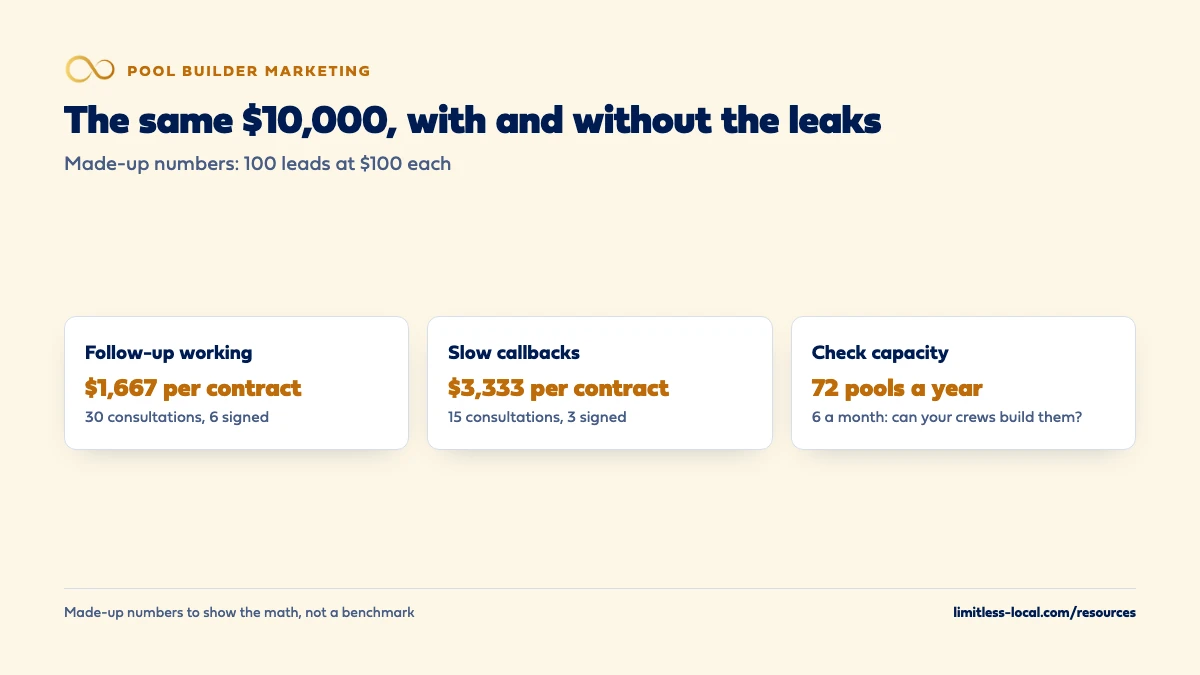
These numbers are made up to show the math, not a benchmark for your market. Say $10,000 a month in ads brings in leads at $100 each, so 100 leads a month.
With follow-up working: every lead gets a call the same day, three in ten book a design consultation (30 consultations), and 1 in 5 consultations signs. That’s 6 signed contracts, or about $1,667 in ad spend per contract ($10,000 divided by 6).
With the leaks: callbacks take days, so only 15 consultations get booked, and the same 1 in 5 sign. That’s 3 contracts, or about $3,333 per contract. Same budget, same ads, double the cost per pool.
Two more checks before you call the first version a success. If an average pool can only afford $1,500 in ad spend, even the good month loses money. And 6 contracts a month is 72 a year: if your crews can’t build that many, the budget is too big for your capacity, not too small for your market.
Frequently asked questions
Does Google spend exactly my monthly budget?
Not day by day. A campaign can spend up to two times its average daily budget on some days, while the month stays within 30.4 times the daily average for most campaigns.
Will raising my budget reset Google's learning?
No. Budget changes take effect in the next auction and never trigger the Learning status. Big changes to conversion goals can.
Can I spend $10,000 a month on Local Services Ads instead?
Only if they’re offered for pool builders in your area, so check in your Google Ads account before planning a budget around them. Even where they are, the same test applies: the leads still have to be called back, qualified and closed.
Should I cut ad spend when my crews are booked?
Usually trim it rather than stop it. Shift money toward the towns, pool types and months you want to fill next, and keep enough running that next season’s buyers still find you. Whether to pause marketing when your schedule is full covers the trade-offs.
Does a bigger budget get my pool company a higher ad position?
Not on its own. Budget decides how often your ads can enter auctions; where they show depends on Ad Rank, which is why lost impression share is split into budget and rank.
Key takeaways
- $10,000 a month is a question about your market, crews and sales process, not about the number itself.
- Use Keyword Planner forecasts and lost impression share to see whether your market can absorb more.
- Fix callbacks, lead ownership, qualifying and tracking before scaling; leaks grow with the budget.
- Raise spend in steps, weighted toward the spring buying season, and never cut to zero.
- Judge it over a full season by cost per signed contract, against what an average pool can afford.
Not sure what's working right now?
Start with a free visibility audit: rankings, Google profile, reviews and tracking, checked against your service area.
More in this section
- What monthly ad spend gets a pool builder steady leads?
- How much should a pool builder spend on marketing?
- What does a pool builder budget beyond ad spend?
- Are Google Ads worth it for pool builders?
- What does cost per lead mean for a pool builder's ad budget?
Sources
- About average daily budgets — Google Ads Help
- About Keyword Planner forecasts — Google Ads Help
- Get impression share data — Google Ads Help
- About Smart Bidding learning — Google Ads Help
- About Performance Planner — Google Ads Help
- About offline conversion imports — Google Ads Help