
How should a pool builder budget for custom vs fiberglass pools?
- How much should a pool builder spend marketing custom gunite pools versus fiberglass or vinyl?
- Why shouldn't custom and fiberglass pools share one marketing budget?
- How do I set the most I can spend to win each type of pool?
- How does a longer sales cycle change the custom pool budget?
- How much of the custom pool budget should go to proof?
- How should a fiberglass or vinyl pool budget be different?
- Does competition change how much each line costs?
- How do I split one total budget between custom and fiberglass?
- How do I track cost per contract for each pool type?
- Should renovations get a budget of their own?
- When should I move money from one line to the other?
- What's different about budgeting two kinds of pools
- A worked example: why fewer custom pools can justify a bigger budget
- Frequently asked questions
- Key takeaways
- More in this section
- Sources
The short version
- Give custom and fiberglass or vinyl their own budgets, campaigns and tracking.
- Set each budget from what a signed contract of that type can afford, times the contracts you want.
- Custom: higher ceiling per contract, longer sale, more money on proof, judged over a longer window.
- Fiberglass and vinyl: lower ceiling, faster sale, more weight on search ads and speed.
For pool builders who sell both high-end custom pools and simpler fiberglass or vinyl jobs, and need each to pay its own way.
Get a free visibility audit · Book a growth call
How much should a pool builder spend marketing custom gunite pools versus fiberglass or vinyl?
Budget for them as two separate lines. Start each from what one signed contract of that type can afford out of its profit, multiply by the contracts you want, and judge each line by its own cost per signed contract. Custom gunite pools usually leave more per job, so they can carry a higher marketing cost per contract, but they take longer to sell and lean on proof, so that budget needs more spent on photos and video and a longer wait before you judge it. Fiberglass and vinyl jobs usually leave less but sign faster, so their budget leans on search ads, fast follow-up and tight cost control.
That’s how we set up pool builders who sell more than one kind of pool: separate campaigns, pages and tracking for each line, judged on cost per signed contract, not one blended number. Every package includes call tracking, source tagging and a monthly cost-per-lead breakdown, and the packages page lists the Google Ads spend each tier manages. We’ve worked this from the builder’s side too, as an equity partner in a pool construction company where we built the lead-generation engine and ran sales and marketing. See our pool builder marketing, or browse the pool builder marketing questions library.
Why shouldn't custom and fiberglass pools share one marketing budget?
Because a blended budget hides which line is paying. Say your overall cost per signed contract looks fine. That number could be a profitable custom line carrying a fiberglass line that loses money on every pool, or the other way round. You can’t fix what one number won’t show you.
The two lines also behave differently month to month. Fiberglass and vinyl leads tend to come from homeowners comparing price and timing, who decide quickly. Custom leads come from homeowners buying a design and a builder’s taste, who may take months. Put them in one pot and the fast, cheap leads fill the calendar while the custom pipeline quietly dries up, or the custom line soaks up money for months before anyone can tell whether it worked.
Separate lines fix both problems. Each gets its own target, its own ad campaigns, its own pages and its own report. Which channels suit each line is a different question, covered in which marketing channels work best for custom pools versus simpler builds. This page is about how much to spend and how to judge it.
How do I set the most I can spend to win each type of pool?
Do the math separately for each type. Take the average contract for that type, subtract materials, labor, subcontractors and permits to get gross profit, then set aside that pool’s share of overhead and the profit you want to keep. What’s left is the most you can spend to win one customer of that type. How much you can afford to spend to win one pool customer goes through each step.
You’ll almost always get two very different ceilings. A custom pool with a spa, water features and a big deck can leave many times what a standard fiberglass install leaves, so it can carry a much higher marketing cost per contract and still make money. A fiberglass or vinyl job needs a tighter number, because there’s less room in each pool.
Use your own job costing, not a rule of thumb. The numbers differ too much between builders, markets and price points for anyone else’s figure to fit your business.
How does a longer sales cycle change the custom pool budget?
You spend months before you know if it worked. A custom buyer might see your ad in spring, visit your site several times, come to a consultation in summer and sign in the fall. The money for that contract went out long before it came back.
Google Ads has a name for this gap. Its definition of a conversion cycle is the amount of time it takes for a click to result in a conversion, and when you import conversions, it also includes the time they take to be reported in your account. For a custom pool, if the conversion you care about is a signed contract, that cycle is long.
Three things follow for the budget:
- Judge it on a longer window. Look at custom leads by the month they came in, and give each month’s leads time to reach a decision.
- Plan the cash. Custom marketing is money spent ahead of revenue. Budget it from what the business can carry before contracts sign.
- Don’t cut it at the first slow month. A quiet month of custom leads can still turn into signed contracts later in the year.
How much of the custom pool budget should go to proof?
More than for any other line. A custom buyer is deciding whether you can build something they’ve imagined, and the evidence is your past work: professional photos of finished pools, short build videos, project pages that tell the story of each yard, and reviews that talk about the design and the process.
Treat that as a real line in the budget, not something squeezed out of ad spend. Some of it is one-time, like photographing a finished project or building out the project pages. Some of it repeats, like adding each new build and keeping the gallery fresh. All of it makes every custom ad dollar work harder, because a homeowner who clicks lands on proof instead of promises.
Fiberglass and vinyl lines need proof too, but less of it per job. Clear photos of finished installs, what the process looks like, and how long it takes usually do the work. Their budget can lean harder on ad spend.
Curious what your marketing is actually booking?
Get a free visibility audit — no obligation, no sales pitch.
How should a fiberglass or vinyl pool budget be different?
Built for speed and volume. These buyers are often comparing a few builders on price, timeline and what’s included, and they decide faster. So the budget should favor:
- Search ads on the searches that name the pool type, in the towns you install in.
- Fast follow-up. A lead that waits loses to the builder who called back first, so time on the phone is part of this line’s cost.
- Clear pages that show the shapes or models you install, what’s included and how the process works.
- Tight cost control. With less room per pool, review cost per signed contract monthly and cut what isn’t paying faster than you would on the custom side.
Capacity matters more here too. If your install crews are booked through spring, extra fiberglass leads have nowhere to go, so the budget should rise and fall with the open slots on your schedule.
Does competition change how much each line costs?
Yes, and you can check it before you set the numbers. The searches homeowners use for a custom builder and for a fiberglass installer aren’t the same, and neither are the builders bidding on them. One may be crowded in your area while the other is wide open.
Google’s Keyword Planner can show you the difference. Its forecasts estimate clicks and cost for a set of keywords, taking your bid, budget, seasonality and historical ad quality into account. Build one plan with your custom pool keywords and another with your fiberglass and vinyl keywords, both for your real service area, and compare what each costs per click and how many clicks each can deliver.
Then sanity-check against each line’s ceiling. If clicks for one line are expensive and the ceiling is low, that line may do better with less ad spend and more referrals, partners or Maps.
How do I split one total budget between custom and fiberglass?
Work it from contracts, not percentages. For each line:
- Decide how many contracts you want next season, within what your crews can build.
- Multiply by the ceiling you can afford per contract for that type.
- That’s the most that line’s marketing can cost. Plan to spend comfortably under it.
Add the two lines together and compare the total with what the business can carry. If it’s too much, cut contracts from the line with the thinner margin first, not across the board. How much a pool builder should spend on marketing covers setting the total, and how a pool builder should split its marketing budget covers dividing each line across channels.
In Google Ads, keep each line in its own campaigns with its own budget. Google’s page About shared budgets explains that a shared budget lets underused budget move automatically to campaigns that are capped by budget. That’s useful within one line. Across two lines, it means money can drift to whichever campaign spends most easily, which usually isn’t the one you meant to fund.

How do I track cost per contract for each pool type?
Tag the pool type on every lead, as early as you can. Separate pages and campaigns do most of the work: a lead from the fiberglass page or the custom pool campaign already tells you which line it belongs to. For calls and referrals, ask on the first call and record it in your CRM, then keep it attached through the consultation, proposal and signed contract.
Each quarter, divide what each line spent by the contracts it signed, grouped by the month the leads came in. Tracking which marketing produces signed pool contracts walks through the setup.
You can teach Google the difference, too. Google’s page on conversion values says assigning values to conversions lets you see the total business value your campaigns generated, not just the number of conversions, and lets automated bidding focus on high-value conversions. Giving a custom pool consultation a higher value than a fiberglass one tells bidding which leads matter more.
Should renovations get a budget of their own?
If you do enough of them, yes. Renovations and resurfacing are a third kind of buyer: an existing pool owner with a problem to fix or a look to update, often on a shorter timeline and a smaller ticket than a new build. Folded into either new-build line, they distort both.
Treat them the same way: their own ceiling per contract, their own pages and campaigns, and their own cost per contract. Whether pool builders should market renovations separately from new pools covers the case for splitting them.
When should I move money from one line to the other?
At planned check-ins, not in the middle of a bad week. Review both lines each quarter and before each season, and move money when one of these is true:
- One line’s cost per signed contract is well under its ceiling and it has room to grow, while the other is over.
- Your crew schedule has filled for one type and has open slots for the other.
- You want to change your mix, for example toward more custom work, and you’re ready to fund the longer wait that comes with it.
When you shift toward custom, shift slowly and give it a full cycle before judging. When you shift toward fiberglass or vinyl, you’ll see the effect sooner, so you can adjust faster.
Not sure which of these is costing you jobs?
A free visibility audit checks the Google profile, reviews, site and tracking, and shows what to fix first.
What's different about budgeting two kinds of pools
Two businesses under one roof. A custom design-build line and a fiberglass or vinyl install line often have different buyers, different crews and different margins. Budget them like separate businesses that share a name.
Your brand has to hold both. A builder known for high-end custom work can confuse custom buyers with price-led fiberglass ads, and the other way round. Separate pages and ads keep each message clean.
The calendar hits them differently. Fiberglass and vinyl buyers often want to swim this summer, so their demand peaks in spring. Custom buyers plan further out, which makes fall and winter spend more useful on that line.
Capacity is set per line. Crews, designers and suppliers differ by pool type, so each line’s budget should follow its own open slots.
A worked example: why fewer custom pools can justify a bigger budget
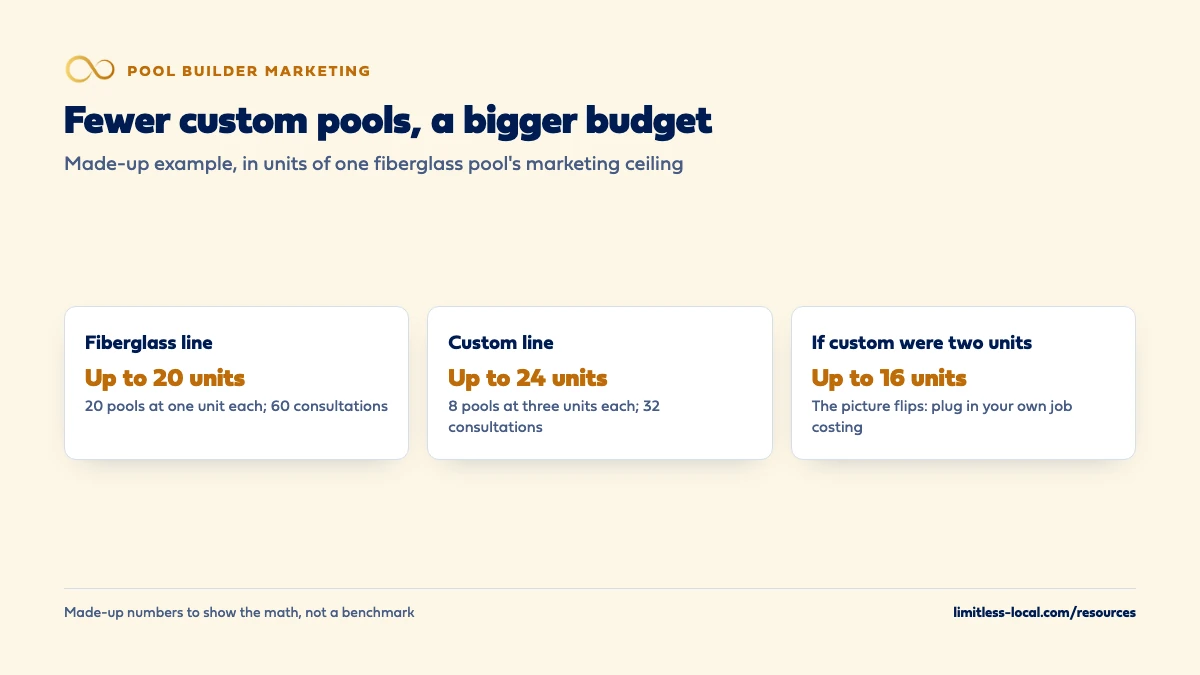
These numbers are made up to show the math, not a benchmark for your market, and there are no dollar figures in it on purpose: plug in your own ceilings.
Say a builder wants 20 fiberglass pools and 8 custom pools next season. Fiberglass consultations sign about 1 in 3 of the time, so that line needs 60 consultations. Custom consultations sign about 1 in 4, so that line needs 32.
Now say job costing shows that a custom pool can afford three times the marketing cost per contract of a fiberglass pool. Count the fiberglass ceiling as one unit. The fiberglass line can spend up to 20 units (20 pools at one unit each). The custom line can spend up to 24 units (8 pools at three units each).
So the custom line, with fewer than half as many pools, can justify the bigger total budget, as long as the builder can wait for those contracts to sign and has the proof to win them. If the custom ceiling were only twice the fiberglass one, the custom line could spend up to 16 units and the picture would flip.
Frequently asked questions
Should custom pools get a bigger share of the marketing budget?
Only if your own numbers say so. A custom pool can usually carry a higher cost per contract, but how much of the budget it gets depends on how many custom contracts you want, whether you can wait for them to sign, and whether you have the portfolio to win them.
Can one Google Ads campaign cover both custom and fiberglass pools?
It can, but you lose control of where the money goes and what each line costs. Separate campaigns, each pointing to its own page, keep the spend, the message and the reporting apart.
Should I show prices for fiberglass pools but not custom ones?
You can. A starting point for standard fiberglass or vinyl packages helps screen buyers, while custom pricing depends on the design, so a range is usually as far as it goes. It’s a positioning choice; whatever you publish, keep it current and accurate.
What if fiberglass leads keep crowding out custom work?
Cap the fiberglass budget to the slots your install crews can fill, and give the custom line its own protected budget and calendar time for design consultations.
How long should I wait before judging the custom pool budget?
Long enough for that line’s leads to reach a decision, which for custom work is usually most of a season. Judge each month’s leads once they’ve had time to sign, not in the month the money was spent.
Key takeaways
- Run custom and fiberglass or vinyl as separate budget lines with their own campaigns, pages and tracking.
- Set each line’s budget from what one contract of that type can afford, times the contracts you want.
- Custom work can carry more per contract but needs proof, patience and cash planned ahead.
- Fiberglass and vinyl budgets lean on search ads, fast follow-up and monthly cost control.
- Move money between lines at planned check-ins, based on cost per signed contract and crew capacity.
Want a second set of eyes on your setup?
We'll look at how you show up locally and where calls are leaking, then send you a plain-English breakdown.
More in this section
- What does a pool builder budget beyond ad spend?
- How should a pool builder split its marketing budget?
- How much should a pool builder spend on marketing?
- How should a pool builder advertise financing options?
- How do pool builders stop attracting price shoppers?
Sources
- Conversion cycle: Definition — Google Ads Help
- About Keyword Planner forecasts — Google Ads Help
- About shared budgets — Google Ads Help
- About conversion values — Google Ads Help