
Which credentials should a pool builder show on its website?

- What licenses, insurance, certifications and warranties should a pool builder put on its website?
- Why do credentials matter so much to pool buyers?
- Which credentials should a pool builder show first?
- Where should my license number go?
- How should I show my insurance?
- How do I show my warranty without overpromising?
- Which certifications and memberships are worth showing?
- Should I show awards, press and big claims?
- Should I list years in business and pools built?
- What credentials should I never show?
- How do credentials fit with reviews and the project gallery?
- Do credentials help with Google and AI search?
- What's different about credentials for pool builders
- A worked example: where each credential goes
- Frequently asked questions
- Key takeaways
- More in this section
- Sources
The short version
- Lead with what homeowners are told to check: license and insurance.
- Spell out your warranty: what it covers, for how long, and who backs it.
- Add certifications, memberships and awards only if they're current and verifiable.
- Put credentials in the footer, about page, consultation page and proposal.
For pool builders who want homeowners to trust them before the first consultation, without cluttering the site with badges nobody checks.
Get a free visibility audit · Book a growth call
What licenses, insurance, certifications and warranties should a pool builder put on its website?
Show the credentials a homeowner can actually check: your contractor license number where your state licenses pool work, the insurance you carry, your warranty terms in plain words, and any current certifications or memberships, such as an industry certification or a manufacturer’s authorized-builder status. Put them where buyers make up their minds, in the site footer, on the about page, on the consultation page and in your proposals, and link to where each one can be verified. Show only what’s real and current, because a badge you can’t back up costs more trust than it earns.
Credentials are one of the first things we put in place when we build or fix a pool builder’s site: license and insurance where buyers look, warranties in plain words, and an about page that answers the trust questions before the consultation. Our websites start with themed sites at $3,750, or $3,000 with any Limitless Engine package, and custom sites from $5,000, with 6- or 12-month payment plans. See how the site fits the rest of the plan on our pool builder marketing page, or browse the rest of the pool builder marketing questions.
Why do credentials matter so much to pool buyers?
Because a pool is one of the biggest things a homeowner will ever buy for their house, and the build tears up their yard for weeks. They’re handing a large deposit to a company they found online, so they look for reasons to trust you, and reasons not to.
They’re also being told what to look for. The FTC’s consumer advice on how to avoid a home improvement scam tells homeowners to consider only contractors who are licensed and insured, to check with their state or county government to confirm a contractor’s license, and to ask the contractor for proof of insurance.
A builder who makes those checks easy earns trust early. A builder who makes the homeowner dig, or ask awkwardly at the consultation, starts the relationship on the back foot.
Which credentials should a pool builder show first?
Put them in this order, from the ones homeowners check most to the ones that are nice to have:
- Your contractor license number, if your state or county licenses pool construction, with a link to the lookup where a homeowner can confirm it.
- Insurance: the coverage you carry, stated plainly.
- Your warranty: what’s covered, for how long, and who backs it.
- Experience you can prove: years building pools and pools completed, if you keep those numbers current.
- Certifications from industry bodies and manufacturers.
- Memberships in trade and local builder associations.
- Awards and press, if they’re real and recent.
The first three answer the question every buyer has: if something goes wrong, am I protected? The rest answer the next one: is this builder any good?
Where should my license number go?
Everywhere a homeowner might look: the footer of every page, the about page, the contact or consultation page, and every proposal. Next to it, link to your state or county license lookup so the homeowner can check it in one click.
In some states it isn’t optional. In California, the Contractors State License Board’s advertising guidelines say licensed contractors must include their license number in all forms of advertising, and they count any website or post that solicits business on the internet as advertising. The civil penalty for not complying is between $100 and $1,000 for a first offense. The same guidelines say you can’t advertise construction work outside the classifications you’re licensed for, and that the law prevents you from saying in your advertising that you’re bonded.
Rules differ from state to state, and some states license pool work at the state level while others leave it to counties or cities. Check your own licensing board’s advertising rules, and follow them on the website, your Google profile, your ads and your truck.
How should I show my insurance?
Say what you carry in plain words, such as general liability and workers’ compensation, and say that you’ll share a certificate of insurance on request. That’s what homeowners are told to ask for, so offering it first shows you have nothing to hide.
Keep a current certificate ready to send the same day someone asks, and update the site when your coverage changes. Many HOAs and some homeowners will want a certificate naming them before work starts, so it helps to explain on the consultation page how that works.
Don’t post policy numbers or scans of the policy itself on the site. A plain statement and a certificate on request is enough.
How do I show my warranty without overpromising?
Write it the way a homeowner would want it explained: what’s covered, for how long, and who stands behind each part. A pool usually carries several warranties at once, so break them out:
- Your own workmanship and structure warranty, with the exact terms.
- Surface or interior finish warranties, and whether they come from you or the finish manufacturer.
- Equipment warranties on pumps, heaters, filters and automation, which usually come from the manufacturer.
Be careful with “lifetime.” The Businessperson’s Guide to Federal Warranty Law notes that lifetime warranties can be a source of confusion, and says ads should tell consumers which “life” measures the warranty’s duration: the life of the product, the time the original buyer owns it, or something else. If you offer a lifetime structural warranty, say whose lifetime and what it covers, right next to the word.
Link to the full warranty document from the warranty summary, so a serious buyer can read every term before the consultation.
Curious what your marketing is actually booking?
Get a free visibility audit — no obligation, no sales pitch.
Which certifications and memberships are worth showing?
The ones a homeowner can verify and that say something about how you build:
- Industry certifications. The Pool & Hot Tub Alliance runs a Find a Pro directory to help homeowners find certified builders and service professionals. If you hold a certification, show it and link to where it can be checked.
- Manufacturer programs. Authorized-builder or certified-installer status from a fiberglass shell, interior finish or equipment manufacturer tells buyers you’ve been trained on what you install, and often affects the warranty they get.
- Trade and local associations. Membership in a pool industry group or your local home builders association shows you’re part of the trade in your area.
Show each one with its full name and what it means, not just a logo. A homeowner doesn’t know what an acronym stands for, and a logo with no explanation reads like decoration. Use a manufacturer’s or association’s logo only if their program allows it.
Should I show awards, press and big claims?
Yes, if they’re real, named and recent. A design award with its name, the project and the year is worth showing next to that project’s photos. “Award-winning pool builder” with nothing behind it isn’t.
The same goes for any claim on the site. The federal Advertising FAQs for small business say advertising must be truthful and non-deceptive, advertisers must have evidence to back up their claims, and the law requires that advertisers have that proof before the ad runs. “Licensed and insured,” “the area’s top-rated builder” and “hundreds of pools built” are all claims you should be able to back up on the day someone asks.
Should I list years in business and pools built?
Yes. For a pool buyer, how many years you’ve built pools in the area and how many you’ve completed are some of the most reassuring things on the site, because they speak to the question of whether you’ll still be around when the warranty matters.
Two rules. Make the numbers exact and true, and update them every year; a counter that hasn’t changed since you launched the site looks worse than no counter. And tie them to proof where you can: the project gallery, reviews from different years, and photos of older pools still looking good. Setting up a project gallery page covers how to make that history easy to browse.
What credentials should I never show?
- Anything expired or lapsed, from a certification to an association membership. Check them once a year.
- Logos you’re not authorized to use, from manufacturers, associations or media outlets.
- Vague labels like “certified builder” without saying certified by whom, for what.
- Claims your state restricts. In California, that includes saying you’re bonded.
- A wall of badges. Ten small logos in the footer tell a homeowner less than three credentials explained clearly.
A homeowner who checks one credential and finds it doesn’t hold up won’t trust anything else on the site.
How do credentials fit with reviews and the project gallery?
They answer different questions. Credentials tell a homeowner you’re qualified and protected. Reviews and your gallery tell them you’re good. A buyer needs both before booking a consultation, and the strongest pages put them side by side: a project page that shows the pool, quotes the homeowner and notes the warranty that came with it.
For builders selling high-end work, credentials are part of what justifies the price. Positioning your pool company as a premium builder covers how proof, process and credentials work together. And for where credentials sit in the path to a booked consultation, what a pool builder website should include to get more consultations walks through the whole page.
Do credentials help with Google and AI search?
They help the homeowner first, and that’s what Google says it’s looking for. Google’s guidance on creating helpful, reliable, people-first content asks whether content presents information in a way that makes you want to trust it, such as clear sourcing, evidence of the expertise involved, and background about the site that publishes it, for example through a site’s About page.
An about page with your license, insurance, warranty, certifications and real history gives that background in plain sight. It also gives AI assistants something concrete to repeat when a homeowner asks whether your company is licensed or what your warranty covers. How a pool builder shows up in AI search results covers the rest of that picture.
Want to see where your company stands?
A free visibility audit shows where you show up on Google, Maps and AI answers, and what it's costing you in calls.
What's different about credentials for pool builders
Big deposits, long builds. A pool buyer hands over more money, for longer, than almost any other home-service customer. That makes license, insurance and warranty the first things they check.
Several warranties in one job. Structure, surface and equipment often carry separate warranties from different companies. Explaining who backs what is a credential in itself.
Rules vary by place. Some states license pool construction directly, others leave it to counties or cities, and advertising rules differ too. Your site should follow the rules where you build, not a national template.
HOAs and permits. Many builds need HOA approval and permits, and a builder who explains how they handle both shows the kind of experience a license number alone can’t.
A worked example: where each credential goes
This builder is made up to show the layout, not a template you have to copy.
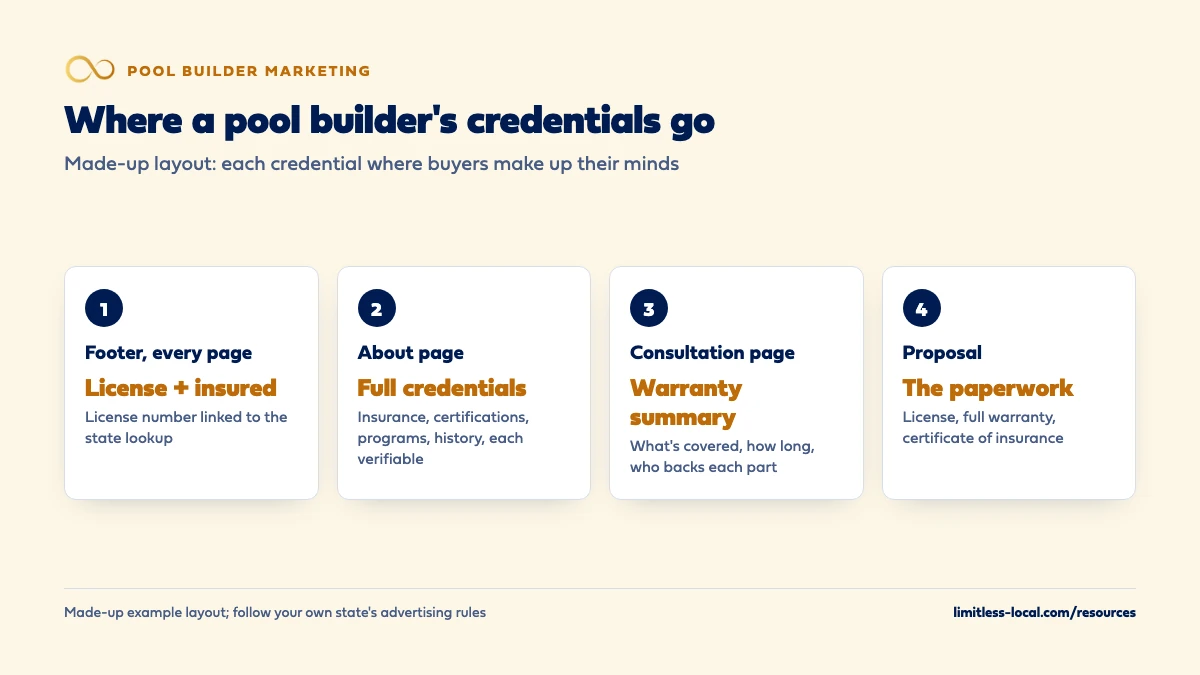
A builder in California with a pool contractor license, general liability and workers’ comp, a written structural warranty, an industry certification and a manufacturer’s authorized-installer status lays it out like this:
- Footer, every page: the license number with a link to the state lookup, and “Insured. Certificate of insurance available on request.”
- About page: the license with the lookup link, the insurance it carries, the certification and the manufacturer program, each with its full name and a link to verify it, plus years in business and pools completed, updated each January.
- Consultation page: a short warranty summary that says what the structural warranty covers and for how long, who backs the surface and the equipment, and a link to the full warranty.
- Proposal: the license number, the full warranty terms and a current certificate of insurance attached.
No wall of logos, no “award-winning” with nothing behind it, and nothing a homeowner could check and find out of date.
Frequently asked questions
Should I put my license number on my Google Business Profile too?
If your state requires the license number in advertising, treat your profile, ads and social pages the same way as your website. Even where it isn’t required, mentioning it in your profile description makes it easy for homeowners to check.
Do I need to show my license number in every ad?
It depends on your state. California, for example, requires licensed contractors to include it in all forms of advertising. Check your own state’s licensing board for its rules.
Is it worth paying for a certification just to show it on my site?
Only if it reflects training your team actually uses and homeowners can verify. A certification earns its place when you can explain what it means for their pool, not just display a logo.
Should I show my financing partners as credentials?
They’re not credentials, but naming the lenders you work with can reassure buyers. Keep financing on its own page, worded the way your lender approves.
How often should I review the credentials on my site?
At least once a year, and whenever a license, policy, certification or membership renews. Put the renewal dates on the same calendar you use for permits and insurance.
Key takeaways
- Lead with license and insurance, because homeowners are told to check both.
- Link your license number to the state or county lookup, and follow your state’s advertising rules.
- Explain each warranty plainly, and say which life a lifetime warranty means.
- Show certifications, memberships and awards only with full names and a way to verify them.
- Put credentials in the footer, about page, consultation page and proposal, and review them yearly.
Not sure what's working right now?
Start with a free visibility audit: rankings, Google profile, reviews and tracking, checked against your service area.
More in this section
- What should a pool builder website include to get more consultations?
- How does a pool builder keep its name, address, phone consistent?
- What should a pool builder post on Instagram and Facebook?
- What keywords should a pool builder target?
- What videos and content build trust for a pool builder?
Sources
- How To Avoid a Home Improvement Scam — Federal Trade Commission
- Advertising Guidelines For Contractors — Contractors State License Board (California)
- Businessperson's Guide to Federal Warranty Law — Federal Trade Commission
- Find a Pro — Pool & Hot Tub Alliance
- Advertising FAQ's: A Guide for Small Business — Federal Trade Commission
- Creating Helpful, Reliable, People-First Content — Google Search Central